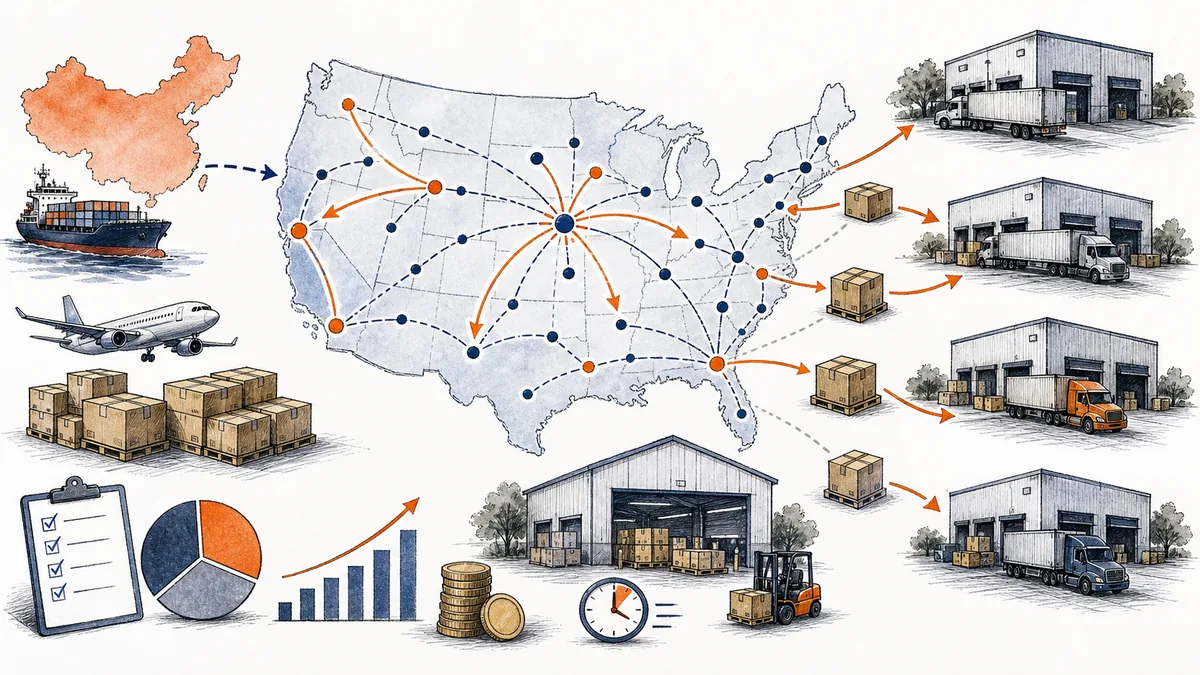
When you send a shipment from China to Amazon FBA, you do not get to decide exactly where your inventory ends up. Amazon's fulfillment network has grown to more than 175 fulfillment and sorting centers across the United States, and the company's algorithms determine how to distribute your stock based on predicted demand, available storage, and logistics efficiency.
Understanding how this system works — and how to use it to your advantage — can meaningfully reduce your fulfillment fees, improve your delivery speeds to customers, and help you avoid costly inventory penalties.
If your shipment is still in the quote-planning stage, pair this warehouse-location guide with the Amazon FBA freight-forwarder China to USA service and the China-to-USA FBA shipping cost examples so split destinations are priced before cargo leaves the supplier.
The Scale of Amazon's Fulfillment Network in 2026
Amazon now operates over 600 facilities across the United States when you include fulfillment centers, sortation centers, delivery stations, and air hubs. Of these, approximately 150 are the large fulfillment centers where FBA seller inventory is physically stored and picked for customer orders. The network is concentrated in high-population states — California leads with around 35 facilities, followed by Texas with 28, and New Jersey with 17. States like Ohio, Pennsylvania, Illinois, and Georgia are also major logistics hubs in the network.
This geographic spread is intentional. Amazon positions inventory close to where customers are most likely to order it, which is why a product with strong East Coast demand will typically end up distributed across fulfillment centers in New Jersey, Pennsylvania, and Georgia rather than sitting in a single warehouse in California.
How Amazon Decides Where Your Inventory Goes
When you create an FBA shipment, Amazon's inventory placement system analyzes your product's sales history and predicted demand by region and assigns your stock to one or more fulfillment centers accordingly. For most sellers, a single inbound shipment will be split across four to six locations across the country.
This distributed model is why customers consistently see Prime two-day delivery regardless of where they live — Amazon has already positioned inventory near them before the order is placed. For sellers, it means faster inventory turns and better conversion rates, since customers are more likely to buy products with faster delivery windows.
The Inbound Placement Fee — and How to Minimize It
Amazon charges an inbound placement fee when it needs to redistribute your inventory after receiving it at a single location. If you send everything to one fulfillment center and Amazon has to move it across the network, you pay for that logistics cost. The fee is assessed per unit and can add up significantly on large shipments.
The way to reduce or eliminate this fee is to participate in Amazon's inbound placement strategy and send inventory to multiple recommended inbound locations — typically four or more. When you spread your inbound shipments across the centers Amazon recommends, you can eliminate the placement fee entirely. Yes, this requires coordinating split shipments with your FBA freight forwarder. But for high-volume SKUs, the savings on placement fees typically outweigh the marginal complexity of multiple inbound locations.
"Sellers often focus entirely on the ocean freight rate and forget that inbound placement fees and aged inventory surcharges can add more to their cost per unit than the shipping itself. A good forwarder helps you plan the full picture, not just get the goods on a boat."
Amazon Warehousing and Distribution (AWD): The Bulk Storage Option
For sellers who want a buffer between their China shipments and Amazon's fulfillment network, Amazon's Warehousing and Distribution (AWD) program offers a compelling option. AWD provides low-cost bulk storage upstream of the FBA network, with automatic replenishment into fulfillment centers when your FBA stock runs low.
This is particularly useful for sellers shipping large ocean freight containers from China who don't want to push all their inventory directly into FBA storage at once. By staging bulk inventory in AWD, you avoid peak-season FBA storage surcharges, reduce the risk of aged inventory fees, and maintain better control over your FBA inventory levels.
What This Means for Your China-to-FBA Shipping Strategy
The practical implication for sellers sourcing from China is that your relationship with the fulfillment center network starts the moment your goods leave the factory. The decisions you make about shipment timing, inbound locations, prep compliance, and inventory staging all have downstream effects on your fees, your delivery speeds, and your product ranking on Amazon.
Sellers who treat the China-to-FBA journey as a single connected logistics problem — rather than a series of disconnected steps — consistently outperform those who think of shipping as a commodity. Choosing the right port of entry, staging the right inventory volumes, and sending to the right inbound locations are all decisions that your freight forwarder should be actively helping you make.
Key Takeaways
- Amazon's network spans 175+ fulfillment centers; your inventory will be distributed based on demand algorithms, not your preference.
- Sending to four or more recommended inbound locations can eliminate the inbound placement fee on high-volume shipments.
- AWD is a valuable tool for staging bulk inventory cost-effectively before it enters the FBA network.
- Monitor your Days of Supply and set replenishment triggers at 35 days to avoid low-inventory-level fees.
- Work with a forwarder who understands FBA delivery requirements and can coordinate split inbound shipments efficiently.
Plan the split-shipment route before booking
- Amazon FBA freight forwarder China to USA for supplier pickup, labels, prep, consolidation and multi-FC delivery planning.
- China-to-USA FBA shipping cost examples for DDP air, DDP sea, first-shipment and split-shipment cost scenarios.
- Shipping cost calculator for the CBM and chargeable-weight estimate before you request a final lane quote.
Ship smarter from China to Amazon FBA.
ForwarderOne helps FBA sellers plan their inbound strategy, coordinate split shipments to multiple fulfillment centers, and deliver fully prepped inventory on time and on budget.
Get a shipping quote