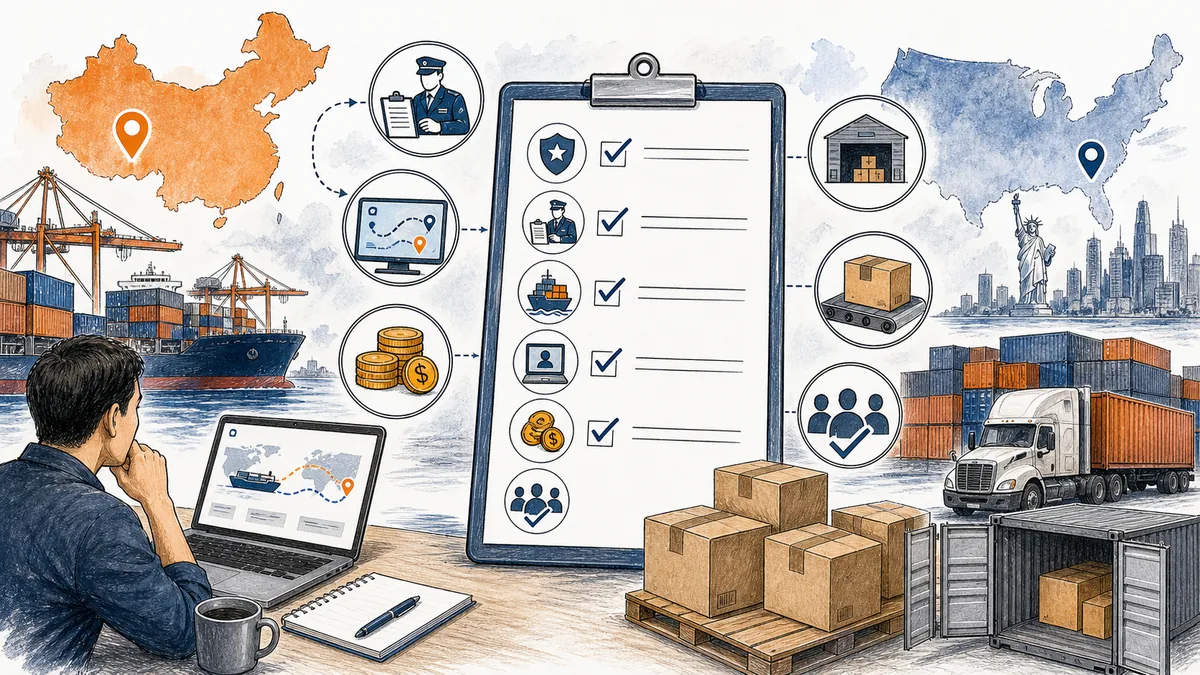
Choosing a freight forwarder is one of the most consequential decisions an Amazon FBA seller or importer makes — and one of the most frequently underestimated. In 2026, with a more complex compliance environment and greater variability in service quality than ever before, the difference between a capable forwarder and an inexperienced one isn't just a matter of price. It can mean shipments held at customs, goods arriving non-compliant at Amazon warehouses, or tariff costs that were never disclosed upfront.
This guide covers what to look for, what to ask, and what to avoid.
Why the Forwarder You Choose Matters More Than Ever
The elimination of the de minimis exemption, tighter US Customs and Border Protection enforcement, and Amazon's discontinuation of its US FBA prep services have all transferred more responsibility onto the freight forwarder. A good forwarder in 2026 is not just a logistics coordinator — they are your customs expert, your compliance partner, and your FBA preparation coordinator, all in one.
A bad one quotes you the lowest rate, ships your goods, and leaves you to sort out the customs hold, the incorrect HTS classification, and the Amazon rejection yourself. The cheapest quote is almost never the best quote.
The Six Things to Check Before Choosing a Forwarder
1. FMC Licensing and NVOCC Registration
For any company legally providing ocean freight services on the China-to-US lane, two credentials are non-negotiable. The first is an FMC License from the Federal Maritime Commission — this is the legal requirement for operating as an ocean freight intermediary in the United States. The second is registration as an NVOCC (Non-Vessel Operating Common Carrier), which gives the forwarder the ability to issue its own bills of lading and negotiate directly with carriers. Ask for these credentials before engaging any forwarder. If they can't produce them quickly, walk away.
2. Genuine Customs Expertise, Not Just Transportation
US Customs and Border Protection has significantly increased scrutiny of China-origin goods since 2025. The forwarder you choose should have a licensed customs broker on staff, be current on HTS code classification, and be actively aware of which tariff exclusions are available for your product categories. Ask them directly: which HTS code will you use for my products, and are there any applicable exclusions? A forwarder who can answer that question confidently and specifically is one worth working with.
3. FBA-Specific Knowledge
Shipping to Amazon fulfillment centers is not the same as standard commercial freight. Amazon's receiving requirements — carton markings, FNSKU labeling, pallet specifications, appointment scheduling — are strict, and non-compliant shipments are refused or assessed additional fees. Your forwarder should have direct experience with FBA delivery, know the requirements by heart, and be able to coordinate prep and labeling on your behalf if needed.
4. A Real Client Portal with Live Tracking
In 2026, any forwarder that cannot offer you real-time shipment tracking through a client portal is not equipped for modern logistics. You should be able to see where your shipment is, what documentation has been filed, and what the expected delivery timeline is — without needing to email or call for updates. Ask to see a demo of their tracking system before you commit.
5. Full Cost Transparency
Ocean freight quotes are notorious for presenting a low headline rate and then adding origin charges, destination charges, documentation fees, customs bonds, and handling fees on top. Always ask for an all-in quote that includes every charge from factory in China to delivery at the Amazon fulfillment center. If a forwarder is unwilling to give you this, that itself is a red flag.
6. A Track Record You Can Verify
Ask for references from other FBA sellers — ideally in your product category. Review any available testimonials or case studies. A forwarder with genuine experience in your trade lane will be able to give you specific examples of how they have handled common challenges: customs holds, peak season delays, damaged goods claims. Vague answers to specific questions are a warning sign.
"The most common mistake I see sellers make is choosing a forwarder based on the lowest quote from a Google search, shipping a container, and then discovering everything the quote didn't include at the destination. A freight forwarder is a long-term partner. Treat the selection process accordingly."
The Current Rate Environment: Why Now Is a Good Time to Ship
One piece of genuinely good news for importers in 2026 is that ocean freight rates on Transpacific lanes are significantly lower than they were in 2025. With approximately 10 million TEU of new vessel capacity entering service this year, structural overcapacity is keeping rates soft. FCL rates from China to the US West Coast currently range from approximately $1,950 to $2,650 for a 40-foot container, with East Coast rates at $3,100 to $3,900 — down 55–60% year-over-year.
This rate environment partially offsets the increased duty costs from higher tariffs, and sellers who lock in favorable freight contracts now are in a better position than those who wait. A well-connected forwarder will be able to secure competitive rates through their carrier relationships, not just pass through spot market prices.
How to Test a New Forwarder Before Committing
If you are switching from an existing forwarder or engaging a new one for the first time, start with a single smaller shipment rather than your largest order. This gives you a low-risk opportunity to evaluate their communication, documentation accuracy, customs handling, and delivery execution before you depend on them for your primary inventory. Most good forwarders will actively welcome this approach — they want to earn your trust on a smaller shipment and grow from there.
Quick Checklist: Questions to Ask Any Forwarder
- Can you provide your FMC License number and NVOCC registration?
- Do you have a licensed customs broker on staff?
- What HTS code would you use for my products, and are there available exclusions?
- Can you provide a fully itemized all-in quote, door to Amazon FBA?
- Do you offer real-time tracking through a client portal?
- Can you coordinate FBA prep and FNSKU labeling from China?
- Can you provide references from other FBA sellers?
- What is your process if a shipment is held at customs?
How ForwarderOne Answers the Checklist
- Licensing and registration
- Ask for the credential packet before booking. A credible quote workflow should make licensing, carrier role and bill-of-lading responsibility clear before freight leaves the factory.
- Customs and duty planning
- ForwarderOne quotes should collect product description, declared value, carton data and HS-code assumptions up front, then show whether DDP shipping China to USA is the right structure for duties, clearance and final delivery.
- FBA-specific execution
- For Amazon-bound freight, the route plan should cover FNSKU labels, carton labels, prep status, appointment data and warehouse delivery rules. Compare the dedicated FBA freight-forwarder service when your shipment is going to a US fulfillment center.
- Portal visibility
- The shipment workflow should keep quote details, documents, milestone updates and delivery status in one client portal so you are not chasing scattered email threads.
- Transparent landed cost
- Before approval, request a route-specific quote that separates factory pickup, international freight, duty, customs clearance and final delivery instead of hiding them behind a single headline rate.
- Verifiable track record
- Ask for lane- and product-specific references, especially if your goods are regulated, fragile, seasonal or tied to a strict Amazon receiving window.
When you are ready to compare a service route instead of only evaluating vendors, start with the DDP shipping China to USA page for landed-cost scope, customs coordination and final delivery planning. Amazon sellers can also compare the dedicated FBA freight-forwarder service when the destination is a US fulfillment center.
ForwarderOne checks every box on this list.
We are an FMC-licensed, FBA-specialist freight forwarder with a transparent all-in pricing model and a dedicated client portal. Get a full cost breakdown for your China-to-US shipment today.
Get a shipping quote