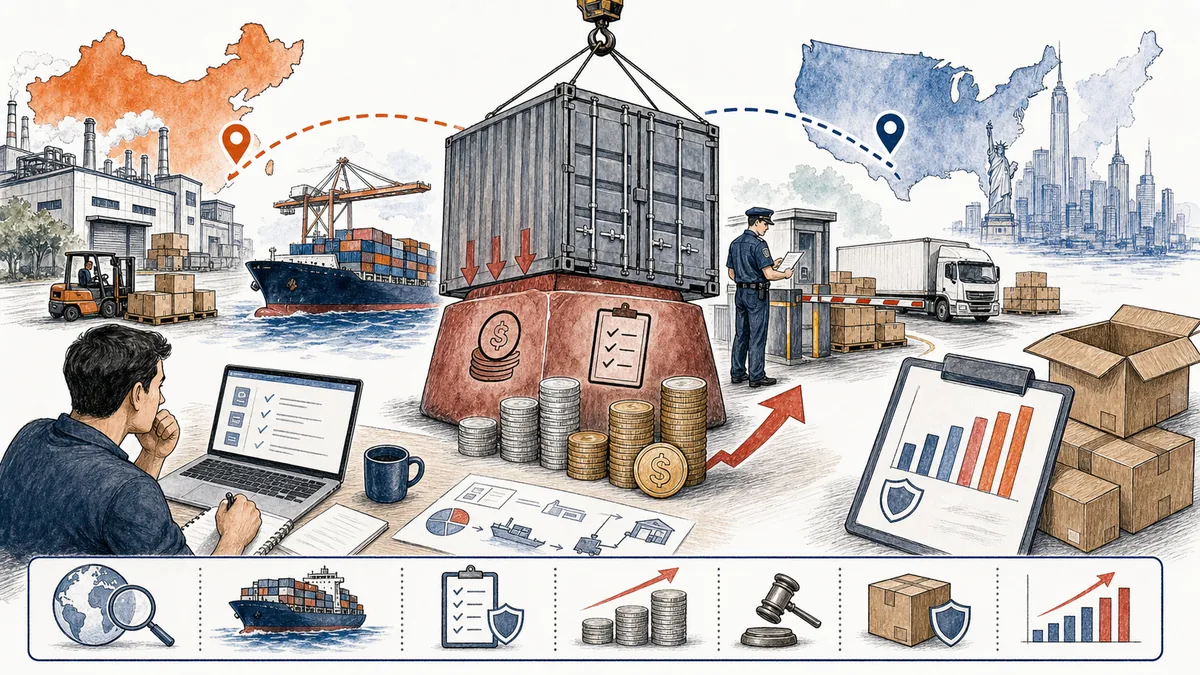
The global trade environment for Amazon FBA sellers sourcing from China has changed more in the past twelve months than in the previous decade combined. Between sweeping tariff increases, the elimination of the de minimis exemption, and structural shifts in ocean freight capacity, sellers who relied on the same approach they used in 2023 are now facing a very different cost reality.
The good news is that this landscape, while more complex, is entirely navigable — and in some ways presents real advantages for sellers who prepare properly. Here is what you need to know heading into the second quarter of 2026.
Use this post as the planning layer, then compare the current DDP shipping China to USA service, Amazon FBA freight forwarder China to USA service, and how to choose a freight forwarder in China guide before you lock shipment terms.
What Has Actually Changed
The single biggest shift is the effective tariff rate on Chinese goods entering the United States. Combining Section 301 base rates with the 15% global tariff that took effect in February 2026, most FBA categories — electronics, apparel, toys, home goods — now carry a total duty burden in the range of 20 to 30 percent. That number has real implications for landed cost calculations and pricing strategy.
Equally significant is the end of the $800 de minimis exemption. Since May 2025 for China and Hong Kong shipments, and August 2025 globally, every single shipment now requires formal customs entry, regardless of value. Small test batches and restocking orders that previously cleared informally now carry the same documentation, duty, and compliance requirements as a full container load.
On top of that, Amazon ended its US FBA prep and labeling services at the start of 2026. Goods must now arrive at fulfillment centers fully prepped, properly labeled, and compliant — or sellers face rejections, delays, and additional fees.
The Silver Lining: Ocean Freight Rates Are Falling
Here is what many sellers are missing amid the tariff noise: ocean freight rates are softening significantly, and that trend is likely to continue through the rest of 2026.
Approximately 10 million TEU of new vessel capacity is entering service this year, creating structural overcapacity across major trade lanes. On the Transpacific route specifically, rates to both the US West Coast and East Coast dropped by around 13–14% over a four-week period in early 2026. Full container load (FCL) pricing now ranges from roughly $2,000 to $4,100 per container depending on destination port — a meaningful improvement from the highs seen in previous years.
For sellers who are consolidating shipments strategically, lower freight rates can partially offset the increased duty burden. The key is to maximize the cargo value per container rather than shipping small, frequent orders.
"The sellers who will come out ahead in this environment are not the ones trying to avoid the new rules — they are the ones who have adapted their supply chain so that the new rules work in their favor. Consolidation, proper classification, and DDP shipping are not optional extras anymore. They are the baseline."
Five Practical Strategies for FBA Sellers Right Now
1. Switch to DDP (Delivered Duty Paid) Shipping
Under DDP terms, your freight forwarder handles customs clearance and duty payment on your behalf before your goods reach Amazon's warehouse. This gives you complete cost predictability — you know your exact landed cost before the shipment leaves China — and eliminates the risk of unexpected charges or clearance delays. Sellers who have made this switch with experienced forwarders are reporting reductions in total landed cost of 15–25% through better classification and duty optimization.
2. Consolidate Shipments to Spread Fixed Costs
With every shipment now requiring formal customs entry, the fixed overhead per order has increased. The simple math favors fewer, larger shipments over frequent small orders. If you have been restocking every few weeks, consider building to a monthly or bi-monthly schedule and shipping more volume per container. With FCL rates where they are today, the economics of a full container are often better than they appear.
3. Ensure Your Products Are Fully Prepped Before Leaving China
With Amazon's prep services gone, this is no longer optional. Work with your FBA shipping agent to build FBA-compliant prep — FNSKU labeling, poly-bagging, bubble wrap, carton markings — directly into your production and packaging workflow in China. Getting this wrong is expensive. Getting it right costs very little when built into the process from the start.
4. Review Your Product Classification and Available Exclusions
The tariff rate on your goods is not always fixed. Harmonized System (HS) code classification matters enormously, and some product categories have active exclusions extended through late 2026 that can significantly reduce your duty burden. An experienced customs broker or forwarder who stays current on these exclusions can make a meaningful difference to your cost structure; use the freight forwarder selection checklist to pressure-test that capability before you hand over shipment data.
5. Build a Longer Inventory Runway
The days of just-in-time restocking from China are effectively over for most FBA sellers. Between longer customs processing times, the elimination of expedited de minimis clearance, and the cost penalty of air freight at current rates, holding 90–120 days of inventory rather than 30–45 is now the more defensible strategy for most products.
What This Means for Your Business Long-Term
The sellers who treat 2026 as a one-off disruption to weather are likely to find themselves revisiting the same challenges in 2027. The structural changes underway — higher baseline tariffs, the end of de minimis, greater compliance requirements — represent a new normal rather than a temporary spike.
The businesses that will grow through this period are the ones investing now in tighter freight partnerships, smarter consolidation strategies, and supply chain processes that are built for the compliance environment as it actually exists today.
China remains, by a wide margin, the most capable and cost-effective manufacturing base for the categories most Amazon sellers operate in. The cost advantage is real and durable. The challenge is ensuring your logistics and customs workflow is sophisticated enough to capture it.
Related route checks before you quote
- DDP shipping China to USA for landed-cost terms, customs, duty and final delivery scope.
- Amazon FBA freight forwarder China to USA for FBA labels, prep, consolidation and warehouse delivery planning.
- How to choose a freight forwarder in China for credential, pricing and communication checks.
Not sure how the new tariff rules affect your shipments?
ForwarderOne works with FBA sellers every day to optimize their China-to-US supply chain for the current environment. Get a quote and see what your actual landed costs look like.
Get a shipping quote