
ARO, or After Receipt of Order, is the term that starts a countdown clock the moment a supplier confirms receipt of a valid purchase order. It is not a transit term, not a shipment date, and not an estimate. It is a contractual trigger. If your PO reads “30 days ARO,” day zero is the date the supplier acknowledges receipt of that PO, and payment or processing is due by day 30. Under 48 CFR 552.238-86, federal contractors must state delivery times in days ARO and map them to FOB terms, which shows how seriously the U.S. government treats this language. ForwarderOne treats ARO acknowledgment as the first operational milestone in every shipment workflow.
Pro Tip: Define “receipt” explicitly in your PO. Specify whether it means an email timestamp, an EDI acknowledgment, a portal confirmation, or PO receipt plus payment clearance. Leaving it vague is the single most common source of ARO disputes.
What does ARO mean in shipping and fulfillment workflows?
ARO covers the internal prep window between a supplier receiving a PO and handing freight to a carrier. That includes pick, pack, label, and QA. It does not include carrier transit time unless the contract explicitly says “ARO delivered.” Conflating the two produces forecast errors that ripple through every downstream SLA.
Here is the operational sequence:
- PO creation and transmission. The buyer sends a PO via email, EDI, or procurement portal.
- Valid PO receipt. The supplier receives the PO. This is day zero only if the PO is complete and valid. A PO missing a ship-to address or payment terms may not trigger the clock.
- Supplier acknowledgment. The supplier confirms receipt. This acknowledgment is the legal start of the ARO period. Without it, day zero is disputed.
- Internal preparation. The supplier begins pick, pack, label, and QA operations. Typical ARO ranges vary by vendor type, often shorter for domestic 3PLs and e-commerce warehouses, and longer for overseas suppliers and custom or made-to-order vendors.
- Carrier handoff. Freight moves to the carrier. ARO ends here unless the clause specifies delivery.
- Transit. Carrier moves the freight. This is outside ARO unless “ARO delivered” language is used.
Your lead-time math should look like this: Lead time = ARO + transit. Counting ARO prep inside transit time, or vice versa, is the most common fulfillment projection error.
For an industry-specific example of coordinating distribution handoffs, see Gjergji Textil's guide to textile distribution workflows.
Pro Tip: Require an automated acknowledgment, either EDI or a portal timestamp, rather than a reply email. A timestamped system record is far harder to dispute than a thread of forwarded messages.

How do you write ARO in a purchase order or contract?
Precise clause language prevents the disputes that vague ARO terms invite. Below are five clause variants covering the most common procurement scenarios, followed by a table of terms every ARO clause should define.
Variant 1 — Basic ARO (stocked goods, domestic): Variant 2 — ARO plus payment confirmation (overseas, made-to-order): Variant 3 — ARO shipped vs. ARO delivered (high-value freight): Variant 4 — Expedited or partial delivery: Variant 5 — Federal contracting (48 CFR-aligned):
| Term to define | Why it matters |
|---|---|
| What counts as “receipt” | Email, EDI, portal ack, or payment clearance — pick one |
| Timezone | Supplier and buyer may be in different time zones; state which governs |
| Business days vs. calendar days | Holidays and weekends can shift a 30-day window by a week or more |
| Partial shipment handling | Does each lot get its own ARO clock, or does the first shipment govern? |
| QA/inspection inclusion | Is QA inside the ARO window or does it pause the clock? |
The minimal clause that prevents most disputes: state the number of days, define receipt, specify calendar vs. business days, and name the acknowledgment method. Four elements. Anything less is an invitation to argue.
Common ARO terms and how to read them as calendar dates
ARO terms like “30 days” or “5 days shipped” translate directly into planning dates once you know what event starts the clock and whether the term covers processing, shipment, or delivery.
| ARO term | Clock starts | What it covers | Calendar vs. business days | Conservative planning note |
|---|---|---|---|---|
| 30 days ARO (payment) | PO acknowledgment | Payment due date | Calendar | Add 2–3 days buffer for banking |
| 5 days ARO shipped | PO acknowledgment | Supplier must ship by day 5 | Usually calendar | Confirm weekends/holidays in writing |
| 10 weeks ARO | PO acknowledgment | Full production + ship window | Calendar | Add 1 week for customs/port delays |
| 30 days ARO delivered | PO acknowledgment | Delivery at buyer’s dock | Calendar | Includes transit; confirm FOB term |
| 2–5 days ARO (e-commerce WH) | PO acknowledgment | Pick/pack/label only | Business days | Verify cutoff time for same-day start |
Worked example 1 — Stocked domestic SKU (short ARO): A buyer sends a PO on Monday, March 2. The supplier’s portal logs the acknowledgment that same day. The clause reads a few calendar days ARO shipped. Day zero is March 2. The supplier must hand freight to the carrier within that timeframe. Add typical ground transit and the buyer can plan for arrival accordingly.
Worked example 2 — Overseas made-to-order (long ARO): A buyer sends a PO on March 2. The overseas supplier acknowledges a few days later. The clause reads a multi-week ARO. Day zero is the acknowledgment date. The ship date is weeks later. Add extended ocean transit and customs clearance time, and the buyer should plan for arrival accordingly. Adding a buffer for port congestion or customs review is recommended.
Weekend and holiday handling matters more than most buyers realize. A “30 business days ARO” clause in a contract with a Chinese supplier needs to specify whose business calendar governs. Chinese New Year alone can shift a 30-day window by two full weeks. The ForwarderOne factory holiday and cargo cutoff calendar is a practical reference for mapping supplier-side blackout periods into ARO planning.
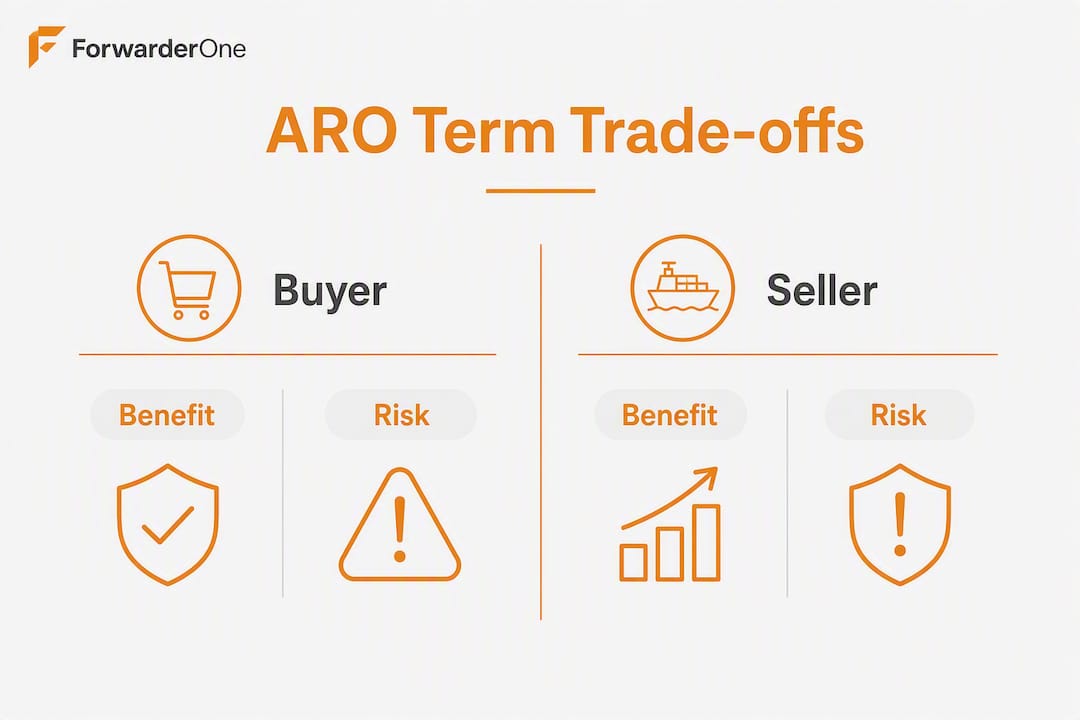
What are the real trade-offs of ARO terms for buyers and sellers?
| Dimension | Buyer benefit | Buyer risk | Seller benefit | Seller risk |
|---|---|---|---|---|
| Cash flow | Deferred payment (30 days ARO) | Supplier may require deposit before starting | Predictable payment timing | Delayed cash receipt if buyer disputes receipt date |
| Inventory planning | Known processing window for safety stock | Vague ARO inflates safety stock needs | Production flexibility with longer ARO | Pressure to compress ARO for competitive bids |
| Dispute risk | Clear SLA if clause is precise | Ambiguous receipt definition triggers disputes | Written acknowledgment protects seller | Buyer may claim receipt was not valid |
| Production flexibility | Partial delivery options reduce stockout risk | Multiple ARO clocks add tracking complexity | Staged production matches ARO windows | Partial lots require separate acknowledgments |
Vendors will often shorten ARO with committed volumes or partial pre-staging. That is a real negotiation lever, not just a courtesy. If you are ordering consistently, ask for a tiered ARO schedule: standard volume at 10 days, committed-volume orders at 5 days.
Pro Tip: Tie ARO performance to objective acknowledgments in the contract, and include an expedited option with a defined premium for critical SKUs. A clause that reads “5 days ARO at standard rate; 2 days ARO at [X]% surcharge” gives both parties a clear escalation path without renegotiating the whole agreement.
What mistakes cause ARO disputes, and how do you avoid them?
Most ARO disputes trace back to one of five root causes:
- Confusing ARO with carrier pickup. ARO ends at carrier handoff (unless “delivered” is specified). Tracking a carrier pickup date as the ARO start is a different error entirely.
- Undefined receipt. If the PO does not say what counts as receipt, both parties will pick the date that favors them.
- Counting prep time twice. Including pick/pack time inside transit estimates and inside ARO produces a double-counted lead time that makes every forecast too long.
- No acknowledgment record. A verbal confirmation or an email that gets deleted is not a timestamp. Without a system record, day zero is a guess.
- Ignoring seasonality. A 10-week ARO placed in November with a Chinese supplier runs directly into Chinese New Year. The buyer who does not account for factory closures will miss their Q1 restock.
Avoidance checklist:
- Define receipt in writing before the first PO is issued
- Require portal or EDI acknowledgment; archive every record
- Include an inspection window clause that pauses or extends ARO if QA is required
- Set safety stock based on the maximum observed ARO, not the average
- Flag seasonal blackout periods in the contract or in a standing SLA addendum
Red flags that a supplier’s ARO commitment is unreliable: acknowledgments that arrive more than 48 hours after PO transmission, PO responses that do not confirm the specific ARO date, and any verbal request to shift the ARO window without a written amendment. Treat each of those as a signal to tighten the contract language before the next order cycle.
How does ARO differ from ATP, ETA, and ETD?
ARO and ATP are frequently confused, but they answer different questions. ARO tells you when processing begins. ATP tells you whether inventory exists to fulfill the order at all. Using one without the other produces commitments you cannot keep.

| Term | Full name | What it measures | When to use it |
|---|---|---|---|
| ARO | After Receipt of Order | Processing/delivery timeline from PO receipt | Setting supplier obligations and payment terms |
| ATP | Availability to Promise | Inventory available to commit to a customer | Confirming you can promise a delivery date |
| ETA | Estimated Time of Arrival | When freight is expected at the destination | Tracking inbound shipments and dock scheduling |
| ETD | Estimated Time of Departure | When freight is expected to leave origin | Planning export documentation and carrier booking |
A combined use case: a buyer wants to promise a customer a delivery date. First, check ATP to confirm the SKU is available. Then check ARO to know when the supplier will begin processing. Add transit (ETA minus ETD) to get the realistic delivery window. Promising a date without both ATP and ARO checks is how stockouts and missed SLAs happen.
What should you confirm before relying on any ARO term?
Run through this checklist before accepting or issuing an ARO-based commitment:
- PO format. Is the PO complete? Missing fields (ship-to, payment terms, item specs) can invalidate receipt and delay day zero.
- Acknowledgment method. Is it EDI, portal, or email? Is the method documented in the contract?
- Payment receipt rules. Does ARO start on PO receipt alone, or does it require deposit clearance?
- QA scope. Is inspection inside the ARO window? If so, how many days does it consume?
- Partial shipment handling. Does each lot carry its own ARO clock?
- Cutoff times. Does a PO received at 4:55 PM start the clock that day or the next business day?
- Seasonality. Are there factory holidays, port congestion windows, or carrier blackout periods that affect the ARO window?
- Timezone. Whose timezone governs day zero?
- Business vs. calendar days. Which does the contract specify, and does the supplier’s acknowledgment system reflect that?
- Escalation contacts. Who do you call if the supplier misses the ARO window? Is there a penalty clause?
Five questions to ask a supplier before signing:
- “What event do you accept as receipt of a valid PO?”
- “Do you include QA time inside your ARO window?”
- “What acknowledgment method do you use, and how quickly do you send it?”
- “How do you handle partial shipments under a single PO?”
- “What is your process if you cannot meet the stated ARO?”
Review ARO performance quarterly. A supplier who consistently acknowledges on day 2 instead of day 0 is effectively adding two days to every lead time. That pattern, tracked over a quarter, is a negotiation data point.
How a DDP freight forwarder reduces ARO-related delivery risk
The most common cause of ARO overruns on international orders is not supplier slowness. It is customs and clearance variability. A shipment that leaves a Chinese factory on day 10 ARO can sit at a U.S. port for an additional 5–15 days if customs documentation is incomplete or duties are unpaid. That variability is entirely outside the supplier’s ARO window, but it lands on the buyer’s timeline.
ForwarderOne’s DDP freight forwarding service addresses this directly. Under a DDP arrangement, ForwarderOne takes custody of customs clearance, duty payment, and final delivery to the U.S. fulfillment center or FBA warehouse. The supplier’s ARO obligation ends at factory handoff; ForwarderOne manages everything after that. For Amazon sellers with tight restock windows, that separation of responsibilities removes the largest source of post-ARO delay.
Key operational advantages to verify when evaluating a DDP forwarder:
- Consolidated pick/pack timelines with defined handoff milestones
- Customs pre-clearance capability (ISF filing, HTS classification, duty pre-payment)
- Dedicated account manager who communicates milestone updates in real time
- FBA labeling and compliance support built into the workflow
- Published on-time performance data available on request
Performance indicators to request from any forwarder: on-time delivery rate, average customs clearance time, SLA response time for exceptions, and escalation process for missed milestones.
Pro Tip: Use DDP terms to shift customs responsibility entirely off the buyer’s plate. Document in the contract which milestones ForwarderOne controls (customs, final delivery) versus which the supplier controls (production, factory handoff). That split makes ARO disputes far easier to resolve because each party owns a defined segment of the timeline.
For sellers managing FBA shipments from China to the U.S., the combination of a precise ARO clause with a supplier and a DDP arrangement with a forwarder covers both ends of the lead-time equation.
Key Takeaways
ARO delivery terms only protect you when the receipt event, acknowledgment method, and calendar rules are defined in writing before the first PO is issued.
| Point | Details |
|---|---|
| Define receipt explicitly | State whether receipt means email, EDI, portal ack, or PO plus payment confirmation in every contract. |
| ARO excludes transit | Lead time equals ARO plus transit; including processing time within transit estimates leads to inaccurate forecasts. |
| Check ATP before promising | Confirm inventory availability with ATP before relying on ARO to set a customer delivery date. |
| Account for seasonality | Factory holidays and port congestion can extend a 10-week ARO by two or more weeks; document blackout periods. |
| ForwarderOne for DDP risk | ForwarderOne’s DDP service removes customs and clearance variability from the buyer’s post-ARO timeline. |
The part of ARO that most contracts still get wrong
Supply chain managers spend real effort negotiating ARO windows, then write “30 days ARO” in the PO and call it done. The number is not the problem. The missing piece is almost always the acknowledgment method. Without a timestamped, system-generated acknowledgment, day zero is whatever both parties agree it was after the dispute starts, which means it is whatever the party with better records says it was.
The contracts that hold up in practice are the ones that treat acknowledgment as a deliverable, not a courtesy. Require it within 24 hours. Specify the format. Archive it automatically. That one operational habit eliminates the majority of ARO disputes before they start.
There is also a subtler issue with long-lead international orders. Buyers negotiate a 10-week ARO with an overseas supplier and then treat that window as fixed. It is not. Factory holidays, material shortages, and port congestion all compress the effective window. The buyers who manage this well build a parallel DDP arrangement so that even when the supplier’s ARO window slips, the customs and delivery leg is already optimized. That is where the real lead-time recovery happens.
ForwarderOne cuts the customs risk out of your ARO timeline
When your supplier meets their ARO window and your freight still arrives late, the culprit is almost always the customs and clearance leg. ForwarderOne solves that specific problem for small and mid-sized Amazon sellers moving inventory from China or Korea to U.S. FBA fulfillment centers.

The service covers DDP shipping, customs clearance, duty payment, FBA labeling, and a dedicated account manager who tracks every milestone. You get one point of contact from factory handoff to fulfillment center check-in. For sellers with tight holiday restock windows or first-time imports where customs documentation is unfamiliar territory, that single-workflow approach removes the variables that turn a clean ARO commitment into a late delivery.
This is a fit if you:
- Ship inventory from China or Korea to U.S. FBA or warehouse destinations
- Need DDP terms to remove customs liability from your side of the transaction
- Are managing peak-season restocks where a one-week customs delay costs real revenue
Request a quote from ForwarderOne and get a DDP shipping plan built around your supplier’s ARO window.
Need a clearer landed-cost plan?
ForwarderOne coordinates supplier pickup, DDP customs clearance, duty payment, FBA prep details, and final delivery under one shipment plan.