Final mile to FBA is the last delivery leg into an Amazon fulfillment center, and it demands a booked appointment, an Amazon-compliant carrier, correct palletization and labeling, and documented customs clearance behind it. The single move that prevents most rejections: lock down who is acting as Importer of Record and secure the Amazon appointment before your cargo ever leaves the origin warehouse.
TL;DR:
- Lock down your Importer of Record and secure the Amazon appointment before cargo departs to avoid rejection delays.
- Confirm carton, pallet, and labeling details match your shipment plan exactly to prevent on-site refusals and receiving holds.
- Book your final mile appointment early, build buffer time into your schedule, and ensure customs documentation is complete before cargo arrives.
- Use a registered partner carrier for smoother appointment scheduling and reliable tracking, and escalate promptly if refused at the gate.
- Choose between DDP and FOB based on control preferences, always comparing total landed costs and verifying all disclosed documentation and liabilities.
What Does the Final Mile to FBA Actually Include?
The final mile to FBA is not a truck dropping boxes at a loading dock whenever it feels like it. Amazon treats every inbound delivery as a scheduled event, and the mode you choose upstream determines what happens at the gate.
- Parcel (SPD): small package shipments, usually under a certain carton count, delivered without an appointment through standard carriers.
- LTL (less than truckload): palletized freight sharing trailer space with other shippers, almost always requiring a dock appointment.
- FTL (full truckload): a dedicated trailer, typically used once volume justifies a full load, still appointment-based.
- Devanning plus LTL: ocean containers get unloaded (“devanned”) at a domestic warehouse, repalletized to FBA specs, then moved by LTL to the fulfillment center.
Each pallet needs FBA-compliant carton labels, FNSKU barcodes on individual units, and pallet-level labels that match what you declared in your Amazon shipment plan. Miss a label or mismatch a carton count, and receiving staff can refuse the load on the spot. This is where final mile delivery for FBA diverges sharply from consumer last-mile shipping: Amazon’s receiving docks enforce trailer height limits, specific pallet dimensions, and dock scheduling windows that a residential delivery never has to clear.
DDP to FBA vs FOB: Which Gives You More Control?
DDP (Delivered Duty Paid) bundles export clearance, main carriage, insurance, import clearance, duty payment, and final delivery into one quoted price. It’s the convenience option, and it carries a convenience premium built into the rate. FOB, by contrast, hands you control at the port. You or a broker you hire handle customs and the final leg yourself, which usually costs less on paper but requires more hands-on coordination.
The risk with DDP isn’t the model itself. It’s opacity. A supplier or freight broker offering DDP without naming who acts as Importer of Record is a red flag, because someone has to legally own that customs entry, and if it’s not disclosed, you may be exposed to post-entry liability you never agreed to.
- FOB plus a known broker suits sellers who already have customs relationships and want cost control.
- DDP suits new sellers who need a single point of accountability while they learn the process.
- Either way, compare quotes on total landed cost, not the headline freight number.
Before accepting a DDP-to-FBA quote, require: the named IOR entity, proof-of-entry documents, explicit scope confirming final delivery is LTL or FTL to the fulfillment center (not just “to port”), and written confirmation of your Amazon FC code.
Pro Tip: An unusually low DDP quote almost always means something is being skipped, whether that’s proper duty declaration or the final-mile delivery itself. Ask what’s excluded before you ask what’s included.
How Do You Book the Final Mile to an FBA Center?
Booking the final mile isn’t one phone call. It’s a sequence, and skipping a step tends to surface as a rejected appointment three weeks later, right when you needed stock on shelves.
- Gather your shipment identifiers. Pull your Amazon FC code, destination address, and shipment ID directly from your Send to Amazon workflow before you contact any carrier.
- Nail down carton and pallet specs. Confirm exact carton counts, pallet counts, dimensions, and weights. Amazon’s system checks these against what you declared, and mismatches trigger holds.
- Compile HS/HTS codes and declared value. Your broker or forwarder needs this to file entry correctly, and Amazon may ask for supporting commercial documentation if a shipment gets flagged.
- Flag battery or regulated content. Lithium batteries, aerosols, and other regulated goods need separate handling and paperwork; don’t let this surface for the first time at customs.
- Confirm your IOR. Decide whether you, a licensed customs broker, or your forwarder is filing as importer, and get that in writing.
- Choose your transport mode. Pallet count and FC receiving rules usually dictate LTL versus FTL versus parcel; ask your forwarder which mode your volume actually justifies.
- Upload FBA label files and confirm palletization. Verify your quote includes pallet prep and labeling, not just linehaul.
- Book the appointment and get proof. Request the appointment confirmation number and retain it. If there’s ever a receiving dispute, this is often the single document Amazon asks for.
On timing, file pre-arrival documentation like an ISF before vessel arrival, not after. Build in buffer days for drayage and palletization ahead of your appointment date. Late filings and rushed pallet prep are the two most common reasons sellers miss their booked slot entirely.
Who Should Be Your Importer of Record, and What Documents Prove It?
Amazon does not act as your Importer of Record. That responsibility sits with you, a licensed customs broker you designate, or, in some arrangements, your forwarder. Amazon’s own receiving guidance clarifies that the fulfillment center is a delivery destination, not a customs entity. Therefore, someone in your supply chain has to legally own the entry.
A licensed forwarder can serve as IOR for sellers without a US tax registration, but only when that arrangement is disclosed in writing, with the forwarder’s entity named and liability terms spelled out.
Documents you should have on file for every shipment:
- Entry summary and proof of duty payment
- CBP release paperwork
- Commercial invoice matched to the correct HS code
- Packing list reconciled against carton counts
- Carrier proof of delivery
- Devanning and palletization records
Contractually, insist on document access on request, cooperation during any audit, and a clear liability position if goods are misdeclared. If duties get overpaid or refunded, get the return process in writing too.
What Are Amazon’s Carrier Rules for Final-Mile Delivery?
Amazon’s Partner Carrier Program covers small parcel, LTL, FTL, and intermodal shipments, and it requires you to select a partner carrier directly inside the Send to Amazon workflow. For domestic final-mile legs, using a PCP-registered carrier tends to smooth appointment booking because Amazon already recognizes that carrier’s credentials.
Operational checks that matter before your truck ever leaves the warehouse:
- Confirm the carrier is registered correctly in Seller Central for this specific shipment.
- Verify trailer and truck specs match what the receiving FC requires (height, dock type, liftgate needs).
- Double check carrier labels are separate from FBA box labels; mixing them up is a common cause of dock confusion.
- Get appointment slot confirmation in writing, not a verbal assurance from dispatch.
If an appointed carrier gets refused at the gate, don’t wait on hold. Escalate through your carrier’s dispatch and your Amazon case log simultaneously, keep your proof-of-booking on hand, and have a contingency carrier or a depot palletization option ready so a single refusal doesn’t stall your entire shipment.
How ForwarderOne Handles the Final Mile Into FBA
A specialized forwarder earns its fee by making every step above someone else’s job. ForwarderOne runs supplier pickup, customs clearance, devanning and palletization, FBA labeling support, appointment booking, final delivery, and proof-of-delivery follow-up as one continuous workflow rather than five separate vendors you have to coordinate yourself.
ForwarderOne states it delivers over 99% on-time performance and assigns each account a dedicated manager, which matters most exactly when something goes wrong at the dock and you need one phone number, not a support ticket queue.
Whatever forwarder you use, ask these questions before booking: who is named as Importer of Record, who pays duties and when, can they produce proof-of-entry documents on request, and will they confirm the appointment number in writing along with proof of delivery. A forwarder that answers all four without hesitation is one worth trusting with your inventory.
How Long Does Final Mile Delivery to FBA Actually Take?
Lead time depends heavily on mode and how prepared your paperwork is before cargo lands. Ocean freight from China or Korea typically takes several weeks in transit, and that’s before the final mile even starts. Once your container clears customs and gets devanned, expect additional days for palletization, then more time waiting on an available appointment slot.
Appointment availability, not trucking distance, is usually the longest variable in the final mile. Popular fulfillment centers near major metro areas can have appointment backlogs during peak shipping windows, especially heading into the fourth quarter when every seller is racing to restock before the holidays. Booking your appointment slot as early as your shipment plan allows, rather than waiting until cargo is palletized and ready, buys you flexibility if your first-choice date fills up.
A realistic planning window looks like this: file pre-arrival documentation before vessel arrival, allow several business days after port clearance for devanning and repalletization, then add appointment lead time on top. Sellers who treat the final mile as an afterthought, something to figure out once the container clears customs, are the ones who end up sitting on palletized inventory with nowhere to send it.
Build your restock calendar backward from your target shelf date, not forward from your ship date. If you need inventory live by a specific date, work backward through appointment lead time, palletization days, and transit time to find your actual cargo-ready deadline, and add a few days of slack because ports and carriers do not run on a fixed schedule.
What Causes the Most Delays in the Final Mile to FBA?
Four problems account for most of the delays sellers report, and nearly all of them are avoidable with better upfront coordination rather than better luck.
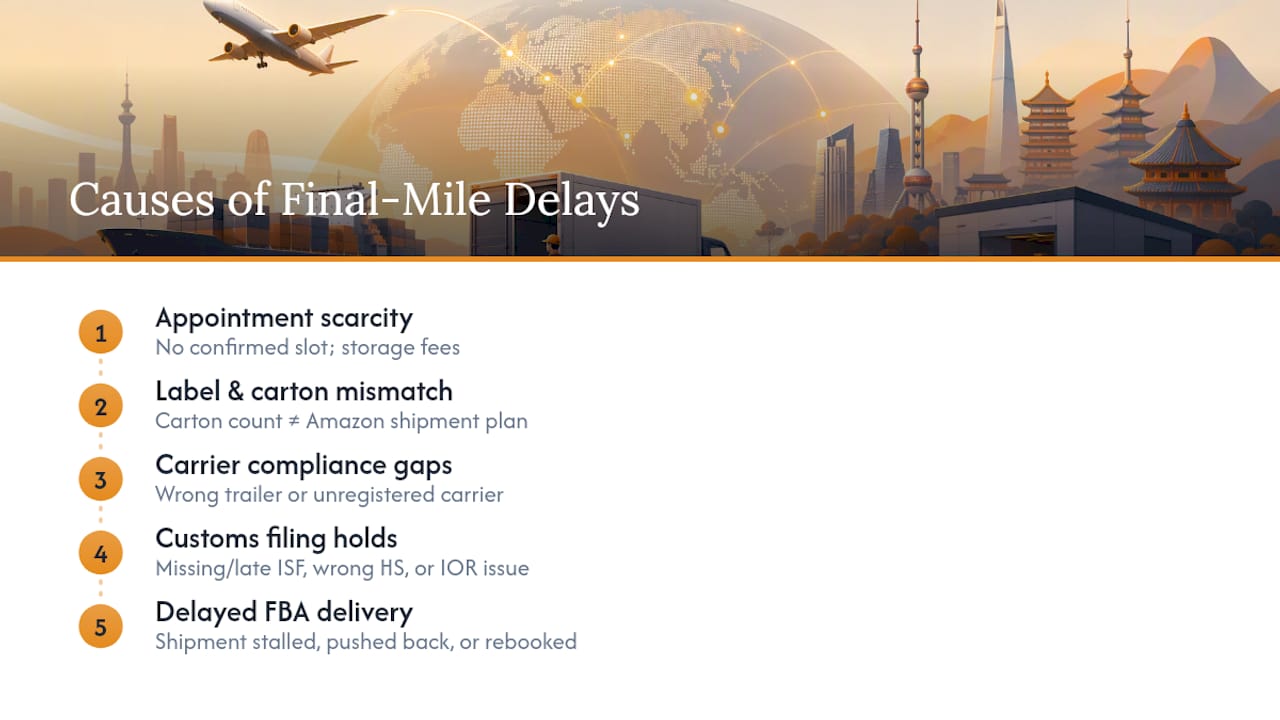
Appointment scarcity. Popular FCs book out fast, especially before peak season, and a shipment that arrives palletized with no confirmed slot just sits in a warehouse racking up storage fees.
Label and carton mismatches. A pallet arriving with a carton count that doesn’t match what was declared in the Amazon shipment plan gets flagged, and flagged shipments get pushed to the back of the receiving queue while someone manually reconciles it.
Carrier compliance gaps. A truck showing up without the correct trailer specs, or a carrier not properly registered for that appointment, can be turned away entirely, forcing a rebooking that costs days.
Customs holds from incomplete filings. Missing or late ISF filings, mismatched HS codes, or an undisclosed Importer of Record can trigger a customs hold that stalls the shipment before it even reaches the final-mile carrier.
Mitigation is mostly about sequencing, not spending more money. Book your appointment as early as your Amazon shipment plan is finalized. Reconcile carton and pallet counts against your plan before the truck loads, not after. Confirm your carrier’s registration and trailer specs a few days ahead, not the morning of pickup. And treat customs filing timing as a fixed deadline, not a flexible one, because a customs hold has a way of cascading into every date that follows it.
What Does Final Mile Delivery to FBA Typically Cost?
Final-mile costs break into a few predictable categories, and understanding each one helps you spot a quote that’s hiding something. Linehaul, the actual trucking from your domestic warehouse or port to the FBA center, scales with distance, mode (LTL versus FTL), and pallet count. Devanning and palletization fees apply if your goods arrive by ocean container and need to be unloaded and repacked onto pallets that meet FBA specs. Labeling fees cover applying FNSKU stickers and carton labels if you didn’t pre-label at origin. Appointment and accessorial fees can include liftgate charges, detention if a truck sits too long at the dock, or storage if your inventory waits on an appointment slot.
Duties and import fees sit separately from final-mile trucking costs but often get bundled into a single DDP price, which is exactly why comparing DDP quotes on total landed cost matters more than comparing the headline number. Two DDP quotes with identical final-mile line items can differ significantly once you account for how duties, insurance, and customs filing fees are allocated.
The cheapest quote on paper is rarely the cheapest shipment in practice. A DDP price that looks 15% below competitors deserves a direct question: what’s excluded, and who exactly is filing as Importer of Record? If a forwarder can’t answer both clearly, the savings usually get recovered later through storage fees, rebooking costs, or a customs hold you didn’t budget for.
How Should You Pack and Prepare Shipments for FBA?
Packing mistakes cause a disproportionate share of final-mile rejections, and most of them trace back to skipping a step that felt optional at the time.
Start with your carton specs matching exactly what you declared in your Amazon shipment plan, down to the dimensions and weight. A carton that’s heavier than declared, even by a small margin, can get flagged during receiving. Apply FNSKU labels to every individual unit before cartons get sealed, not after, because relabeling sealed boxes at a warehouse costs time and money you didn’t plan for.
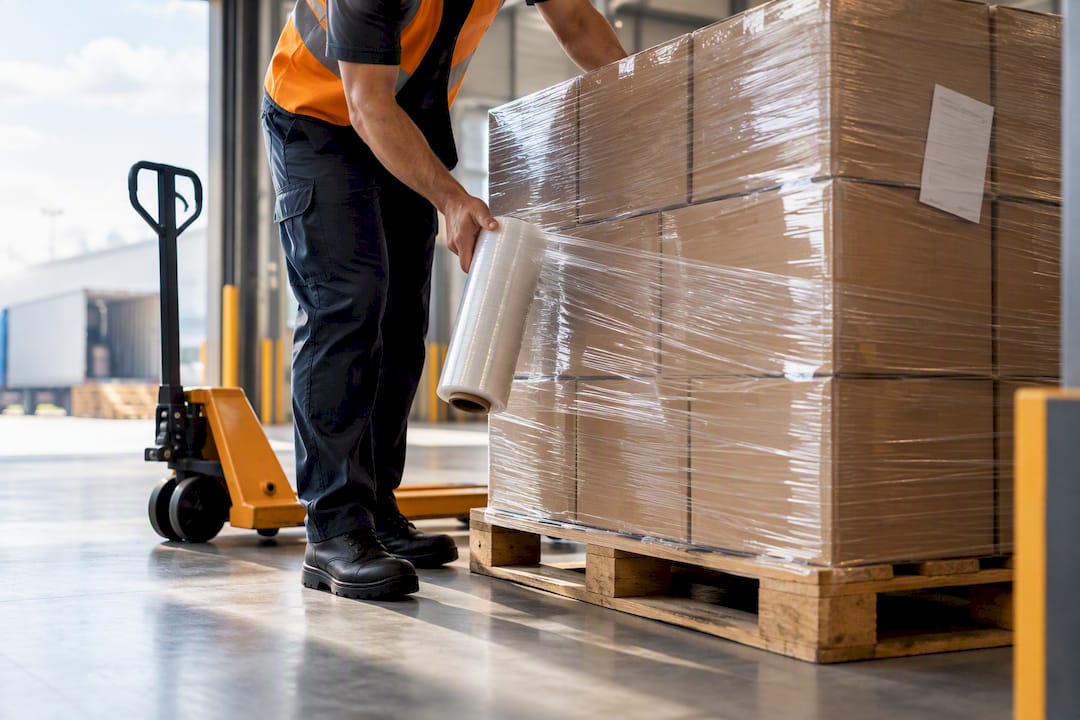
Pallets need to meet FBA’s physical specifications: proper stacking height, weight distribution that won’t shift in transit, and stretch wrap tight enough to survive loading and unloading without cartons sliding loose. A pallet label should be visible and scannable without anyone having to dig through wrap to find it.
Reconcile your packing list against your actual carton count before the truck leaves origin, not after it arrives at the FC. Discrepancies discovered at the dock are far more expensive to fix than discrepancies caught at your warehouse, where you still have time to correct labels or repack a pallet.
Battery-containing products and other regulated goods need their own documentation trail, separate from standard packing lists, because customs and Amazon both check for this independently. Flag these to your forwarder early so the paperwork is ready before cargo ships, not scrambled together after a hold notice arrives.
What Insurance and Liability Coverage Do You Need for FBA Shipments?
Cargo insurance covers loss or damage during transit, but coverage gaps tend to appear at the exact points where responsibility changes hands, port to warehouse, warehouse to final-mile carrier, carrier to FBA dock. Confirm your policy covers the entire journey, not just ocean transit, since a gap during devanning or final-mile trucking leaves you exposed right when goods are most likely to get damaged from handling.
Liability for a rejected or damaged shipment often comes down to who legally owned the goods at the moment of the incident. If your forwarder is acting as Importer of Record, your contract should specify exactly where their liability ends and yours begins, particularly for post-entry issues like a customs reassessment or a duty dispute discovered after delivery.
Get insurance certificates in writing for every shipment, not just a blanket assurance that “everything is covered.” A specific certificate naming your shipment, its declared value, and the coverage period gives you something to file a claim against if cargo arrives damaged or a pallet goes missing between the port and the FC.
Can You Track Final-Mile Carriers Through Amazon’s System?
Amazon’s Seller Central dashboard shows shipment status updates once a carrier scans a shipment into their system, but the level of detail depends heavily on whether that carrier integrates directly with Amazon’s tracking APIs or reports status manually. Carriers registered through the Partner Carrier Program tend to sync status updates more reliably because Amazon already has a data connection with them.
For non-PCP carriers, tracking visibility can lag, and you may find yourself relying on your forwarder’s own tracking system rather than Amazon’s dashboard for real-time updates. This is one reason working with a forwarder who provides proactive status updates, rather than making you check a portal repeatedly, matters more than it sounds. The appointment confirmation itself functions as a kind of digital handshake between your carrier and Amazon’s receiving system, and that confirmation record is often more reliable than generic tracking pings for confirming your shipment actually has a slot.
Ask your forwarder directly how they relay status: do you get proactive notifications, or do you have to request updates? A forwarder that pushes appointment confirmations and proof-of-delivery to you automatically saves you the job of chasing that information down yourself during a week when you’re already juggling ten other shipments.
A Logistics Lead’s Priority Order for the Final Mile
If you only fix three things before your next shipment, fix these in order. First, confirm your importer and lock down document access, because everything downstream depends on knowing who legally owns the customs entry. Second, confirm your FBA labels and palletization plan before cargo leaves origin. Third, get your carrier appointment booked with documentation in hand, not a verbal promise.
A single point of contact who already has your entry documents on file recovers a stalled shipment in hours. Without one, you’re calling three different vendors trying to figure out who has the paperwork Amazon is asking for.
Get Your Final Mile to FBA Handled Without the Guesswork
Specialized freight forwarding services for sellers moving inventory from China and Korea into FBA address common shipment breakdown points such as the handoff between customs clearance and the Amazon dock appointment. An all-inclusive DDP workflow may cover supplier pickup, customs clearance, FBA labeling and prep, and appointment coordination under one dedicated account manager, reducing the need to coordinate multiple vendors separately while trying to hit a restock date.

If you’re planning your next shipment from China or Korea into an FBA center, get a DDP shipping quote or reach out through the FBA freight forwarder page to have your shipment details reviewed before cargo leaves origin. Getting the Importer of Record and appointment details confirmed early is the single fastest way to avoid a stalled pallet sitting in a warehouse instead of on an FBA shelf.
Primary Sources Used in This Guide
This guide draws on Amazon’s own Seller Central and Partner Carrier Program documentation for carrier and receiving rules, along with practical DDP-to-FBA guides covering Importer of Record responsibilities and total landed cost comparisons for sellers shipping from Asia.
Sources
FAQ
What Is Final Mile to FBA?
Final mile to FBA is the last delivery leg of your shipment into an Amazon fulfillment center, requiring a booked appointment, an Amazon-compliant carrier, proper palletization and labeling, and documented customs clearance. It differs from consumer last-mile delivery because Amazon enforces specific trailer, labeling, and appointment requirements at the receiving dock.
Who Can Be the Importer of Record for FBA Shipments?
Amazon does not act as Importer of Record for inbound FBA shipments. The seller, a licensed customs broker, or in some cases a forwarder acting as IOR can fill that role, provided the arrangement is disclosed in writing with proper documentation.
Should I Choose DDP or FOB for FBA Shipments?
DDP bundles customs clearance, duties, and final delivery into one price and suits sellers who want a single point of accountability, while FOB gives more control to sellers who already have broker relationships. Compare both on total landed cost rather than the headline freight rate before deciding.
How Do I Book an Appointment With Amazon for Final-Mile Delivery?
Appointments are booked through the Send to Amazon workflow in Seller Central, using a carrier registered under Amazon’s Partner Carrier Program where possible. Confirm your FC code, carton and pallet counts, and delivery mode before requesting the slot, and retain the appointment confirmation number as proof.
Does ForwarderOne Handle the Full Final Mile Into FBA?
ForwarderOne manages the complete workflow from supplier pickup through customs clearance, palletization, FBA labeling, appointment booking, and final delivery under one DDP service. Current pricing is available directly through the ForwarderOne site since rates vary by shipment volume and origin.
Want a shipping plan built around your cargo?
ForwarderOne coordinates freight, customs, duties, and final delivery in one managed workflow for ecommerce and Amazon FBA shipments.