Ocean freight and air freight are the two dominant modes of international cargo transport, and the right choice between them is determined by five core factors: transit time, cost, cargo type, carbon footprint, and supply chain risk tolerance. Neither mode is universally superior. The ocean vs air freight comparison factors that matter most shift depending on whether you are shipping 500 kg of electronics on a tight deadline or 10,000 kg of seasonal goods with a six-week window. This article breaks down every factor you need to evaluate, including 2026 market conditions, sustainability regulations, and hybrid strategies that many sellers overlook entirely.
1. Primary factors to compare between ocean and air freight
The freight mode decision framework covers six distinct variables, and skipping any one of them leads to either overspending or stockouts.
Transit time is the most visible difference. Air freight door-to-door takes 3 to 7 days, while ocean freight averages 18 to 40 days depending on route and port congestion. Ocean transit times have grown even longer recently due to rerouting around the Cape of Good Hope, adding 10 to 14 days to certain lanes. That gap has real consequences for inventory planning.

Cost structure is the second factor. Sea freight spot rates dropped roughly 70% from their 2022 peaks due to overcapacity, making ocean freight significantly more affordable in 2026. Air freight prices remain stable but are still several times higher per kilogram. The table below summarizes the core comparison:
| Factor | Air freight | Ocean freight |
|---|---|---|
| Transit time | 3 to 7 days | 18 to 40 days |
| Cost per kg | High | Low |
| CO2 per ton-km | ~500g | 10 to 40g |
| Cargo size limit | Small to medium | Unlimited |
| Reliability | High | Moderate |
| Regulatory complexity | Moderate (CORSIA) | High (IMO, EU ETS) |
Carbon footprint is no longer a secondary concern. Ocean freight emits approximately 40 to 50 times less CO2 per ton-kilometer than air freight. For companies with 2030 net-zero commitments, this gap alone can determine mode selection. Capacity, reliability, and customs complexity round out the framework and are covered in the sections below.
2. How transit time and cost trade-offs impact shipping decisions
Speed costs money, but so does running out of stock. The real question is which cost is larger for your specific shipment.
On the China-to-USA lane, ocean freight via the Pacific typically runs 18 to 25 days port-to-port. Air freight on the same lane delivers in 3 to 5 days. For an Amazon FBA seller heading into Q4, a 20-day difference in replenishment speed can mean the difference between capturing peak demand and losing the Buy Box entirely. You can review 2026 China-to-USA cost examples to see how these numbers translate into real landed costs.
The rule of thumb used by experienced freight managers is straightforward. If shipping cost exceeds 15 to 20% of the value of the goods, ocean freight is the better choice. Below that threshold, air freight often lowers total landed cost because it reduces inventory holding time, insurance exposure, and stockout risk. High-value electronics and pharmaceuticals regularly justify air freight premiums for exactly this reason.
Chargeable weight calculations also differ between modes. Air freight uses a volumetric weight divisor of approximately 6,000 cm3/kg, which makes low-density, bulky cargo disproportionately expensive by air. Ocean freight charges by CBM at roughly 1,000 kg per cubic meter. Understanding this before you book prevents billing surprises that can erase your margin.
Pro Tip: Before comparing freight quotes, calculate your shipment’s volumetric weight for air and its CBM for ocean. The mode that looks cheaper on a per-kg basis is often not cheaper once chargeable weight is applied.
Here is a practical decision sequence for mode selection:
- Calculate the freight cost as a percentage of total goods value.
- Determine your maximum acceptable delivery window based on current stock levels.
- Factor in insurance, warehousing, and stockout costs for the longer mode.
- Compare total landed cost, not just the freight invoice.
- Select the mode where total landed cost is lower, not where the quote is lower.
3. What role does sustainability play in choosing ocean or air freight
Sustainability has moved from a marketing checkbox to a procurement constraint for a growing number of importers and their retail partners.
Air freight produces roughly 500g CO2 per ton-kilometer, compared to 10 to 40g for ocean freight. That 40 to 50x difference means a single air shipment can consume a month’s worth of a company’s carbon budget. For sellers supplying large retailers with Scope 3 emissions targets, the freight mode you choose directly affects your customer’s sustainability reporting.
Regulatory pressure is accelerating this shift. Sea freight now falls under IMO FuelEU Maritime and the EU Emissions Trading System, which mandate emissions reductions of 20 to 30% by 2028. These rules are pushing carriers toward LNG, methanol, and ammonia-powered vessels. Air cargo emissions are addressed through IATA’s CORSIA program, which remains voluntary for most operators. The regulatory asymmetry means ocean freight faces harder near-term compliance costs, but air freight’s absolute emissions remain far higher per shipment.
Practical sustainability integration looks like this for logistics managers:
- Assign a carbon cost per shipment using your company’s internal carbon price.
- Set a threshold for when air freight is permitted based on urgency and margin.
- Track modal split quarterly and report it against net-zero milestones.
- Prioritize ocean freight for all non-urgent replenishment to reduce baseline emissions.
Sustainability’s influence on freight choice is now a key factor in 2026 planning. Ocean freight is the default for companies working toward net-zero goals, while air remains reserved for high-margin, time-critical shipments where the carbon cost is justified by business necessity.
4. How hybrid freight strategies optimize cost, speed, and risk
A hybrid sea-air strategy ships cargo by ocean to a midpoint hub, then by air for the final leg. It is the most underused tool in the logistics manager’s kit.
Hybrid sea-air freight cuts delivery times by up to 50% compared to ocean-only and reduces cost by up to 50% compared to air-only shipments. The math works because the ocean leg covers the longest distance at the lowest cost, and the air leg covers the shorter final distance at a premium that is still far below a full air route. Transshipment hubs like Singapore and Dubai are the most common midpoints for Asia-to-US and Asia-to-Europe lanes.
| Strategy | Cost vs air-only | Speed vs ocean-only | Best use case |
|---|---|---|---|
| Ocean only | Lowest | Slowest | Bulk, non-urgent goods |
| Air only | Highest | Fastest | Urgent, high-value goods |
| Sea-air hybrid | Up to 50% lower | Up to 50% faster | Balanced urgency and cost |
Hybrid strategies work best in three specific scenarios. First, when you have a firm delivery deadline that ocean alone cannot meet but a full air shipment is cost-prohibitive. Second, when you are managing seasonal inventory and need to accelerate part of a shipment without paying air rates on the full volume. Third, when geopolitical disruptions or port congestion make pure ocean routing unreliable and you need a contingency that does not triple your freight bill.
The main operational pitfall is documentation complexity. Sea-air shipments cross two transport modes and often two customs jurisdictions at the hub. Working with a freight forwarder experienced in China to USA freight forwarding eliminates most of this friction.
Pro Tip: When evaluating a hybrid route, ask your forwarder for the total door-to-door transit time including hub dwell time. Some Singapore and Dubai hubs add 2 to 4 days of handling, which can erode the speed advantage if not accounted for.
5. Which freight option suits different product types and business scenarios
Product characteristics determine mode fit more reliably than any other single variable.
Air freight handles about 0.5% of global trade by weight but 35% by value. That ratio tells you exactly what belongs on a plane: small, light, high-value goods where speed protects margin. Pharmaceuticals, semiconductors, luxury goods, and perishable food products are the clearest examples. For e-commerce sellers, air freight is the right call for emergency restocking, new product launches, and any shipment where a stockout would cost more than the freight premium.
Ocean freight accounts for 90% of global trade volume and accommodates cargo that air simply cannot take, including hazardous materials, oversized machinery, and full container loads of consumer goods. For Amazon FBA sellers shipping standard replenishment from China, ocean freight via a DDP shipping service is the default choice for anything with a lead time of four weeks or more.
Here is a practical product-to-mode matching guide:
- Air freight: Electronics, pharmaceuticals, luxury apparel, perishables, samples, and emergency stock.
- Ocean freight: Furniture, appliances, toys, apparel in bulk, auto parts, and any shipment over 200 kg with a flexible timeline.
- Hybrid: Seasonal goods with a firm but not immediate deadline, mid-value products where partial air acceleration makes financial sense.
For e-commerce sellers specifically, the decision often comes down to inventory velocity rather than freight price alone. A seller with 14 days of stock remaining cannot afford a 30-day ocean transit regardless of the cost savings. Building a replenishment calendar that triggers ocean orders at 60 days of remaining stock and air orders at 20 days eliminates most emergency freight spend over time.
Key takeaways
The most effective freight strategy combines ocean freight for planned replenishment, air freight for urgent or high-value shipments, and hybrid solutions to bridge the gap between cost and speed.
| Point | Details |
|---|---|
| Transit time drives urgency decisions | Air delivers in 3 to 7 days; ocean takes 18 to 40 days, making lead time the first filter. |
| Total landed cost beats freight price | Factor in stockout risk, insurance, and holding costs before choosing the cheaper quote. |
| Sustainability favors ocean | Ocean emits 40 to 50x less CO2 per ton-km, making it the default for net-zero programs. |
| Hybrid strategies cut both cost and time | Sea-air combinations reduce cost by up to 50% vs air-only and speed by up to 50% vs ocean-only. |
| Product type determines mode fit | Air suits high-value, low-weight cargo; ocean suits bulk, heavy, and non-urgent shipments. |
Why I think most sellers get the freight decision backwards
After working through hundreds of freight decisions with Amazon sellers and logistics managers, the pattern I see most often is this: sellers fixate on the freight quote and ignore the cost of the decision itself.
A seller who saves $800 by choosing ocean over air, then runs out of stock for 10 days during peak season, has not saved $800. They have lost whatever their daily revenue was during those 10 days, plus the ranking damage that follows a stockout on Amazon. The freight quote is visible. The stockout cost is invisible until it hits. That asymmetry causes most of the bad freight decisions I see.
The second mistake is treating sustainability as optional. Retailers like Walmart and Target are already asking suppliers for Scope 3 emissions data. If your freight modal split is 80% air, that number will eventually become a commercial liability, not just an ethical one. Shifting to ocean or hybrid freight now builds a defensible position before it becomes a requirement.
The sellers who get this right build a replenishment model first, then select the freight mode that fits it. They know their stock cover at any given time, they have pre-negotiated rates for both ocean and air, and they use air freight as a deliberate tool rather than a panic response. That is the standard worth aiming for.
— Keven
How ForwarderOne helps you ship smarter from China to the USA
ForwarderOne is built specifically for Amazon FBA sellers and e-commerce businesses that need reliable, cost-efficient freight from China to US fulfillment centers. Whether your shipment calls for ocean, air, or a hybrid approach, ForwarderOne’s all-inclusive freight services cover DDP shipping, customs clearance, and last-mile delivery in a single workflow.
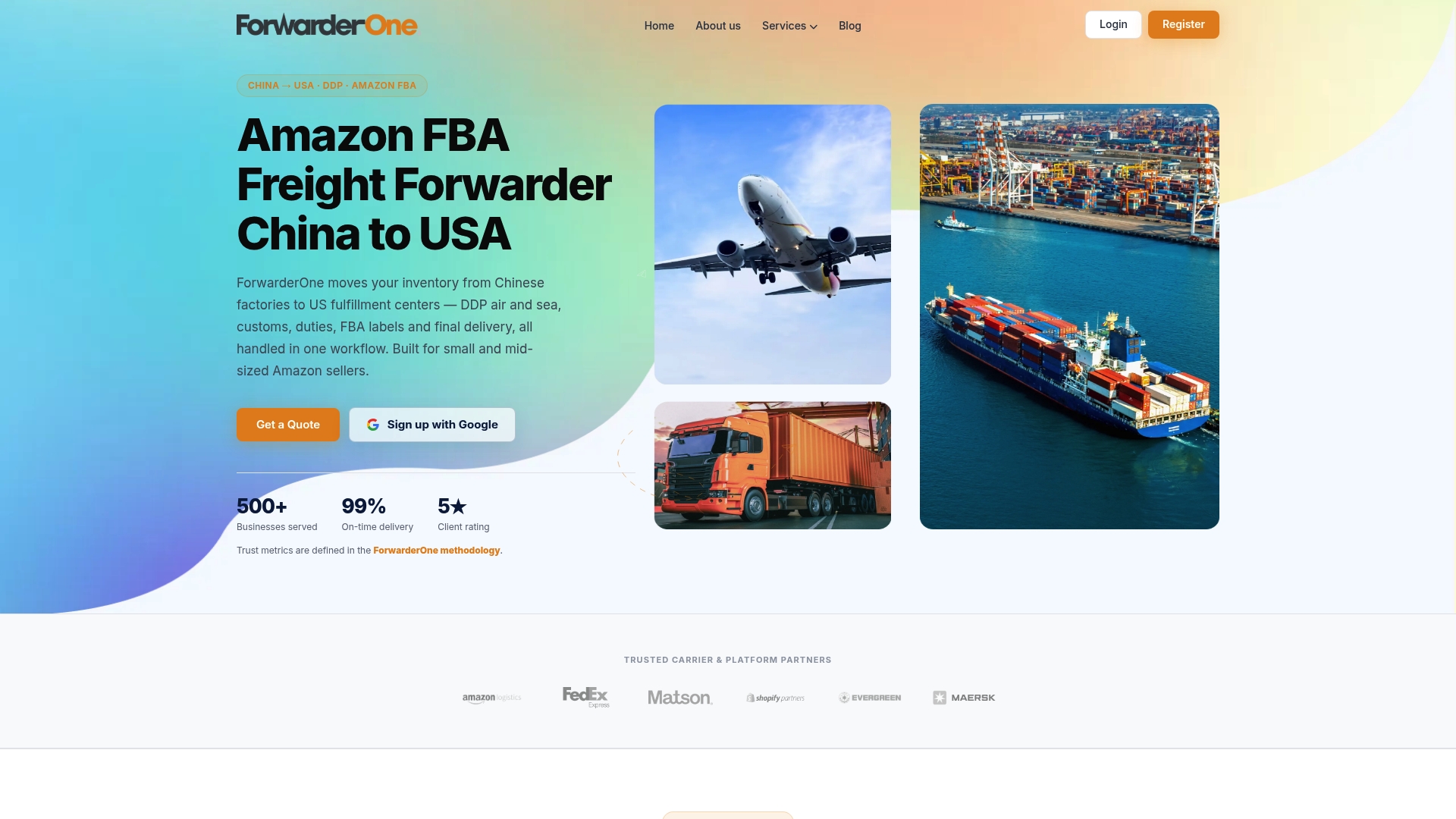
With over 99% on-time delivery and a dedicated account manager for every client, ForwarderOne removes the guesswork from mode selection. The platform’s FBA freight forwarding options are priced transparently, so you can compare ocean and air costs against your actual inventory position before committing. If you are managing seasonal peaks or navigating 2026 tariff changes, ForwarderOne’s team handles the complexity so you can focus on selling.
FAQ
What is the main difference between air and ocean freight?
Air freight delivers in 3 to 7 days at a significantly higher cost per kilogram, while ocean freight takes 18 to 40 days at a fraction of the price. The right choice depends on your shipment’s urgency, value, and volume.
When does air freight cost less than ocean freight overall?
Air freight lowers total landed cost when the freight charge is below 15 to 20% of the goods’ value, or when the cost of a stockout or delayed delivery exceeds the air freight premium. High-value, lightweight goods like electronics and pharmaceuticals are the most common cases.
How much more carbon does air freight produce than ocean freight?
Air freight produces roughly 500g of CO2 per ton-kilometer compared to 10 to 40g for ocean freight, making ocean freight 40 to 50 times cleaner per unit of cargo moved.
What is a sea-air hybrid freight strategy?
A sea-air hybrid ships cargo by ocean to a midpoint hub such as Singapore or Dubai, then by air for the final leg. This approach cuts transit time by up to 50% versus ocean-only and cost by up to 50% versus air-only.
Which freight mode is better for Amazon FBA sellers?
Ocean freight is the standard choice for planned replenishment with a four-week or longer lead time. Air freight is reserved for emergency restocking, new product launches, or high-value goods where speed protects sales rank and margin.
Need help choosing ocean, air, or hybrid freight?
Send your carton data, supplier city, inventory deadline, Amazon destination and target budget. ForwarderOne will compare DDP air, DDP sea and hybrid routing against your real replenishment window.