Amazon will refuse your pallet at the door if it breaks the required footprint, height, or weight limits. The footprint must be a standard 48 x 40 inches, total height must stay within Amazon’s specified maximum, and total weight must not exceed the allowed maximum, all including the pallet itself. All three include the pallet itself, not just your cartons stacked on it.
Get those right and you’re most of the way there, but the details that trip up sellers are smaller than height and weight.
- Wrap: clear stretch wrap only. Black or opaque film is not accepted as it blocks scanners from reading labels.
- Labels: four pallet labels, one on each side, placed where they can be scanned easily without unwrapping.
- Pallet type: a standard four-way entry wood pallet in good condition with no broken boards or exposed nails.
- Overhang: cartons may only slightly exceed the pallet edge within set limits, with possible exceptions for single oversized items that are properly documented.
- Imports: wood pallets need an ISPM-15 heat-treatment stamp or Amazon’s receiving dock can turn the whole load away.
TL;DR:
- Ensuring your pallet meets the 48 x 40 inch footprint, 72 inches height, and 1,500 pound weight limits prevents rejection at Amazon receiving.
- Using clear stretch wrap and placing four visible labels on each side in the upper left corner is critical for scanner readability and smooth processing.
- Proper pallet construction with corner boards, a top sheet, and at least four wrap passes enhances stability and prevents damage during transit.
- Only standard four-way GMA wood pallets in good condition and with an ISPM-15 stamp for imports are acceptable for inbound shipments.
- Pre-measuring, weighing, and documenting your pallets before pickup reduces delays caused by height, weight, label, or wrap issues.
What Are Amazon’s Pallet Size, Height, and Weight Requirements?
Amazon’s inbound pallet standards are stricter than most sellers expect the first time they ship LTL freight. The footprint has to match a GMA pallet: 48 inches long by 40 inches wide, no substitutions. That’s the industry-standard four-way pallet used across most US freight networks, so sourcing one isn’t the hard part. Getting the load on top of it to comply is where sellers actually lose time and money.
Here’s how the three core limits work in practice:
- Footprint: 48 x 40 inches. Cartons need to sit inside or very close to this boundary. A pallet built on the wrong size base, even a common 42 x 42 industrial pallet, gets flagged during receiving because Amazon’s dock equipment and slotting are built around GMA dimensions.
- Height: 72 inches maximum, pallet included. Measure from the floor to the highest point of your stacked cartons, not from the top of the pallet deck. Sellers routinely measure carton height alone and forget the 5 to 6 inches the pallet itself adds, which is exactly how a “compliant” 70 inch stack becomes a 76 inch rejection.
- Weight: 1,500 pounds maximum, pallet included. Weigh the finished pallet on a floor scale before it ships, not your individual carton weights added up on paper. Moisture, packing materials, and rounding errors compound fast across 40 to 50 cartons.
The overhang rule catches almost as many sellers as the height limit. Cartons may extend past the pallet edge by up to 3 inches on any side. Anything wider than that risks damage in transit and gets rejected on sight, since overhanging cartons are the first thing a forklift catches on a poorly stacked load. There’s a narrow exception for a single oversized item that exceeds the standard footprint. That’s for genuinely oversized single SKUs, not a workaround for sloppy stacking, and Amazon expects it documented at shipment creation rather than discovered at the dock.
Pro Tip: Weigh and measure every pallet before it leaves your warehouse, not after your forwarder picks it up. A $30 warehouse scale pays for itself the first time it stops you from sending a 1,540 pound pallet across the country only to have it rejected and rerouted.
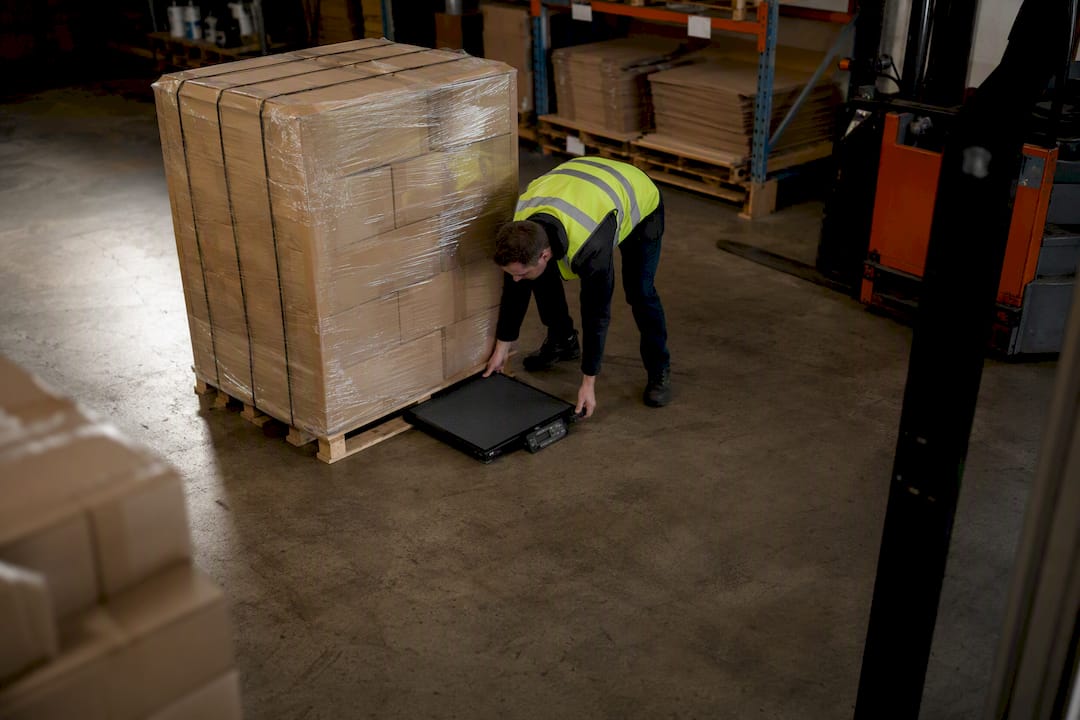
If a single SKU is heavy enough to push your pallet near the ceiling, split it across two pallets rather than trying to squeeze under 1,500 pounds. It’s a smaller headache than a rejected shipment sitting in a receiving queue for a week.
How Should FBA Pallet Labels Be Placed for Scanning?
Every pallet needs four labels, one per side, placed in the upper left quadrant of each face so a scanner passing by at any angle can pick it up without someone flipping the pallet around. This isn’t a suggestion buried in fine print. It’s one of the most common reasons pallets get pulled for manual processing, which typically comes with extra fees and slower check in.
Generate your pallet labels directly in Seller Central during shipment creation, print them at full size, and apply them before wrapping. A label that’s too small, printed at the wrong scale, or taped over a seam in the cardboard is functionally the same as no label at all once a scanner tries to read it.
- Print at the size Seller Central generates. Don’t shrink labels to save paper.
- Place one on each of the four sides, not just the two facing the forklift.
- Apply labels to a flat section of the load, never across a gap or a carton edge.
- Confirm all four are visible after wrapping, not just before.
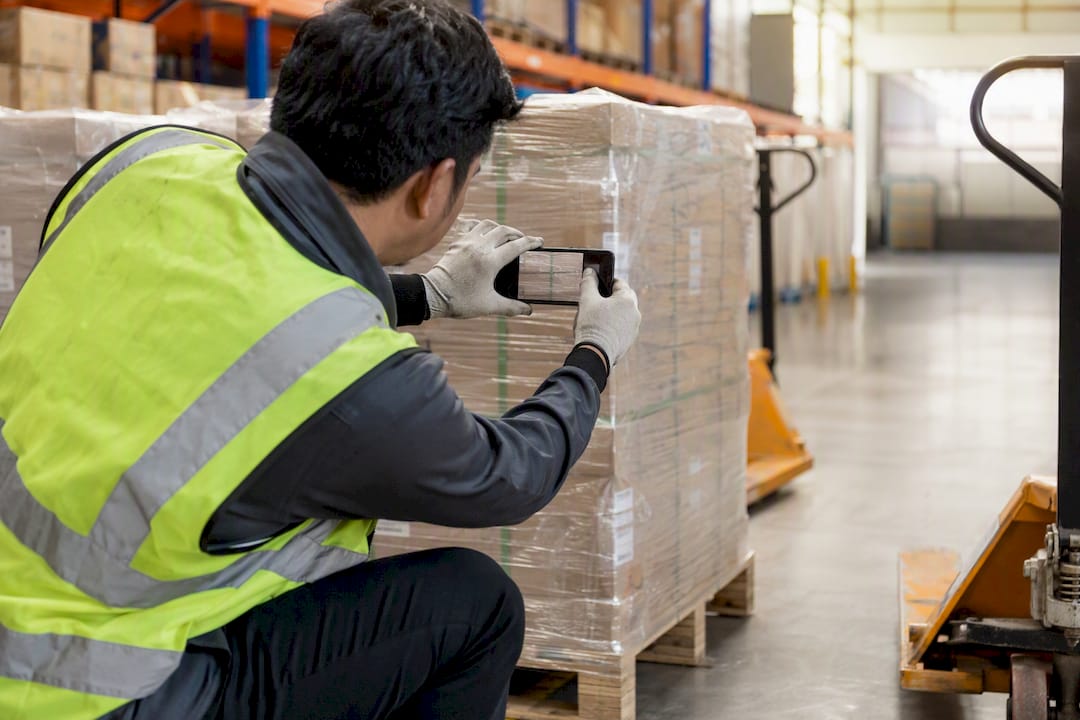
Before the pallet leaves your facility, pull out your phone and scan each label with a barcode app or even just the camera zoomed in. If you can’t read it clearly through the wrap, the FC scanner won’t either, and that’s the whole reason clear wrap only is a hard rule rather than a preference. Black and opaque stretch film block infrared and optical scanners the same way a hand covering a barcode would. Sellers who use tinted wrap because it “looks cleaner” or hides damage are trading a cosmetic preference for a guaranteed scan failure.
Pro Tip: Take a photo of each labeled side before wrapping and again after. If a label ends up hidden behind a fold or a seam, you’ll catch it in the photo instead of finding out when the pallet gets rejected three states away.
What’s the Right Way to Build and Wrap an FBA Pallet?
A pallet that survives an 1,800 mile LTL trip and one that arrives crushed usually started the same way, with the difference showing up in the stacking pattern and the wrap.
- Choose your stacking pattern. Column stacking, boxes aligned directly on top of each other, works for uniform, sturdy cartons and gives you the cleanest weight distribution. Brick stacking, where each layer offsets the one below it like bricks in a wall, interlocks the load and resists shifting better for mixed carton sizes. Use brick stacking whenever your cartons vary in dimension.
- Add corner boards and a top sheet. Vertical corner boards protect edges from crushing when straps tighten, and a top sheet or cap distributes pressure evenly across the highest layer. Strapping helps lock a tall load together, but it needs to sit over corner protection, not directly against bare cartons, or it will cut into the cardboard during transit.
- Wrap with clear film, minimum four passes. Start at the pallet deck itself, not the first layer of cartons, so the film anchors the load to the base. Work upward with roughly 50% overlap on each pass, and finish by folding the film over the top to seal it. Four passes covers most standard loads; irregular, heavy, or top-heavy pallets need six or more passes for the wrap to actually hold under highway vibration.
Once wrapped, give the pallet a firm push test on two sides. If cartons shift more than an inch, add another pass or two rather than shipping it and hoping. A little extra film is cheaper than a repalletized load and a missed appointment window. For sellers still dialing in carton sizing before it hits the pallet, our packaging requirements guide covers the carton side of this in more depth.
Which Pallet Types and Conditions Does Amazon Accept?
Amazon expects a standard GMA 48 x 40 wood pallet with four way entry, meaning a forklift or pallet jack can pick it up from any of the four sides rather than just two. Four way access speeds up receiving, and Amazon’s dock equipment is built around it. Two way stringer pallets slow things down and, depending on the FC, may get pushed to a manual lane.
Condition matters as much as design. Grade A pallets, the ones without broken deck boards, protruding nails, or splintered stringers, are the baseline. Run through this before anything ships:
- No broken, cracked, or missing deck boards.
- No exposed or protruding nails or staples.
- Full deck coverage, no large gaps between boards.
- Stringers intact and square, not leaning or split.
- Dry wood, no visible mold or water damage.
If your pallets are coming from overseas, the ISPM-15 stamp is not optional. This is the international heat-treatment mark that confirms the wood won’t carry pests across borders, and customs agents check for it before freight ever reaches an Amazon dock. No stamp, no clean entry, and that delay happens before your shipment even gets to the compliance checks covered here.
One more thing worth flagging: slip sheets, the thin cardboard or plastic sheets some shippers use instead of wood pallets, are not acceptable for LTL or FTL inbound to Amazon. They save weight and space in a container, but Amazon’s receiving equipment is built for pallets, not sheets, and a slip sheet load gets refused on arrival.
When Does Amazon Require Palletized Shipments?
Palletization isn’t automatic for every FBA shipment. A handful of thresholds decide when loose cartons stop being an option:
- Shipments over 150 pounds total typically move to LTL freight, which requires pallets.
- 20 or more cartons in a single shipment usually gets palletized rather than hand loaded.
- Any LTL or FTL freight booking assumes palletized cargo unless your carrier explicitly floor loads.
Floor loading, stacking cartons directly in a trailer without pallets, is sometimes cheaper for very dense, uniform freight, but it requires carrier and FC appointment coordination that most small sellers don’t have set up. If you’re unsure which category your shipment falls into, palletizing is almost always the safer default.
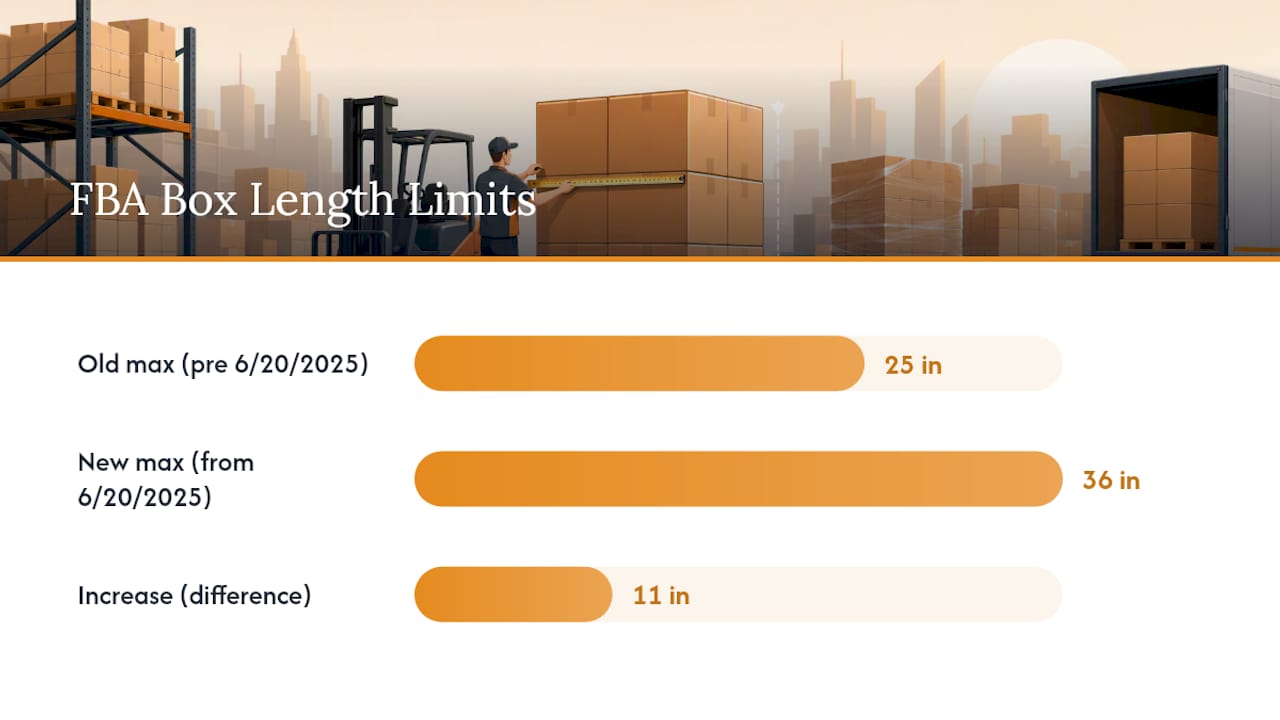
Carton selection got a little easier in the middle of 2025. Amazon raised its maximum box length for FBA orders from 25 to 36 inches, effective June 20 of that year. That single change means fewer sellers need to double box long items just to stay under the old limit, which in turn makes it easier to hit clean column or brick stacking patterns on the pallet itself.
What Steps Happen Between Packing and Pickup?
Once your pallets are built, labeled, and wrapped, the administrative side takes over, and skipping a step here is how compliant pallets still end up delayed.
- Generate pallet labels in Seller Central. This happens as part of shipment creation, and it’s worth double checking the label count matches your actual pallet count before printing. A mismatch here means relabeling at the last minute.
- Schedule your carrier appointment. LTL and FTL deliveries to Amazon FCs require a scheduled dock appointment, and missing that window can push your pickup or delivery back days. Confirm whether the carrier has lift gate capability if your facility doesn’t have a loading dock, since that’s a common gap that surfaces the morning of pickup.
- Prepare accurate bill of lading details. Your BOL needs the Amazon shipment ID, correct piece counts, and accurate total weight. A BOL that doesn’t match what’s physically on the truck creates discrepancies that slow down receiving even when the pallets themselves are perfect.
- Confirm FC acceptance criteria with your carrier or forwarder. Not every FC handles every pallet condition or dimension the same way, and a quick confirmation call before pickup catches mismatches early. This is exactly the kind of detail a freight forwarder tracks so you don’t have to chase it FC by FC, and it’s also where our shipment creation walkthrough is worth a read if you’re setting this up for the first time.
What Causes FBA Pallet Rejections and How Do You Fix Them?
Most rejections trace back to the same handful of causes, and nearly all of them are fixable before the pallet ever leaves your building.
- Height or weight over limit. Remove cartons and repalletize, or split the SKU across two pallets.
- Black or opaque wrap. Rewrap entirely in clear film. There’s no partial fix for this one.
- Unreadable or misplaced labels. Reposition to the upper left quadrant on all four sides and rescan with your phone before shipping.
- Broken or low grade pallet. Swap the pallet itself rather than trying to reinforce a cracked stringer or board.
- Overhang beyond 3 inches. Restack with corners aligned, or use the documented oversized item exception if it genuinely applies.
The financial argument for catching these before pickup is straightforward: splitting a heavy SKU across two pallets up front costs less than paying rework fees and absorbing the delay of a rejected shipment getting rerouted or repalletized at a third party facility. Rejected freight doesn’t just cost money, it costs the days your inventory sits somewhere other than an Amazon shelf.
If a pallet fails inspection mid transit or gets flagged at a consolidation point, that’s the moment to call your forwarder or 3PL rather than trying to manage a remote fix. Rebuilding a pallet correctly from a warehouse hundreds of miles away isn’t something most sellers can coordinate alone, and a forwarder with boots on the ground at that location can usually turn it around faster than starting over from your own facility.
Pre-Pickup Pallet Checklist
Run this before every pallet leaves your warehouse, especially if a different team member handles packing versus shipping paperwork.
- Measure and weigh the finished pallet. Confirm it’s under 72 inches and 1,500 pounds.
- Check all four sides for a visible, scannable pallet label. Photograph each side.
- Inspect wrap coverage for full clear film with no gaps, and confirm no cartons overhang more than 3 inches.
- Verify corner boards and strapping are in place if the load is tall or irregular.
- Confirm your carrier appointment time and that your BOL references the correct Amazon shipment ID.
- Send pickup confirmation to your account manager or forwarder with photos attached.
Six steps, maybe ten minutes per pallet. It’s a small amount of time against the alternative of a rejected shipment sitting in limbo for a week.
How ForwarderOne Supports Pallet Compliance
Getting all of this right on every shipment, every time, is exactly the kind of repetitive operational work that eats a seller’s week. ForwarderOne builds pallet compliance into its DDP workflow rather than treating it as a separate step: pre-shipment inspection, palletization to Amazon’s exact specs, labeling with photo proof before pickup, and appointment coordination with the receiving FC.
That process runs alongside a track record of over 99% on-time delivery and a dedicated account manager assigned to each seller, so questions about a specific FC’s receiving quirks get answered by someone who already knows the shipment, not a generic support queue. For sellers moving inventory from China or Korea, our guide on shipping inventory into FBA walks through how that handoff works end to end.
- Pre-shipment inspection catches Grade A and ISPM-15 issues before pallets ever ship.
- Palletization and labeling are handled to Amazon’s exact specs, with photo documentation.
- A dedicated account manager coordinates carrier appointments and BOL accuracy.
The One Rule That Prevents Most Pallet Problems
If there’s one habit that separates sellers who never deal with pallet rejections from sellers who fight this every quarter, it’s measuring and labeling before wrapping, not after. Most of the failures in this guide, height overages, hidden labels, weight miscalculations, get baked in during the stacking phase and only become visible once the pallet is already wrapped and loaded. Catching them earlier costs a scale and a phone camera. Catching them later costs a rejected shipment.
My practical suggestion for busy teams: keep a photo folder for every pallet pickup, four label shots and one full pallet shot, timestamped before the truck leaves. It takes two minutes and it turns “I think it was compliant” into proof, which matters the day a shipment gets flagged and you need to show what actually left your dock.
Get Pallet Compliance Handled With ForwarderOne
Building compliant pallets shipment after shipment is doable on your own, but it’s also the kind of task that eats hours every week and carries real financial risk when something slips through. ForwarderOne folds pallet prep directly into its DDP service, so inspection, palletization, labeling, and customs clearance happen as one coordinated process instead of five separate handoffs between you, a factory, and a freight broker.
That matters most for sellers managing inventory from China or Korea, where a rejected pallet doesn’t just cost a few days, it can mean missing a restock window during a peak sales period. With a dedicated account manager assigned to your shipments and a delivery track record built specifically around getting inventory into FBA without rework, ForwarderOne handles the operational details covered in this guide so you’re not the one catching a mislabeled pallet three weeks into transit.
If you’re planning your next shipment from China or Korea to a US fulfillment center, get a quote through our FBA freight forwarding service and find out what a fully managed DDP shipment looks like for your product line.
Key Takeaways
Amazon rejects pallets almost exclusively for six fixable reasons: wrong height, wrong weight, opaque wrap, unreadable labels, damaged pallets, and excess overhang.
| Point | Details |
|---|---|
| Know the hard limits | Stay within 48 x 40 inches, 72 inches tall including the pallet, and 1,500 pounds total weight. |
| Use clear wrap only | Black or opaque film blocks label scanners and is a top cause of manual processing fees. |
| Label all four sides | Place labels in the upper left quadrant of every face and verify scannability with your phone before shipping. |
| Confirm pallet grade and ISPM-15 | Use Grade A GMA pallets and check imported wood pallets carry a valid heat-treatment stamp. |
| Consider managed compliance | ForwarderOne builds inspection, palletization, and labeling into its DDP workflow to reduce rejection risk. |
FAQ
Is FBA Still Profitable in 2026?
FBA remains a viable model for sellers who control landed cost and avoid preventable fees, and pallet rejections are one of the more overlooked costs eating into margin when shipments get delayed or reworked.
What Are the Biggest FBA Mistakes to Avoid?
Beyond product and pricing errors, the most common operational mistake is treating pallet prep as an afterthought. Wrong wrap color, missing labels, and unmeasured pallet height cause a large share of avoidable receiving delays.
Is Buying an Amazon Pallet Worth It?
If you mean liquidation pallets resold by Amazon, that’s a separate business model from shipping your own inventory into FBA and isn’t addressed by the pallet requirements covered here.
How Many Amazon Sellers Make Over $100k?
Public figures on seller revenue distribution vary by source and methodology, so no single verified number applies broadly. What’s consistent across sellers at any revenue level is that inbound shipping compliance, including pallet standards, directly affects how much inventory actually reaches shelves on time.
What Happens if My Pallet Exceeds 1,500 Pounds?
Amazon will refuse it or route it to special handling, so split the heaviest SKUs across two pallets before shipping rather than risking a rejection at the dock.
Can I Use a Standard Wood Pallet Instead of GMA?
No. Amazon expects a 48 x 40 inch GMA four way pallet in Grade A condition, and nonstandard footprints commonly get flagged during receiving.
Need Amazon-ready pallet prep?
ForwarderOne coordinates supplier pickup, inspection, palletization, labeling, customs clearance, and DDP delivery so FBA inbound freight is checked before it reaches the receiving dock.