When someone searches for an Amazon warehouse in California, they're usually looking for one of two things: a job or a facility address. The short answer is that Amazon operates dozens of fulfillment centers, sortation centers, delivery stations, and specialty sites across the state, and every one of them posts facility-specific openings on Amazon.jobs. The fastest move is to search by your ZIP code or city on that portal to see live pay rates and current openings at the nearest site.
Three facilities worth knowing by name right away: ONT2 (the San Bernardino fulfillment center), the Tracy FC at 1500 E Grant Line Rd, and the massive Ontario robotics-enabled warehouse that anchors the Inland Empire logistics corridor. For Amazon sellers who need to get inventory into these facilities from overseas, ForwarderOne handles FBA freight forwarding from China and Korea with DDP shipping that covers customs and delivery in one workflow.
Key facilities and first steps at a glance:
- ONT2 — Amazon Fulfillment Center, San Bernardino, CA (Inland Empire cluster)
- Tracy FC — 1500 E Grant Line Rd, Tracy, CA (Northern California)
- Ontario mega-FC — roughly 4.5 million sq ft, Inland Empire
- Search tool — Amazon.jobs, filtered by ZIP or city for live pay and openings
- Sellers — ForwarderOne for FBA inbound logistics from Asia to California FCs
Key Takeaways
California's Amazon warehouse network spans dozens of facilities, with the Inland Empire cluster in Ontario, San Bernardino, Fontana, and Moreno Valley serving as the state's primary logistics hub for both job seekers and FBA sellers.
| Point | Details |
|---|---|
| Where to find live openings | Search Amazon.jobs by ZIP or city for current pay rates and shift availability at specific facilities. |
| Major facility cluster | The Inland Empire (Ontario, San Bernardino, Fontana, Moreno Valley) hosts the largest concentration of California FCs. |
| Scale of automation | The Ontario FC spans roughly 4.5 million sq ft and uses more than 7,000 robots alongside about 2,000 employees. |
| Verify addresses before traveling | Use MapQuest or Apple Maps to confirm facility addresses; facility codes like ONT2 map to specific street addresses. |
| Sellers shipping to California FCs | ForwarderOne offers DDP FBA forwarding from China and Korea to California fulfillment centers with customs included. |
What types of Amazon warehouses exist in California?
Amazon's California footprint covers five distinct facility types, and knowing which is which saves you from applying to a role that doesn't match what you're looking for.
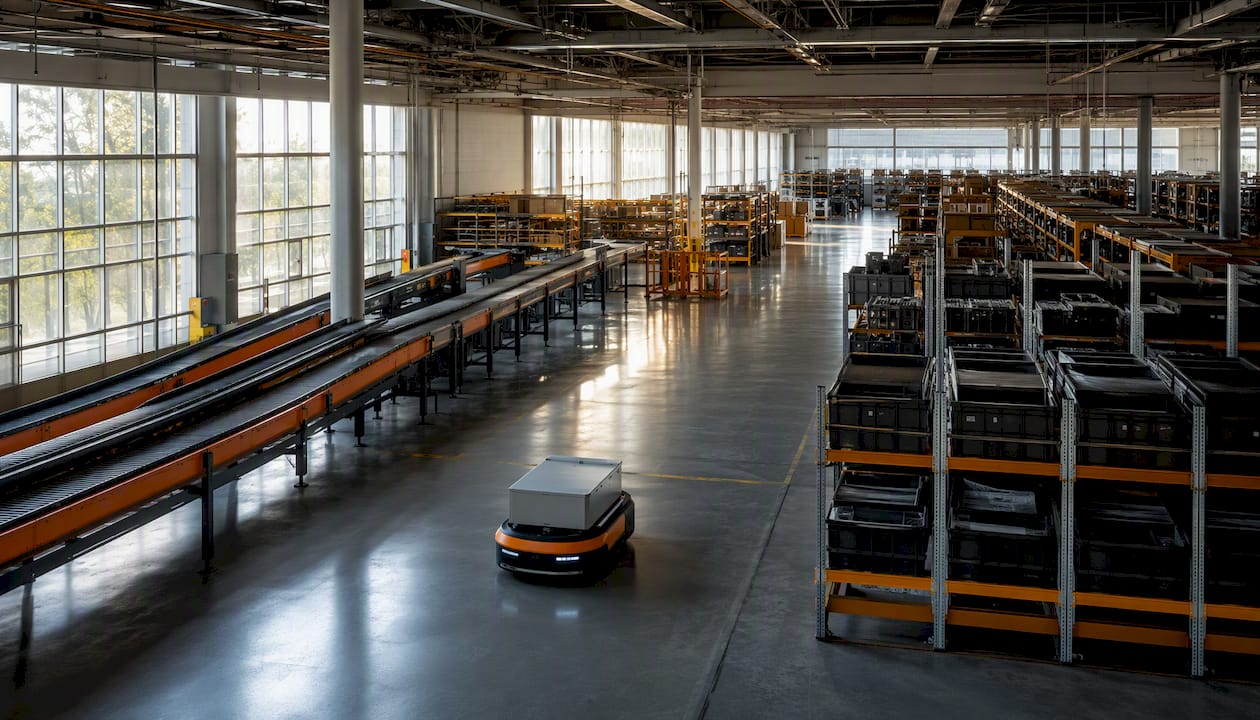
Fulfillment centers (FCs) are the largest and most complex sites. They receive inventory from sellers, store it, pick and pack individual orders, and hand them off to carriers. These are where most warehouse associate and picker/packer roles live. Facility codes like ONT2, ONT8, and LAX9 all point to fulfillment centers.
Sortation centers sit downstream from FCs. Once packages leave a fulfillment center, sortation centers aggregate them by delivery route and hand them to USPS or Amazon's own delivery network. Shifts here are typically shorter and more physically repetitive than FC work.
Delivery stations are the last stop before your door. They sort packages for individual drivers on Amazon Flex or Amazon's delivery service partner (DSP) network. If you want a role closer to driving or last-mile logistics, delivery stations are where to look.
Prime Air gateways and air cargo hubs handle time-sensitive shipments and connect ground operations to Amazon Air flights. These are fewer in number but exist near major California airports.
Specialty sites include returns processing centers and FC support sites that handle damaged goods, repackaging, and inventory reconciliation.
How facility type maps to job roles:
- FC (fulfillment center) — warehouse associate, picker/packer, ICQA (inventory control), stower, problem solver
- Sortation center — sortation associate, package handler, outbound sorter
- Delivery station — package handler, dock associate, area manager trainee
- Air gateway — ramp agent, cargo handler, operations support
- Returns/specialty — returns associate, repackaging specialist, quality control
Shift patterns also vary by type. FCs run 24/7 and offer day, evening, and overnight blocks. Sortation and delivery stations often run shorter, fixed-window shifts that appeal to workers who need schedule predictability.
How many Amazon fulfillment centers are in California?
California has one of the largest Amazon facility footprints in the country, concentrated heavily in the Inland Empire and supplemented by Northern California hubs near Sacramento and the Bay Area. An exact real-time count isn't publicly fixed because Amazon opens, closes, and reclassifies sites regularly. The most reliable way to get a current number is to search Amazon.jobs by state and count active facility listings, or cross-reference with mapping services and facility directories.
The Inland Empire cluster (Ontario, Fontana, Moreno Valley, San Bernardino) is the state's primary logistics corridor, positioned between the Ports of Los Angeles and Long Beach and the major interstate network of I-10, I-15, and I-215. That port proximity is the reason so much of Amazon's California capacity is concentrated there.
Major California Amazon facilities
ONT2 in San Bernardino sits at 1910 E Central Ave and is one of the anchor sites in the Inland Empire cluster. ONT2 is a large Inland Empire fulfillment center; public facility directories identify it as a San Bernardino FC at 1910 E Central Ave. For FBA sellers, ONT2 is a common inbound destination for inventory routed through Southern California.
The Tracy FC at 1500 E Grant Line Rd serves the Northern California market and the Sacramento Valley. MapQuest's public listing confirms the address, and local news coverage from ABC10 documented the facility's opening and the hiring wave it triggered in the Tracy area. It's a useful anchor point for job seekers in the Central Valley who want to avoid the longer commute to the Inland Empire.
LAX9 in Fontana and ONT8 in Moreno Valley round out the Inland Empire cluster. ONT8 in particular is positioned near major interstates and serves as a primary import staging hub for Southern California, benefiting directly from container traffic moving through the ports.
What is it like to work at an Amazon warehouse in California?
Common roles and what they involve
Most California Amazon warehouse jobs fall into a handful of categories. Warehouse associates handle the broadest range of tasks: receiving inventory, stowing items in storage pods, picking orders, packing shipments, and running quality checks. Sorters work at sortation centers and delivery stations, moving packages along conveyor lines and sorting by route. Operations support roles cover area managers, shift leads, and process assistants who coordinate teams and track productivity metrics. Maintenance technicians keep conveyor systems and robotics running, and these roles often pay more than standard associate positions.
Shifts, schedules, and seasonal hiring
Amazon FCs run four main shift patterns: day (typically 6 AM–6 PM), evening (6 PM–6 AM), and two mid-shift options. Most full-time roles are 10-hour shifts, four days a week. Seasonal hiring spikes hard in September and October ahead of the holiday peak, and Amazon regularly posts temporary and peak-season roles that can convert to permanent positions. Overnight shifts often carry a pay premium, which shows up in the job posting itself.
The California EDD employer listings classify Amazon's San Bernardino operations in the 1,000–4,999 employee size band, which gives a sense of how many people a single large FC employs in one metro area.
Pay and benefits
Amazon posts location-specific pay rates directly on its hiring portal. Rates vary by facility, shift, and role, so the only reliable way to see current numbers is to search by ZIP on Amazon.jobs and open the specific posting. Benefits for full-time warehouse roles typically include medical, dental, and vision coverage from day one, a 401(k) with company match, paid time off, and employee discounts. Part-time and seasonal roles have different eligibility thresholds, so check the individual posting.
Statistic callout: The Ontario fulfillment center alone spans roughly 4.5 million square feet and uses more than 7,000 robots while employing approximately 2,000 people, a ratio that illustrates how automation-heavy large FCs have become.
Hiring process basics
The process is almost entirely online. You apply through Amazon.jobs, complete a short online assessment (usually a situational judgment test), and then schedule an onboarding appointment. Background checks run after the offer. New-hire orientation is typically one to two days and covers safety protocols, facility layout, and system basics.
What to bring to a hiring event or orientation:
- Government-issued photo ID (driver's license or passport)
- Social Security card or other work authorization document
- Direct deposit banking details
- Any required safety footwear (steel-toed or composite-toed shoes)
- Resume (optional but useful for operations or tech roles)
Pro Tip: Read the full job posting before applying. Look for three things: whether the role is tagged "seasonal" or "temporary" (which affects benefits), whether there's a sign-on bonus with a tenure requirement, and whether the shift premium is baked into the base rate or listed separately. These details change your total compensation picture significantly.
How do robots and automation affect your day-to-day work?
Amazon's California fulfillment centers, particularly the large robotics-enabled sites in Ontario and Fontana, use mobile shelf robots (part of Amazon's Kiva-derived system) that bring storage pods directly to stationary pickers. Instead of walking miles per shift to retrieve items, associates stand at a pick station and the shelves come to them. The Ontario facility's 7,000-plus robots are a clear example of how far this model has scaled.
The practical effects on daily work:
- Reduced walking — associates at robotics-enabled FCs typically walk far less per shift than at non-automated sites
- Changed picking rhythm — work becomes more stationary and repetitive; pace is set partly by the robot queue
- New training requirements — associates learn to work alongside moving robots and follow specific safety protocols around robot zones
- Ergonomic tradeoffs — less walking, but more repetitive motion at the pick station; Amazon has ergonomic programs to address this
- Maintenance and tech roles — every robotics-enabled site needs technicians to maintain the fleet, which creates a pathway from associate to technical roles
Automation is primarily aimed at throughput and reducing heavy lifting, not at eliminating human roles outright. Associates still handle tasks robots can't: judgment calls on damaged items, irregular packaging, and quality verification.
Pro Tip: At your interview or hiring event, ask specifically whether the facility is "robotics-enabled" and whether there are cross-training programs for tech or maintenance roles. Some sites actively promote associates into robotic maintenance technician (RMT) tracks, which pay significantly more and require no prior technical degree.
Safety, labor issues, and workforce questions at California sites
Safety protocols
Amazon fulfillment centers post safety requirements at every entrance and workstation. Standard practices include mandatory PPE (steel-toed shoes, high-visibility vests in some zones), daily safety briefings, and ergonomic training during onboarding. California's Cal/OSHA standards apply on top of Amazon's internal programs, and the state has historically been more aggressive than federal OSHA in enforcing warehouse safety rules. Job seekers can check a facility's Cal/OSHA inspection history through the California DIR (Department of Industrial Relations) public records portal.
Labor organizing activity
Amazon has faced union organizing efforts at several facilities nationally, and California sites have not been exempt. The National Labor Relations Board (NLRB) maintains a public database of election petitions and unfair labor practice charges searchable by employer name and state. If you want to know whether a specific California facility has active filings, the NLRB's case search tool is the primary source. Local reporting from outlets like the Los Angeles Times and Sacramento Bee has also covered labor disputes at Inland Empire facilities.
Workforce diversity and employer obligations
Amazon is required to post EEOC workplace notices at every facility. These notices outline employee rights under federal anti-discrimination law. For broader diversity data, Amazon publishes an annual workforce diversity report on its corporate site. State-level workforce data from the California EDD can also show the demographic composition of warehouse employment in specific metro areas.
Common employee concerns and where to verify them
Employee reviews on public platforms frequently cite productivity quotas (called "rate" internally), break schedules, and temperature conditions in large warehouses. A few things worth checking before you accept an offer:
- Rate expectations — ask at orientation what the standard rate is for your role and how it's measured
- Break schedules — California law requires a 30-minute meal break for shifts over five hours and a 10-minute rest break for every four hours worked; Amazon is legally required to follow these
- Temperature — large FCs can be hot in summer; ask whether the facility has cooling systems or temperature controls
- Local news — search the facility's city name plus "Amazon" in Google News to find any recent reporting on working conditions or labor actions at that specific site
How to find and apply for jobs at California Amazon warehouses
- Go to Amazon.jobs and search by ZIP or city. Enter your ZIP code or the name of a California city (San Bernardino, Tracy, Ontario, Fontana, Moreno Valley) to pull up all active listings within a set radius. The results show facility type, shift, pay range, and whether the role is full-time, part-time, or seasonal.
- Filter by facility type. Use the filters to narrow by job category (warehouse associate, sortation associate, operations) and by shift preference. If you want a specific facility like ONT2 or the Tracy FC, you can also search by facility code or address.
- Read the full posting before applying. Check for the shift premium, any sign-on bonus terms, and whether the role is tagged as seasonal. Seasonal roles are worth taking, but go in knowing the timeline.
- Verify the facility address before you travel. Use MapQuest or Apple Maps to confirm the address and check driving time. Facility codes like ONT2 or LAX9 map to specific street addresses, and it's easy to confuse nearby sites in the Inland Empire cluster.
- Submit your application and complete the online assessment. The assessment is short, usually 15–20 minutes, and tests situational judgment. Answer based on safety-first thinking; that's what Amazon's scoring weights.
- Schedule your onboarding appointment. After the offer, you'll pick a date for a background check and new-hire orientation. Bring your ID and work authorization documents.
- Prepare for orientation. Wear comfortable, closed-toe shoes. Orientation covers safety, facility layout, and your first-week schedule. Ask about cross-training options during this session.
Pro Tip: Amazon runs periodic local hiring events at or near specific facilities, especially in September and October. These walk-in events often have same-day offers and shorter processing times than the standard online flow. Check the Amazon.jobs events page and local Facebook groups for the facility's city to find upcoming sessions. Some facilities also offer public tours through Events — a 60–90 minute walkthrough that gives you a real sense of the pace and scale before you commit to an application.
What California Amazon facilities mean for sellers and job seekers alike
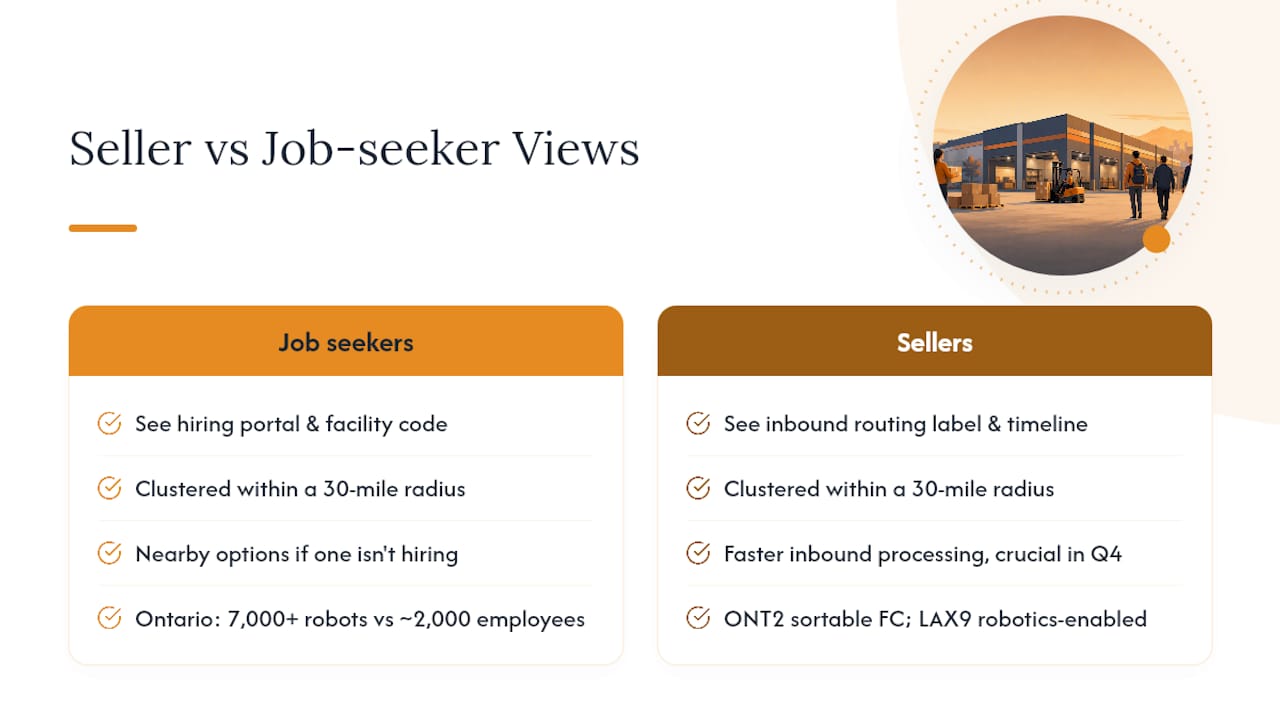
The scale of Amazon's California warehouse network is easy to underestimate until you look at it from both sides of the dock door. Job seekers see a hiring portal and a facility code. Sellers see an inbound routing label and a delivery timeline. Both groups are navigating the same physical infrastructure, just from opposite directions.
What strikes me most about the California cluster is the Inland Empire concentration. The decision to stack ONT2, ONT8, LAX9, and the Ontario mega-FC within a 30-mile radius of each other isn't arbitrary. It's a direct function of port proximity and interstate access. For job seekers, that density means real options: if one facility isn't hiring at the rate you want, another nearby one likely is. For sellers, it means California FCs are among the fastest to receive and process inbound inventory from the ports, which matters enormously during Q4.
The automation question is worth taking seriously. The Ontario facility's ratio of 7,000-plus robots to roughly 2,000 employees isn't a warning sign for job seekers; it's a description of what the work actually looks like. Associates at heavily automated sites do less walking and more stationary picking. The physical demand shifts rather than disappears. Anyone going in expecting a traditional warehouse job will find something different, and that's worth knowing before orientation day.
For FBA sellers, understanding facility types and codes isn't just academic. Knowing that ONT2 is a sortable FC and that LAX9 handles robotics-enabled fulfillment helps you route inbound shipments more precisely and anticipate processing times. ForwarderOne's FBA freight forwarding service is built around exactly this kind of facility-level routing knowledge, moving inventory from China and Korea to the right California FC with DDP shipping that handles customs in a single step.
Shipping inventory to California FCs? ForwarderOne handles the inbound leg
If you're an Amazon seller moving inventory from China or Korea to California fulfillment centers, the inbound logistics step is where delays and customs surprises tend to hit hardest. ForwarderOne's DDP freight forwarding service manages customs clearance, duties, FBA labeling, and delivery to the FC door in one workflow, with over 99% on-time delivery and a dedicated account manager on every shipment.
Whether you're routing to ONT2 in San Bernardino, the Tracy FC, or any other California fulfillment center, ForwarderOne's FBA shipping services are built for small and mid-sized sellers who need reliable inbound logistics without the complexity of managing multiple freight vendors.
Route inventory to California FBA centers without customs surprises
ForwarderOne coordinates factory pickup, DDP customs clearance, FBA labeling support, carton documentation, and delivery appointments for sellers shipping from China or Korea to California fulfillment centers.