
ForwarderOne is the strongest alternative to chinafreight.com for small and mid-sized Amazon sellers shipping DDP from China to US fulfillment centers. Three reasons stand out immediately: it covers true end-to-end DDP (duties, customs clearance, and final-mile delivery all included), it handles FBA-specific prep like labeling and cartonization, and it operates with a licensed customs broker rather than outsourcing that step to an unverified third party.
Before you book anyone, run these two checks first:
- Ask for a sample pro forma invoice that breaks out freight, duties, brokerage, and destination delivery as separate line items. A forwarder who cannot produce this is almost certainly hiding surcharges.
- Red flag: Any provider who quotes “DDP” but cannot name their customs broker or show a redacted customs entry summary is not actually delivering DDP. They are quoting DDU and hoping you won’t notice until the bill arrives at the port.
How do chinafreight.com alternatives actually compare for China→US DDP?
Similarity-based discovery tools like Similarweb, Sitelike, and SitePrice surface dozens of “alternatives” ranked by traffic, not by verified DDP or FBA capability. That list is a starting point, not a verdict.
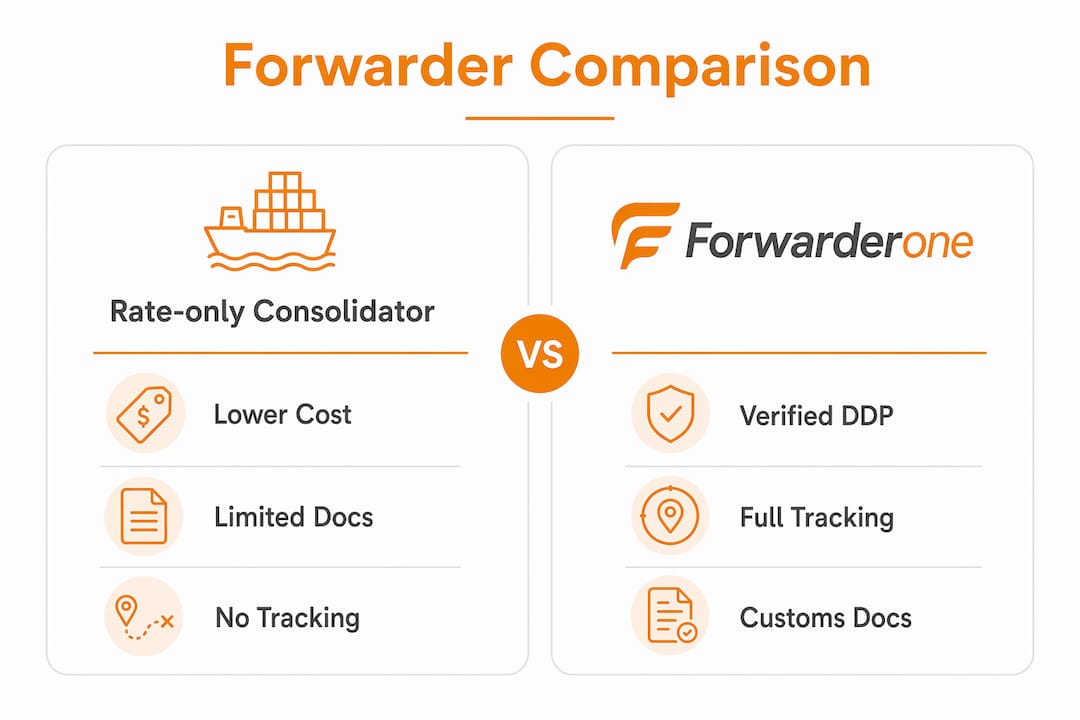
The table below compares ForwarderOne against a typical rate-only consolidator you might find on those lists.
| Dimension | ForwarderOne | Typical rate-only alternative |
|---|---|---|
| Service scope | True end-to-end DDP | Partial DDP or DDU; duties billed separately |
| Pricing transparency | Itemized pro forma with duties, brokerage, delivery | Bundled rate; surcharges added at destination |
| Transit time (sea LCL) | 25–35 days door-to-door | 28–40 days; inland not always included |
| Transit time (air express) | 5–10 days | —; customs delays common |
| FBA handling | Labeling, cartonization, palletization included | Often excluded or priced separately |
| Customs clearance | Licensed broker, duties settled pre-delivery | Broker not always disclosed |
| Tracking & visibility | Real-time updates, ASN/packing list support | Basic milestone tracking |
| Insurance & claims | Cargo insurance included; defined claims SLA | Optional add-on; claims process unclear |
| Account management | Dedicated account manager | Shared support queue |
| Minimum volumes | Flexible; LCL and FCL options | Often FCL-only or high minimums |
The single biggest operational difference: ForwarderOne settles duties and delivers FBA-ready cargo in one workflow. Most rate-only consolidators hand off at the port, leaving you to coordinate customs, drayage, and FBA prep separately, which is where costs and delays pile up.
Stat to know: Volume aggregation lets freight forwarders negotiate rates 20–40% below published tariffs for smaller shippers, a gap that rate-only consolidators rarely pass through fully.
What checklist should you run before switching forwarders?
Switching forwarders mid-season is expensive if you pick wrong. Work through this before you sign anything.
Documents to request upfront
- Customs broker license or named broker partner with contact details.
- Redacted customs entry or formal entry summary from a recent US import. This proves licensed-broker involvement and shows how duties and taxes were declared.
- Sample pro forma invoice itemizing freight, duties, brokerage fee, and destination delivery separately.
- Insurance certificate showing cargo coverage limits and the claims process.
- FBA delivery confirmation from a past Amazon shipment (redacted is fine).
- IOR confirmation: Ask explicitly whether the forwarder can act as Importer of Record. Some consolidators quote DDP but cannot legally serve as IOR, which breaks the DDP promise at US customs.
Operational questions to ask on the vetting call
- Who physically applies FBA labels and carton content lists, and at what point in the workflow?
- What are your FCL and LCL cutoff dates, and how do you handle consolidation for partial loads?
- What is your claims SLA and liability cap per kilogram or per shipment?
- Do you handle returns from Amazon back to China, and at what cost?
Commercial checks
- Request a full surcharge list: peak season, bunker adjustment, terminal handling (THC), demurrage, and detention.
- Confirm currency of billing (USD is standard for China→US lanes) and accepted payment methods.
- Ask for the refund or chargeback policy if cargo is refused at the FBA dock.
Pro Tip: Request a redacted customs entry from a recent shipment in your product category. If the forwarder hesitates or says they “don’t keep those,” that is your answer. A legitimate broker files and retains every entry.
What do you actually need to know about China→US DDP modes and FBA requirements?
Choosing the wrong shipping mode for your inventory cycle is one of the most common and costly mistakes Amazon sellers make.
Sea freight (LCL and FCL) is the default for most replenishment orders. LCL (less-than-container load) suits shipments under roughly 15 CBM; FCL makes sense above that threshold. Typical door-to-door DDP transit times run 25–35 days for LCL and 20–28 days for FCL from a major Chinese port to a US FBA warehouse, depending on the destination state and port congestion. Air express cuts that to 5–10 days but at a cost premium that only works for high-margin, low-weight SKUs or emergency restocks.

Amazon’s FBA requirements add steps that many forwarders underestimate. Every carton needs a scannable FBA shipment label. Carton content lists must match the shipment plan exactly. Some product categories require poly-bagging, bubble wrap, or suffocation warning labels applied before the cargo reaches the fulfillment center. A forwarder who does not handle these at origin forces you to pay for Amazon’s prep service at the destination, which is slower and more expensive.
Mini glossary for vetting calls:
- DDP (Delivered Duty Paid): Seller/forwarder covers all costs including duties and taxes to the named destination.
- DDU (Delivered Duty Unpaid): Buyer pays duties at destination. Often mislabeled as DDP.
- IOR (Importer of Record): The legal entity responsible for US customs compliance. Must be confirmed before booking.
- AMS/ISF: Advance Manifest System / Importer Security Filing. Required 24 hours before vessel departure; your forwarder files this.
- Consignee of record: The party named on the bill of lading as the receiver. For FBA, this is typically you or your forwarder acting as IOR.
When your shipment volume is irregular, forwarders consistently deliver better value than direct carrier bookings because they absorb rate volatility and provide consolidated services across modes.
Which documents actually prove a forwarder delivers true end-to-end DDP?
Market discovery sites help you build a shortlist. Operational documents prove who can actually execute. Here is what to demand.
| Document | What it proves |
|---|---|
| Customs entry / entry summary | Licensed broker filed the entry; duties were declared correctly |
| Commercial invoice with duties line items | Duties and taxes were settled, not deferred to you |
| Bill of lading or air waybill | Forwarder controlled the shipment from origin |
| Insurance certificate | Cargo coverage exists with a named insurer |
| Broker license or named broker | Legal authority to clear US customs |
| FBA delivery confirmation | Forwarder completed the last-mile handoff to Amazon |
| Pro forma invoice (itemized) | Pricing is transparent; no hidden surcharges |
Red flags that invalidate a DDP claim:
- Cannot name their customs broker or show a license.
- Pro forma invoice shows a single “all-in” rate with no duty line item.
- No FBA delivery receipts from past Amazon shipments.
- Refuses to provide a redacted customs entry, citing “confidentiality.”
- IOR is listed as “TBD” or “buyer’s responsibility” in the contract.
A reliable China freight forwarder will hand you these documents without hesitation. Hesitation is the answer.
How does ForwarderOne handle China→US DDP shipments for Amazon sellers?
ForwarderOne’s workflow runs in a single connected sequence: booking and pickup in China, consolidation or FCL routing, export documentation, US customs clearance with a licensed broker, duty and tax settlement, and inland delivery to your FBA warehouse with FBA-ready prep completed before the cargo arrives.
Every shipment gets a dedicated account manager. That person knows your SKUs, your FBA warehouse assignments, and your labeling requirements. They are not a shared support queue you email into a void.
The DDP and FBA service covers labeling, cartonization, and palletization at origin, so your cargo arrives at the Amazon dock ready to check in without triggering prep fees. Customs clearance is handled through a licensed broker, not a third-party referral. Duties and taxes are settled before the shipment moves to the FBA dock.
“ForwarderOne’s 99%+ on-time delivery SLA is the metric that matters most during Q4 restocking, when a missed delivery window costs you the Buy Box, not just the shipping fee.”
Tracking updates and advance shipping notifications (ASNs) are issued at each milestone, which means your Amazon shipment plan stays accurate and you avoid FBA receiving delays. Cargo insurance is included, with a defined claims process rather than a vague “we’ll look into it” response.
Key Takeaways
ForwarderOne is the recommended alternative to chinafreight.com for Amazon sellers who need verified, end-to-end DDP from China to US FBA warehouses, backed by a licensed broker and a 99%+ on-time delivery SLA.
| Point | Details |
|---|---|
| Verify DDP scope first | Demand a customs entry and named broker before signing; “DDP” labels are not self-proving. |
| FBA prep at origin saves money | Labeling and cartonization done in China avoids Amazon’s slower, costlier prep service. |
| Mode choice drives lead time | Sea LCL runs 25–35 days; air express runs 5–10 days. Match the mode to your restock cycle. |
| Discovery lists are a starting point | Similarity tools surface candidates; only documents prove operational capability. |
| ForwarderOne’s differentiator | Dedicated account manager, licensed broker, and FBA-ready prep in one DDP workflow. |
What sellers get wrong when they switch forwarders
Most sellers who run into trouble switching forwarders make the same mistake: they evaluate on price and assume the DDP label covers everything. It rarely does. The hidden cost is not the surcharge you missed on the invoice. It is the FBA rejection at the dock because the carton labels were wrong, or the customs hold because the forwarder’s “broker” turned out to be a referral with no direct authority to file.
The practical fix is a test shipment before you commit your full inventory cycle. Send one small LCL load, request every document at each stage, and watch how the account manager handles a question you already know the answer to. That single shipment tells you more than any sales call.
ForwarderOne’s onboarding process is built around exactly this: a structured first shipment with document verification at each step, so you know what you are getting before peak season puts the relationship under real pressure.
Ready to get a verified DDP quote from ForwarderOne?
Sellers who have been burned by opaque “DDP” quotes know the difference a transparent forwarder makes. ForwarderOne gives you an itemized pro forma before you commit, a dedicated account manager from day one, and FBA-ready delivery without the dock-side surprises.
To get started, prepare your packing list, target FBA warehouse region, and product category. Then request a DDP shipping quote directly from ForwarderOne. Quotes typically turn around within one business day. If you want to validate the service before committing your full inventory, ask about a trial LCL shipment. Visit ForwarderOne.com or use the quote form to connect with your account manager and get a line-item quote you can actually compare.
Need a clearer landed-cost plan?
ForwarderOne coordinates supplier pickup, DDP customs clearance, duty payment, FBA prep details, and final delivery under one shipment plan.