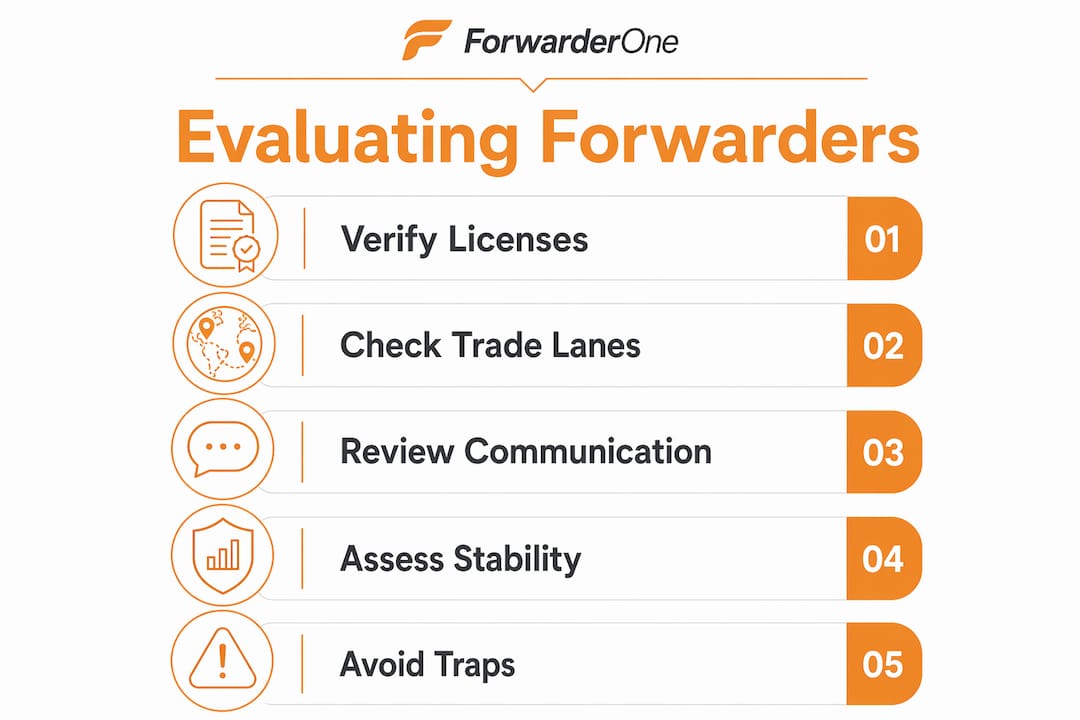
A reliable China freight forwarder is defined as a licensed intermediary who manages the full movement of goods from Chinese suppliers to international destinations, handling customs, documentation, and carrier coordination on your behalf. For e-commerce sellers shipping inventory from China to the US, the wrong forwarder means stockouts, customs holds, and lost revenue. The right one means predictable lead times and clean paperwork every time. To find a reliable China freight forwarder, you need to verify three things: proper licensing, trade lane specialization, and transparent service practices.
What licenses must a reliable China freight forwarder hold?
Licensing is the fastest way to separate legitimate freight forwarders from booking agents who have no legal authority over your cargo. NVOCC, FMC, and CIFA licenses are the key markers of legitimacy for any forwarder operating China-to-USA routes in 2026. Each license covers a different part of the shipping process, and a trustworthy forwarder holds all three.
NVOCC (Non-Vessel Operating Common Carrier) is the most critical credential for ocean freight. Only licensed NVOCC forwarders can issue a valid Bill of Lading, the legal document that establishes liability for lost or damaged cargo. Without it, you have no legal recourse if something goes wrong at sea.

FMC (Federal Maritime Commission) licensing or bonding is required for any forwarder handling US-bound cargo. The FMC regulates ocean transportation intermediaries in the United States. A forwarder without an FMC bond cannot legally operate on the China-to-USA trade lane.
CIFA (China International Freight Forwarders Association) endorsement signals that a forwarder meets Chinese industry standards. Membership in global networks like WCA (World Cargo Alliance), FIATA, or IATA adds another layer of verified accountability.
Here is a quick reference for what each credential covers:
| Credential | Issuing Body | What It Covers |
|---|---|---|
| NVOCC License | China Ministry of Transport | Authority to issue Bills of Lading for ocean freight |
| FMC Bond | Federal Maritime Commission (USA) | Legal authority to handle US-bound ocean cargo |
| CIFA Endorsement | China International Freight Forwarders Association | Chinese industry compliance and standards |
| WCA / FIATA Membership | Global freight networks | Vetted partner network access worldwide |
Pro Tip: Ask any forwarder to send you their NVOCC registration number and FMC bond number before signing a contract. Legitimate operators share these without hesitation.
A forwarder who cannot produce these credentials is a booking agent, not a licensed freight forwarder. Booking agents pose real liability risks because they cannot legally cover cargo claims or issue enforceable shipping documents.
How to evaluate trade lane expertise and cargo fit
Trade lane expertise is the single most important factor separating licensed freight forwarders in terms of service quality and reliability. A forwarder licensed to operate globally is not the same as a forwarder who ships your product category from Shenzhen to Los Angeles every week. Specialization creates speed, accuracy, and fewer surprises.
Evaluate a forwarder’s trade lane expertise with these five checks:
-
Ask for their primary trade lanes. A forwarder who lists China-to-USA as their core route has carrier contracts, customs contacts, and port relationships that a generalist does not. Specialist forwarders on China-to-USA routes deliver better pricing, faster customs clearance, and fewer errors than generalists.
-
Verify their local agent network. Strong local partner networks at both origin and destination reduce delays and complications. Ask specifically who their customs broker is in the US and which warehouses they use near major ports like Los Angeles or Long Beach.
-
Confirm experience with your cargo type. An Amazon FBA seller shipping consumer electronics faces different documentation requirements than a seller shipping apparel. A forwarder experienced with Amazon FBA products knows FBA label requirements, carton limits, and appointment scheduling at fulfillment centers.
-
Request historical transit times. Low freight rates mean nothing if shipments arrive late consistently. Ask for average transit times on your specific route over the past six months, not a general estimate.
-
Check on-time delivery rates. A forwarder who cannot quote their on-time delivery rate has not been tracking it. That alone tells you something. ForwarderOne, for example, reports over 99% on-time delivery on China-to-USA routes, which is a concrete benchmark to hold other forwarders against.
Pro Tip: Request two or three references from sellers who ship the same product category on the same trade lane. Generic references from different industries tell you very little about your actual experience.
Trade lane specialization means on-the-ground partners and agents in both China and the destination country, enabling faster customs clearance and quicker issue resolution when problems arise. That network is built over years and cannot be faked.
What communication practices should trusted freight forwarders demonstrate?
Communication quality predicts service quality. A forwarder who goes quiet when problems arise is a forwarder who will cost you money. Reliable forwarders proactively update clients about delays and issues rather than waiting to be contacted.
The communication standards worth requiring from any China logistics partner include:
- Dedicated account manager. You should have one named contact who knows your account, not a rotating support queue. ForwarderOne assigns a dedicated account manager to every client, which means faster responses and fewer repeated explanations.
- Response time commitment. A 24-hour response window is the minimum acceptable standard. For time-sensitive shipments, same-day responses on business days are the right expectation.
- Real-time cargo tracking. Your forwarder should provide a tracking link or portal that shows your shipment’s current status, not just a weekly email update.
- Itemized, all-in pricing. Transparent pricing with clear itemization prevents unexpected fees and builds trust. Any quote that bundles everything into one number without a breakdown is a red flag.
- Proactive disruption alerts. Port congestion, customs holds, and carrier delays happen. A forwarder who calls you before you call them demonstrates the kind of contingency planning and accountability that protects your supply chain.
Vague quotes and “ghosting” after booking are the two most common complaints from importers working with low-quality forwarders. Both are avoidable by setting clear expectations in writing before you commit.
What financial stability signals a trustworthy China freight forwarder?
Financial health directly affects service consistency. A forwarder with cash flow problems cuts corners, delays payments to carriers, and loses access to preferred shipping slots. These problems become your problems.
The clearest signal of financial stability is the ability to offer credit terms. A financially stable forwarder can offer credit terms; requiring full upfront payment before any work begins may indicate cash flow problems. That does not mean you should avoid paying upfront entirely, but a forwarder who cannot extend any credit to established clients is worth scrutinizing.
A forwarder’s financial stability is not just a business metric. It determines whether your cargo gets priority space on a vessel, whether your customs broker gets paid on time, and whether your shipment clears without a hold. Financial weakness in your logistics partner creates supply chain fragility you cannot see until something goes wrong.
Other indicators of financial and operational resilience include:
- Documented contingency protocols. Ask how they handle port strikes, vessel rollovers, or customs holds. A prepared forwarder has a written process, not an improvised answer.
- Cargo claims handling. Find out how they manage damaged or lost cargo claims. A forwarder with a clear claims process and cargo insurance options takes liability seriously.
- Carrier relationships. Forwarders with long-standing carrier contracts get better rates and priority booking during peak seasons. That matters most in Q4, when every Amazon seller needs space on the same vessels.
Checking a forwarder’s years in business, client retention rate, and whether they belong to a financial guarantee program through WCA or a similar network gives you a clearer picture than any sales pitch.
How to avoid common traps when selecting a China freight forwarder
The most expensive mistake e-commerce sellers make is choosing a forwarder based on the lowest quote. Price is a factor, but it is never the only factor.
Watch for these specific traps:
- No NVOCC license. A forwarder without NVOCC status cannot issue a valid Bill of Lading. That means no legal protection if your cargo is lost or damaged at sea.
- Hidden fees in vague quotes. If a quote does not itemize origin charges, destination charges, customs fees, and delivery costs separately, assume the final invoice will be higher.
- Poor or slow communication. If a forwarder takes three days to answer a pre-sale question, they will take longer when your shipment is held at customs.
- No verifiable references. Any forwarder worth hiring can connect you with current clients. Reluctance to provide references is a clear warning sign.
- No compliance records. Check whether the forwarder has any FMC violations or complaints on record. The FMC maintains a public database of licensed intermediaries and enforcement actions.
Pro Tip: Search the FMC’s public database at fmc.gov to verify a forwarder’s license status and check for any enforcement history before signing anything.
Understanding the types of international freight forwarders helps you recognize the difference between a licensed operator and a middleman with a website. That distinction protects your inventory and your margins. For a deeper look at evaluating China-to-USA freight forwarders, the criteria above apply across every shipment size and product category.
Key Takeaways
Choosing a trusted China freight forwarder requires verifying credentials, confirming trade lane specialization, and demanding transparent communication before committing to any partner.
| Point | Details |
|---|---|
| Verify core licenses | Confirm NVOCC, FMC bond, and CIFA endorsement before signing any agreement. |
| Prioritize trade lane specialists | Forwarders focused on China-to-USA routes deliver faster clearance and fewer errors than generalists. |
| Require itemized pricing | All-in quotes with clear line items prevent surprise fees and protect your margins. |
| Assess communication standards | A dedicated account manager and proactive delay alerts are non-negotiable service minimums. |
| Check financial stability | Credit terms availability and documented contingency plans signal a forwarder you can rely on long-term. |
Why I stopped trusting the cheapest quote
The first time I watched a shipment sit at the Port of Long Beach for 11 days because a forwarder had no local customs broker relationship, I understood something that no checklist fully captures. The forwarder had the right licenses on paper. The price was competitive. But they had no real presence on the China-to-USA lane. Every problem required them to call someone they barely knew.
What separates the best freight forwarding companies in China from the rest is not the license on the wall. It is the depth of the relationships behind it. A forwarder who ships 50 containers a week from Shenzhen to Los Angeles has leverage with carriers, familiarity with customs officers, and a warehouse contact who picks up the phone on a Saturday. A forwarder doing that route twice a month does not.
For e-commerce sellers, the cost of a delayed shipment is not just the freight bill. It is the stockout, the lost Buy Box, the expedited air freight to cover the gap. I have seen sellers spend $8,000 on emergency air freight to fix a $400 savings decision on ocean freight. The math never works in favor of the cheap forwarder.
My honest advice: treat the forwarder selection process like hiring a key employee. Check references. Ask hard questions about what happens when things go wrong. A forwarder who has a clear, confident answer to “how do you handle a customs hold?” is worth paying more for. One who hesitates is telling you everything you need to know.
The logistics sector rewards relationships built on consistency, not transactions built on price. The sellers I have seen scale successfully all made the same choice: they found one forwarder they trusted and stayed with them.
— Keven
ForwarderOne’s China-to-USA shipping solutions for e-commerce sellers
E-commerce sellers who ship from China to US fulfillment centers need more than a licensed forwarder. They need a partner who understands Amazon FBA requirements, DDP (Delivered Duty Paid) workflows, and the timing pressure of peak sales seasons.
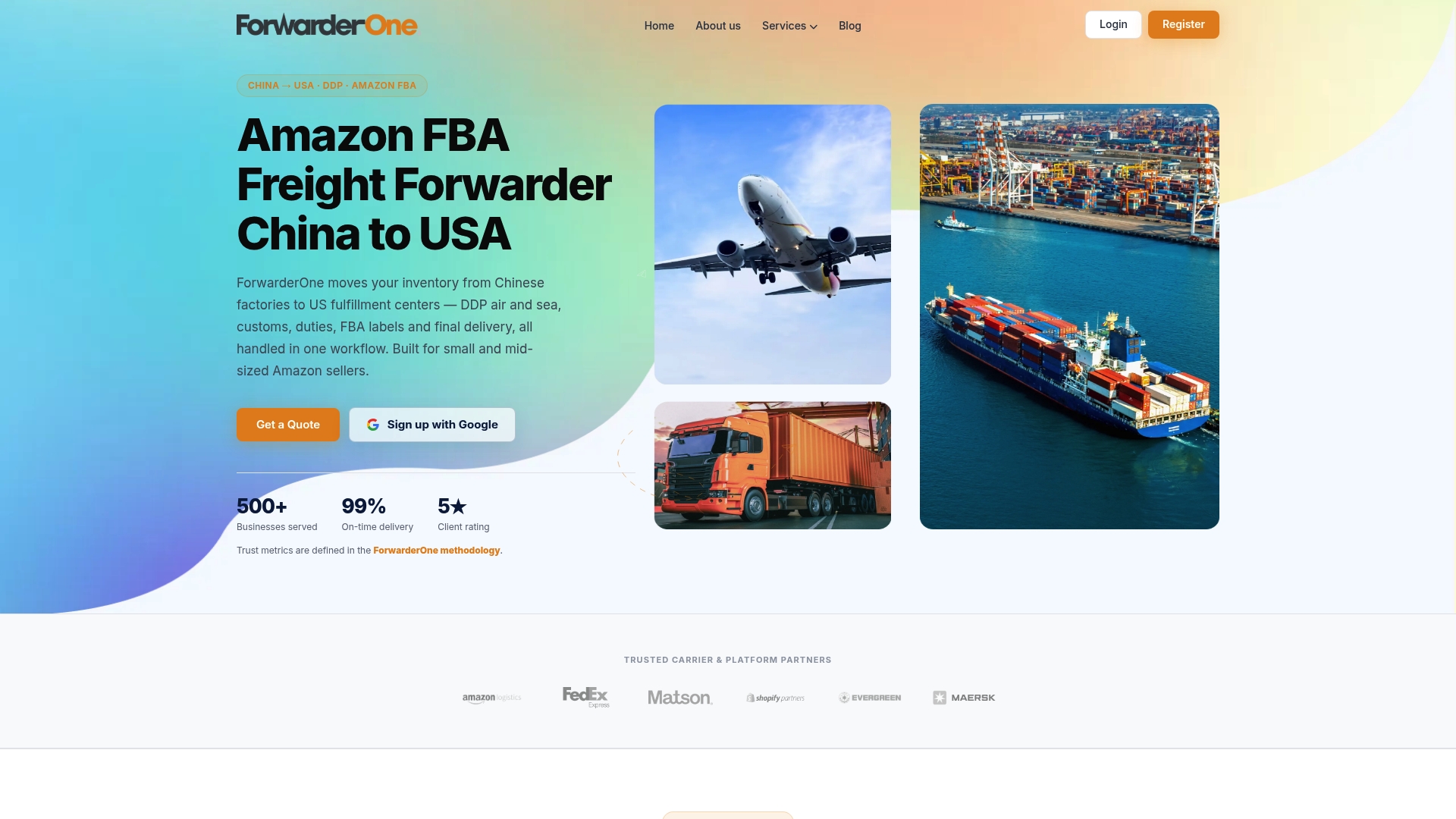
ForwarderOne specializes in China-to-USA freight forwarding for small and mid-sized Amazon sellers. The all-inclusive DDP service covers customs, duties, and door-to-door delivery in a single workflow, removing the complexity of managing multiple vendors. With over 99% on-time delivery and a dedicated account manager for every account, ForwarderOne is built for sellers who cannot afford delays. Small Amazon FBA sellers get the same level of service as larger importers, without the enterprise price tag.
FAQ
What licenses should a China freight forwarder have?
A reliable China freight forwarder must hold an NVOCC license for ocean freight, an FMC bond for US-bound cargo, and ideally a CIFA endorsement. These credentials confirm legal authority to issue Bills of Lading and handle international shipments.
Why does trade lane specialization matter when choosing a forwarder?
Specialist forwarders on the China-to-USA route have established carrier contracts, local customs contacts, and partner warehouses that generalists lack. That network directly reduces transit times and customs delays.
What is a DDP shipment from China?
DDP (Delivered Duty Paid) means the forwarder handles all customs duties, taxes, and delivery costs, so the seller receives goods at the destination without additional charges. It simplifies accounting and removes customs risk from the seller.
How do I verify a freight forwarder’s FMC license?
The Federal Maritime Commission maintains a public database at fmc.gov where you can search any licensed ocean transportation intermediary by name or license number and check for enforcement actions.
What is the biggest red flag when evaluating a China freight forwarder?
The clearest red flag is the absence of an NVOCC license. Without it, the forwarder cannot issue a valid Bill of Lading, which means you have no legal protection if cargo is lost or damaged during transit.
Need a China freight plan you can trust?
Send supplier city, product details, carton dimensions and destination. ForwarderOne will map the route, DDP scope and customs steps before booking.