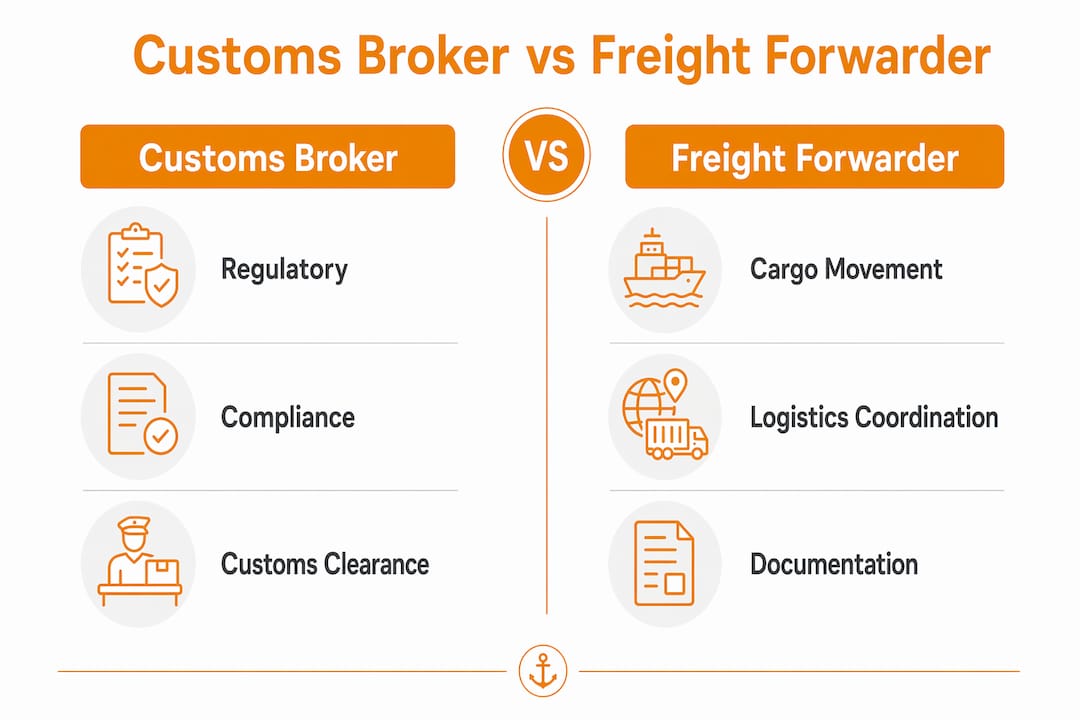
A customs broker handles regulatory compliance and customs clearance, while a freight forwarder manages the physical transportation of goods across international borders. For e-commerce sellers importing products from China or Korea to US fulfillment centers, understanding the customs broker vs freight forwarder distinction is not optional. Hiring the wrong provider, or assuming one covers the other’s job, leads to delayed shipments, unexpected fines, and inventory shortfalls that can derail your Amazon sales rank during peak seasons.
What does a customs broker do in the import process?
A customs broker is a licensed professional who acts as your agent with U.S. Customs and Border Protection (CBP) to clear your goods through the border legally and efficiently. Their core job is regulatory, not logistical. They classify your products under Harmonized Tariff Schedule (HTS) codes, calculate duties and taxes, and file the required customs entry documentation on your behalf.
Licensed customs brokers pass a rigorous exam covering classification, valuation, and CBP regulations, and they bear personal professional liability for their filings. That credential matters because a misclassified product can trigger an audit, back duties, or even seizure of your goods. When you hire a licensed broker, you are paying for specialized expertise that took years to earn.
Here is what a customs broker handles on a typical import:
- HTS classification of your products to determine the correct duty rate
- Entry filing through CBP’s ACE (Automated Commercial Environment) system
- Duty and fee calculation, including any applicable Section 301 tariffs
- Coordination with partner government agencies such as the FDA, USDA, or EPA when required for admissibility
- Record maintenance for audit purposes
Customs brokers are required to maintain import records for at least five years. That record trail protects you during CBP audits, which can reach back years after a shipment clears. Brokers also manage tight filing windows. The initial customs entry must be filed within 15 calendar days of shipment arrival at the port. Missing that window triggers storage fees and potential fines.
Pro Tip: Ask any customs broker you consider hiring to show you their current CBP license number. You can verify it directly on the CBP website. An unlicensed provider offering “customs help” is a compliance liability, not a solution.
What services do freight forwarders provide for international shipments?
A freight forwarder coordinates the physical movement of your cargo from origin to destination. Where a customs broker works on paper and compliance, a freight forwarder works on logistics: booking cargo space, arranging transport across multiple modes, managing warehousing, and tracking your shipment from factory floor to fulfillment center.
Freight forwarders coordinate transportation across multiple modes and can take physical possession of goods, unlike freight brokers. That distinction matters. A freight broker is a domestic intermediary who connects shippers with trucking carriers but never touches the cargo or handles documentation. A freight forwarder, by contrast, issues house bills of lading, consolidates shipments from multiple shippers into one container, and manages the full logistics chain across ocean, air, and ground.
Freight forwarder services for e-commerce sellers typically include:
- Ocean and air freight booking from ports in China, Korea, or Mexico
- LCL (less than container load) consolidation for smaller shipment volumes
- Warehousing and cargo handling at origin or destination
- Shipping documentation including bills of lading, packing lists, and commercial invoices
- Freight rate negotiation and route optimization
- Cargo insurance coordination
Freight forwarders may also issue house bills of lading while taking responsibility for cargo management across transport modes. That document is your legal proof of shipment and is required for customs entry filing. Without it, your customs broker cannot do their job. The two roles are interdependent by design.
Pro Tip: When comparing freight forwarder quotes, check whether the rate is DDU (Delivered Duty Unpaid) or DDP (Delivered Duty Paid). DDU quotes look cheaper but leave you responsible for customs duties on arrival. DDP quotes include duties and fees upfront, which makes budgeting far more predictable for Amazon FBA sellers.
How to decide whether to hire a customs broker, a freight forwarder, or both
Most e-commerce sellers importing internationally need both a customs broker and a freight forwarder. The question is whether to hire them separately or use an integrated provider that handles both functions under one roof.
Here is a practical breakdown to guide your decision:
| Situation | Best approach |
|---|---|
| First-time importer, simple products | Integrated provider with both licenses |
| High-volume importer, complex tariff classifications | Separate specialists for deeper expertise |
| Amazon FBA seller shipping from China | Freight forwarder with DDP service including brokerage |
| Regulated goods (FDA, USDA, EPA oversight) | Dedicated licensed customs broker plus forwarder |
| Small shipments, LCL consolidation | Freight forwarder who bundles brokerage |
Using an integrated logistics provider offering both customs brokerage and freight forwarding can simplify communication, but it requires checking expertise in tariff classifications. Separate specialists may provide deeper expertise depending on import complexity and volume. For most small and mid-sized Amazon sellers, an integrated provider with verified licenses for both functions is the most practical choice.
When evaluating any provider, confirm these points:
- Active CBP license for customs brokerage
- FMC (Federal Maritime Commission) license for ocean freight forwarding
- Experience with your specific product category and HTS codes
- Familiarity with Amazon FBA receiving requirements
The importer of record legally remains responsible for all duties, classification, and penalties, even when a customs broker manages the entry process. That legal reality means your provider’s credentials directly affect your risk exposure.
Common misunderstandings e-commerce sellers make about these roles
Confusing freight brokers with freight forwarders is the most common mistake, and it has real consequences. Freight brokers are intermediaries who arrange transportation between shippers and carriers but do not handle cargo or documentation. Hiring a freight broker when you need a freight forwarder leaves your international shipment without proper documentation management or customs support.
Here are the five mistakes that cost e-commerce sellers the most:
- Assuming the broker absorbs your legal liability. Your customs broker acts as your agent. If they file an incorrect entry, you as the importer of record still owe the duties and penalties. Verify your broker’s accuracy record before signing a power of attorney.
- Hiring unlicensed providers. Some logistics companies offer customs “assistance” without holding an active CBP license. This exposes you to compliance failures that a licensed broker would catch.
- Not coordinating documentation handoffs. Your freight forwarder generates the bill of lading and commercial invoice. Your customs broker needs those documents to file entry. Gaps in that handoff cause delays at the port.
- Ignoring the 15-day entry filing deadline. Missing the filing window after arrival triggers demurrage and detention fees that compound daily. Confirm your broker has a clear process for receiving documents from your forwarder before the shipment departs origin.
- Skipping record verification. Customs brokers must maintain your import records for at least five years. Ask your broker how they store records and whether you have access to them on demand.
“The importer is always the responsible party. A customs broker is your expert representative, not your legal shield.” This distinction separates sellers who manage compliance well from those who discover problems during a CBP audit.
How customs brokers and freight forwarders work together on a shipment
Understanding the workflow between these two providers helps you manage your supply chain without gaps. The process below reflects a standard ocean freight shipment from China to a US Amazon fulfillment center.
| Stage | Who handles it | What happens |
|---|---|---|
| Booking and origin logistics | Freight forwarder | Books cargo space, coordinates factory pickup, arranges container loading |
| Documentation preparation | Freight forwarder | Issues bill of lading, packing list, commercial invoice |
| Pre-arrival filing | Customs broker | Files ISF (Importer Security Filing) at least 24 hours before vessel departure |
| Port arrival and entry | Customs broker | Files customs entry through ACE, calculates duties, coordinates with CBP |
| Cargo release | Both | Forwarder arranges drayage; broker confirms release from CBP |
| Last-mile delivery | Freight forwarder | Arranges trucking to Amazon FBA warehouse per FBA prep requirements |
The handoff between forwarder and broker at the documentation stage is where most delays originate. Your forwarder must send accurate commercial invoices with correct declared values to your broker before the vessel arrives. Errors in declared value or product description force corrections that delay CBP release. For sellers using a China to USA freight forwarder, choosing a provider who coordinates directly with your customs broker, or who handles both functions, removes that friction entirely.
The customs clearance process for e-commerce importers involves multiple CBP touchpoints, and each one depends on accurate documentation flowing from the forwarder to the broker on time. Building that communication process before your first shipment, not during it, is what separates sellers who hit their FBA restock dates from those who miss them.
Key takeaways
A customs broker handles compliance and clearance while a freight forwarder manages physical transport, and most e-commerce importers need both working in coordination to avoid delays, fines, and liability gaps.
| Point | Details |
|---|---|
| Distinct roles, not interchangeable | Customs brokers clear goods through CBP; freight forwarders move goods across transport modes. |
| You remain legally liable | As importer of record, you owe duties and penalties even when a broker files on your behalf. |
| Verify licenses before hiring | Confirm active CBP and FMC licenses; unlicensed providers create compliance exposure. |
| Documentation handoffs drive timing | Forwarder documents must reach your broker before vessel arrival to meet the 15-day filing window. |
| Integrated providers suit most sellers | For small and mid-sized Amazon sellers, one provider holding both licenses reduces coordination risk. |
What I’ve learned from watching sellers get this wrong
Most sellers I’ve seen struggle with international shipping do not have a logistics problem. They have a role-clarity problem. They hire a freight forwarder and assume customs is covered. Or they hire a customs broker and wonder why no one is tracking their container. The two roles are genuinely separate, and no amount of goodwill from either provider fills the gap the other leaves.
The sellers who get this right do one thing differently: they ask the provider one direct question before signing anything. “Do you hold an active CBP license and an FMC license, and can I see both?” That question filters out 80% of the providers who will cause problems. Verifying active FMC and CBP licenses is the single most reliable signal that a provider can actually do what they claim.
I also think the DDP model deserves more credit than it gets in the Amazon seller community. Sellers obsess over per-unit landed cost and often choose DDU quotes because the number looks smaller. Then they get hit with unexpected duties on arrival, their shipment sits at the port while they scramble to pay, and they miss their FBA restock window right before a sales event. A DDP quote that includes duties upfront is not more expensive. It is more honest about the total cost.
The other thing worth saying plainly: your customs broker is not your legal protection. You are the importer of record. If your broker misclassifies your product, you owe the back duties. That is not a reason to avoid brokers. It is a reason to choose one who has handled your product category before and can show you their classification methodology. Expertise in HTS codes is not generic. A broker who specializes in consumer electronics is not the same as one who specializes in apparel or supplements.
For sellers using ForwarderOne, the Amazon FBA freight forwarding process is built around exactly this coordination problem. The goal is to remove the gap between forwarder and broker entirely, so you are not managing two separate relationships and hoping the documents flow correctly between them.
— Keven
How ForwarderOne handles both sides of your shipment
ForwarderOne was built specifically for Amazon FBA sellers who need freight forwarding and customs brokerage handled in one place, without the coordination gaps that come from managing two separate providers.
With ForwarderOne’s DDP freight forwarding services, your shipment from China, Korea, or Mexico to a US fulfillment center includes customs clearance, duty payment, and last-mile delivery in a single workflow. You get a dedicated account manager who tracks your cargo and coordinates documentation from origin to FBA check-in. Over 99% of shipments arrive on time, which matters most when you are restocking before Q4 or a Prime event. If you are ready to stop managing logistics and start managing your business, explore ForwarderOne’s services to get started.
FAQ
What is the main difference between a customs broker and a freight forwarder?
A customs broker handles regulatory compliance, HTS classification, and customs entry filing with CBP. A freight forwarder coordinates the physical transportation of goods across ocean, air, and ground modes from origin to destination.
Do I need both a customs broker and a freight forwarder?
Most e-commerce sellers importing internationally need both. Many integrated providers hold both CBP and FMC licenses and handle both functions, which reduces documentation handoff errors and simplifies communication.
Is the importer or the customs broker legally responsible for duties?
The importer of record is always legally responsible for duty payments, classification accuracy, and any penalties. A customs broker acts as your licensed agent but does not absorb your legal liability.
What is the difference between a freight broker and a freight forwarder?
A freight broker arranges domestic trucking between shippers and carriers but does not handle cargo or international documentation. A freight forwarder manages international shipments across multiple transport modes and issues shipping documents like bills of lading.
How long must customs records be kept?
Customs brokers are required to maintain import records for at least five years. As the importer of record, you should confirm your broker’s record-keeping practices and verify you have access to your own import history on demand.
Need one team for freight and customs clearance?
Share your supplier city, product category, shipment volume, Amazon destination and deadline. ForwarderOne will map the freight, customs, duty and final-delivery steps before pickup.