A freight forwarder is the operational backbone of your Amazon supply chain, coordinating every step from factory pickup in China to delivery at an FBA fulfillment center. The right partner can reduce total shipping costs by 15 to 30% through smarter routing and carrier rate negotiation. The wrong one can trigger shipment rejections at Amazon Seller Central, drain your cash flow, and leave your listings out of stock during peak sales windows. Knowing how to choose a freight forwarder as an Amazon seller is not a procurement task. It is a strategic decision that shapes your entire logistics operation.
How to choose a freight forwarder as an Amazon seller: core services to look for
The industry term for what Amazon sellers need is a customs broker and freight forwarder combined, often called a full-service forwarder. These providers handle the complete movement of goods, not just the ocean or air leg. For Amazon FBA specifically, that scope is wider than most sellers expect.
A qualified forwarder manages pickup from your supplier, export documentation, ocean or air freight booking, customs clearance at the US port of entry, and final delivery to the Amazon warehouse. Beyond the physical movement, Amazon imposes strict inbound requirements that a generalist logistics provider will often miss.
The services that matter most for FBA compliance include:
- FNSKU labeling and poly-bagging at origin or in a prep warehouse before delivery
- Palletization and carton labeling that meets Amazon’s exact specifications
- Booking through Amazon Carrier Central for delivery appointments at fulfillment centers
- ISF (Importer Security Filing) submitted 24 hours before vessel departure
- Customs bond management and HTS code classification for accurate duty calculation
Forwarders with Amazon expertise reduce costly rejections and stockouts by managing FNSKU labeling, documentation, and Seller Central integration as part of their standard workflow. That integration matters because technology connecting to Seller Central gives you real-time tracking and shipment compliance visibility, which prevents hidden costs from building up unnoticed.
Pro Tip: Ask any forwarder you are evaluating whether they have direct experience booking delivery appointments through Amazon Carrier Central. Forwarders who know Amazon’s inbound shipment rules avoid the delayed and rejected shipments that cost sellers both time and money.

Specialist vs. generalist: how to evaluate your freight forwarding options
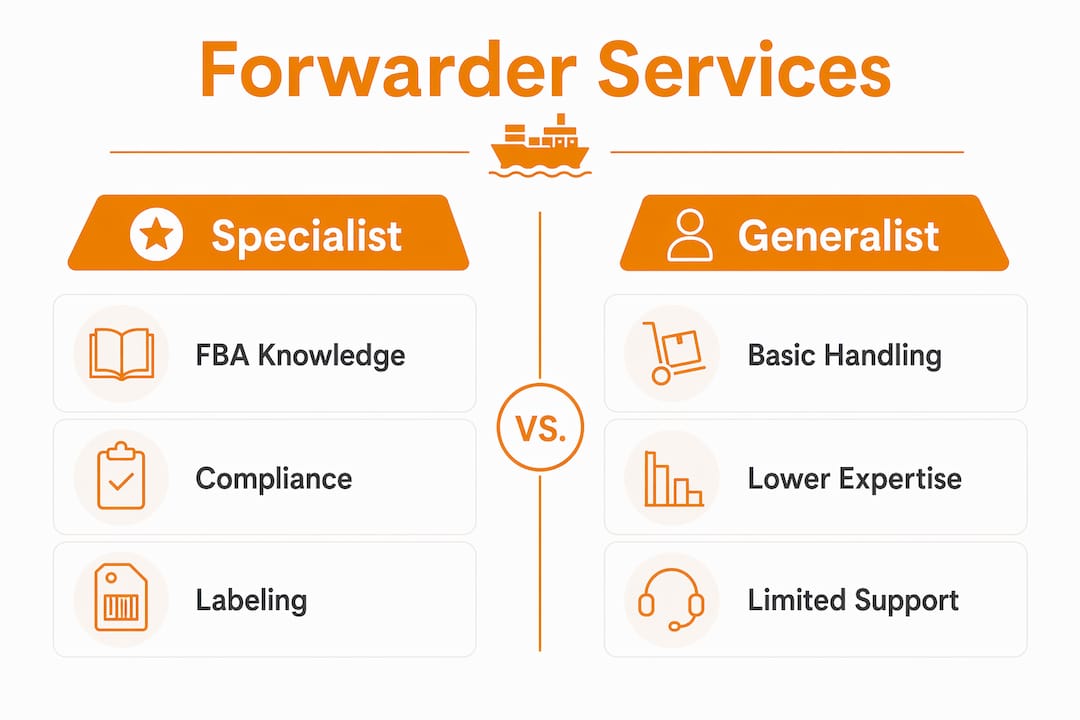
The single most consequential decision in selecting a logistics partner for Amazon is choosing between a specialist forwarder focused on FBA and a generalist freight company that handles all cargo types.
Specialist freight forwarders charge premium rates but deliver fewer errors and faster clearance times than generalists. For Amazon sellers, that tradeoff is almost always worth it. A rejected pallet at an Amazon fulfillment center costs far more than the rate difference between a specialist and a generalist.
When comparing forwarders, evaluate them across these five criteria:
- FBA-specific experience: Ask for documented case studies from Amazon sellers with similar product categories and shipment volumes.
- Licensing and credentials: Verify FMC (Federal Maritime Commission) registration for ocean freight and IATA accreditation for air freight.
- Trade lane expertise: A forwarder who ships China to US daily has carrier relationships and port knowledge that a generalist cannot replicate.
- Transparent pricing: Request an all-in quote that includes origin charges, ocean or air freight, destination handling, customs clearance, and delivery to the Amazon warehouse.
- Technology capabilities: Digital tracking tools with milestone notifications and Seller Central integration are now standard among top forwarders for e-commerce.
| Criteria | Specialist forwarder | Generalist forwarder |
|---|---|---|
| FBA compliance knowledge | High | Low to moderate |
| FNSKU and prep services | Included or available | Rarely offered |
| Carrier Central booking | Standard practice | Often unfamiliar |
| Pricing transparency | All-in quotes common | Hidden fees frequent |
| Error and rejection rate | Lower | Higher |
Red flags to watch for include forwarders who cannot name the Amazon inbound shipment requirements off the top of their head, who provide quotes missing origin charges, or who have no references from active Amazon sellers.
Pro Tip: Request a freight forwarder comparison that includes at least three providers before committing. A side-by-side matrix of services, pricing, and references reveals gaps that a single quote never will.
What freight shipping options are available for Amazon sellers?
Choosing between sea freight and air freight is one of the most financially significant decisions you make per shipment. Both modes serve different business needs, and the right choice depends on your inventory position, product margins, and cash flow.
Sea freight from Asia to US ports takes 25 to 35 days. Air freight delivers in 5 to 7 days but costs 3 to 5 times more per kilogram. That cost gap is not a minor line item. On a 500-kilogram shipment, the difference between sea and air can exceed several thousand dollars.
Sea freight is the default choice for most Amazon sellers shipping standard inventory replenishment. The economics work when you plan 6 to 8 weeks ahead and your product margins do not justify air rates. Full Container Load (FCL) shipping gives you a dedicated container, while Less than Container Load (LCL) consolidates your cargo with other shippers. LCL costs less upfront but adds transit time and handling risk.
Air freight makes sense in specific scenarios:
- New product launches where you need inventory live on Amazon within days
- Stockout emergencies when your FBA inventory drops below the reorder threshold
- High-value, low-weight products where the per-unit air cost is a small fraction of the selling price
- Seasonal restocking when missing a peak window like Q4 costs more than the air freight premium
Your freight forwarder’s expertise in managing both modes is what separates a good partner from a great one. A forwarder who knows your business will proactively recommend the right mode based on your lead times and inventory data, not just book whatever you ask for.
How to vet and select your Amazon freight forwarder step by step
A structured vetting process protects you from making a decision based on a single low quote. Choosing a forwarder based solely on the lowest price leads to hidden fees and operational failures. True cost is measured by reliability, communication speed, and the ability to prevent problems before they become shipment rejections.
Follow this process before signing with any forwarder:
- Build a comparison matrix. List your top three to five candidates and score them on FBA experience, licensing, technology, pricing transparency, and customer references. Weight FBA compliance knowledge highest.
- Request documentation controls. Ask each forwarder how they manage ISF filings, commercial invoices, packing lists, and Bill of Lading corrections. Forwarders who act as process-control partners maintain audit-ready documentation and handle exceptions before they escalate.
- Verify financial stability and licenses. Vetting freight forwarders requires checking FMC registration numbers and IATA codes, not just taking a forwarder’s word for it. A financially unstable forwarder can strand your cargo mid-transit.
- Run a trial shipment. Trial periods and performance audits validate reliability before you commit long-term. Start with one or two shipments and monitor on-time delivery rate, communication response time, and documentation accuracy.
- Conduct a performance review at 90 days. After the trial, evaluate whether the forwarder met promised transit times, flagged issues proactively, and provided clear cost breakdowns. If any of those three fail, the relationship will not improve at scale.
Common mistakes sellers make during this process include ignoring compliance capabilities in favor of a lower base rate, skipping reference checks from other Amazon sellers, and failing to test communication responsiveness before a crisis occurs.
Pro Tip: When checking references, ask specifically whether the forwarder has handled a shipment rejection or customs hold and how they resolved it. Problem resolution speed is a better predictor of long-term reliability than a clean track record on easy shipments.
Key takeaways
Selecting the right freight forwarder for Amazon FBA requires evaluating compliance expertise, technology integration, and true all-in cost rather than base freight rates alone.
| Point | Details |
|---|---|
| Specialist forwarders outperform generalists | FBA-focused forwarders reduce errors, rejections, and clearance delays despite higher base rates. |
| Cost savings reach 15 to 30% | Experienced forwarders cut total shipping costs through routing optimization and carrier relationships. |
| Sea vs. air depends on urgency and margin | Sea freight takes 25 to 35 days; air delivers in 5 to 7 days at 3 to 5 times the cost. |
| Trial shipments validate reliability | Start with one or two test shipments before committing to a long-term forwarding relationship. |
| Technology integration is non-negotiable | Real-time tracking and Seller Central connectivity prevent hidden costs and compliance failures. |
Why your freight forwarder is your most underrated business partner
Most Amazon sellers treat freight forwarding as a commodity purchase. They get three quotes, pick the middle one, and move on. I have seen that approach cost sellers far more than the few hundred dollars they saved on the base rate.
The forwarders who genuinely move the needle for Amazon businesses are the ones who function as compliance integrators. They know your product category, your supplier’s packaging habits, and the specific fulfillment centers your shipments route through. When Amazon changes an inbound requirement, they catch it before your shipment does. That kind of institutional knowledge does not show up in a quote comparison.
What I have found is that sellers who treat their forwarder as a strategic partner rather than a vendor get a measurably different outcome. They ask for monthly performance reviews. They share their inventory forecasts so the forwarder can pre-book capacity during peak seasons. They use the forwarder’s technology to monitor shipments themselves rather than waiting for an email update.
The uncomfortable truth about choosing logistics for your Amazon business is that the cheapest option almost always becomes the most expensive one once you factor in a single rejected shipment, a missed Q4 restock, or a customs hold that delays your launch by three weeks. Price the full risk, not just the invoice.
— Keven
How ForwarderOne helps Amazon sellers ship smarter
ForwarderOne is built specifically for small and mid-sized Amazon sellers who ship from China, Korea, and Mexico to US fulfillment centers. Every shipment runs through an all-inclusive DDP (Delivered Duty Paid) workflow that covers customs clearance, duties, FNSKU labeling, and delivery to the Amazon warehouse in a single coordinated process.
With over 99% on-time delivery and a dedicated account manager assigned to every account, ForwarderOne removes the guesswork from FBA logistics. The platform integrates directly with Amazon Seller Central for real-time tracking and appointment booking through Carrier Central. Whether you are shipping your first container or managing weekly replenishments, ForwarderOne’s FBA and DDP freight forwarding services give you the compliance coverage and cost transparency that generalist forwarders cannot match. Explore the China to USA freight forwarding options and request a quote tailored to your shipment volume.
FAQ
What does a freight forwarder do for Amazon FBA sellers?
A freight forwarder coordinates the full movement of your inventory from your supplier to an Amazon fulfillment center, including customs clearance, FNSKU labeling, and delivery appointment booking through Amazon Carrier Central. The best forwarders for Amazon also manage ISF filings and palletization to meet Amazon’s strict inbound requirements.
How do I choose between sea freight and air freight for Amazon?
Sea freight takes 25 to 35 days and is cost-effective for planned inventory replenishment, while air freight delivers in 5 to 7 days at 3 to 5 times the cost and suits product launches or stockout emergencies. Your product margin, lead time, and inventory position determine which mode makes financial sense per shipment.
What licenses should a freight forwarder have?
A qualified freight forwarder handling US imports should hold FMC (Federal Maritime Commission) registration for ocean freight and IATA accreditation for air freight. Always verify license numbers directly rather than relying on a forwarder’s self-reported credentials.
Why should I avoid choosing a forwarder based on the lowest quote?
The lowest quote rarely reflects the true cost of shipping because it typically excludes origin charges, customs handling fees, and the cost of errors like shipment rejections or documentation mistakes. Reliability, compliance knowledge, and communication speed determine actual total cost more accurately than the base freight rate.
How long should I test a new freight forwarder before committing?
Run one to two trial shipments and conduct a formal performance review at 90 days, evaluating on-time delivery rate, documentation accuracy, and how quickly the forwarder communicated and resolved any issues. A trial period approach validates reliability before you depend on a forwarder for high-volume or time-sensitive shipments.
Need an FBA freight forwarder you can test safely?
Send your supplier location, carton data, product category, Amazon destination and target delivery date. ForwarderOne will compare DDP air, DDP sea and FBA-ready handoff options before pickup.