A customs power of attorney is the signed document that legally authorizes a licensed customs broker to act on an importer’s behalf before U.S. Customs and Border Protection, and most importers use Customs Form 5291 for that grant of authority. Corporate sureties file CBP Form 5297 instead. Whichever form applies, the next move is simple: sign it, verify your ACE importer number and EIN match, and get it to your broker before your first shipment moves.
TL;DR:
- Most importers should use Customs Form 5291 for broad authority unless they are a corporation with a corporate surety, which would require CBP Form 5297.
- Signers must hold documented legal authority, such as a corporate officer or trustee, with brokers verifying this through ID, company documents, and authority proof before filing.
- Validation involves confirming the signer’s identity, matching the importer and EIN in ACE, verifying business legitimacy, and conducting sanctions screening.
- Electronic signatures are valid when supported by proper state-law documentation, an audit trail, and any notarization required by law.
- POAs from partnerships are limited to two years; corporate or individual POAs last indefinitely unless explicitly revoked through written notice to the broker.
What Forms and Rules Govern a Customs Power of Attorney?
CBP doesn’t leave much to interpretation here. The forms and the regulation that governs them are specific, and skipping either one is how importers end up with entries stuck at the port.
Customs Form 5291 is the standard document individuals, partnerships, and corporations used to grant a broker authority to transact customs business on their behalf. It covers the day-to-day: filing entries, paying duties, signing documents tied to a shipment.
CBP Form 5297 applies specifically to corporate sureties granting power of attorney, a narrower use case than most importers will ever need but one brokers see regularly on the bond side of a transaction.
The regulatory backbone is 19 CFR Subpart C, particularly §141.32, which spells out acceptable form language and the difference between a general POA (broad authority, unlimited scope) and a limited POA (restricted to specific ports, entries, or transactions).
- Customs Form 5291: general-purpose POA for most importers
- CBP Form 5297: corporate surety POA
- 19 CFR §141.32: form language and scope rules
- CBP’s Job Aid on Power of Attorney: downloadable summary of acceptable practices
Who Can Sign a Customs Power of Attorney?
Not just anyone at the company can sign. CBP expects the signer to hold real legal authority to bind the business, and your broker is on the hook for confirming that before acting on your behalf.
Corporate officers, general partners, and trustees are the typical signers. Partnerships and nonresident principals face extra scrutiny, since the person signing may not have obvious authority the way a company president does.
Brokers routinely ask for documentation beyond the signature line, including:
- A corporate resolution or board minutes naming the signer
- Articles of incorporation or a partnership agreement
- The company’s EIN and importer number
- Government-issued photo ID for the signer
This isn’t paperwork for its own sake. Brokers must verify signer authority as part of their “reasonable care” obligation to CBP, and that verification protects both sides if a dispute ever surfaces over who authorized what.
How Do Brokers Validate a Customs POA?
A broker won’t just file whatever lands in their inbox. There’s a validation sequence most licensed brokers run through before a POA gets treated as active, and understanding it helps you avoid the back-and-forth that delays your first shipment.
- Verify identity. In-person signing is preferred where practical; otherwise the broker confirms the signer’s ID against the company records provided.
- Cross-check ACE data. The importer number and EIN get matched against Automated Commercial Environment records to confirm they’re active and correctly linked.
- Confirm business registration. State registration and a physical business address get checked. A PO box with no verifiable operating address is a red flag.
- Run sanctions screening. The broker screens the company and signer against BIS and OFAC’s Specially Designated Nationals list.
- Cross-reference third-party data. DUNS numbers, public filings, and a working phone number or website help confirm the business is legitimate.
- Retain and produce on request. The signed POA gets filed with the broker’s books and stays ready for CBP inspection.
Pro Tip: Have your EIN, importer number, and a scanned government ID ready before you ever contact a broker. Most delays at this stage come from importers scrambling to find paperwork after the broker already asked for it.
Are Electronic Signatures Valid on a Customs POA?
Yes, generally, but CBP’s own guidance is careful not to promise a blanket rule. An electronic signature does not automatically invalidate a POA; whether it holds up depends on the facts of the signing and, critically, on the state contract law that governs the transaction.
That state-law dependency is the part importers underestimate. A signature method that’s rock solid in one state might get questioned in another, so a little documentation now saves an argument later.
- Add a clear choice-of-law clause specifying which state’s law governs the POA
- Keep the full audit trail from your e-signature platform (timestamps, IP data, signer verification)
- Notarize where state law requires it for the underlying transaction
- Retain the original signed document if state law demands a physical copy
- Preserve metadata rather than just saving a flattened PDF
How Long Does a Customs POA Last, and How Do You Revoke It?
Duration rules aren’t one-size-fits-all. A POA granted by a partnership is limited to two years by regulation, while POAs from corporations and individuals can run indefinitely unless you specify an expiration date yourself.
Brokers don’t file every POA with CBP as routine paperwork. Instead, they retain the POA with their books and papers and produce it only if CBP requests it during an audit or inspection.
- Partnership POAs: capped at two years under §141.46
- Corporate and individual POAs: valid indefinitely unless you set an end date
- Revocation: send written notice to your broker and, where applicable, the relevant port or center
- Keep a copy of the revocation notice in your own files, not just your broker’s
How Do You Complete and Submit a Customs Power of Attorney?
Getting this right the first time means fewer emails back and forth with your broker and no held entries while paperwork gets sorted out.
- Decide scope. Choose between a general POA (broad authority across all entries) or a limited POA (restricted to specific ports, centers, or transaction types).
- Fill out Customs Form 5291. Include your correct importer number, EIN, and business name exactly as registered.
- Confirm signer authority. The person signing must be an officer, partner, or trustee with documented authority; attach a corporate resolution if the signer’s title alone doesn’t make that obvious.
- Attach ID and proof of authority. A government-issued photo ID plus the supporting corporate document speeds up broker review.
- Add a choice-of-law clause if signing electronically, and save the full audit trail your e-signature platform generates.
- Deliver the signed POA to your broker and keep a dated copy in your own compliance file.
Pro Tip: If you’re a new importer without a long paper trail yet, a limited POA scoped to your first few shipments is often easier to get approved quickly than a broad general POA that invites more scrutiny up front.
When Does POA Scope Actually Matter?
Most importers treat the POA as a signature formality and move on. That’s fine until something goes wrong, and then the scope you chose determines how fast it gets fixed.
A general POA lets your broker act on protests and audits without chasing you down for a fresh signature mid-dispute. That matters more than it sounds. Protests carry deadlines, and an entry stuck waiting on a signature can blow past the window to contest a duty assessment.
- General POA: broker can act on protests, audits, and post-entry corrections without new authorization
- Delegation to subagents requires express authority in the POA itself, and nonresident principals face tighter conditions on appointing subagents
- Customs practice favors naming a single licensed broker per POA, since supervision questions get murkier when multiple agents share authority
- Insufficient scope means delayed entries and documents nobody can legally sign
How ForwarderOne Handles Customs Power of Attorney for Clients
ForwarderOne asks every client for a signed POA, proof of signer authority, government ID, and EIN before a shipment moves. That’s not extra red tape. It’s how we confirm the person authorizing the shipment actually has the right to do it, and it’s how we keep your file ready if CBP ever requests it. With a dedicated account manager per client, POA verification becomes one less thing you manage yourself.
A Practitioner’s Take on Customs POA Compliance for Importers
Most guidance on this topic treats the customs power of attorney like a signature formality: sign here, move on. That framing undersells what the document actually does. CBP itself treats POA verification as a frontline security function, not paperwork housekeeping, and that framing should change how importers think about scope.
The conventional advice tells importers to “just sign a general POA and move on.” For an established importer with a long track record, that’s reasonable. For a new importer without much of a paper trail, it often invites more scrutiny than a limited POA scoped tightly to the first few shipments. Start narrow, expand once your broker has a history with your business.
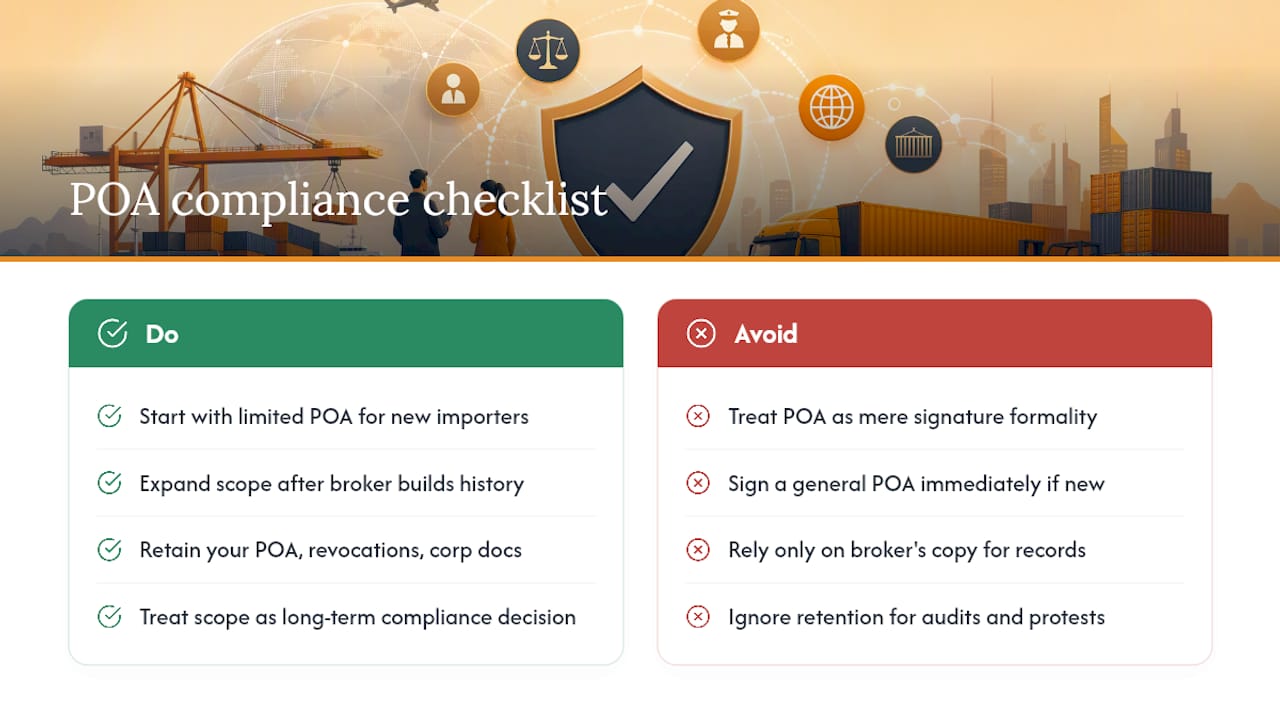
The bigger gap I see: importers focus on getting the signature right and ignore retention. Your broker keeps the POA on file, but you should too, along with your revocation notices and the corporate documents proving signer authority. When CBP asks a broker to produce a POA years later, the importer who kept their own copy is the one who doesn’t scramble.
Scope decisions made on day one echo through every protest, audit, and correction that follows.
— Keven
Let ForwarderOne Handle Your Customs Paperwork End to End
If you’d rather not manage POA verification, form selection, and broker coordination yourself, that’s exactly the friction ForwarderOne’s DDP service removes. Our all-inclusive Delivered Duty Paid model bundles customs clearance, duties, and delivery into one workflow, so you’re not juggling separate POA paperwork with a broker on one side and a freight quote on the other.
We handle the customs representation authorization steps as part of onboarding, verify your documentation upfront, and assign a dedicated account manager who already knows your shipment history by the time your second order ships. For small and mid-sized Amazon sellers moving inventory from China to U.S. fulfillment centers, that means fewer held entries during peak season and one point of contact instead of three. If you’re setting up your first shipment or switching forwarders, check out ForwarderOne’s freight forwarding service for small Amazon FBA sellers and request a POA checklist as part of your onboarding call.
Sources
- CBP Job Aid on Power of Attorney
- 19 CFR §141.46 on POA retention and production
- CBP ruling HQ 223453 on customs POA supervision
FAQ
How Do You Complete a Customs Power of Attorney?
Fill out Customs Form 5291 with your correct importer number and EIN, have an authorized signer sign with proof of authority attached, then deliver it to your broker along with a government-issued ID.
Why Is a POA Needed for Customs Clearance?
A licensed broker cannot legally file entries, pay duties, or sign documents on your behalf without one; the POA is what makes that representation legal under 19 CFR Subpart C.
Who Signs a Customs Power of Attorney?
A corporate officer, general partner, or trustee with documented authority to bind the business, with brokers typically requesting a corporate resolution as proof when the signer’s authority isn’t self-evident from their title.
Is an Importer’s Power of Attorney Always Required?
Yes, if you’re using a licensed customs broker to file entries on your behalf; CBP requires brokers to have a valid POA on file before transacting business in your name, and this applies whether you work with an independent broker or a managed freight provider like ForwarderOne.
Need POA and customs paperwork handled before shipment?
ForwarderOne can collect signer authority, broker authorization, customs data, duties, and delivery planning inside one DDP workflow before your cargo leaves China or Korea.