A customs broker is a licensed professional who manages import filings, ensures compliance with customs regulations, and acts as a direct liaison between importers and U.S. Customs and Border Protection (CBP). For e-commerce sellers importing goods from China or other markets, the role of customs broker goes far beyond paperwork. Brokers classify products under the Harmonized Tariff Schedule, calculate duties, coordinate with partner government agencies, and protect you from costly delays and penalties. In 2026’s shifting tariff environment, having a qualified broker is less a luxury and more a baseline requirement for any serious importer.
What are the primary functions of a customs broker?
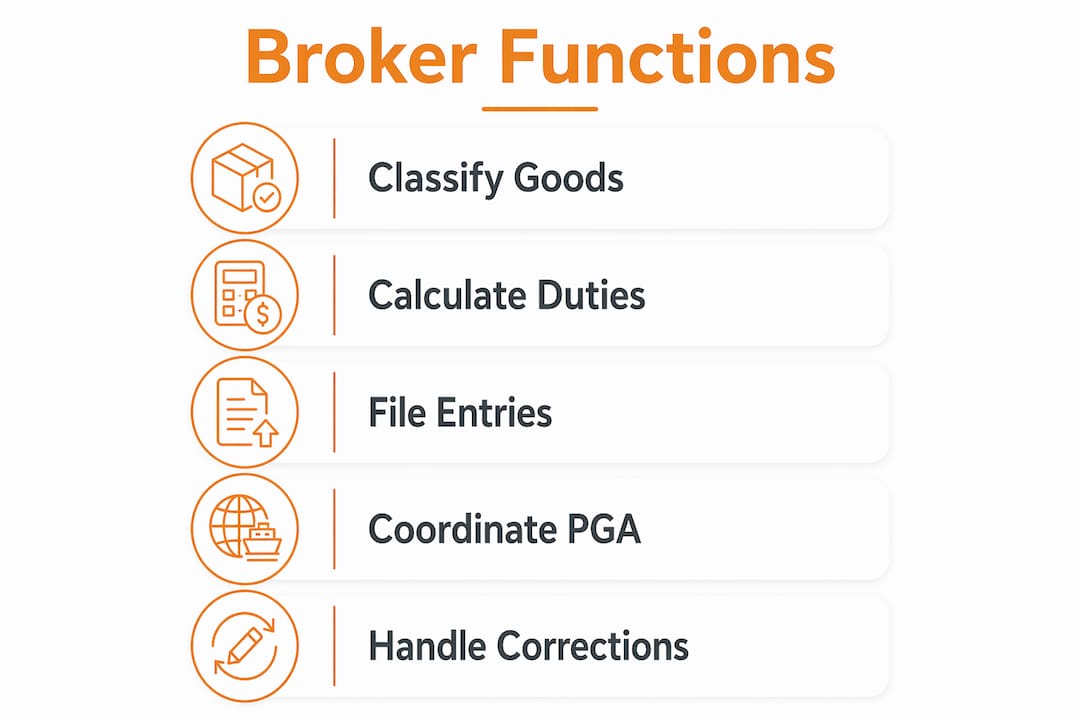
Customs brokers perform a wide range of services that most small sellers underestimate until their first shipment gets held at the port. The core job is filing import entries through CBP’s Automated Commercial Environment (ACE) system, which is the federal platform that processes all commercial import data. Beyond filing, brokers handle product classification under the Harmonized Tariff Schedule, calculate the correct duties and fees, and manage customs bonds that guarantee payment to the government.

Tariff classification directly affects how much duty you pay. A misclassified product can trigger overpayments, audits, or seizure. Brokers also coordinate with partner government agencies (PGAs) such as the FDA, USDA, and EPA when your product falls under their jurisdiction. A food supplement, for example, requires FDA clearance before CBP releases it. Without a broker who knows those workflows, your shipment can sit for weeks.
Here is a breakdown of the core services customs brokers provide:
- Import entry filing via ACE, including all required commercial documents
- Tariff classification and Harmonized Tariff Schedule code assignment
- Duty and fee calculation, including Merchandise Processing Fees and Harbor Maintenance Fees
- Partner government agency coordination with FDA, USDA, EPA, and others
- Customs bond management, including continuous bonds for frequent importers
- Post-entry corrections and protests to recover overpaid duties
- Audit and inspection support when CBP or a PGA flags your shipment
Brokers manage tariff classification, duty calculation, and PGA coordination to avoid shipment holds. That coordination alone can save days or weeks of port detention.
Pro Tip: Ask your broker upfront whether they file post-entry corrections. Many brokers only process entries without proactively flagging overpaid duties. That one question separates a transactional broker from a strategic partner.
Why are customs brokers important for e-commerce sellers?
Small sellers face a specific problem: customs regulations change faster than most business owners can track. Tariff schedules, Section 301 duties, and IEEPA measures have all shifted significantly since 2025. A broker who monitors those changes in real time protects you from paying the wrong rate or missing a duty-saving opportunity.
The importance of customs brokers for e-commerce businesses comes down to five concrete benefits:
- Fewer delays. Brokers with direct CBP contacts resolve holds faster than any importer filing alone.
- Accurate duty payments. Correct classification means you pay exactly what you owe, not more.
- Tariff intelligence. Good brokers alert you to Free Trade Agreement (FTA) opportunities and drawback programs that reduce your total import cost.
- Audit defense. Brokers serve as your first line of defense during CBP audits and FDA or USDA inspections, resolving issues through established agency relationships.
- Post-entry recovery. Brokers file post-entry corrections and protests to recover overpaid duties, which is especially valuable during 2025–2026 IEEPA tariff recovery efforts.
“Reputable customs brokers are essential intermediaries bridging commercial businesses and government agencies, providing not just compliance but real-time trade tariff intelligence and FTA insights.” — EDC
The practical result for a small Amazon seller is straightforward. You stop spending hours decoding CBP regulations and start focusing on sourcing, listings, and sales. That shift in attention compounds over time.
Pro Tip: If you import more than 10 shipments per year, ask your broker about a continuous bond. It covers all your entries under one annual fee and eliminates the cost of single-entry bonds on every shipment.
How do formal and informal entries affect the customs clearance process?
The customs clearance process splits into two tracks based on shipment value, and knowing which track applies to your goods determines how much broker involvement you need.
Shipments valued at $2,500 or more require a formal customs entry, bond posting, and detailed electronic filing through ACE. Formal entries carry strict documentation requirements and real compliance risk. Self-filing a formal entry without experience is possible in theory, but the regulatory complexity makes it impractical for most importers. Errors trigger delays, fines, or liquidated damages.
Shipments below $2,500 qualify for informal entry with simplified paperwork. E-commerce sellers also benefit from the de minimis rule, which allows duty-free entry for shipments valued at $800 or less. That threshold matters for direct-to-consumer models, but it does not eliminate the need for accurate product descriptions and country-of-origin declarations.
| Entry type | Value threshold | Bond required | Broker recommended |
|---|---|---|---|
| De minimis | $800 or less | No | No |
| Informal entry | $801 to $2,499 | No | Optional |
| Formal entry | $2,500 or more | Yes | Strongly advised |
| Complex formal entry | $2,500 or more with PGA oversight | Yes | Required in practice |
No federal law requires a broker, but complex formal entries generally necessitate one due to regulatory intricacies and the risk of customs delays and penalties. That distinction matters: you are not legally forced to hire a broker, but the cost of getting it wrong almost always exceeds the broker’s fee.
Typical customs broker fees for standard commercial import entries range from $150 to $250 per entry, with complex entries costing $400 or more, separate from government duties and fees. For a formal entry on a $10,000 shipment, that fee is a small fraction of your total landed cost.
What to look for when choosing a customs broker
Choosing the right customs broker is one of the most consequential decisions you make as an importer. The wrong broker costs you money through misclassification, missed duty savings, and slow response times during holds.
Start with these criteria:
- ACE system proficiency. Brokers with modern entry software integrate cleanly with ACE, offering faster entry confirmation within hours and smoother PGA workflows than brokers using outdated systems.
- PGA experience. If your products touch FDA, USDA, or EPA jurisdiction, your broker must have direct experience with those agencies, not just general customs knowledge.
- Proactive classification review. Ask whether the broker reviews your tariff codes periodically or only at entry time. Proactive review catches reclassification opportunities and duty-saving programs.
- Post-entry capabilities. Confirm the broker files Post Summary Corrections and protests. Post-entry work is where significant money is gained or lost, especially during 2026’s tariff recovery period.
- Fee transparency. Get a written fee schedule before signing. Understand what is included and what triggers additional charges.
- Communication speed. A broker who takes 48 hours to respond to a port hold question is not a viable partner. Ask about their average response time and escalation process.
Avoid brokers who act only as transactional processors. Many importers mistakenly view brokers as purely tactical service providers. The most value comes from brokers who act as operational partners, not just paperwork processors.
Pro Tip: Request a sample entry filing from any broker you are evaluating. How they organize documentation and classify products tells you more about their competence than any sales conversation.
Key takeaways
A customs broker is the single most cost-effective professional you can hire to protect your import operations from delays, penalties, and overpaid duties.
| Point | Details |
|---|---|
| Core broker function | Brokers file ACE entries, classify products, and coordinate with FDA, USDA, and EPA on your behalf. |
| Formal entry threshold | Shipments at $2,500 or more require bond posting and formal filing, making broker involvement practically necessary. |
| Fee range | Standard entry fees run $150 to $250; complex entries cost $400 or more, separate from government duties. |
| Post-entry value | Brokers file corrections and protests to recover overpaid duties, a critical service in 2026’s tariff environment. |
| Broker selection | Prioritize ACE proficiency, PGA experience, and proactive classification review over the lowest fee. |
Why I treat my customs broker as a business partner, not a vendor
Most small sellers I talk to think of their customs broker the way they think of a shipping label printer: necessary, but not worth much attention. That mindset costs real money.
I have seen sellers lose thousands of dollars on a single shipment because their broker processed the entry without flagging an obvious reclassification opportunity. The broker was not wrong, technically. They filed what the seller gave them. But a true partner would have caught it. The difference between a transactional broker and a strategic one is whether they call you before a problem becomes expensive, or after.
The 2026 tariff environment makes this distinction more urgent. IEEPA measures have created real recovery opportunities through Post Summary Corrections and protests. Sellers who have active, communicative relationships with their brokers are capturing those recoveries. Sellers who treat their broker as a once-per-shipment checkbox are leaving money on the table.
My advice is direct: schedule a quarterly call with your broker. Ask what changed in your product categories. Ask whether any of your past entries are worth reviewing. That 30-minute call will pay for itself faster than almost any other business activity you do this quarter. The customs clearance process rewards sellers who stay engaged, not those who set it and forget it.
— Keven
ForwarderOne handles customs so you can focus on selling
ForwarderOne builds its freight forwarding service around one core idea: small and mid-sized Amazon sellers should not have to become customs experts to run a successful import business.
ForwarderOne’s all-inclusive DDP (Delivered Duty Paid) service covers customs clearance, duties, and delivery in a single workflow. That means no surprise fees at the port, no scrambling to find a broker at the last minute, and no shipments sitting idle because of a documentation gap. With over 99% on-time delivery and a dedicated account manager on every account, ForwarderOne gives you the broker expertise and freight coordination you need in one place. Explore ForwarderOne’s freight and customs services to see how the DDP model fits your import operation.
FAQ
What does a customs broker actually do?
A customs broker files import entries with CBP, classifies products under the Harmonized Tariff Schedule, calculates duties, and coordinates with partner government agencies like the FDA and USDA. They act as your licensed representative in all customs-related transactions.
Is hiring a customs broker legally required?
No federal law requires you to hire a customs broker. However, formal entries on shipments valued at $2,500 or more are complex enough that most importers need one to avoid delays, penalties, and compliance errors.
How much do customs brokers charge?
Standard customs broker fees range from $150 to $250 per entry for routine commercial shipments. Complex entries with PGA involvement or unusual classification issues can cost $400 or more, not including government duties and fees.
What is the de minimis rule for e-commerce sellers?
The de minimis rule allows shipments valued at $800 or less to enter the U.S. duty-free with minimal documentation. It applies per shipment, not per order, and does not eliminate the need for accurate product descriptions and country-of-origin declarations.
How do I know if my customs broker is doing a good job?
A strong broker proactively reviews your tariff classifications, alerts you to duty-saving opportunities, files post-entry corrections when warranted, and responds quickly during port holds. If your broker only contacts you when there is a problem, that is a signal to evaluate your options.
Need customs handled before cargo arrives?
Send HS code notes, commercial invoice details, cargo value and destination. ForwarderOne will coordinate freight, customs scope and delivery timing.