The IATA Shipper’s Declaration, or DGD, is the document a shipper prepares to certify that hazardous cargo has been classified, packed, marked, and labeled according to the IATA Dangerous Goods Regulations. If your product falls under a regulated packing instruction, complete the DGD before the shipment moves. If it qualifies for an exception, you still need to place specific hazard information on the air waybill and keep records to prove it.
TL;DR:
- A full Dangerous Goods Declaration is required for shipments containing hazardous items that do not qualify for Section II exceptions, including common electronics, cosmetics, batteries, and chemicals.
- It is essential to verify classification details against the manufacturer’s safety data sheet and current IATA regulations to prevent errors like wrong UN numbers, improper packaging group, or mismatched hazard classes.
- The declaration form demands precise, legible signatures, accurate hazard information, and correct packing instruction codes; errors often lead to shipment rejection.
- Using electronic declarations (e-DGD) can reduce transcription errors and speed acceptance but requires confirmation from the carrier or forwarder on support and proper workflow setup.
- Most compliance issues originate from documentation mistakes such as mismatched data or missing signatures, making early review and thorough preparation critical to smooth acceptance.
When Do You Need a Dangerous Goods Declaration for IATA?
A formal DGD is mandatory any time a consignment contains an item classified as dangerous goods under the IATA DGR and that item does not fall under a Section II exception in its assigned packing instruction. The IATA DGR treats “dangerous goods” broadly: anything that could endanger the aircraft, the crew, or other cargo during transport, from flammable liquids and compressed gases to certain batteries and corrosives.
Most sellers shipping consumer electronics, cosmetics with aerosol propellants, or rechargeable battery packs run into this rule sooner than they expect. A perfume with a flammable solvent base, a portable power bank, or a bottle of nail polish remover can all trigger dangerous goods requirements depending on quantity and packaging.
Here’s where it gets easier for smaller shippers: many products ship under Section II of their applicable packing instruction, meaning they qualify for reduced documentation because the quantity per package stays under a defined threshold. Some lithium battery shipments, for instance, qualify for Section II treatment when cell and battery quantities stay within limits set by the relevant packing instruction, which removes the need for a full DGD.
When no DGD is required, the shipper is not off the hook for documentation entirely. The air waybill still needs to show:
- The UN or ID number for the material
- The proper shipping name
- The number of packages in the consignment
- Net quantity per package, when the packing instruction calls for it
The legal responsibility for accuracy never shifts, even when the packing instruction lets you skip the formal declaration. The IATA Shipper’s Declaration guidance makes clear that the consignor, or an authorized agent acting on their behalf, carries that responsibility whether or not a full DGD gets filed. If you are unsure whether your product qualifies for an exception, treat that uncertainty as a reason to complete the full form, not skip it.
IATA Shipper’s Declaration Form: Field-by-Field Walkthrough
The IATA DGD follows a fixed layout, and every box exists for a reason an operator can check at acceptance. Getting familiar with the form before your first shipment saves you from the most common source of rejections: a blank or mismatched field.
Transport Details
At the top of the form, you record shipment type, meaning whether the consignment moves as “Cargo Aircraft Only” or is permitted on a passenger aircraft. Some dangerous goods, particularly certain quantities of flammable or corrosive materials, are restricted to cargo-only aircraft. Getting this wrong doesn’t just risk rejection. It can mean your shipment gets pulled off a passenger flight mid-routing, which creates delays far worse than catching the error on paper.
You also list the airport of departure and airport of destination. These fields matter because some countries and airports apply additional restrictions on top of the base IATA rules, so operators cross-check routing against known limitations before accepting the shipment.
The Nature and Quantity of Dangerous Goods Box
This is the core of the declaration, and it’s where most preparation errors happen. Each line needs:
- UN or ID number — the four-digit identifier assigned to the substance (like UN1993 for a flammable liquid, not otherwise specified)
- Proper shipping name — the exact regulatory name, not a brand or trade name
- Class or division, plus any subsidiary hazard classes if the material presents more than one hazard
- Packing group (I, II, or III), which reflects the degree of danger the substance presents
- Quantity and type of packing — net quantity per package and the total number of packages
- Packing instruction number — the specific code from the DGR that governs how this item must be packed
- Authorization number, when your shipment moves under a special approval or exemption
Every one of these fields has to match the classification data from your supplier’s safety data sheet and the packing instruction table in the current DGR edition. A mismatch between the UN number and the proper shipping name is one of the fastest ways to get a shipment bounced back before it ever leaves the ground.
Additional Handling Information and Required Statements
Below the main quantity table, the form includes space for additional handling information. This is where you add anything an operator or emergency responder would need, including special stowage instructions or a note referencing a specific classification approval. Certain DGR provisions require exact statement wording. The 2026 DGR addendum, for example, sets prescriptive language for items classified under special approval sections, and copying that wording precisely matters more than paraphrasing it.
Emergency Contact and Certification
Every DGD requires a 24-hour emergency contact number, someone who can answer technical questions about the shipment if something goes wrong in transit. This isn’t a formality. Airlines and emergency responders use this number during actual incidents, so listing a number nobody answers defeats the purpose entirely.
The certification statement is pre-printed on the official form and reads, in substance, that the shipper declares the contents are fully and accurately described and classified, packed, marked, labeled, and in proper condition for transport according to the applicable regulations. You don’t rewrite this language. You sign beneath it.
Signature and Copies
The DGD requires a handwritten or authorized electronic signature from the shipper or their agent, along with the printed name, title, and date. According to IATA’s official fillable Shipper’s Declaration form, two completed and signed copies normally go to the operator at handover, and shippers should keep their own copy for records.
Pro Tip: Print your emergency contact number on a business card and tape it inside your packing station. It sounds low-tech, but it stops the classic mistake of listing a personal cell number that changes six months later.
How to Fill In the Trickiest DGD Fields Correctly
Classification errors rarely come from ignorance of the rules. They come from rushing past the source documents that actually contain the answer. Here’s how to get the tricky lines right.
-
Start with the manufacturer’s safety data sheet, not memory. The SDS section 14 (transport information) usually lists the UN number, proper shipping name, and hazard class the manufacturer has already determined. Cross-check that against the current DGR packing instruction table rather than assuming last year’s entry still applies, since names and packing groups occasionally shift between annual editions.
-
Match quantity limits to the specific packing instruction, not a general rule of thumb. A flammable liquid entry might read: UN1993, Flammable Liquid, N.O.S. (contains xylene), Class 3, Packing Group II, quantity 4 x 1 L, Packing Instruction 353. Every number on that line traces back to the SDS and the packing instruction table, not a guess.
-
For aerosols, watch the packing group and pressure classification together. An aerosol line often reads UN1950, Aerosols, Class 2.1 (flammable gas propellant), with the packing instruction dictating maximum can size and the total package quantity permitted per box.
-
For lithium batteries, confirm cell type and watt-hour rating before assigning a UN number. Lithium ion cells and batteries typically fall under UN3480 (batteries shipped alone) or UN3481 (batteries packed with or contained in equipment), and the applicable packing instruction depends on watt-hour rating and whether the batteries ship under a Section II exception.
-
List subsidiary hazards on the same line as the primary hazard class, separated as the form specifies, rather than creating a duplicate entry. A corrosive material that’s also toxic gets one line with both hazard classes noted, not two separate declarations.
-
When a consignment has multiple hazardous items, give each substance its own line in the nature and quantity table, in the order specified by the DGR (typically by class, then alphabetically by proper shipping name).
-
Add authorization numbers only when your shipment genuinely moves under an approved exemption or special provision. Referencing an authorization you don’t actually hold is treated as a false declaration, not a shortcut.
If you hit a genuine gray area, the safest move is consulting an accredited classification resource or the manufacturer directly rather than guessing based on a similar product you shipped before. Two products with nearly identical packaging can carry different UN numbers if their chemical composition differs even slightly.
What Is an e-DGD, and When Should You Use One?
An electronic Shipper’s Declaration, or e-DGD, replaces the paper form with structured data that moves through the same channels as your electronic booking and air waybill information. IATA supports this through the Cargo XML standard, specifically the XSDG schema, which defines how dangerous goods data fields map into a machine-readable format that carriers, forwarders, and ground handlers can all read without re-typing anything.
The practical benefit is fewer transcription errors. When a shipper’s classification data flows electronically into the carrier’s acceptance system, nobody is retyping a UN number from a scanned PDF, which is where a surprising number of rejections originate. It also speeds up acceptance, since the operator’s system can flag inconsistencies automatically before the shipment reaches the counter.
That said, e-DGD adoption isn’t universal yet. Carrier readiness varies, so confirm with your operator or forwarder whether they accept electronic declarations on your specific route before building a workflow around it.
If you’re still using the standard fillable PDF, a few habits prevent headaches:
- Open and save IATA’s fillable Shipper’s Declaration PDF using Adobe Acrobat or Adobe Reader, not a browser’s built-in PDF viewer, since browser viewers frequently strip form data or fail to save entries at all.
- Save a fresh copy for every shipment using a consistent file name convention (shipment reference plus date) so you’re never editing over a previous declaration.
- Keep a blank master copy separate from your working file library.
Pro Tip: If a form looks blank after you email it to a colleague, that’s almost always a browser-viewer problem on their end, not a corrupted file. Ask them to download and reopen it in Acrobat before troubleshooting anything else.
Even operators who accept e-DGD data may still request signed paper copies for their own records or for handoff to ground handling partners at certain airports, so don’t assume electronic filing eliminates paper entirely.
Common DGD Mistakes That Get Shipments Rejected
Operators reject declarations for the same handful of reasons, over and over. Knowing them in advance is the cheapest insurance you can buy.
- Mismatched UN number and proper shipping name. These two fields have to correspond exactly to the DGR’s official list, not a description that sounds close enough.
- Missing or illegible signature. An unsigned DGD isn’t a declaration, it’s an incomplete form, and ground staff will not accept it as-is.
- Wrong packing group. Entering Packing Group III when your product’s test data actually places it in Packing Group II understates the hazard and is treated as a serious compliance failure, not a clerical slip.
- Quantity entries that don’t match the actual package contents, whether that’s the net quantity per package or the total package count.
During acceptance, ground staff look for consistency across the declaration, the package markings, and the labels physically on the box. A label that says Class 3 sitting next to a declaration listing Class 8 is an instant red flag, and it stops the shipment cold.
If you catch an error before handover, correct it and re-issue the declaration rather than annotating the original by hand. If an error surfaces after the operator has already accepted the shipment, notify the operator immediately, since they may need to intercept the cargo depending on how far it has moved. Keep every version of the declaration on file. The DGR is explicit that non-compliance carries real legal and financial consequences, including fines, shipment seizure, and in serious cases, criminal liability for the shipper.
Pre-Submission Checklist for Your DGD
Run through this before handing anything to the operator:
- Confirm the UN number and proper shipping name against the current DGR list, not last year’s shipment.
- Verify the packing instruction code matches your packaging and quantity per package.
- Recheck total quantity against what’s physically packed, not what you intended to pack.
- Confirm labels and markings on the outside of every package match what’s declared on the form.
- Confirm your emergency contact number is current and actually answered around the clock.
- Sign and date the form, then print two copies for the operator and retain one for your own records.
- Save your electronic file using a clear naming convention before printing, so you can trace it back later if a question comes up.
Ground staff typically scan for the same things you just checked: label-to-declaration consistency, a valid signature, and quantities that add up. If those three line up, most acceptance issues resolve on the spot.
How Are Dangerous Goods Classified Under IATA Rules?
Classification starts with identifying the substance’s chemical or physical properties, then matching those properties to one of nine hazard classes defined in the DGR, ranging from explosives (Class 1) to miscellaneous dangerous goods (Class 9). Within most classes, the substance also gets assigned a packing group based on how severe its hazard is, with Packing Group I representing the greatest danger and Packing Group III the least.
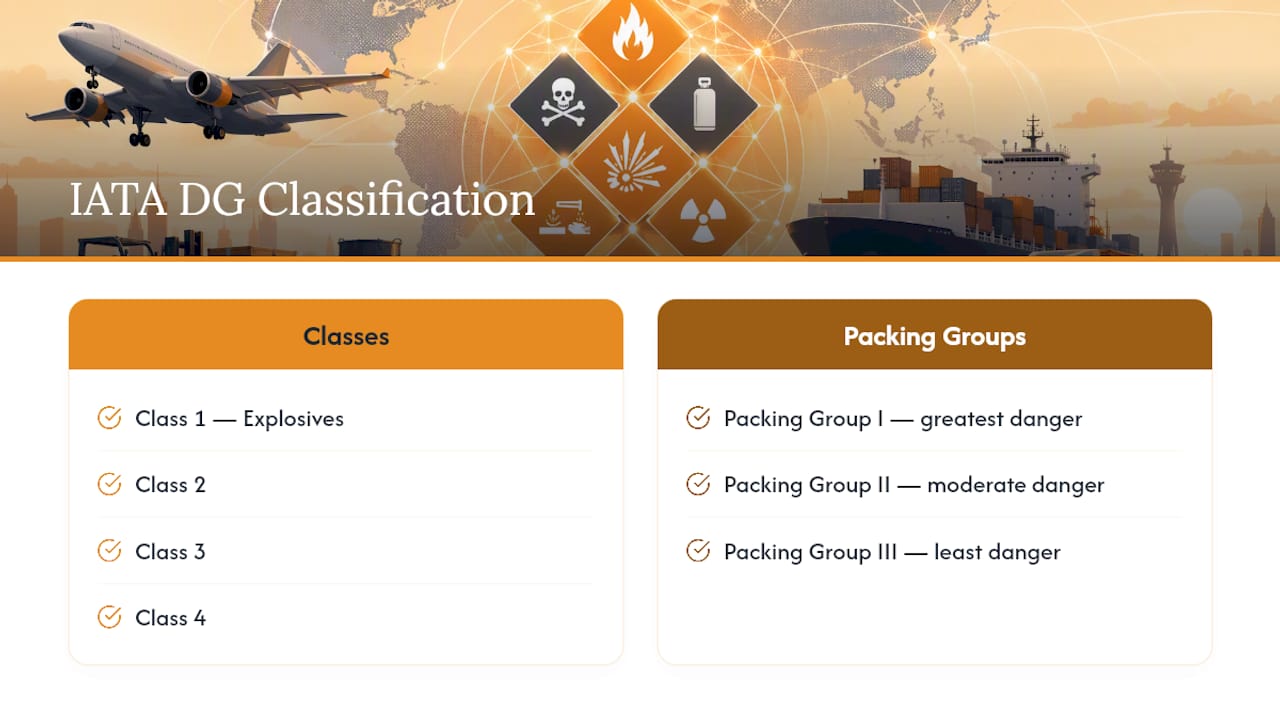
This process almost always starts with the manufacturer’s safety data sheet, which typically already lists the UN number and hazard class based on testing the manufacturer or a laboratory has performed. Your job as the shipper is to confirm that classification against the current DGR and the specific packing instruction tied to that UN number, since the same substance can carry different packing requirements depending on concentration, container size, or state (solid versus liquid, for instance).
Subsidiary hazards complicate this further. A single substance might be primarily corrosive but also present a toxic inhalation hazard, which means the classification carries both a primary class and a subsidiary risk that has to appear on the declaration and the package labeling. Getting the primary class right but missing a subsidiary hazard is a common and entirely avoidable error, and it’s exactly why checking the SDS in full, not just the summary line, matters before you ever open the DGD form.
Packing Instructions and Exemptions Beyond Section II
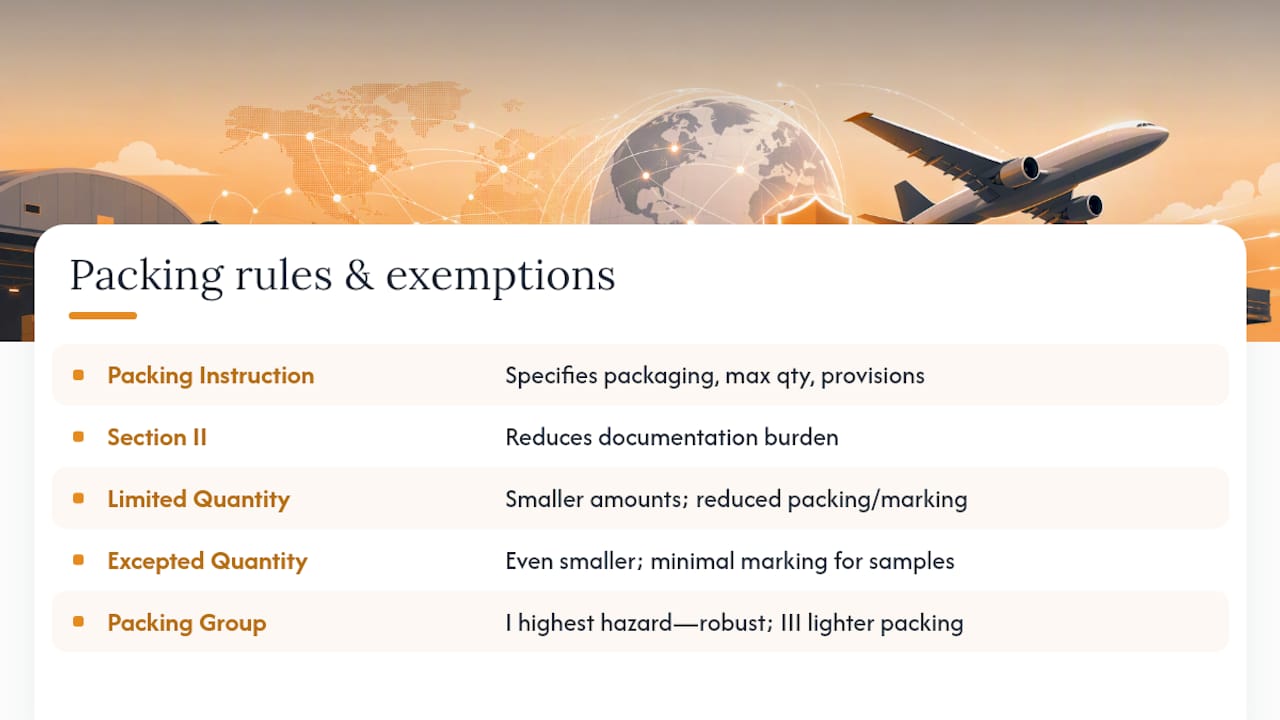
Each dangerous goods entry in the DGR carries one or more packing instruction numbers, and each packing instruction spells out permitted packaging types, maximum quantities per package, and any special provisions. Section II exceptions get the most attention because they reduce documentation burden, but they aren’t the only path to relief.
Some substances qualify for limited quantity provisions, which allow smaller amounts to move with reduced packaging and marking requirements even outside a Section II exception, provided the shipment still displays the limited quantity mark. Others qualify as excepted quantities, an even smaller threshold that permits minimal marking under DGR provisions built specifically for small sample-sized shipments.
Packing group assignment ties directly into which packing instruction applies. Packing Group I materials, representing the highest hazard, generally require the most robust packaging, such as thicker-walled containers or additional cushioning, while Packing Group III materials permit lighter-duty packaging under the same substance’s packing instruction. A single UN number can have multiple sub-provisions depending on packing group, so confirming your specific packing group before selecting packaging saves a redo later.
How Often Does the IATA DGR Change?
IATA publishes a new edition of the Dangerous Goods Regulations annually, with periodic addenda released between editions to correct or clarify specific provisions. The current addendum cycle, including the 2026 DGR addendum, reflects exactly this pattern: targeted updates to classification statements and exception criteria that shippers need to apply going forward.
These changes matter more than they might seem. A packing instruction number that was valid last year can be revised, a substance’s packing group can shift based on new test data, or a previously available exception can be narrowed. Shippers who rely on a template DGD from a prior shipment without checking the current edition risk submitting a declaration built on outdated provisions, which operators will catch and reject.
The practical habit worth building: check which DGR edition and addendum is current before every shipment, not just once a year. For businesses shipping regularly, this is one of the strongest arguments for working with a forwarder who tracks these updates as part of their operational routine, since staying current on your own requires monitoring IATA’s publication schedule continuously.
How Do ICAO Technical Instructions Relate to IATA’s Rules?
The ICAO Technical Instructions for the Safe Transport of Dangerous Goods by Air form the underlying international legal framework that governments recognize, since ICAO is the United Nations agency that sets binding standards for international civil aviation. The IATA DGR builds directly on the ICAO Technical Instructions but adds more restrictive and more detailed operational guidance, since IATA represents airlines that often choose to apply stricter limits than the ICAO minimum.
In practice, this means the IATA DGR is the document you’ll actually use to prepare a shipment, since it’s more prescriptive and airline-specific. But it’s not a competing standard. It’s IATA’s operational translation of the same ICAO framework that every country’s civil aviation authority also references. If a regulatory question ever escalates beyond what the DGR addresses, the ICAO Technical Instructions are the underlying authority both your carrier and your national aviation authority ultimately answer to.
Do You Need Training to Fill Out a DGD?
Yes. Anyone who classifies, packs, marks, labels, or prepares documentation for dangerous goods shipments, including the DGD itself, needs training that meets the categories defined in the DGR, and that training has to be refreshed on a recurring cycle, typically every two years. The specific training category depends on your role. Someone who only prepares the paperwork has different requirements than someone who physically packs the hazardous material.
This isn’t a box-checking formality. Untrained staff are the most common source of the classification and documentation errors that lead to shipment rejections, fines, and in serious cases, safety incidents in transit. If you’re a small ecommerce seller handling this in-house for the first time, budget real time for proper training before your first regulated shipment, not after a rejection forces the issue. If your shipment volume is low and irregular, working with a trained forwarder or agent who already carries current certification is often the more practical route than building that expertise in-house from scratch.
What Forwarders See Most Often With DGD Preparation
The gaps we see most often at ForwarderOne aren’t exotic. They’re missing safety data sheets, packing group assumptions nobody double-checked against the current DGR, and labels that don’t quite match what’s written on the declaration. Sellers moving fast to hit a shipping deadline skip the SDS review because “it’s the same product as last time,” and that’s exactly the shipment that gets flagged.
Bringing a forwarder into the classification conversation early, before packaging decisions get locked in, tends to prevent more problems than catching them at the paperwork stage. It’s easier to confirm a packing instruction and adjust packaging up front than to repack a shipment that already failed acceptance. The same goes for e-DGD setups: knowing which lanes and carriers actually support electronic declarations before you build a workflow around them saves a redo down the line.
Our take is that most DGD problems are documentation problems, not chemistry problems. The substance was classified correctly. Somebody just typed the wrong packing group into the form, or forgot to update the emergency contact after a staff change. That’s a solvable problem with the right process in place.
— Keven
Get Help With Dangerous Goods Documentation From ForwarderOne
A dedicated freight forwarding service gives Amazon sellers and ecommerce brands a documentation safety net that a spreadsheet and a rushed Friday afternoon can’t match. If you’re shipping regulated inventory from China or Korea, a specialized team can review SDS documentation, confirm packing instructions, and check your DGD against the current DGR edition before your shipment ever reaches the airport, coordinated through a dedicated account manager.

That review happens inside our all-inclusive DDP shipping workflow, so customs clearance, duties, and delivery to your FBA fulfillment center move as one connected process instead of five separate handoffs you have to manage yourself. If your product line includes batteries, aerosols, or other regulated goods, an early classification check can often be the difference between a shipment that clears on schedule and one that sits at acceptance while paperwork gets redone.
If you’re preparing your next shipment and want a second set of eyes on your dangerous goods documentation before it goes to the operator, talk to our team about your shipping needs and get a quote built around your specific product line.
Official IATA Resources for Completing a DGD
The IATA Dangerous Goods page is the starting point for current guidance on classification, the Shipper’s Declaration, and e-DGD standards. For the actual form, IATA publishes both fillable and non-fillable versions of the Shipper’s Declaration, which lists every required field and the exact certification wording your signature confirms.
For the full regulatory text, including packing instructions, packing group criteria, and current exceptions, the IATA Dangerous Goods Regulations is the primary reference, with the 2026 DGR addendum covering the latest prescriptive statement updates and exception clarifications shippers need for the current cycle.
FAQ
What Is Considered Dangerous Goods Under IATA Rules?
Dangerous goods are items that could endanger the aircraft or people on board during transport, covering categories from flammable liquids and gases to corrosives, batteries, and oxidizers as defined in the IATA DGR.
Who Is Responsible for Filling Out a Dangerous Goods Declaration?
The shipper, or consignor, is legally responsible for preparing an accurate DGD, though an authorized agent can complete it on the shipper’s behalf; the Shipper’s Declaration guidance confirms that responsibility stays with the shipper regardless of who fills out the form.
What Exactly Is a Dangerous Goods (DG) Declaration?
It’s a formal certification, prepared on IATA’s Shipper’s Declaration form, stating that a consignment’s hazardous contents have been classified, packed, marked, and labeled according to the current IATA DGR.
How Do I Get a Dangerous Goods Note (DGN)?
A Dangerous Goods Note, sometimes called a DGN in ocean and multimodal shipping, is a separate document from the IATA air Shipper’s Declaration; for air shipments specifically, you complete the IATA DGD using the official fillable form rather than a DGN, and a freight forwarder like ForwarderOne can help confirm which document your specific mode of transport requires.
Need a cleaner dangerous-goods handoff?
ForwarderOne helps sellers review SDS details, DDP scope, customs paperwork, and FBA delivery requirements before regulated cargo leaves the supplier.