Restricted party screening is the mandatory check of every counterparty against U.S. government watchlists before you sign a contract, ship a product, or send a payment. Screen the customer, the consignee, the end user, and any bank or agent touching the deal, and do it before you commit, not after. The Consolidated Screening List rolls together the government’s core watchlists into one searchable feed, and it should be your first stop.
Three checks anchor almost every screening program:
- OFAC’s Specially Designated Nationals List — dealings with anyone on it are generally prohibited outright.
- BIS Entity List and Denied Persons List — these typically trigger license requirements or outright denial of export privileges.
- BIS Unverified List — a caution flag meaning BIS could not verify the end user, so extra diligence is required before you proceed.
Pro Tip: Run the screen before you quote a price. A blocked counterparty discovered after you’ve booked a shipment is a far more expensive problem than one caught during intake.
Key Takeaways
Restricted party screening works only when it happens before every transaction, includes an ownership check, and produces a written record someone can audit later.
| Point | Details |
|---|---|
| Screen before committing | Check every counterparty against the CSL and OFAC/BIS lists before signing, shipping, or paying. |
| A hit is not a verdict | Confirm identity, check aliases, and route true matches to legal or a license application. |
| Ownership check is mandatory | Apply the OFAC 50% rule to catch entities blocked through ownership, not name matches. |
| Rescreen on a schedule | Automate periodic rescreens since watchlists update constantly and one-time checks go stale fast. |
| Document every decision | Log the date, lists checked, match rationale, and resolution for every screening event. |
What Restricted Party Screening Covers and Why It Matters
Screening obligations fall on any U.S. person, meaning individuals, companies, and their employees, subsidiaries, and agents operating under U.S. jurisdiction, including anyone shipping from or through the United States. Export controls attach to the party involved, not just the item being shipped. A perfectly legal product can still become an illegal export if it lands in the hands of a listed entity, a front company, or a subsidiary majority owned by one.
That distinction trips up a lot of businesses that treat compliance as a product classification exercise and skip the counterparty check entirely.
Skipping the check carries real teeth. Missing a match on the SDN list generally requires that transaction to be blocked and reported to the Office of Foreign Assets Control, and failing to do either compounds the violation. Consequences commonly include:
- Civil penalties that can run into the hundreds of thousands of dollars per violation
- Criminal referral for willful violations
- Loss of export privileges, which can shut down an entire product line
- Mandatory disclosure and remediation costs that dwarf the original transaction value
Which Government Lists Actually Matter, and What a Hit Means
Five sources come up in nearly every compliance policy, and each carries a different legal weight when a name matches.
- Consolidated Screening List (CSL) — the aggregator covering most federal restricted and denied party lists in one searchable index, maintained by the Consolidated Screening List program.
- OFAC Specially Designated Nationals (SDN) List — a match generally means all dealings are prohibited, and any property involved must be blocked and reported.
- BIS Entity List — a match typically triggers a license requirement for some or all items, depending on the listing’s specific restrictions.
- BIS Denied Persons List (DPL) — a match usually means export privileges have been formally revoked for that party, with essentially no gray area.
- BIS Unverified List (UVL) — a match is not a prohibition, but it does mean BIS could not confirm the end user’s legitimacy during a prior review, and it should raise your diligence bar.
| List | Administering Agency | Typical Consequence of a Match |
|---|---|---|
| SDN List | OFAC (Treasury) | Block and report; dealings generally prohibited |
| Entity List | BIS (Commerce) | License requirement, often with a presumption of denial |
| Denied Persons List | BIS (Commerce) | Export privileges revoked |
| Unverified List | BIS (Commerce) | Red flag requiring added end-user verification |
Each per-list finding carries a distinct legal consequence, which is why a single “clear” or “hit” result from an aggregator isn’t the end of the analysis. The CSL search tool supports fuzzy-name matching and returns confidence scores for near-matches, and the same data is available as downloadable files or through an API for teams building the check into their own systems.
When Should You Screen a Counterparty?
Screening is not a one-and-done gate at signup. It needs to recur at four distinct moments in the relationship:
- Onboarding — before a new customer, vendor, consignee, or partner enters your system.
- Before each transaction — every shipment, invoice, and payment, since a party can go from clean to listed overnight.
- On material change — a change in ownership, shipping destination, end use, or company name.
- Scheduled rescreens — running the same names against updated lists on a recurring cadence.
Screen every party with a real role in the deal: the customer, the consignee, the end user, the receiving bank, the freight forwarder, and any affiliated entity acting on their behalf. Institutional screening programs treat subsidiaries, agents, and banks as squarely in scope, not just the named buyer on the invoice.
On timing, institutional practice offers a useful benchmark: screenings often complete within three business days when the requester supplies a full legal name and location up front. Incomplete names or missing addresses are the single biggest cause of delay.

Pro Tip: Build the screening step into your intake form, not into a separate manual task. If the salesperson has to remember to email compliance, the check gets skipped during a busy week.
How Do You Handle a Screening Hit?
A name match is a starting point for investigation, not an automatic transaction kill. A positive match doesn’t always mean the deal is blocked; it means you now owe the counterparty a closer look.
Work through the match in this order:
- Confirm identity using date of birth, business registration number, or physical address, since common names produce a high rate of false positives.
- Search known aliases and prior trade names tied to the entity.
- Run an ownership and ultimate beneficial ownership (UBO) check. Under OFAC’s 50% rule, an entity that is 50% or more owned by one or more blocked persons is itself treated as blocked, even if its own name appears nowhere on any list.
- Decide the next step: clear the false positive and document why, escalate to legal counsel for a true match, or file a license application with BIS or OFAC if the transaction might still be permissible under a general or specific license.
- If the match is confirmed and no license applies, stop the transaction, block any associated funds or property, and file the required report with OFAC.
Ownership analysis is where most basic screening tools fall short, since a simple name match misses affiliate structures entirely, and shell companies are built specifically to exploit that gap.
Rescreening, Recordkeeping, and Keeping an Audit Trail
Government lists update constantly, so a screen from six months ago tells you almost nothing about today’s risk. Automated periodic rescreening is standard practice at institutions that manage screening at scale, and it should be standard at yours too.
A defensible file for each screening event needs, at minimum:
- The date and time the screen ran
- Which lists were checked (SDN, Entity List, DPL, UVL, and any others)
- The match score or rationale if a fuzzy hit occurred
- How the hit was resolved and who approved that resolution
- Any license number or legal opinion tied to the decision
Pro Tip: Export your screening logs as CSV or through an API on a set schedule, not manually at year end. A regulator asking for two years of records on short notice is a bad time to discover your archive has gaps.
Automating Screening: APIs, Fuzzy Matching, and Workflow Integration
The government feeds are free and authoritative, but they stop at name matching. The CSL API gives you machine readable access to the same fuzzy matching engine that powers the public search tool, which is enough for a small operation running occasional checks.
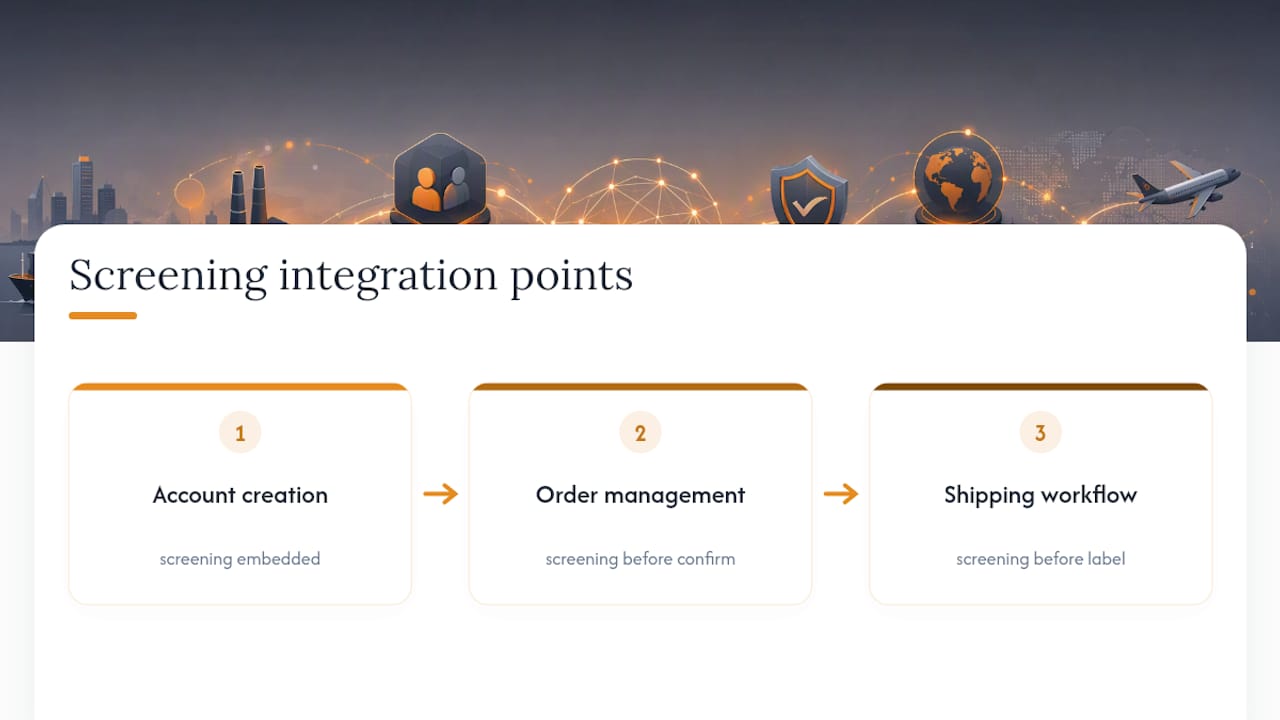
Where commercial screening platforms earn their cost is ownership analysis, scheduled rescreens run automatically in the background, and audit-ready reporting that a compliance officer can hand to an auditor without reformatting anything. Integration usually follows one of three patterns: screening embedded at account creation, screening triggered inside order management before an order confirms, or screening called from the shipping workflow right before a label prints. Logistics platforms are increasingly building compliance checks directly into operational workflows rather than treating them as a separate manual step, which is the direction the whole industry is heading.
A fuzzy hit isn’t a verdict. Capture the match score, pull the counterparty’s registration and ownership documents, and log who made the call and why. That log becomes the primary evidence if regulators ever ask you to explain the decision.
What a Working Screening Program Actually Looks Like Day to Day
A five-step daily loop covers most of it: screen every new and active counterparty, run the ownership check when a hit or a red flag appears, document the resolution with a timestamp, escalate confirmed matches to legal immediately, and schedule the next rescreen before you close the file.
The mistakes that cause real damage are rarely exotic. Teams screen only the buyer’s name and skip the consignee or the paying bank. They keep results in someone’s inbox instead of a searchable log. Fix the scope, fix the recordkeeping, and check ownership every time, and most exposure disappears.
Freight forwarders sit inside this workflow too, since customs and delivery obligations don’t exist in a vacuum from compliance. ForwarderOne’s own notes on the customs refund process reflect that same operational thinking, that compliance and logistics execution are the same discipline, not two separate departments passing paperwork back and forth.
Sources
- Consolidated Screening List
- Restricted Party Screening Guidance and Procedures
- Restricted Party Screening — Princeton ORPA
FAQ
What Does "Restricted Party Screening" Mean?
It's the process of checking a counterparty's name, and often its owners and affiliates, against government watchlists like the CSL, the OFAC SDN List, and the BIS Entity, Denied Persons, and Unverified Lists before doing business with them.
What Is Sanctioned Party Screening?
Sanctioned party screening is essentially the same practice, focused specifically on OFAC’s sanctions programs and the SDN List, where a match generally prohibits the transaction outright and requires blocking and reporting.
What Does It Mean to Be a Restricted Party on a Government List?
It means a government agency has determined that dealing with that entity is prohibited or restricted, whether through an outright ban (SDN, Denied Persons List), a license requirement (Entity List), or a caution flag for unverified end users (Unverified List).
Do All Parties to a Transaction Need to Be Screened?
Yes. A defensible screening program covers the customer, the consignee, the end user, and any bank, agent, or affiliate with a real role in the deal, not just the party signing the purchase order.
Need compliance-aware freight execution?
ForwarderOne coordinates supplier pickup, customs clearance, DDP duty handling, and delivery with a documented workflow so compliance checks happen before freight is committed.