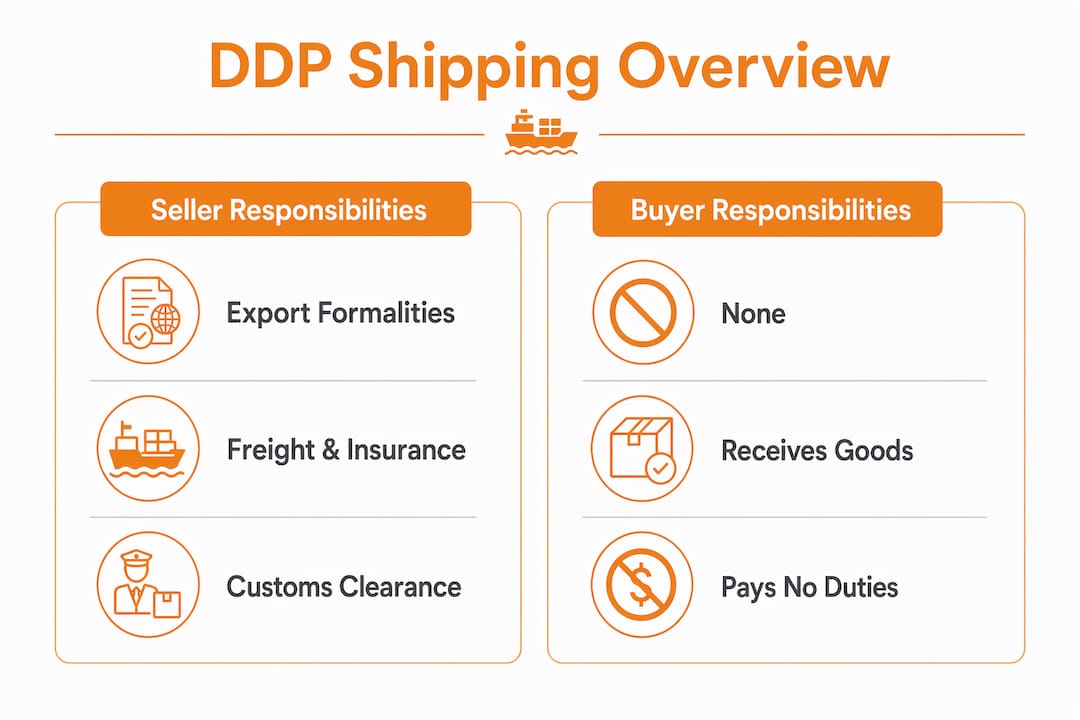
Delivered Duty Paid (DDP) shipping is defined as a shipping arrangement where the seller assumes full responsibility for all costs and risks, including export formalities, freight, insurance, customs clearance, import duties, taxes, and final delivery to the buyer’s location. For Amazon sellers sourcing from China, Korea, or Mexico, this DDP shipping Amazon sellers guide covers everything you need to execute international shipments confidently, from Incoterms 2026 obligations to FBA labeling rules and Importer of Record setup. Getting DDP right means your inventory lands at Amazon fulfillment centers without customs surprises, delays, or rejected shipments.
What does DDP shipping mean for Amazon sellers?
DDP shipping places all costs and risks on the seller, covering export duties, freight, customs clearance, import duties, taxes, and delivery to the destination ready for unloading. The buyer’s only obligation is to receive the goods and make payment. For Amazon sellers, this translates to a clean, predictable logistics model where your supplier or freight forwarder handles every step before the inventory hits an Amazon warehouse dock.
The cost structure under DDP is more complex than it looks. DDP pricing sums product cost, freight, insurance, export and import duties, taxes, clearance fees, inland transport, and the seller’s margin to define the total landed cost. There is no single formula. You must itemize every component to price accurately and avoid absorbing unexpected charges.
One critical detail most sellers miss: contract clarity on VAT and unloading obligations can make or break a DDP deal. A contract written as “DDP, VAT excluded” shifts the tax burden back to the buyer without warning. Unloading at the destination is also not automatically the seller’s responsibility under DDP unless the contract says so. Define both terms explicitly before any shipment moves.
| Responsibility | Seller (DDP) | Buyer (DDP) |
|---|---|---|
| Export formalities | Yes | No |
| Freight and insurance | Yes | No |
| Import customs clearance | Yes | No |
| Duties and taxes | Yes | No |
| Delivery to named place | Yes | No |
| Unloading at destination | Defined by contract | Defined by contract |
| Receipt of goods | No | Yes |
Pro Tip: Always attach a written addendum to your DDP contract specifying whether VAT and unloading are included. A one-line clarification prevents costly disputes after delivery.
How to label and pack Amazon FBA shipments under DDP
Amazon’s inbound requirements are non-negotiable, and they apply regardless of your shipping terms. Amazon FBA inbound requires unique FNSKU barcodes on every unit, a unique FBA Box ID label on each carton, and four FBA Pallet ID labels per pallet side. Missing or incorrect labels cause receiving delays and rejections at fulfillment centers, which directly hits your stock availability.

Box dimensions matter just as much as labels. Amazon mandates box sizes not exceeding 25 inches on any side, with a weight limit of 50 lbs per box for standard items. Staying within these limits reduces receiving delays and lowers the risk of shipping damage. Oversize items follow separate rules, so confirm your product category before packing.
The data on your carton labels must match your Amazon shipment plan exactly. Mismatched carton data or missing FBA Box IDs cause receiving failures even when duties and taxes are fully prepaid. Good data handoff is as important as customs clearance. Review the FBA packaging requirements guide before finalizing your shipment plan.
| Labeling and packing step | Requirement |
|---|---|
| Unit label | FNSKU barcode on every sellable unit |
| Carton label | Unique FBA Box ID per carton |
| Pallet label | Four FBA Pallet ID labels, one per side |
| Box size | Max 25 inches on any side |
| Box weight | Max 50 lbs for standard items |
| Shipment plan match | Carton data must match plan exactly |
Pro Tip: Use a thermal label printer set to 300 DPI minimum. Laser-printed labels on plain paper can smear in humid shipping containers, causing scan failures at Amazon docks.
What is the Importer of Record and why does it matter?
The Importer of Record (IOR) is the legal entity accountable for customs declarations, duty payments, and compliance with U.S. Customs and Border Protection (CBP) regulations. Under DDP terms, the seller or a designated U.S.-based agent must serve as the IOR. The IOR must be legally registered and bonded to U.S. Customs to act on behalf of foreign sellers and avoid costly import clearance issues.
Many sellers confuse the IOR with the consignee. The consignee is the party receiving the goods, often Amazon’s fulfillment center. The IOR is the party legally responsible for the import. Amazon does not act as the IOR for seller shipments. You must arrange IOR coverage yourself or through a licensed customs broker.
Customs brokers file entry documents on behalf of the IOR, who is listed on CBP Form 7501, Box 26. The IOR is the legal entity that pays duties and can claim tariff refunds. Getting this wrong delays your shipment at the port and can result in penalties.
Key IOR responsibilities under DDP:
- Hold a valid customs bond (single-entry or continuous)
- File accurate entry documents with CBP
- Pay all applicable import duties and taxes
- Maintain records for CBP audit purposes
- Comply with all applicable import regulations
- Respond to CBP inquiries and requests for information
If you are a foreign seller without a U.S. business entity, work with a licensed U.S.-based IOR agent. ForwarderOne can connect you with the right customs resources to keep your shipments moving. Learn more about the customs clearance process for e-commerce importers.
Step-by-step process for executing a DDP shipment to Amazon
A clean DDP shipment follows a defined sequence. Skipping steps or reordering them creates gaps that cause delays at customs or at the Amazon receiving dock.
- Gather shipment details. Confirm buyer and seller information, product descriptions, HS codes, declared values, and the named delivery location. Define unloading and VAT terms in writing before booking.
- Create your Amazon shipment plan. Log into Seller Central and create the inbound shipment plan before packing begins. Your carton labels must match this plan exactly.
- Confirm packaging and labeling. Apply FNSKU labels to all units. Print unique FBA Box ID labels for each carton. Prepare pallet labels if shipping on pallets. Verify box dimensions and weights.
- Book freight with a DDP-experienced forwarder. Choose a freight forwarder with direct experience in Amazon FBA shipments. ForwarderOne’s DDP shipping service covers customs clearance, documentation, and delivery to U.S. fulfillment centers.
- Complete export formalities. Your supplier or forwarder handles export customs in the origin country. Confirm all export documents are accurate before the shipment departs.
- Set up IOR coverage. Confirm your IOR designation and customs bond are in place before the shipment arrives at a U.S. port. Your customs broker files the entry on your behalf.
- Track the shipment and manage customs clearance. Stay in contact with your forwarder during transit. Respond quickly to any CBP document requests to avoid holds.
- Confirm delivery at the Amazon warehouse. Verify the shipment is received in Seller Central. Check for any discrepancies in unit counts and document them immediately.
Pro Tip: Send your forwarder a complete shipment brief including the Amazon shipment plan ID, carton count, total weight, and HS codes before booking. A single document shared upfront prevents the back-and-forth that delays departures.
Common pitfalls Amazon sellers face with DDP shipping
DDP shipping fails at predictable points. Knowing where things go wrong lets you fix problems before they become expensive.
Common mistakes to avoid:
- Applying incorrect or duplicate FBA Box ID labels across cartons
- Submitting carton data that does not match the Amazon shipment plan
- Failing to designate a valid IOR before the shipment arrives at the U.S. port
- Using “DDP, VAT excluded” terms without informing the buyer
- Choosing a freight forwarder with no Amazon FBA experience
- Missing or incomplete commercial invoices and packing lists
- Undervaluing goods on customs documents to reduce duties
Comprehensive DDP documentation must include a commercial invoice, packing list, certificates of origin where required, and proof of duty payment. Any mismatch or missing document causes delays or rejections at Amazon warehouses. Prepare and review your document package at least five business days before the estimated arrival date.
Caution: Under DDP terms, the seller is responsible for delivery to the named place, but unloading is not automatically included. If your contract does not explicitly state that unloading is the seller’s responsibility, Amazon’s dock staff may refuse to unload, or you may face unexpected charges. Clarify this in writing with your freight forwarder and in your contract before the shipment moves.
Key Takeaways
DDP shipping gives Amazon sellers full control over international logistics costs and customs compliance, but that control only delivers results when labeling, IOR setup, and documentation are executed without errors.
| Point | Details |
|---|---|
| Seller bears all DDP costs | Product, freight, duties, taxes, and delivery are all the seller’s responsibility under DDP. |
| FBA labeling is non-negotiable | Every unit needs an FNSKU, every carton a unique FBA Box ID, and every pallet four ID labels. |
| IOR must be designated early | A valid customs bond and IOR registration must be in place before the shipment reaches a U.S. port. |
| Contract terms prevent disputes | Specify VAT and unloading responsibilities in writing before any shipment is booked. |
| Data accuracy drives FBA receipt | Carton data must match the Amazon shipment plan exactly or receiving failures will occur. |
Why DDP mastery separates growing sellers from stuck ones
I have worked with dozens of small Amazon sellers who chose DDP because it sounded simple. Pay one price, goods arrive at the warehouse. The reality is that DDP is only simple when every detail is handled correctly. When it breaks, it breaks expensively.
The sellers who scale internationally are not the ones who found a cheaper freight rate. They are the ones who built a repeatable process: a standard shipment brief, a labeling checklist their supplier follows without reminders, and a forwarder who knows Amazon’s inbound requirements as well as they know customs. That combination is rare, and it is worth paying for.
The IOR piece catches more sellers off guard than anything else. A foreign seller without a U.S. entity cannot legally act as the IOR. Discovering that at the port, with a container sitting in customs hold, is a very expensive lesson. Set up your IOR arrangement before you book your first DDP shipment, not after.
My practical suggestion: build a one-page shipment checklist that covers labeling, documentation, IOR confirmation, and shipment plan matching. Run every shipment through it before it leaves the origin country. The sellers I have seen grow fastest are the ones who treat logistics as a system, not a series of one-off decisions.
— Keven
ForwarderOne’s DDP freight forwarding for Amazon sellers
Small and mid-sized Amazon sellers need a freight forwarder who understands both international customs and Amazon’s specific inbound requirements. ForwarderOne handles DDP shipments from China, Korea, and Mexico to U.S. Amazon fulfillment centers, managing customs clearance, documentation, and labeling compliance in a single workflow.
With over 99% on-time delivery and a dedicated account manager for every client, ForwarderOne gives sellers the reliability they need during peak periods like Q4. Whether you are shipping your first container or scaling to weekly replenishments, ForwarderOne’s FBA freight forwarding service removes the customs complexity so you can focus on growing your catalog and keeping your listings in stock.
FAQ
What does DDP mean in Amazon shipping?
DDP stands for Delivered Duty Paid. The seller covers all shipping costs, customs clearance, import duties, and taxes, delivering goods to the buyer’s named location ready for receipt.
Who is the Importer of Record for DDP Amazon shipments?
The seller or a designated U.S.-based agent acts as the Importer of Record. Amazon does not serve as the IOR. The IOR must hold a valid customs bond and be registered with CBP to legally clear the shipment.
What labeling does Amazon require for DDP inbound shipments?
Amazon requires an FNSKU barcode on every unit, a unique FBA Box ID on each carton, and four FBA Pallet ID labels per pallet side. Boxes must not exceed 25 inches on any side or 50 lbs in weight.
What documents are required for a DDP shipment to Amazon FBA?
A complete DDP shipment requires a commercial invoice, packing list, certificates of origin where applicable, and proof of duty payment. All documents must match the Amazon shipment plan exactly to avoid receiving delays.
Is DDP shipping worth it for small Amazon sellers?
DDP is worth it for sellers who want predictable landed costs and no customs surprises. The key is working with a forwarder experienced in Amazon FBA inbound requirements to handle the complexity correctly from the start.
Want DDP priced before your supplier ships?
Send cargo value, HS code notes, supplier city, carton dimensions and FBA destination. ForwarderOne will build a DDP quote with duties, clearance and delivery included.