Yes, FDA prior notice is required for nearly every food shipment entering the United States, and you need to submit it electronically and secure a PN Confirmation Number before your cargo arrives. Miss the mode-specific window, and the FDA can refuse the shipment outright. If you’re unsure whether your product qualifies, file through ABI/ACE/ITDS or the FDA Prior Notice System Interface right away and keep that confirmation with your shipping paperwork.
TL;DR:
- Filing must be done within specific timeframes: at least 2 hours before road arrival, 4 hours before rail or air arrival, 8 hours before water arrival, and before shipment for international mail.
- Using ABI/ACE/ITDS is recommended for commercial shipments due to its integration with customs, but PNSI is necessary if filing without a broker or for mail.
- Missing or incorrect fields, especially product codes, lot numbers, or shipment identifiers, can lead to shipment refusal, hold, or destruction at port.
- Starting October 1, 2026, international mail shipments must include a carrier name and tracking number in the prior notice.
- Proper coordination between prior notice filing and customs entry, supported by a provider like ForwarderOne, reduces rejection risk and streamlines shipment clearance.
What Is FDA Prior Notice and Why Does It Exist?
Prior notice is the advance electronic filing that tells the FDA what food is entering the country, where it came from, and how it’s arriving, before it physically crosses the border. The requirement traces back to Section 801(m) of the FD&C Act, enacted after the Bioterrorism Act of 2002, and is codified in 21 CFR Part 1, Subpart I.
The rule covers food for humans and animals crossing U.S. borders by any transportation mode, whether commercial cargo or personal shipment. It doesn’t apply to every category. Some products fall under USDA jurisdiction instead, and certain personal-use scenarios are carved out. But if your product code flags as FDA-regulated, prior notice isn’t optional. It’s the price of entry.
When to Submit: Timelines by Transport Mode
Timing is where most shipments actually fail, not the paperwork itself. The FDA sets minimum lead times by transport mode, and your prior notice must be confirmed by the FDA, not just submitted, before those windows close.
- Road (land): at least 2 hours before arrival
- Rail and air: at least 4 hours before arrival
- Water (ocean freight): at least 8 hours before arrival
- International mail: must be submitted before the article is even sent to the U.S.
Statistic Callout: Two separate systems govern how early you can file. ABI/ACE/ITDS accepts submissions no more than 30 days in advance, while the FDA Prior Notice System Interface (PNSI) rejects anything filed earlier than 15 days out. File too early in PNSI and the system bounces it back.
A Federal Register final rule published in September 2025 adds a new wrinkle starting October 1, 2026: international mail shipments will need a carrier name and tracking number attached to the prior notice, plus defined resubmission deadlines after a refusal or hold.
How to Submit Prior Notice: ABI/ACE/ITDS vs. FDA PNSI
Most commercial importers file through the Automated Broker Interface, integrated with CBP’s Automated Commercial Environment and the International Trade Data System (ABI/ACE/ITDS). This is the system your customs broker almost certainly already uses, since it bundles prior notice with the entry filing itself.
The FDA Prior Notice System Interface (PNSI) is the fallback. Use it when you don’t have broker access to ABI/ACE, when you’re shipping via international mail, or when a commercial filing has some unusual complication that ABI can’t handle cleanly.
Whichever system you use, every field must be entered in English, using the Latin alphabet. No exceptions, even if your invoice or packing list arrived in another language.
- Confirm your FDA product code before you touch either system.
- Gather manufacturer and shipper details in advance, since re-entering them mid-filing invites typos.
- Select your shipment type carefully in PNSI. Once chosen, it locks. You cannot edit it. If you pick wrong, you have to create an entirely new prior notice.
- Use the copy function for repeat shipments, but double-check quantities and lot numbers every time, since copied entries carry old data forward.
Pro Tip: If a submission gets rejected or needs correction after confirmation, don’t try to edit it in place. Cancel and resubmit as a new prior notice. Trying to patch a confirmed filing usually creates more errors than it fixes.
The Required Information: 21 CFR §1.281 Fields
21 CFR §1.281 spells out exactly what a complete prior notice needs. Missing even one required field is enough to trigger a hold, so build your pre-shipment checklist around this list rather than improvising at filing time.
- Submitter and transmitter contact information, plus the entry type and any CBP identifiers on file
- FDA product code for each food article, its common or usual name, and the quantity being shipped
- Lot or code numbers where applicable, along with manufacturer or grower identification
- Country of production and country from which the article is shipped
- Anticipated arrival information: port of entry, carrier, and mode-specific identifiers
| Shipment Mode | Key Identifier Required |
|---|---|
| Ocean | Vessel name and voyage number |
| Air | Flight number and airline carrier code |
| Truck | Carrier name and estimated crossing point |
| Rail | Rail carrier and car number |
| International mail (from Oct 1, 2026) | Carrier name and tracking number |
For mail shipments specifically, the recipient’s name and address round out the filing, and starting October 1, 2026, that carrier tracking number becomes mandatory rather than optional.
Exemptions and Special Cases
Not every shipment needs a prior notice, and knowing the exceptions saves you from filing paperwork nobody’s asking for.
- Personal-use gifts sent by individuals, not businesses, generally fall outside the requirement.
- Diplomatic pouches and similar official shipments are exempt under longstanding customs practice.
- Products under exclusive USDA jurisdiction, like most meat, poultry, and certain egg products, don’t require FDA prior notice at all.
- Transshipment, future export, and foreign trade zone routing are not blanket exemptions. FDA-regulated food can still need prior notice even when the cargo is not entering ordinary U.S. retail commerce.
- International mail carries its own rulebook, and the October 2026 change tightens it further by requiring a tracking number tied to the filing.
If you’re not sure your shipment qualifies for an exemption, file anyway. A prior notice that wasn’t strictly necessary costs you a few minutes. A missing one that was necessary can cost you the whole shipment.
What Happens When Prior Notice Is Missing or Wrong
The FDA’s response to a defective prior notice is blunt: refusal of admission, a hold at the port, or in worse cases destruction or forced export, all at the importer’s expense. Importers carry the ultimate liability here, even when a broker prepared the actual filing.
Most refusals trace back to the same handful of mistakes:
- Filing after the mode-specific deadline instead of before it
- Leaving required fields incomplete, especially lot numbers and manufacturer identification
- Using the wrong FDA product code for the article being shipped
- Misreading an HTS code’s FD flag, which signals FDA jurisdiction whether or not you expected it
After a refusal or hold, the 2025 Federal Register rule sets specific windows for resubmission and FDA review requests, replacing what used to be a murkier process. Sellers who’ve dealt with a surprise hold know how fast inventory problems cascade from there. Our breakdown of why customs holds shipments covers what typically happens after the initial refusal.
Pro Tip: Keep a running log of every PN Confirmation Number tied to a shipment, cross-referenced against your commercial invoice. When a broker asks for it during an unexpected hold, you want that number in seconds, not after a scramble through email threads.
A Practical Pre-Shipment Checklist for Importers and Brokers
Treat prior notice as a workflow, not a form. Here’s the sequence that keeps most shipments moving cleanly through the process.
- Verify your FDA product code and facility registration weeks before the shipment date, not the week of.
- Check the HTS code for an FD flag. If it’s flagged, prior notice applies, no matter how routine the product seems.
- Calculate your filing window based on transport mode, then confirm it fits within ABI/ACE’s 30 day maximum or PNSI’s 15 day window.
- Build the submission, entering each food article separately with its lot numbers and quantities.
- Submit and capture the PN Confirmation Number the moment the FDA confirms it.
- Attach that confirmation number to your shipping documents and hand it to your carrier or broker as needed.
Statistic Callout: The 30 day and 15 day filing ceilings for ABI/ACE and PNSI, respectively, are the single most common source of avoidable rejection. Sellers who file too far in advance simply get bounced back to redo the whole thing. Our guide on avoiding Amazon FBA customs delays walks through how that timing mistake ripples into fulfillment center stockouts.
Keven’s Take: Where Amazon Sellers Actually Get Burned
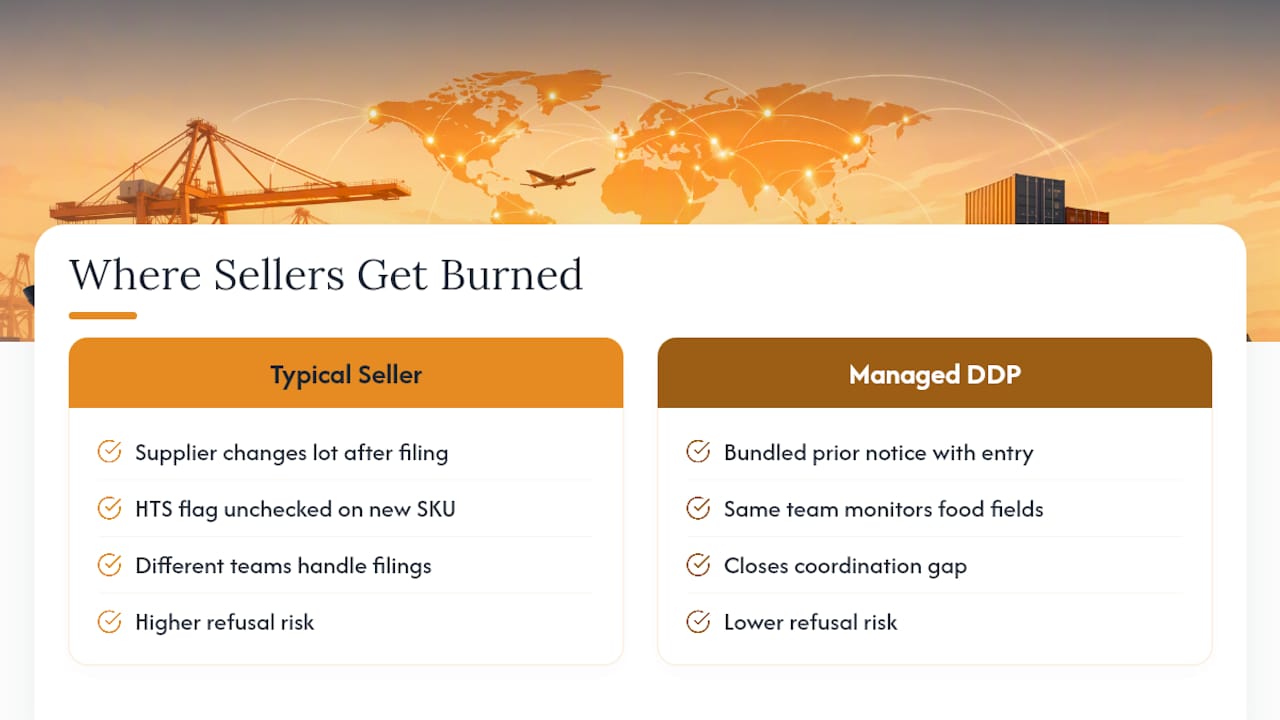
The mistakes I see repeated most aren’t legal misunderstandings. They’re operational ones: a seller’s supplier changes a lot number after the prior notice already went in, or nobody double-checks the HTS flag on a new SKU. Small errors, big consequences.
Bundling prior notice filing with customs entry, the way a managed DDP service does, closes that gap because the same team handling your entry paperwork is watching the food-specific fields too. That coordination is exactly where refusal risk drops.
— Keven
Let ForwarderOne Handle Prior Notice and Customs Together
Filing prior notice correctly means nothing if your customs entry, duties, and delivery aren’t coordinated with it, and that’s the gap ForwarderOne closes for Amazon sellers moving inventory from China to U.S. fulfillment centers.
Our DDP service bundles prior notice filing support directly into the customs clearance workflow, so the same team tracking your PN Confirmation Number is also handling your entry, duties, and delivery scheduling. That’s the practical advantage over piecing together a broker, a filer, and a carrier separately: one dedicated account manager who already knows your product codes, your typical shipment cadence, and where your filings tend to get flagged.
When you’re vetting any provider for this work, confirm they can actually handle PN confirmation end to end, file through ABI/ACE directly, and support you if a shipment gets held or refused. Check out ForwarderOne's freight and customs services to see how prior notice fits into a full DDP shipment from China to your fulfillment center, and get a quote before your next shipment window closes.
Sources
- FDA guidance on prior notice for imported food shipments
- 21 CFR 1.281 required prior notice information
- Federal Register final rule on prior notice submissions and international mail identifiers
FAQ
Is FDA Prior Notice Required for All Food Imports?
Prior notice is required for nearly all FDA-regulated food entering the United States, though exemptions exist for personal gifts, diplomatic shipments, and products under exclusive USDA jurisdiction.
Who Is Responsible for Filing the Prior Notice Form?
The importer, or a customs broker acting on their behalf, typically files prior notice through ABI/ACE/ITDS or FDA PNSI, but the importer holds ultimate legal responsibility for its accuracy.
How Do I Complete an FDA Prior Notice Submission?
You submit electronically through ABI/ACE/ITDS or the FDA PNSI portal, entering product codes, quantities, lot numbers, and shipment details in English using the Latin alphabet.
Where Can I Submit Prior Notice for a Mail Shipment?
International mail shipments generally require filing through the FDA PNSI, since standard mail carriers aren’t integrated into ABI/ACE, and starting October 1, 2026, a carrier tracking number becomes a required field.
What Happens If My Prior Notice Filing Gets Refused?
A refused shipment gets held at the port at the importer’s expense, and the 2025 Federal Register rule sets specific timeframes for resubmitting or requesting FDA review after a refusal or hold.
Need prior notice, customs, and DDP timing handled together?
ForwarderOne coordinates food shipment paperwork, customs entry data, duties, and final delivery inside one managed freight workflow before inventory moves to Amazon or another fulfillment channel.