Customs holds shipments when import documentation, product classification, or declared values fail to meet the requirements of the receiving country’s regulatory authority. For small online sellers shipping from China to the US, this is not a rare edge case. Documentation errors drive over 80% of international shipping delays, and customs holds account for roughly 40% of all delays in cross-border trade. The World Customs Organization and US Customs and Border Protection (CBP) both operate on a simple rule: goods do not move until every document, duty, and declaration checks out. Understanding why customs holds shipments is the first step toward preventing delays that cost you money and inventory availability.
Why does customs hold shipments?
A customs hold is the formal term for when CBP or another national customs authority detains a shipment pending review. The hold can be triggered by a document problem, a classification error, an unpaid duty, or a random inspection. Most holds fall into one of six categories.
Documentation errors and missing paperwork are the single biggest cause. Customs agencies cross-reference your commercial invoice, packing list, and bill of lading against each other. Minor discrepancies in weights, quantities, or descriptions trigger manual reviews that add 2–5 days to clearance. A vague product description like “electronic parts” instead of “USB-C charging cables, 1-meter, 20W” is enough to flag a shipment.
Incorrect Harmonized System (HS) codes are the second most common trigger. The HS code is the international product classification number that determines duty rates and import restrictions. 15% of global customs declarations contain HS code errors, and a wrong code can hold a shipment for 5–14 days while customs reclassifies the goods. For Amazon sellers, a misclassified product can also mean paying the wrong duty rate, which creates a financial liability on top of the delay.

Unpaid or under-declared duties and taxes freeze shipments at the port. Customs will not release goods until all financial obligations, including import VAT and customs bonds, are confirmed. Undervaluing goods to reduce duty exposure is a common mistake among new sellers. CBP uses transaction value, computed value, and deductive value methods to verify declared prices, and discrepancies trigger holds.
Restricted, prohibited, or regulated goods require additional permits or certifications. Products like lithium batteries, food supplements, cosmetics, and certain electronics fall under agency oversight from the FDA, CPSC, or EPA. Shipping without the required certification means the shipment sits until you produce the paperwork or the goods are refused entry.
Random and risk-based inspections happen regardless of how clean your documentation is. CBP uses the Automated Targeting System (ATS) to score shipments by risk level. High-risk scores, new importers, and certain trade lanes from China receive more scrutiny. These inspections are not a sign of wrongdoing. They are a built-in feature of the customs inspection process.
Importer Security Filing (ISF) failures are a leading preventable cause for ocean freight. The ISF, also called the 10+2 filing, must be submitted 24 hours before loading in the origin port. Missing or late ISF filings under 19 CFR § 149 carry $5,000 penalties and guarantee a hold on arrival.
Pro Tip: Always request a copy of your supplier’s packing list before the shipment leaves the factory. Compare it line by line against your commercial invoice. Catching a quantity mismatch before departure costs nothing. Fixing it after a customs hold costs time, fees, and potentially lost sales rank on Amazon.
How long do customs holds last?
Clearance timelines vary significantly based on the reason for the hold and the type of inspection triggered.
| Scenario | Typical Duration |
|---|---|
| Compliant ocean freight, no issues | 1–3 business days |
| Document review or minor discrepancy | 2–5 business days |
| HS code reclassification | 5–14 business days |
| Physical examination (tailgate or intensive) | 5–15 business days |
| Complex investigation or prohibited goods | 30+ business days |
Compliant shipments clear US customs in 1–3 business days for ocean freight. Once a hold is triggered, that window extends to 5–15 business days for standard examinations. Complex cases involving valuation fraud investigations or prohibited goods can exceed 30 days.
The financial damage compounds quickly. Storage and demurrage fees begin accruing immediately when a shipment is detained at the port. Container demurrage at major US ports like Los Angeles or Long Beach can run $150–$300 per day after the free period expires. A two-week hold on a 20-foot container can add $2,000 or more in port fees before you even address the customs issue itself.
Peak shipping seasons, including the pre-holiday surge in September through November, create port congestion that compounds customs delays. Random inspection rates rise when import volumes spike, meaning a shipment that would clear in two days during February might sit for a week in October. Plan your restocking timeline with a buffer for seasonal hold risk.
The customs clearance timeline for Amazon sellers is especially tight because FBA receiving windows and inventory lead times leave little room for unexpected holds.
How to prevent customs holds before they happen
Prevention is far cheaper than resolution. The following steps address the most common reasons for customs hold before your goods leave the origin country.
-
Verify every document before shipment. Your commercial invoice, packing list, and bill of lading must match exactly. Product descriptions, quantities, weights, and declared values must be identical across all three documents. Customs agencies compare these documents in detail, and even a one-unit discrepancy in quantity triggers a manual review.
-
Classify products with the correct HS code. Use the CBP online tools or consult a licensed customs broker to confirm the 10-digit HTS code for every product you import. Do not rely on your supplier’s suggested code. Suppliers optimize for export classification, which does not always match US import classification.
-
Use DDP shipping terms where possible. Delivered Duty Paid (DDP) means the freight forwarder or shipper handles all duties, taxes, and customs clearance before delivery. This removes the risk of duty underpayment or missed filings on your end. DDU (Delivered Duty Unpaid) shifts that responsibility to you or your customs broker at destination, which increases the chance of errors.
-
File the ISF on time for every ocean shipment. The ISF must be submitted 24 hours before the cargo is loaded at the origin port. Work with a freight forwarder who files ISF as part of their standard service. A freight forwarder who handles duties and ISF filings removes this risk entirely for small sellers who lack in-house compliance staff.
-
Prepare certificates and permits in advance. If your product requires FDA registration, a CPSC certificate of conformity, or an FCC declaration, obtain these before the shipment departs. Customs will not accept “in progress” documentation as a substitute for the actual certificate.
-
Monitor your shipment actively. Use your carrier’s tracking system and set up alerts for status changes. Random inspections and peak season surges increase hold rates unpredictably. Catching a hold notification on day one and responding immediately can cut the total delay by several days.
Pro Tip: Build a pre-shipment compliance checklist and share it with your supplier before every order. Include HS code confirmation, invoice format requirements, and ISF data fields. Suppliers who ship to the US regularly will recognize the checklist and complete it accurately.
What to do when your shipment is held by customs
A customs hold is not a final decision. Most holds are resolved once you provide the right information or payment.
-
Get the specific reason for the hold in writing. Contact your freight forwarder or customs broker immediately and request the CBP hold notice or examination order. The notice will specify whether the hold is for a document review, a physical examination, or a compliance issue. Knowing the exact reason determines your next action.
-
Gather and correct the flagged documents. If customs flagged a discrepancy between your invoice and packing list, issue a corrected invoice with a clear explanation of the change. If the HS code is wrong, work with your broker to submit a reclassification request with supporting product documentation.
-
Pay outstanding duties without delay. Customs will not release goods until all duties, taxes, and fees are paid in full. If CBP has assessed additional duties due to undervaluation, pay the corrected amount immediately. Disputing the assessment while the goods sit at the port only increases your storage fees.
-
Prepare for a physical inspection if requested. CBP may require a tailgate examination (opening the container) or a more intensive devanning inspection. Make sure your goods are packed in a way that matches the packing list exactly. Mislabeled cartons or unlisted items found during a physical inspection escalate the hold to a more serious compliance review.
-
Respond to every customs query within 24 hours. Speedy response to customs queries is critical to avoid escalating demurrage and storage fees. Delays in your response are treated as delays in compliance, and the clock on port fees keeps running regardless.
-
Avoid common mistakes that extend holds. Do not submit partial documentation hoping to buy time. Do not contact CBP directly without your customs broker present. Do not attempt to reroute the shipment to a different port while it is under hold. Each of these actions adds days to the resolution process.
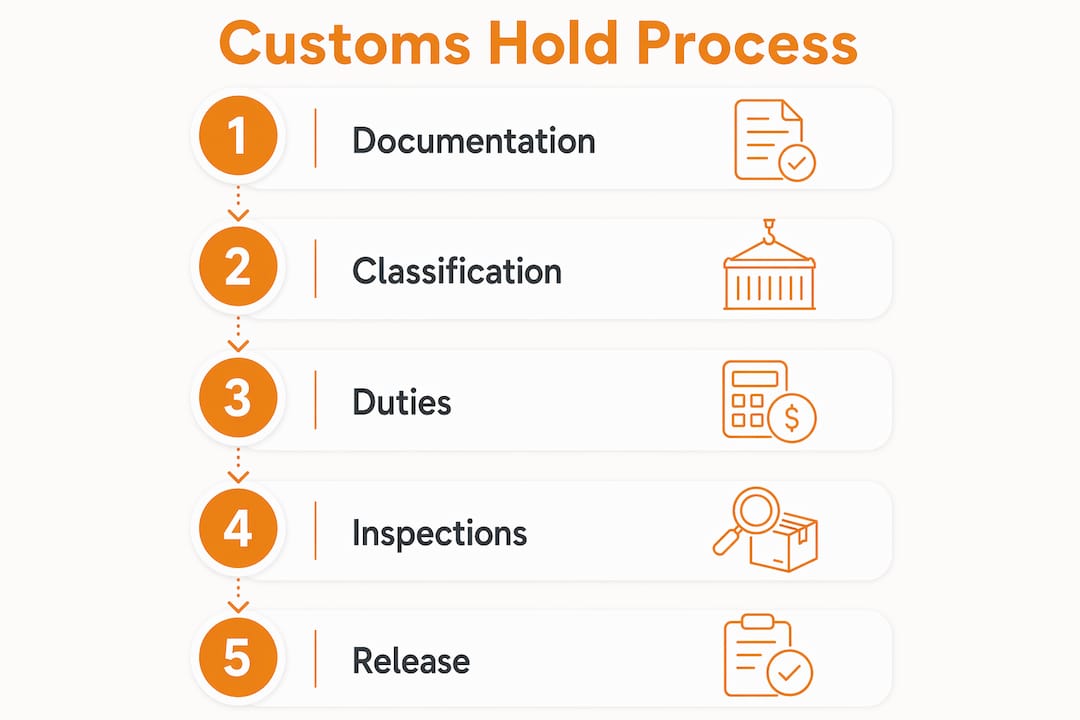
The US customs clearance process for e-commerce importers follows a defined sequence. Understanding each step helps you respond faster and more accurately when a hold occurs.
Key Takeaways
Customs holds are almost always preventable. Accurate documentation, correct HS codes, and timely ISF filings eliminate the three most common causes before a shipment ever reaches the port.
| Point | Details |
|---|---|
| Documentation is the top cause | Over 80% of customs delays trace back to document errors, mismatches, or missing paperwork. |
| HS code errors are costly | Wrong product codes cause 5–14 day holds and affect 15% of global customs declarations. |
| ISF filing is non-negotiable | Missing the 24-hour ISF deadline for ocean freight triggers $5,000 penalties and guaranteed holds. |
| DDP terms reduce your risk | Delivered Duty Paid shipping puts customs compliance responsibility on the forwarder, not you. |
| Speed matters when held | Responding to customs queries within 24 hours limits demurrage fees and shortens total delay. |
The real cost of customs holds is not the delay itself
After years of watching small sellers navigate international freight, the pattern is consistent. Sellers who get burned by customs holds once almost always had the same problem: they treated paperwork as an afterthought and assumed their supplier would handle the details.
The delay is painful. But the real damage is what the delay does downstream. A two-week hold in October means your inventory misses the pre-holiday restocking window at Amazon FBA. Your listing goes out of stock. Your organic rank drops. Competitors with inventory in stock capture your sales. By the time your goods clear customs and arrive at the fulfillment center, you have lost ground that takes months to recover.
I have seen sellers lose more in suppressed ranking and missed sales than they ever would have paid a competent customs broker for the entire year. The math is not close. A licensed customs broker or a freight forwarder with in-house compliance expertise costs a fraction of what a single bad hold costs in lost revenue.
The other thing sellers underestimate is the value of logistics partners who specialize in their trade lane. A generalist freight forwarder who handles dozens of different routes will not know the specific CBP targeting patterns for China-to-US ocean freight the way a specialist does. That specialization matters when your shipment is flagged and you need someone who can respond to CBP with the right documentation on the first attempt.
Build your compliance process before you need it. A pre-shipment checklist, a reliable customs broker, and DDP shipping terms are not luxuries for large importers. They are the baseline for any seller who depends on inventory availability to run their business.
— Keven
How ForwarderOne helps small sellers avoid customs holds
Customs clearance issues are the most common reason small Amazon sellers lose inventory lead time. ForwarderOne’s DDP freight forwarding services handle documentation, duty payment, ISF filing, and customs clearance as a single managed workflow, so you do not carry the compliance risk yourself.
ForwarderOne works specifically with small and mid-sized Amazon sellers shipping from China to US fulfillment centers. Every shipment includes a dedicated account manager who monitors customs status and responds to CBP queries on your behalf. With over 99% on-time delivery, ForwarderOne’s process is built to keep your inventory moving, especially during peak seasons when customs hold rates climb. If you want to ship from China to the US without customs clearance surprises, explore ForwarderOne’s shipping solutions for small sellers.
FAQ
Why does customs hold shipments in the first place?
Customs holds shipments when documentation, product classification, declared values, or regulatory certifications do not meet the importing country’s requirements. CBP and other customs authorities must verify compliance before releasing goods.
How long does a customs hold typically last?
Compliant shipments clear in 1–3 business days. Shipments under examination face 5–15 business days of delay, and complex investigations can exceed 30 days.
What is the most common reason for a customs hold?
Documentation errors are the leading cause, contributing to over 80% of international shipping delays. Mismatched invoices, packing lists, and bills of lading are the most frequent triggers.
What is an ISF filing and why does it matter?
The Importer Security Filing (ISF) is a mandatory US customs submission required 24 hours before ocean freight is loaded at the origin port. Missing the deadline results in $5,000 penalties and a guaranteed hold on arrival.
Does DDP shipping prevent customs holds?
DDP (Delivered Duty Paid) shipping significantly reduces hold risk by placing customs compliance responsibility on the freight forwarder. It does not eliminate the possibility of random inspections, but it removes the most common causes of preventable holds.
Want fewer customs surprises on the next shipment?
Send your commercial invoice, packing list, HS codes, and delivery target. ForwarderOne will check the DDP path and customs handoff before your cargo leaves the supplier.