Shipping inventory from China to Amazon FBA is defined as the end-to-end process of moving goods from a Chinese manufacturer or supplier to an Amazon fulfillment center in the United States, fully prepped, labeled, and customs-cleared before arrival. Getting this process right determines whether your products reach customers on time or sit in limbo racking up fees. The FBA shipping process has grown more demanding in 2026, with Amazon eliminating its internal prep services entirely. Sellers who treat logistics as an afterthought pay for it in rejected shipments, stockouts, and lost sales.
What are the updated Amazon FBA prep and labeling requirements for 2026?
Amazon discontinued prep and labeling services effective January 15, 2026. That means every unit you ship must arrive at the fulfillment center already prepped, labeled, and packaged to Amazon’s exact standards. There are no exceptions and no second chances at the warehouse door.
The requirements sellers must meet before inventory leaves China include:
- FNSKU labels: Every unit needs a scannable FNSKU barcode printed and applied before shipment. Amazon will not accept manufacturer barcodes as a substitute unless you are enrolled in the Amazon barcode exemption program.
- Box labels: Each shipping carton needs a box content label and a shipment label generated from Seller Central. These must match the shipment plan exactly.
- Poly-bagging: Soft goods, loose items, and anything that can spill or tangle must be poly-bagged with a suffocation warning on bags larger than 5 inches on any side.
- Bubble wrap and padding: Fragile items require individual wrapping. Amazon checks this at receiving, and inadequate protection triggers a non-compliance fee.
- Master carton limits: Boxes must not exceed 50 lbs unless a single unit weighs more than that. Oversized cartons get refused.
Non-compliance with these requirements causes shipment delays, rejections, or additional fees that eat directly into your margins. A rejected pallet at an Amazon warehouse can take weeks to resolve and costs you the sale velocity you built.
Pro Tip: Work with your Chinese supplier or a local prep center in China to apply FNSKU labels and poly-bagging before goods leave the factory. Catching errors at the source is far cheaper than correcting them after the shipment lands in the US.
For a full breakdown of current packaging rules, the FBA packaging requirements guide from ForwarderOne covers every category in detail.
How to choose the best shipping method for your FBA inventory from China
The three main options for getting goods from China to an Amazon fulfillment center are sea freight, air freight, and express courier. Each serves a different situation, and picking the wrong one costs you either money or time.
| Shipping method | Transit time | Best for | Cost level |
|---|---|---|---|
| Sea freight (FCL/LCL) | 30–45 days port-to-port | Large, heavy shipments | Lowest |
| Air freight | 7–15 days door-to-door | Mid-size, time-sensitive loads | Medium |
| Express courier | Under 7 days | Small, urgent shipments | Highest |
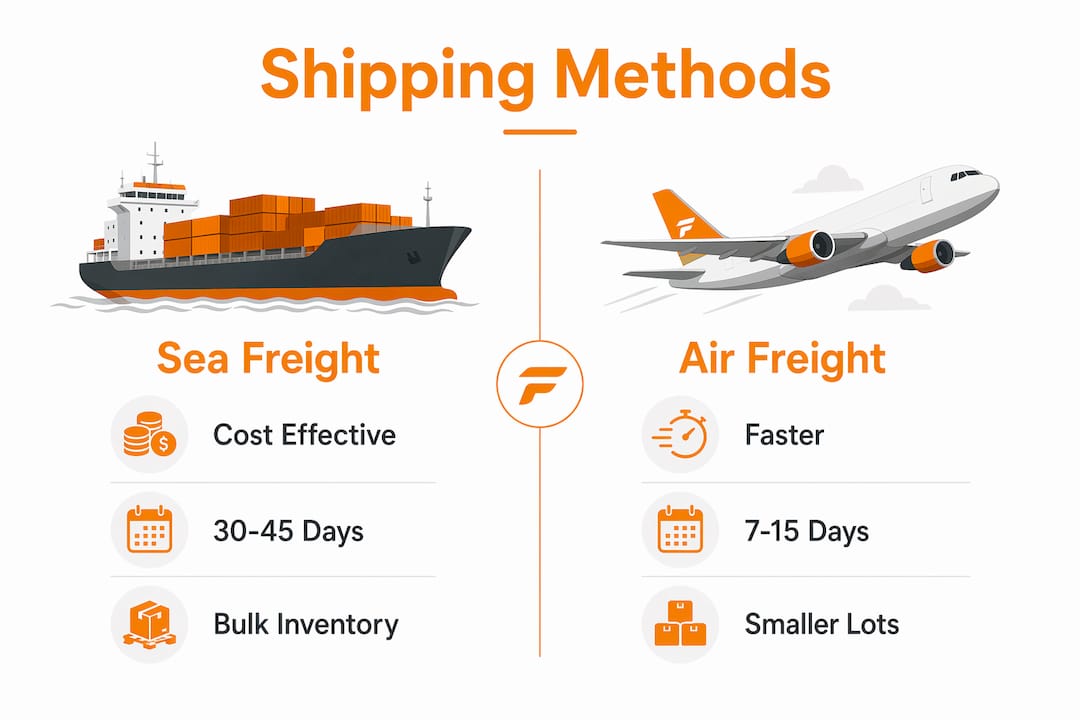
Air freight takes 7–15 days door-to-door, while sea freight averages around 24 days with an additional 3–5 day buffer during peak seasons like Q4. That gap matters enormously when you are running low on stock heading into the holiday rush.
Sea freight is the right call for bulky, non-urgent inventory. A full container load (FCL) gives you the lowest cost per unit, but you need to plan 6–8 weeks ahead to account for port-to-port transit plus customs clearance. Less-than-container-load (LCL) shipments share container space with other cargo, which costs less than FCL but adds handling time at the consolidation warehouse.
Air freight hits the middle ground. It costs more than sea but far less than express, and the 7–15 day door-to-door window makes it viable for restocking fast-moving SKUs or launching a new product where speed to shelf matters. Express couriers like DHL or FedEx work for samples or small urgent replenishments, but the per-kilo rate makes them impractical for anything over 50 kg.
Pro Tip: Split your shipments when launching a new product. Send a small air freight batch first to start generating sales rank, then follow up with a larger sea freight order to replenish at lower cost.
Step-by-step guide to creating a shipment plan in Amazon Seller Central
Creating a shipment plan is the formal step that connects your physical inventory to Amazon’s fulfillment network. Every shipment from China must have a corresponding plan in Seller Central before goods arrive at a warehouse.
- Log into Seller Central and open “Send to Amazon.” This is Amazon’s current workflow for creating inbound shipments. The older “Manage FBA Shipments” flow has been retired for most sellers.
- Select your products and quantities. Add each SKU you are shipping and enter the exact unit count. Accuracy here is critical. Discrepancies between your plan and the actual carton contents trigger receiving delays.
- Confirm prep requirements for each SKU. Seller Central will prompt you to confirm who is handling prep (you or Amazon). Since Amazon no longer offers prep services, select “Seller” for every item.
- Review Amazon’s warehouse allocation. Amazon assigns fulfillment centers based on its own demand and capacity algorithm. You cannot choose a specific warehouse. Your shipment may be split across two or three locations, which affects your freight costs.
- Print and send box labels and shipment labels to your supplier. Your Chinese supplier or prep center needs these files before they pack the cartons. Send them as PDFs with clear placement instructions.
- Choose your carrier for the final US leg. The Amazon Partnered Carrier Program offers discounted rates through UPS for small parcel delivery and Amazon Freight for LTL shipments, but it limits your scheduling flexibility. For shipments arriving from China, your freight forwarder typically handles the final delivery to the fulfillment center.
- Book your freight and confirm the shipment. Once your freight forwarder has the shipment details, confirm the plan in Seller Central and share the PRO number or tracking information so the system can match the inbound shipment.
Coordinate closely with your supplier throughout this process. Miscommunication about label placement or carton dimensions is one of the most common causes of receiving delays.
Why DDP shipping is non-negotiable for Amazon FBA imports from China
Delivered Duty Paid, or DDP, is the shipping term that defines who pays customs duties and taxes before goods are delivered. For Amazon FBA, DDP is mandatory. Amazon will not accept shipments where duties are still owed at delivery, a situation known as DDU (Delivered Duty Unpaid). If your shipment arrives DDU, Amazon refuses it at the dock.
Working with a freight forwarder that offers full DDP service solves this problem at the source. Here is what a DDP freight forwarder handles on your behalf:
- Factory pickup in China: The forwarder collects goods directly from your supplier, eliminating the need for you to arrange domestic Chinese transport.
- Export customs in China: All export declarations and documentation are filed by the forwarder.
- International freight: The forwarder books and manages the ocean or air shipment.
- US customs clearance: Import duties, ISF filing, and CBP entry are handled and paid before the goods reach the fulfillment center.
- Final delivery to Amazon: The forwarder delivers directly to the Amazon warehouse address specified in your shipment plan.
Freight forwarders are strategic partners that help manage risk and reduce costs, not just logistics providers. A good forwarder knows Amazon’s receiving requirements and will flag compliance issues before they become expensive problems. ForwarderOne’s DDP shipping service is built specifically for Amazon sellers, covering every step from the factory floor to the fulfillment center.
Common pitfalls when shipping from China to Amazon FBA
Most shipping problems are predictable and preventable. The sellers who avoid costly mistakes are the ones who build checklists and stick to them.
- Skipping the label audit before shipment. FNSKU labels printed at the factory sometimes scan incorrectly due to low-quality printers or wrong label sizes. Always request a scan test from your supplier before the full print run.
- Choosing sea freight for a time-sensitive restock. Sea freight takes 30–45 days port-to-port. If your stock is running low, that timeline will leave you out of stock for weeks. Match your shipping mode to your actual inventory runway.
- Shipping DDU by accident. Some freight brokers quote lower rates by defaulting to DDU terms. Always confirm in writing that your shipment is DDP before booking.
- Failing to communicate Amazon’s requirements to your supplier. Your factory may have shipped to other retailers before, but Amazon’s rules are specific. Send your supplier Amazon’s packaging guidelines in writing, not just verbally.
- Ignoring peak season delays. Sea freight averages 24 days under normal conditions, but that can stretch by 3–5 days during peak periods. Build buffer time into your replenishment calendar for October and November shipments.
Pro Tip: Create a pre-shipment checklist that your supplier signs off on before goods leave the factory. Include FNSKU label placement, poly-bagging confirmation, carton weight, and DDP terms. One page of documentation prevents weeks of headaches.
Key Takeaways
Shipping inventory from China to Amazon FBA successfully requires DDP compliance, accurate shipment planning, and prep completed before goods leave the factory.
| Point | Details |
|---|---|
| Prep before departure | All labeling, poly-bagging, and packaging must be done in China before shipment. |
| Match mode to urgency | Use air freight for fast restocks and sea freight for large, planned orders. |
| DDP is mandatory | Amazon rejects DDU shipments; always confirm DDP terms with your freight forwarder. |
| Plan in Seller Central first | Create your shipment plan before goods ship so warehouse labels and routing are ready. |
| Freight forwarders reduce risk | A DDP forwarder handles customs, duties, and final delivery in one workflow. |
Why I think most sellers underestimate the logistics side of Amazon
Sellers spend months researching products, running PPC campaigns, and tweaking listings. Then they hand off the shipping to whoever quotes the lowest rate and hope for the best. That is the wrong order of priorities.
I have seen sellers lose their entire Q4 season because a shipment arrived at an Amazon warehouse without proper FNSKU labels. The warehouse refused it, the seller scrambled to find a local prep center, and by the time inventory was available, the holiday window had closed. The product research was solid. The listing was good. The logistics killed the business.
The sellers who scale consistently treat their freight forwarder the same way they treat their best supplier. They communicate early, share their inventory calendar, and build the relationship before they need it. A forwarder who knows your business can flag a customs issue before it becomes a delay, suggest a faster routing when you are running low on stock, and negotiate better rates as your volume grows.
The 2026 prep requirement changes are a good example of why this matters. Amazon eliminated its internal prep services with relatively short notice. Sellers who had strong forwarder relationships already had a plan. Sellers who were managing logistics ad hoc scrambled to find prep solutions in China at the last minute, often at inflated rates.
Resilience in your supply chain is not about having a backup plan for every scenario. It is about having partners who know your operation well enough to adapt when things change. That is the real value of getting logistics right.
— Keven
ForwarderOne handles your China to FBA shipments end to end
Shipping inventory from China to Amazon FBA involves more moving parts than most sellers expect. ForwarderOne specializes in exactly this workflow, handling everything from factory pickup in China to final delivery at your assigned Amazon fulfillment center.
Every shipment through ForwarderOne is fully DDP, meaning customs duties, ISF filing, and US import taxes are covered before your goods touch American soil. ForwarderOne’s team knows Amazon’s 2026 prep and labeling requirements and works directly with your supplier to catch compliance issues before they become warehouse rejections. With over 99% on-time delivery and a dedicated account manager for every client, ForwarderOne gives small and mid-sized sellers the same logistics reliability that large brands rely on. Get a quote for your next shipment through ForwarderOne’s FBA freight forwarding services and see what end-to-end DDP shipping actually looks like.
FAQ
What does DDP mean for Amazon FBA shipments?
DDP stands for Delivered Duty Paid, meaning all customs duties and taxes are paid before delivery. Amazon requires DDP for all inbound shipments and will refuse any shipment where duties remain unpaid at the warehouse.
How long does shipping from China to Amazon FBA take?
Air freight takes 7–15 days door-to-door, while sea freight averages around 24 days with additional delays during peak seasons. Express courier services deliver in under 7 days but cost significantly more per kilogram.
Can I choose which Amazon warehouse receives my inventory?
No. Amazon assigns fulfillment centers based on its own demand and capacity algorithm. Your shipment may be split across multiple warehouses, which affects your total freight cost.
Do I still need to prep and label inventory in China?
Yes. Amazon discontinued its prep and labeling services on January 15, 2026. All FNSKU labeling, poly-bagging, and packaging must be completed before goods leave China.
What happens if my shipment arrives without proper labels?
Amazon will delay or reject the shipment at the receiving dock. Non-compliant shipments can incur additional fees and may require costly rerouting to a third-party prep center before redelivery.
Ready to move China inventory into FBA?
Share supplier city, carton details, SKU count, cargo value and assigned FBA destinations. ForwarderOne will compare DDP air, LCL and sea freight before pickup.