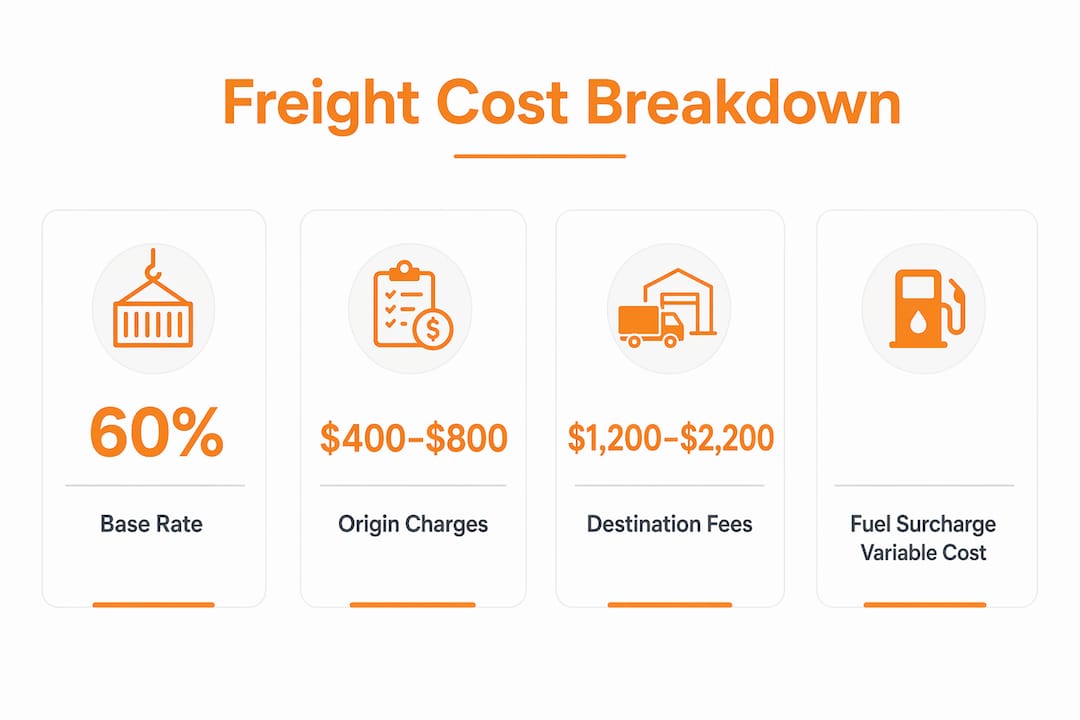
International freight cost is defined as the total sum of a base transit rate plus a layered stack of origin charges, destination charges, fuel surcharges, and operational fees that together determine what you actually pay to move goods across borders. Most e-commerce operators discover this the hard way: the quoted freight rate typically covers only 60–65% of the total cost, with the remaining 35–40% arriving as line items on a final invoice that nobody warned them about. Understanding international freight cost factors explained in full, not just the headline number, is the difference between healthy margins and a cash flow crisis. Carriers like Maersk on ocean lanes and Cathay Cargo on air routes each apply their own surcharge structures, which means the same shipment can carry a different final price depending on who moves it.
What are the main components of international freight cost?
The base freight rate is the largest single line item, but it is far from the only one. For ocean freight on a 40-foot container (FEU), the quoted rate covers the carrier’s cost to move the box from origin port to destination port. Everything before and after that voyage is billed separately, and those charges add up fast.
Origin port charges cover the work done before the vessel departs. Origin charges total roughly $400–$800 per 40-foot container and typically include terminal handling at around $240, documentation fees near $75, export customs clearance around $130, a bunker adjustment factor, and a security surcharge. Each of these is a real cost passed through by the port, the terminal operator, or the customs authority. None of them appear in the base freight quote.

Destination charges are where the real surprises live. US West Coast destination charges run $1,200–$2,200 per container and include terminal handling ($320 typical), customs clearance ($175), drayage to the warehouse or fulfillment center ($580), chassis rental, pier pass fees, and demurrage if pickup is delayed. That is a wide range, and the variance depends on port congestion, chassis availability, and whether your container gets flagged for a customs exam.
Here is a simplified cost breakdown for a typical trans-Pacific 40-foot container:
| Cost Component | Typical Range | Share of Total |
|---|---|---|
| Base ocean freight rate | $2,500–$4,000 | 60–65% |
| Origin port charges | $400–$800 | 8–12% |
| Destination charges | $1,200–$2,200 | 22–30% |
| Fuel and misc. surcharges | $200–$600 | 5–10% |
A $3,200 quoted freight rate can become a $5,125 final invoice after all charges are applied. That is a 60% variance on what you thought you were paying. Operators who budget only from the base quote routinely face cash flow shortages of $1,800–$2,500 per container, and at ten containers per year, that compounds into $18,000–$25,000 in recurring surprises.
Pro Tip: Always request a full door-to-door quote that itemizes every surcharge before committing to a shipment. A forwarder who cannot provide this level of detail is not a forwarder you want managing your inventory.
How do fuel prices and market volatility affect freight rates?
Fuel surcharges are a passthrough cost. Carriers do not absorb fuel price increases. They pass them directly to shippers, often with very short notice. This is the mechanism that makes all-in freight costs spike rapidly even when base rates stay flat.
The clearest recent example: jet fuel prices rose from approximately $95.95 to $197.00 per barrel between February and March 2026, driven by geopolitical tensions in the Middle East. Air cargo carriers responded by adding surcharges of up to 55 cents per kilogram. For a 500 kg air shipment, that is $275 in added cost that appeared on invoices within weeks of the price move. Sellers who had locked in air freight budgets for Q2 were caught short.
Ocean freight is not immune. Bunker adjustment factors on ocean lanes move with marine fuel prices, and carriers update them monthly or even weekly on volatile routes. The key dynamics that drive surcharge variability include:
- Route-specific fuel exposure: Trans-Pacific lanes carry different bunker costs than Asia-Europe routes due to distance and port call patterns.
- Carrier hedging posture: Carriers that hedge fuel aggressively pass through less volatility. Those that do not hedge pass through all of it, and the trend has been toward less hedging.
- Spot vs. contract rates: Contract shippers sometimes get surcharge caps; spot shippers absorb the full market rate.
- Surcharge update frequency: Some carriers update fuel surcharges weekly. Others do it monthly. Knowing your carrier’s schedule lets you time bookings more effectively.
Fuel surcharges are not a fee you negotiate away. They are a market reality. The only way to manage them is to monitor fuel price indices, understand your carrier’s update cycle, and build a surcharge buffer into every freight budget.
Pro Tip: Subscribe to the weekly fuel price reports from the International Air Transport Association (IATA) and the Baltic Exchange for ocean. Thirty minutes of reading per week can prevent thousands of dollars in budget overruns.
What operational fees and surcharges commonly surprise e-commerce shippers?
Demurrage and detention are the two fees that most reliably blindside first-time importers. They are not distance-based or weight-based. They are reliability costs tied to operational efficiency, meaning they reflect how quickly you move your container through the port system, not how far it traveled.
Demurrage accrues when a container sits at the terminal beyond the carrier’s free time window. Free time is typically 3–7 days, and once it expires, charges of $100–$500 per day begin accumulating in a tiered structure that escalates the longer the container sits. A container delayed by a customs exam, a chassis shortage, or a missed terminal appointment can rack up $1,500 in demurrage before you even realize the clock started.
Here is the sequence of operational fees that stack up in a typical US import scenario:
- ISF filing fee: The Importer Security Filing must be submitted 24 hours before vessel departure. Forwarders charge $25–$75 for this. Missing it triggers a $5,000 CBP penalty.
- Terminal handling charge (destination): Paid to the terminal operator for unloading and staging the container. Non-negotiable and port-specific.
- Customs clearance fee: Charged by your customs broker or forwarder for processing the entry. Typically $150–$250, but a customs exam adds $300–$1,000 in exam fees plus demurrage during the hold.
- Drayage: The truck move from port to warehouse. Rates vary by distance and chassis availability. Chassis shortages at ports like Los Angeles and Long Beach regularly push drayage costs 20–40% above standard rates.
- Chassis rental: If the drayage carrier does not own chassis, you pay a daily rental. This often runs $25–$50 per day and is separate from the drayage quote.
Pro Tip: Track your container’s vessel discharge date the moment it is confirmed. Schedule pickup within 48 hours of discharge to stay inside free time and avoid demurrage entirely. This single habit eliminates one of the most common and avoidable costs in international freight.
Spot truckload rates also factor into the final mile. Spot truckload rates rose approximately 20% year-over-year entering early 2026, driven by capacity contraction and rising operating costs. For Amazon FBA sellers routing containers to fulfillment centers, this directly affects the drayage component of destination charges.
How can e-commerce operators budget effectively for freight costs?
Budgeting for international freight means budgeting for the whole landed cost, not the base freight quote. Treat destination charges as a separate mini-budget within your freight planning because random variables like customs exams, chassis availability, and terminal appointment windows can cause large cost swings that are impossible to predict from the base rate alone.
Practical steps that reduce budget variance:
- Request itemized all-in quotes. Ask every forwarder to break out origin charges, destination charges, fuel surcharges, and any route-specific fees. A quote that shows only a base rate is incomplete.
- Build a 15–20% surcharge buffer. Add this to every freight budget line as a contingency for fuel spikes, demurrage, and exam fees. Adjust it based on historical variance for your specific trade lane.
- Negotiate free time extensions on volume. Carriers and terminals will extend free time from 5 days to 7 or even 10 days for shippers with consistent volume commitments. This reduces demurrage exposure significantly.
- Use a freight cost calculator. Tools like the shipping cost calculator from ForwarderOne let you model total landed cost including surcharges before you commit to a shipment.
- Monitor carrier surcharge schedules. Know when your carrier updates its fuel surcharge. Booking just after an update gives you the most accurate cost picture for that cycle.
- Work with forwarders who provide full transparency. The right freight forwarder from China will proactively flag surcharge changes and help you time shipments around cost spikes.
The true freight forwarding cost across borders is always higher than the initial quote. Accepting that reality and planning for it is the foundation of sound freight budgeting.
How do freight methods and shipment types influence cost factors?
The choice between Full Container Load (FCL), Less Than Container Load (LCL), and air freight determines not just the base rate but the entire surcharge structure and risk profile of your shipment.
FCL vs. LCL: FCL pricing is quoted per FEU (40-foot equivalent unit) and gives you exclusive use of the container. LCL pricing is billed per cubic meter or metric ton, averaging $80–$150 per CBM, and adds 5–10 days to transit time due to consolidation and deconsolidation at both ends. LCL also carries higher per-unit risk because your cargo shares a container with other shippers’ goods, and any customs hold on another shipper’s cargo can delay your entire shipment.
| Freight Mode | Cost Basis | Typical Transit (China to USA) | Best For |
|---|---|---|---|
| FCL (40ft) | Per container | 14–21 days | Large, regular volume shipments |
| LCL | Per CBM / metric ton | 20–30 days | Small or irregular shipments |
| Air freight | Per kilogram | 3–7 days | High-value or time-sensitive goods |
Air freight costs 5–12 times more per kilogram than ocean freight, with trans-Pacific rates running $4–$8 per kg under normal conditions and $8–$20 per kg during peak periods or fuel spikes. The math works for high-value electronics or seasonal goods where a stockout costs more than the freight premium. For low-margin, high-volume products, air freight destroys profitability.
For Amazon FBA sellers specifically, the DDP shipping model consolidates customs, duties, and delivery into a single workflow, which removes the destination charge complexity from your plate entirely. This is worth understanding before choosing a freight mode and service structure.
Key takeaways
International freight costs are defined by a multi-layer structure where the base rate covers only 60–65% of the total, and origin charges, destination fees, fuel surcharges, and operational costs make up the rest.
| Point | Details |
|---|---|
| Base rate is not the full cost | The quoted freight rate covers 60–65% of total cost; budget for the full landed cost. |
| Destination charges vary widely | US West Coast destination fees run $1,200–$2,200 per container depending on port conditions. |
| Fuel surcharges move fast | Jet fuel doubled in one month in early 2026, adding up to 55 cents/kg in air cargo surcharges. |
| Demurrage is avoidable | Schedule container pickup within 48 hours of vessel discharge to stay inside free time windows. |
| Freight mode shapes total cost | Air freight costs 5–12x more per kg than ocean but cuts transit to 3–7 days for time-sensitive goods. |
What I’ve learned about freight costs that most guides skip
The biggest misconception I see among e-commerce operators is treating the freight quote as the freight cost. It is not. It is the starting point of a negotiation with reality, and reality always adds line items.
Destination charges are where most sellers get hurt, and they get hurt repeatedly because they never build a separate budget for them. I have seen operators running ten containers a year absorb $20,000 in annual demurrage and exam fees that never appeared in their unit economics. They were profitable on paper and cash-flow negative in practice. The fix is not complicated. It requires treating destination charges as their own cost center, tracking free time religiously, and choosing forwarders who send proactive alerts rather than surprise invoices.
Fuel surcharge volatility is the other underestimated factor. The 2026 jet fuel spike was not a black swan event. Fuel markets move on geopolitical news, refinery capacity, and seasonal demand, and they move fast. Sellers who had air freight in their Q2 plans and no surcharge buffer took a direct hit to margin. The answer is not to avoid air freight. It is to model surcharge scenarios before committing, not after.
My strongest recommendation: build a freight cost model that separates base rate, origin charges, destination charges, and a fuel/surcharge buffer into four distinct budget lines. Review it every quarter. The sellers who do this consistently are the ones who scale without freight surprises derailing their cash flow.
— Keven
How ForwarderOne takes the guesswork out of freight costs
Managing the full stack of international freight cost factors is exactly what ForwarderOne is built for. The platform specializes in FBA and DDP freight forwarding from China, Korea, and Mexico to US fulfillment centers, with all-in pricing that covers customs, duties, and delivery in a single quote. There are no surprise destination charge invoices and no fuel surcharge ambushes.
ForwarderOne provides dedicated account managers who monitor surcharge schedules, track container free time, and flag cost changes before they hit your invoice. For sellers who want to model costs before booking, the freight cost calculator gives a full landed cost estimate including surcharges. With over 99% on-time delivery, ForwarderOne keeps your FBA inventory moving reliably, especially during peak seasons when freight volatility is highest. If you want shipping cost reduction built into your logistics model from day one, this is where to start.
FAQ
What does international freight cost actually include?
International freight cost includes the base transit rate plus origin port charges, destination charges, fuel surcharges, customs clearance fees, drayage, and operational fees like demurrage. The base rate typically covers only 60–65% of the total invoice.
Why is my final freight invoice higher than the quote?
Freight quotes rarely include destination charges, fuel surcharges, ISF filing fees, chassis rental, or demurrage. These add-ons routinely increase the final invoice by 35–40% above the quoted rate.
How do I calculate total landed freight cost?
Add the base freight rate to origin charges ($400–$800), destination charges ($1,200–$2,200 for US West Coast), fuel surcharges, and a 15–20% contingency buffer for operational fees. Use a freight calculator to model this before booking.
When does air freight make financial sense for e-commerce?
Air freight at $4–$8 per kg makes sense for high-value or time-sensitive goods where a stockout or delay costs more than the freight premium. For low-margin, high-volume products, ocean FCL is almost always the better choice.
What is the fastest way to reduce demurrage charges?
Track your container’s vessel discharge date and schedule pickup within 48 hours of discharge to stay inside the carrier’s free time window. Demurrage charges of $100–$500 per day begin the moment free time expires.
Need a freight quote with the full landed-cost picture?
Share the product category, carton count, weights, dimensions, supplier address and delivery target. ForwarderOne will separate freight, customs, duties and destination fees before pickup.