Shipping to Mexico is fully doable for U.S. ecommerce sellers, but it hinges on three things you cannot skip: a Mexican importer RFC (or a Mexican importer of record), a licensed customs broker for anything that isn’t a small, compliant courier shipment, and a pre-shipment check against Mexico’s product standards. Before you book freight, run a tariff and NOM check, line up your Mexican IOR or broker partner, and confirm whether your goods qualify for USMCA treatment. Get those three right, and everything else in this guide is just execution.
TL;DR:
- Ensuring a Mexican RFC and an approved customs broker are in place before shipping is crucial to avoid formal entry delays and extra costs.
- USMCA-qualified goods over $117 with origin proof can clear duty-free at 19%, while non-USMCA shipments face a 33.5% simplified customs rate, affecting profitability.
- Proper pre-shipment checks for NOM standards, permits, and accurate documentation prevent holds; most failures stem from missing RFC, incorrect invoice values, or absent permits.
- Shippers often underestimate the impact of missing or incorrect RFCs, which shifts shipments from quick courier clearance to lengthy formal entries requiring a licensed broker.
- Managed DDP shipping services can streamline customs clearance and reduce administrative overhead, especially for small to medium-sized sellers expanding into Mexico.
What Are the Key Facts About Mexico Customs for Ecommerce?
Mexico’s low-value shipment rules have changed recently, and the threshold amounts matter for clearance.
- Express shipments can qualify for tax-free treatment up to a low-value threshold, and USMCA-origin goods can go duty-free up to a higher threshold under specific conditions, according to Trade.
- Since August 15, 2025, Mexico’s global simplified rate sits at 33.5% for non-USMCA shipments and 19% for qualifying USMCA entries over $117.
- The Manifestación de Valor (MV) value declaration became mandatory late in 2025.
- Courier clearance rules tightened in late 2024, requiring new importer and consignee data on shipments.
The number that trips up most sellers: miss the RFC field on your paperwork, and a shipment that should clear quickly gets bumped into formal customs entry, according to Preferred Shipping’s summary of the October 2024 rule changes. SAT (Mexico’s tax authority) and ANAM (the National Customs Agency) enforce these rules and publish updated guidance as changes roll out.
Who Can Import Into Mexico? RFC and Importer of Record Explained
Mexico will not let a foreign company act as the importer of record. Every import declaration needs a Mexican RFC (Registro Federal de Contribuyentes, the Mexican tax ID) tied to the goods, and that ID has to belong to a Mexican legal entity or resident, according to trade.gov’s ecommerce compliance guide. If you don’t have one, you have three realistic paths:
- Contract a Mexican importer-of-record (IOR) service that files under its own RFC on your behalf.
- Partner with a Mexican distributor or trading company that already imports and resells.
- Incorporate in Mexico and register your own RFC, which makes sense mainly at higher volumes.
Whoever holds the RFC also holds legal liability for the declaration. That’s why a missing RFC doesn’t just cause a paperwork delay. It knocks the shipment out of the simplified courier lane entirely and forces a full formal entry, which costs more and takes longer.
What Documents Does a Pedimento Require?
The pedimento is Mexico’s official customs declaration, and it only gets accepted when the supporting paperwork lines up. Prepare these before you ship:
- Commercial invoice with product description, HS code, unit values, and buyer/seller details, ideally in Spanish or bilingual format.
- Detailed packing list matching the invoice line by line.
- Bill of lading or air waybill.
- RFC of the Mexican importer of record.
- Certificate of origin if you’re claiming USMCA preferential duty.
- Any sector-specific permits (COFEPRIS, SENASICA, etc.) tied to the product category.
The Manifestación de Valor (MV) filed through VUCEM, Mexico’s single-window trade portal, now carries mandatory value declaration data as of December 2025. Most shipment holds trace back to one of three gaps: mismatched invoice values, a missing certificate of origin, or an RFC that was never entered at the airway-bill stage.
How Are Duties and IVA Calculated on Imports to Mexico?
Mexico’s customs valuation starts with the transaction value on your invoice, and the Manifestación de Valor now formally ties any adjustments (freight, insurance, royalties) into that number before it hits the pedimento. From there:
- Standard IVA (value-added tax) applies on top of the customs value plus duty.
- Duty rates depend on your HS code and Mexico’s own NICO tariff fraction, which can differ from the US HS code even for identical products, so confirm the exact line with a broker.
- USMCA preferential duty (0% on qualifying goods) requires proof of origin data matching USMCA’s minimum data elements, not just a stamped certificate.
A quick landed-cost contrast: a $200 shipment with confirmed USMCA origin can clear at 0% duty plus IVA. The identical shipment without origin proof gets taxed at the global simplified rate of 33.5% on top of IVA. That gap alone often decides whether a Mexico expansion is profitable.
Which Mexican Standards and Permits Apply to Your Products?
Non-tariff barriers stop more ecommerce shipments than tariffs do. Mexico’s Official Standards (NOMs) require Spanish-language labeling, and NOM-050 and NOM-051 specifically govern commercial and food-product labeling, respectively. Beyond labeling, certain categories need sector permits before they ever reach the border:
- Cosmetics, supplements, and medical devices generally require COFEPRIS registration.
- Food, plants, and animal-derived products fall under SENASICA oversight.
- Electronics and toys often need NOM compliance certificates specific to that product class.
- Some categories require registration in Mexico’s Padrón de Importadores (importers registry) before the RFC can even be used to import them, according to trade.gov’s guidance on prohibited and restricted imports.
Shipping without the right permit doesn’t just mean a delay. It usually means seizure or return at the seller’s cost.
Pro Tip: Check your product’s NOM and permit status before you quote pricing to customers, not after you’ve already sold the item. A COFEPRIS or SENASICA hold can sit for weeks while your customer is asking where their order is.
How Does Mexico’s Customs Clearance Process Actually Work?
Two lanes exist, and which one your shipment lands in depends on value, documentation, and product type.
- Simplified courier lane: low-value, compliant shipments with a valid RFC and complete data clear in hours to a couple of days.
- Formal pedimento entry: anything missing RFC, requiring a permit, or exceeding value thresholds gets routed here, adding days and requiring a licensed agente aduanal (customs broker).
- Broker validation: the broker checks tariff classification, origin claims, and MV data before filing, since importer and broker now share liability for errors, an insight noted in trade.gov’s customs regulations guide.
Expect brokerage fees, potential storage charges if a shipment sits, and inspection fees if ANAM flags it for physical review. A compliant express shipment might clear same-day; a formal entry missing paperwork can stretch past a week.
Pro Tip: Ask your broker upfront which customs office your goods will route through. Certain tariff lines are only processed at specific offices, and picking the wrong routing during quoting can add days you didn’t budget for.
What Does It Cost to Land a Product in Mexico?
Landed cost is the number that actually determines your Mexico margin, and it’s more than product price plus duty.
Landed cost = product cost + freight + insurance + duty + IVA + broker fees + domestic delivery + marketplace fees.
| Cost component | USMCA-qualifying (0% duty) | Non-USMCA / no origin proof |
|---|---|---|
| Product cost | $200 | $200 |
| Freight + insurance | Freight and insurance | Freight and insurance |
| Duty | $0 | 33.5% simplified rate duty |
| IVA | Applied on value + duty | Applied on value + duty |
| Broker/handling fees | Varies by shipment | Varies by shipment |
- Marketplaces often collect IVA and some fees at checkout for cross-border sales; courier and delivery fees are more commonly collected at the door.
- The gap between the two columns above is exactly why confirming USMCA origin evidence before shipping matters more than almost any other single decision.
Your Pre-Shipment Checklist Before Booking Freight to Mexico
Run through this before your first pallet or box leaves the warehouse:
- Confirm the correct HS code and Mexican NICO tariff line for your product.
- Gather USMCA origin evidence if you plan to claim preferential duty.
- Run a NOMs and sector-permit check (COFEPRIS, SENASICA, or Padrón de Importadores as applicable).
- Secure a Mexican RFC or partner with a Mexican importer of record.
- Prepare a Spanish-language commercial invoice with complete product detail.
- Line up a licensed customs broker and confirm VUCEM/MV data transmission timing.
- Decide your routing strategy: consolidate inventory in the U.S. and ship in bulk, or hold local stock in Mexico for faster delivery, a model many U.S. brands use to cut per-unit landed cost, according to BringGo Ship’s market-entry guide.
- Confirm your returns process and a local point of contact before your first sale.
Pro Tip: Treat the RFC step as a hard gate, not a formality. If it’s missing when the airway bill is created, the shipment can’t use the simplified lane at all and has to be refiled as a formal entry, which often doubles your admin time.
What Sellers Consistently Get Wrong About Mexico Customs
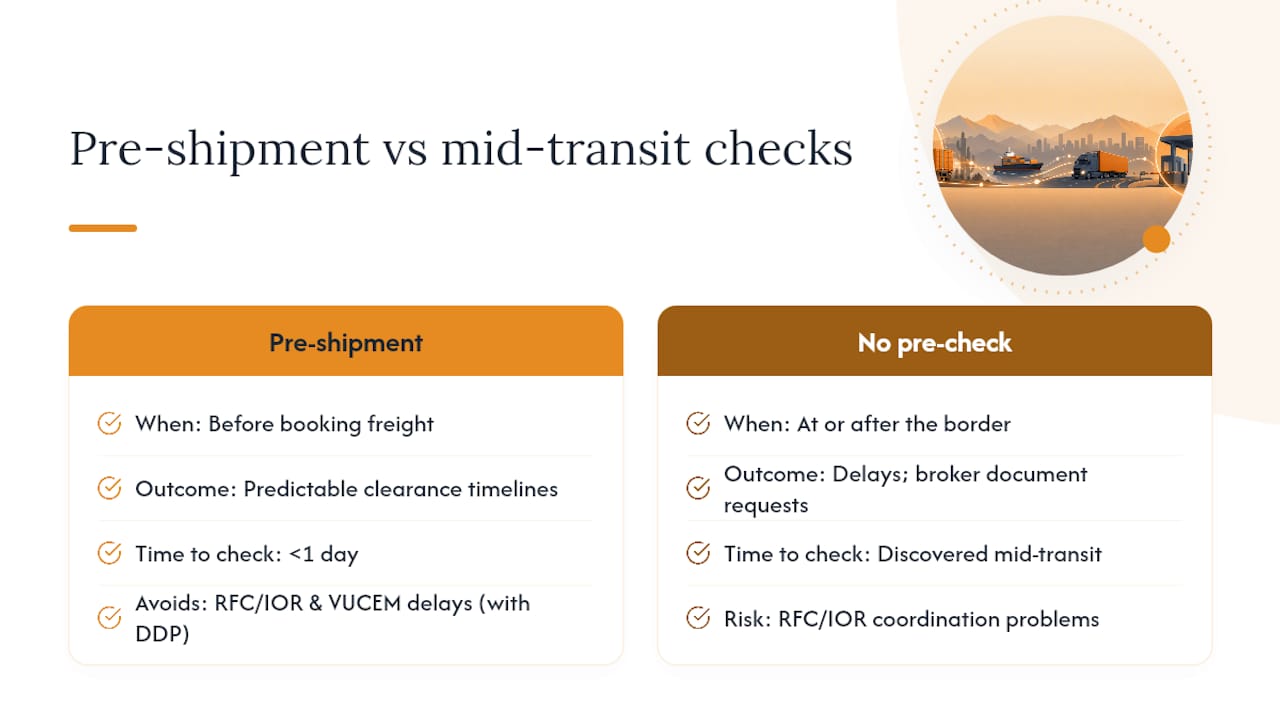
Most compliance failures we see aren’t exotic. They’re the basics: a seller assumes their U.S. HS code will translate cleanly to Mexico’s NICO system, or they wait until a shipment is already at the border to check if their product needs a COFEPRIS permit. Both mistakes are entirely preventable with a pre-shipment check that takes less than a day.
Some logistics platforms offer DDP workflows to help sellers avoid delays related to RFC/IOR coordination and VUCEM filings. Sellers who run the compliance check before booking freight typically see predictable clearance timelines; sellers who skip it usually find out the hard way, mid-transit, when a broker sends back a document request.
— Keven
Ship to Mexico Without Managing Customs Yourself
There’s a real cost to handling Mexico customs on your own: sourcing an IOR, vetting a broker, tracking VUCEM filing deadlines, and hoping your NOM research was thorough enough. Some DDP (Delivered Duty Paid) services coordinate customs clearance, duties, and final delivery within a single workflow to simplify shipping.
If you’re a small or mid-size Amazon seller sending your first shipment into Mexico, or you already sell in the U.S. and want to expand without hiring a customs team, a managed DDP approach removes the RFC and broker guesswork entirely. Sellers running high volume or complex SKUs benefit most, since the coordination overhead scales fast once you’re shipping regularly. ForwarderOne’s China to Mexico shipping service walks through how DDP works for FBA-bound and direct-to-consumer inventory alike. Check your product’s routing and get a quote through ForwarderOne’s FBA freight forwarding page before you book your next shipment.
Where to Verify Mexico’s Customs Rules Directly
- Trade covers documentation standards and enforcement contacts.
- Trade explains RFC requirements and broker liability.
- Trade lists NOMs, permits, and the Padrón de Importadores.
- Avalara’s de minimis threshold table is a quick reference for low-value shipment rules.
Sources
- Trade
- Trade
- Trade
- Mexico regulatory changes to informal (low value) shipments | Preferred Shipping
- De minimis threshold table - Avalara
FAQ
What Are the Import Duties From Mexico to the USA?
That’s a separate flow from shipping into Mexico. Goods moving from Mexico into the U.S. depend on USMCA origin status and U.S. tariff classification, and rates vary by HS code rather than a single flat percentage.
What Are the Customs Requirements for Shipping to Mexico?
You need a Mexican RFC (or a Mexican importer of record), a compliant commercial invoice, proof of origin for USMCA claims, and any required NOM or sector permits (COFEPRIS, SENASICA) before the shipment can clear.
What Are the Customs Tariffs for Mexico in 2026?
Non-USMCA shipments face a global simplified rate of 33.5%, while qualifying USMCA shipments over $117 face 19%, based on rates that took effect August 15, 2025. IVA applies on top of the customs value plus duty in both cases.
What Are Common Mistakes at Mexico Customs?
The most frequent errors are missing the RFC field, submitting an invoice that doesn’t match Manifestación de Valor data, and shipping products without confirming NOM or permit requirements first. Any one of these can push a shipment from a same-day courier clearance into a formal entry that takes days longer.
Can ForwarderOne Handle Mexico Customs for My Shipments?
Some DDP services coordinate RFC/IOR requirements, broker filing, and VUCEM documentation within one shipping workflow instead of leaving each component to the seller.
Need Mexico customs handled before freight moves?
ForwarderOne coordinates DDP routing, customs documentation, duties, and delivery so Mexico expansion does not become a border paperwork project.