
Customs valuation sets the monetary basis used to calculate ad valorem duties, import taxes, and trade statistics on every shipment entering the United States. Three things matter most:
- Transaction value is the primary method. Under the WTO Valuation Agreement, the price actually paid or payable for goods sold for export to the U.S. is the starting point. All other methods are fallbacks, applied only when transaction value cannot be used.
- The importer of record carries the compliance burden. U.S. Customs and Border Protection (CBP) expects every importer to exercise “reasonable care” when declaring value, which means keeping supporting documents before the shipment arrives, not after a question is raised.
- Missing or suspect documentation triggers real consequences. CBP can issue a Form 28 (Request for Information), open a focused assessment audit, reliquidate the entry with additional duties owed, and in serious cases refer the matter for civil or criminal penalties according to U.S. customs enforcement procedures.
Key Takeaways
Transaction value is the legal foundation of customs valuation in the U.S., and every importer of record must be able to substantiate it with documents before CBP asks.
| Point | Details |
|---|---|
| Transaction value is primary | The price paid or payable, plus statutory adjustments, is the starting point for every U.S. entry. |
| Add assists, royalties, and packing | Omitting these statutory additions is the most common cause of undervaluation and CBP inquiries. |
| Reasonable care is a legal standard | CBP expects importers to review invoices, retain records for five years, and consult brokers on complex transactions. |
| Binding rulings reduce uncertainty | Submit transaction details to CBP in advance to get a written valuation determination before goods ship. |
| ForwarderOne manages DDP compliance | ForwarderOne’s end-to-end DDP service covers customs clearance, duty calculation, and valuation support for Amazon FBA sellers. |
Why does customs valuation matter beyond paying the right duty?
The importance of customs valuation reaches further than the duty bill on any single shipment. Customs value is the taxable base for ad valorem duties, meaning a 10% tariff rate applied to a $50,000 declared value produces a $5,000 duty, while the same rate on a correctly adjusted $60,000 value produces $6,000. That $1,000 gap is not a rounding error; it is the difference between a compliant entry and an underpayment that CBP can recover for up to five years.
Beyond duties, the declared value feeds into U.S. trade statistics that inform policy decisions, and it can affect whether goods qualify for preferential tariff treatment under a Free Trade Agreement. The USTR is explicit: arbitrary valuation uplifts by importing countries can effectively negate negotiated tariff concessions, which is precisely why the WTO Valuation Agreement exists. A fair, uniform system protects U.S. exporters abroad just as it governs what foreign suppliers declare when shipping into the U.S.
Key policy point: As Trade, the Valuation Agreement’s goal is a neutral, rules-based system that benefits both businesses and customs administrations by removing discretionary or arbitrary assessments.
The practical benefits for importers are concrete:
- Predictable duty costs that can be built into landed-cost models
- Reduced risk of post-entry audits triggered by values that look inconsistent with market prices
- Cleaner FTA origin and value-content calculations
- Accurate trade data that supports industry-level advocacy
Who is responsible in the U.S.: CBP, the importer of record, and reasonable care
CBP administers customs valuation under Title 19 of the U.S. Code, which codifies CBP’s authority over entry valuation, reliquidation, and penalty assessment. The importer of record is the party legally responsible for the accuracy of every entry — typically the U.S. buyer, the consignee, or a licensed customs broker acting under a power of attorney.
CBP’s “informed compliance” principle, detailed in CBP’s valuation guidance, holds that CBP will publish clear rules and guidance, and in return importers must exercise reasonable care. That standard is not vague goodwill; it has practical content:
- Reviewing the commercial invoice against the purchase order and contract before filing
- Identifying and adding statutory adjustments (assists, royalties, packing) before declaring value
- Retaining supporting documents for at least five years from the date of entry
- Consulting a licensed customs broker or attorney when valuation facts are complex
Enforcement actions CBP can take when reasonable care is not met include:
- Form 28 (Request for Information): a written inquiry asking the importer to explain or document the declared value
- Focused Assessment or Compliance Measurement Audit: a structured review of entry records, often covering multiple shipments
- Reliquidation: CBP re-determines the correct duty and issues a bill for the difference, plus interest
- Civil penalties: under 19 U.S.C. § 1592, penalties range from the unpaid duties up to four times the unpaid duties depending on culpability (negligence, gross negligence, or fraud)
- Criminal referral: reserved for deliberate fraud, such as systematic invoice falsification
What is transaction value and what gets added to it?
Transaction value is the price actually paid or payable for the merchandise when sold for export to the United States, adjusted by specific statutory additions. It is the primary method under the WTO Valuation Agreement and the method CBP applies to the vast majority of U.S. entries.
The CBP Valuation Encyclopedia lists the standard additions that must be included when not already in the invoice price:
- Assists: molds, dies, tooling, artwork, or design work provided by the buyer to the seller free of charge or at reduced cost. These often do not appear on a commercial invoice at all, which is one of the most common valuation errors.
- Royalties and license fees the buyer must pay as a condition of sale
- Packing costs (labor and materials) not included in the invoice price
- Selling commissions paid by the buyer
- Proceeds of resale that accrue to the seller
- International freight and insurance when required by the trade terms
For transaction value to be accepted, the sale must meet four conditions: the goods must be sold for export to the U.S., there must be no restriction on disposition, the sale price must not be subject to a condition that prevents determining value, and no part of the proceeds of resale can accrue to the seller without adjustment. Supporting documents to have ready: the commercial invoice, the purchase order or contract, and proof of payment (wire transfer confirmation or bank statement).
The six-method hierarchy: when does CBP move past transaction value?
The WTO Valuation Agreement prescribes a strict sequence. CBP works through it in order, stopping at the first method that can be applied. Skipping a method or applying them out of sequence is not permitted.
| Method | Name | When it applies |
|---|---|---|
| 1 | Transaction value | Price paid or payable for the specific shipment, with adjustments |
| 2 | Transaction value of identical goods | Same goods, same producer, same country, exported around the same time |
| 3 | Transaction value of similar goods | Goods that closely resemble the imported goods in materials and function |
| 4 | Deductive value | Resale price in the U.S. market, working backward after deducting profit, overhead, and duties |
| 5 | Computed value | Manufacturer’s cost of production plus profit and general expenses |
| 6 | Fallback (flexible) | Any reasonable means consistent with WTO principles when methods 1–5 all fail |
Methods 2 and 3 require finding comparable sales data for goods exported at roughly the same time, which is often unavailable for specialized or custom products. Method 4 works backward from U.S. resale prices and requires reliable domestic sales data. Method 5 is the least-used in practice: as the WTO notes, computed value requires detailed manufacturing cost data that manufacturers typically treat as confidential, making it difficult for importers to obtain. The IMF’s analysis of valuation implementation confirms that methods beyond transaction value create significant practical challenges, particularly for smaller importers without access to comparable market data.
Pro Tip: An importer may request that CBP apply Method 5 (computed value) before Method 4 (deductive value) — this reversal is explicitly allowed under the Agreement and can be advantageous when the importer has access to manufacturer cost data but lacks reliable U.S. resale figures.
Common valuation adjustments and related-party complications
Related-party transactions — sales between a parent company and its subsidiary, or between a buyer and seller with common ownership — receive heightened scrutiny. The relationship alone does not disqualify transaction value, but CBP will examine whether the relationship influenced the price.

The WCO Guide to Customs Valuation and Transfer Pricing addresses this directly: transfer-pricing documentation prepared for tax purposes can be relevant in a customs valuation examination, though the two frameworks do not align perfectly. An arm’s-length price for tax purposes is not automatically accepted as the customs value.
Documents that help demonstrate an arm’s-length price in related-party transactions:
- Transfer pricing studies or intercompany pricing policies
- Comparable uncontrolled price analyses
- Evidence that the price approximates the transaction value of identical or similar goods sold to unrelated buyers
- Profit-margin analyses showing the price falls within industry norms
For non-related-party transactions, the most frequently overlooked adjustments involve assists. A U.S. buyer who provides a Chinese manufacturer with molds, packaging artwork, or proprietary tooling at no charge must add the value of those assists to the invoice price. The cost to the buyer (or fair market value if the assist was produced internally) is the figure to add.
When does CBP challenge a declared value?
The sequence from initial doubt to enforcement follows a predictable path, and knowing it helps importers respond effectively.
- Trigger: CBP’s automated targeting system or a reviewing officer flags a declared value as inconsistent with known market prices, prior entries, or industry benchmarks.
- Form 28 (Request for Information): CBP issues a written request for documents supporting the declared value. The importer typically has 30 days to respond.
- Form 29 (Notice of Action): If the response is insufficient, CBP issues a proposed rate advance, stating the adjusted value it intends to use.
- Reliquidation: CBP officially re-liquidates the entry at the adjusted value. Additional duties, plus interest, become immediately payable.
- Penalty assessment: If undervaluation results from negligence, gross negligence, or fraud, a penalty notice may be issued under 19 U.S.C. § 1592. Penalties for negligence can reach the unpaid duties; fraud penalties can reach four times the unpaid duties.
- Criminal referral: Systematic falsification of invoices or deliberate undervaluation schemes can be referred to Homeland Security Investigations (HSI) for criminal prosecution.
The WCO confirms that customs administrations have the legal authority to reject a declared value when there is persistent, well-founded doubt, and that the importer bears the burden of providing documentation to resolve that doubt.
Numeric example: how customs value becomes an ad valorem duty
Here is a straightforward calculation showing how the role of customs valuation translates directly into dollars owed.
- Invoice price: $40,000 (price paid to the Chinese manufacturer, FOB Shanghai)
- Add: assists (molds provided by the U.S. buyer, amortized to this shipment): $2,500
- Add: royalties (license fee paid by buyer as a condition of sale): $1,500
- Customs value: $44,000
- HTSUS ad valorem duty rate (illustrative; check the actual rate for your product): 7.5%
- Duty owed: $44,000 × 7.5% = $3,300
Had the importer declared only the invoice price of $40,000, the duty would have been $3,000. The $300 difference is an underpayment — and if CBP discovers it, interest accrues from the date of entry. On a high-volume import program, the same omission across dozens of shipments compounds quickly. Always verify the applicable HTSUS rate for your specific product classification; the rate above is illustrative only.
Documentation checklist: what should importers keep to support declared value?
Good recordkeeping is the practical solution to avoiding persistent doubt. The WCO recommends that importers maintain exhaustive documentation as the primary defense against valuation challenges.
- Commercial invoices (showing unit price, quantity, description, and trade terms)
- Purchase orders and sales contracts
- Proof of payment (bank wire confirmations, account statements)
- Freight and insurance invoices
- Packing lists
- Bills of lading or air waybills
- Assist documentation (cost records, purchase invoices for molds, tooling, or artwork)
- Royalty or license agreements
- Transfer pricing studies for related-party transactions
- Any correspondence with the seller that discusses price, discounts, or conditions of sale
CBP expects these records to be retained for five years from the date of entry. For e-commerce sellers importing from China, the U.S. customs clearance process requires all of this documentation to be available at the time of entry, not assembled afterward.
Pro Tip: If you lack direct cost data for an assist (for example, tooling your manufacturer produced and you cannot obtain an invoice), reconstruct the cost using quotes from comparable suppliers, your internal accounting records, or a written explanation of how the value was estimated. CBP accepts reasonable proxies when the methodology is documented and transparent.
Practical steps to reduce valuation risk
Reducing customs valuation risk does not require a legal team. It requires consistent process.
- Prepare complete, accurate invoices that reflect the actual transaction, including all conditions of sale. An invoice that omits assists or royalties is not just incomplete; it is a potential 19 U.S.C. § 1592 violation.
- Work with a licensed customs broker who understands valuation rules. A broker can identify adjustments you may have missed and flag related-party issues before entry. The role of a customs broker in valuation support is often underestimated by first-time importers.
- Request a binding advance ruling from CBP when the facts are clear but the valuation treatment is uncertain. CBP’s ruling program lets importers submit the transaction details and receive a written determination before the goods ship. That ruling is binding on CBP at the port of entry.
- Review your HTSUS classification and duty rate before each new product launch. The rate determines how much every dollar of customs value costs you in duty.
- Audit your own entries periodically. Comparing declared values across shipments of the same product from the same supplier will surface inconsistencies before CBP does.
How does customs valuation affect FTA eligibility?
Free Trade Agreements such as USMCA, KORUS, and others use customs value as an input into rules-of-origin calculations, particularly regional value content (RVC) tests. If the declared customs value of a component is understated, the RVC calculation may show the good qualifies for preferential treatment when it actually does not — or vice versa.
The impact of customs valuation on FTA claims is direct: an incorrect customs value can cause a good to fail its origin test, triggering denial of the preferential tariff rate and potential recovery of the duty difference. Importers claiming FTA benefits should cross-check their customs values against the RVC formula for each product, and retain the supporting documents for both the valuation and the origin claim.
How can importers get a valuation determination in advance?
CBP’s binding ruling program, administered through the National Commodity Specialist Division and the Office of Regulations and Rulings, allows any importer to request a written ruling on how CBP will treat a specific transaction. For valuation, this means submitting the transaction details, the relationship between buyer and seller, any assists or royalties, and the proposed customs value methodology.
A binding ruling is CBP’s written commitment to apply a specific valuation treatment to that transaction. It eliminates uncertainty, speeds clearance, and provides a documented defense if the entry is later reviewed. Trade.gov guidance recommends advance rulings particularly for high-value or related-party transactions where the valuation method is not straightforward. The ruling request is submitted through CBP’s online ruling portal (rulings.cbp.gov) and typically takes several weeks to process.
What are your rights when CBP disputes your declared value?
When CBP issues a Form 29 (Notice of Action) proposing a value adjustment, the importer has the right to respond before reliquidation. The dispute resolution path in the U.S. follows this sequence:
After reliquidation, the importer may file a protest with CBP under 19 U.S.C. § 1514 within 180 days of the liquidation date. The protest asks CBP to reconsider its determination. If CBP denies the protest, the importer can escalate to the Court of International Trade (CIT), a federal court with exclusive jurisdiction over customs matters. From the CIT, further appeal goes to the Court of Appeals for the Federal Circuit, and ultimately to the Supreme Court.
Most disputes are resolved at the protest stage. Importers with strong documentation and a clear legal argument often succeed at that level without litigation. The key is responding promptly and completely to Form 28 inquiries — a well-documented response at that early stage frequently prevents reliquidation entirely.
What happens when you get the customs value wrong?
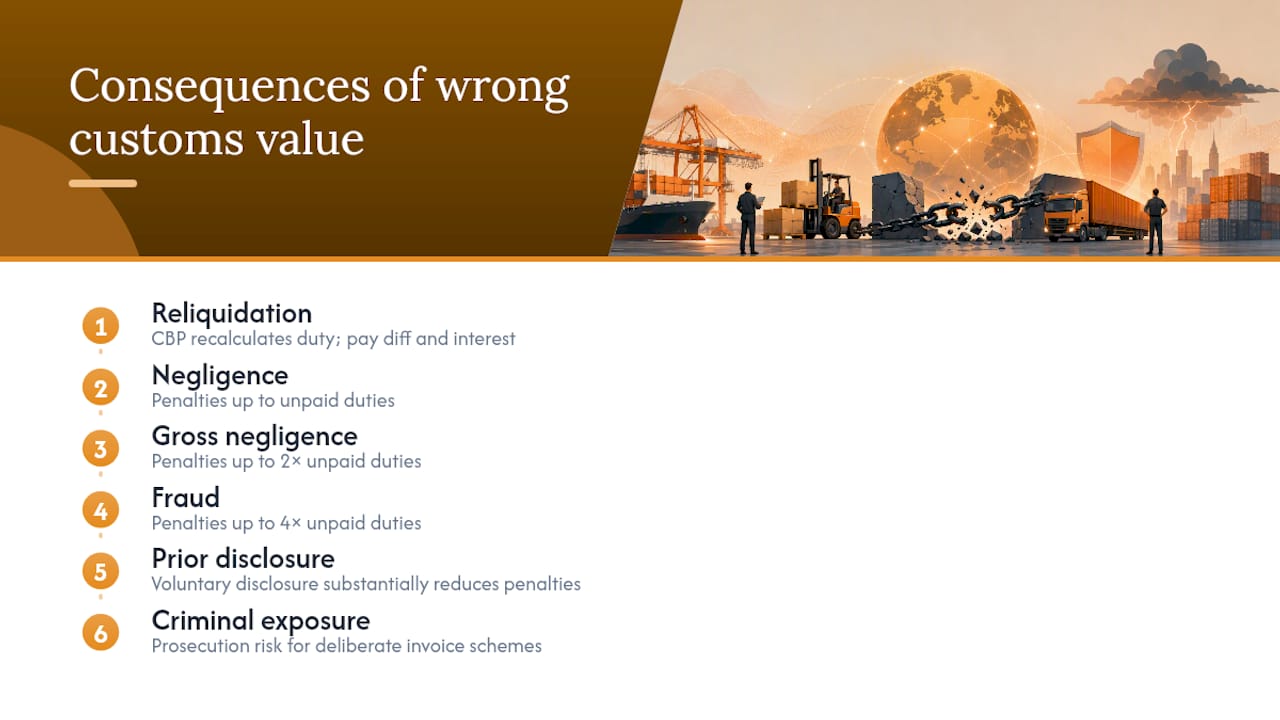
Undervaluation, whether intentional or accidental, carries a tiered set of consequences under 19 U.S.C. § 1592.
Reliquidation is the baseline outcome: CBP recalculates the duty on the correct value and bills the importer for the difference plus interest. There is no cap on how far back CBP can look within the statute of limitations.
Civil penalties are assessed based on culpability. Negligence (you should have known) can result in penalties up to the unpaid duties. Gross negligence (you showed reckless disregard) can reach two times the unpaid duties. Fraud (intentional misrepresentation) can reach four times the unpaid duties. CBP does offer a prior disclosure process: if an importer voluntarily discloses a violation before CBP has initiated a formal inquiry, penalties are substantially reduced.
Criminal exposure arises when the facts show deliberate, systematic invoice falsification or a scheme to defraud the U.S. government. This is not a theoretical risk for e-commerce sellers who use “double invoicing” (one invoice for customs, a different one reflecting the real price). HSI actively investigates these schemes, and prosecutions do occur.
The practical takeaway: a valuation error caught internally and corrected through prior disclosure costs far less than one discovered by CBP during an audit.
Why valuation accuracy is worth the effort
Most importers I see run into trouble not because they are dishonest, but because they conflate landed cost with customs value. Landed cost is an internal accounting concept that includes freight, insurance, duties, and overhead. Customs value is a legal concept defined by statute: the price actually paid or payable, plus specific statutory additions. Treating your internal cost model as your customs value is one of the most common and expensive mistakes in import compliance.
The second pattern I notice is that sellers treat valuation as a one-time setup task. They get the first shipment right, then stop reviewing as the product mix changes, assists accumulate, or the supplier relationship shifts to a related party. Valuation is a living compliance obligation, not a checkbox.
The business case for getting it right is straightforward: fewer CBP inquiries mean faster clearance, predictable duty costs make pricing decisions easier, and clean valuation records make FTA claims defensible. Start with a simple valuation checklist for your top five products by import value. That alone will surface most of the risk.
ForwarderOne handles customs valuation complexity for Amazon sellers
Customs valuation errors are expensive, but they are also preventable when you have the right team managing your entries. ForwarderOne’s DDP shipping service from China to the U.S. covers customs clearance, duty calculation, and HTS classification in a single workflow, so you are not assembling documents under pressure at the port.
For small and mid-sized Amazon FBA sellers, ForwarderOne assigns a dedicated account manager who reviews your commercial invoices, flags missing adjustments like assists or royalties before entry, and coordinates with your customs broker on valuation questions. The FBA freight forwarding service is built specifically for sellers moving inventory from China to U.S. fulfillment centers, with over 99% on-time delivery and full DDP coverage so duties are never a surprise. If you have a related-party transaction or a high-value shipment where valuation treatment is uncertain, the team can help you prepare the documentation needed to request a binding advance ruling before your goods ship. Get a quote at ForwarderOne.com and have your next shipment’s valuation handled correctly from the start.
Need a clearer landed-cost plan?
ForwarderOne coordinates supplier pickup, DDP customs clearance, duty payment, FBA prep details, and final delivery under one shipment plan.