
ForwarderOne is the strongest alternative to pinnaclefreight.com for small and mid-sized Amazon sellers shipping from China or Korea to US fulfillment centers. Three things set it apart: a true DDP service that covers customs, duties, and last-mile delivery in one workflow; built-in FBA labeling and compliance support; and a dedicated account manager who stays with your account through peak season.
TL;DR:
- ForwarderOne handles DDP end-to-end, so you never chase a customs broker separately.
- FBA labeling, carton marking, and compliance prep are included, not add-ons.
- Over 99% on-time delivery and a named account manager reduce the risk of Amazon check-in failures.
- To start: request a DDP quote or trial shipment directly at ForwarderOne.com.
What are the best pinnaclefreight.com alternatives for FBA sellers?
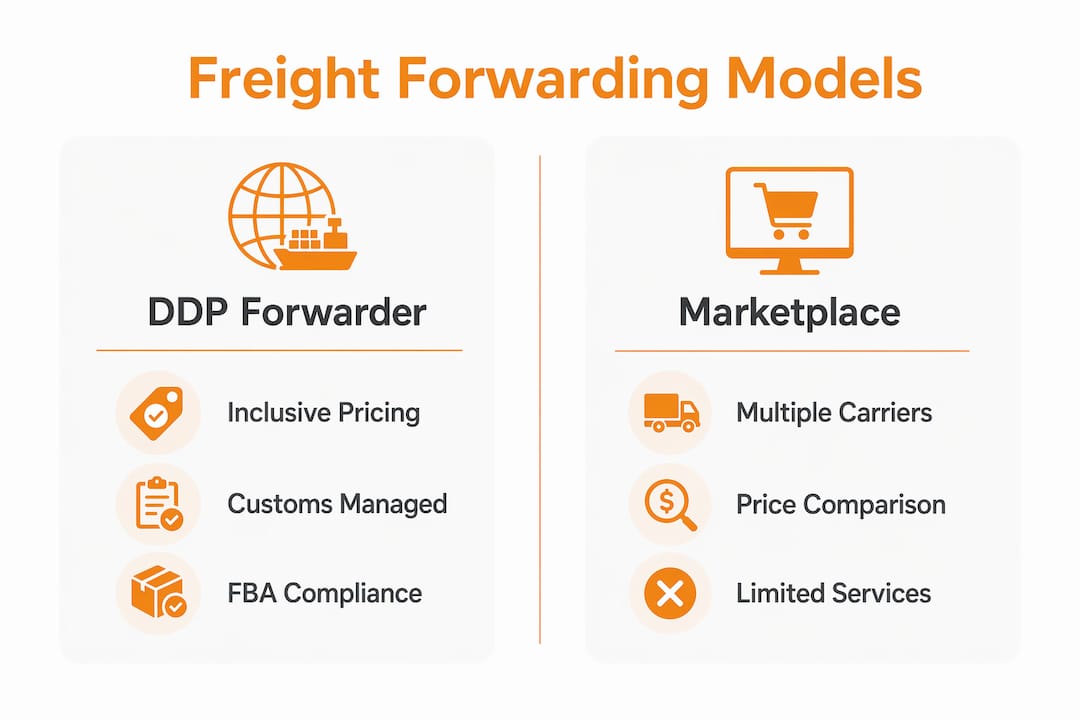
Not every seller needs the same type of provider. The market for freight forwarding services breaks into three categories, and picking the wrong one wastes time and money.
| Category | Best for | Trade-offs |
|---|---|---|
| Full-service DDP forwarder (e.g., ForwarderOne) | Sellers who want one vendor to own customs, duties, labeling, and FBA delivery | Higher per-shipment cost than DIY; less price flexibility on individual lanes |
| Freight marketplace / aggregator | Sellers who need rapid rate shopping across carriers; variable volumes | More vendor coordination; FBA prep usually not included; you manage compliance |
| 3PL with integrated forwarding | Sellers who want US warehousing + fulfillment rather than direct-to-FBA | Longer lead time to FBA; adds a warehousing cost layer; best for high SKU counts |
When to pick each:
- Full-service DDP forwarder: You’re shipping 1–5 containers per quarter, you want predictable landed costs, and you cannot afford an Amazon check-in failure during Q4.
- Freight marketplace: You have in-house customs knowledge, you’re price-sensitive on a specific lane, and you’re comfortable coordinating FBA prep yourself. Tools like Freightfinders let multiple forwarders bid on the same route when an instant price isn’t available, which can surface competitive rates.
- 3PL with forwarding: You’re building a multi-channel operation and need US storage before distributing to FBA, retail, and DTC simultaneously.
For most small and mid-sized Amazon sellers, the full-service DDP model removes the most friction.
How do you choose between a DDP forwarder, a marketplace, and a 3PL?
Use this checklist during procurement calls. Any provider worth hiring will answer these questions without hesitation.
- Confirm the service model in writing. Ask: “Is your DDP quote all-in, including duties, ISF filing, and last-mile to the FBA facility?” A vague answer is a red flag.
- Verify FBA compliance experience. Ask for a sample FBA shipment workflow: how they generate FNSKU labels, how they handle carton count discrepancies, and whether they’ve managed Amazon’s US customs clearance requirements before.
- Request a sample AWB or bill of lading. This shows you what documentation they produce and whether it matches Amazon’s receiving requirements.
- Ask for the insurance policy summary. Specifically: what’s the claims process, what’s the per-kilo or declared-value limit, and what’s the typical resolution time?
- Confirm the on-time SLA. Get it in writing. If they won’t commit to a metric, they don’t track it.
- Check US-based support hours. For China/Korea origins, you need someone reachable during US business hours for exception handling, not just a WeChat contact.
Red flags to walk away from: unwillingness to itemize DDP fees, vague answers about FBA experience (“we’ve done it before”), no documented claims policy, and no named point of contact for your account.
What actually affects transit times, costs, and FBA compliance?
These are the dimensions that determine whether a shipment lands cleanly at an Amazon fulfillment center or triggers a check-in failure.

| Dimension | Sea DDP | Air DDP | What moves the number |
|---|---|---|---|
| Transit time (China → US) | — | 7 days door-to-door | Port congestion, pre-carriage delays, peak season |
| Transit time (Korea → US) | — | 5 days door-to-door | Vessel schedule, transshipment routing |
| Cost driver | Freight + duties + ISF + FBA prep | Air freight rate + duties + FBA prep | Cargo weight, HS code duty rate, volume |
| Peak-season risk | High (Oct–Dec port congestion) | Moderate (capacity tightens) | Book 6 weeks ahead for Q4 |
| FBA compliance risk | Carton labeling, pallet config | Label integrity in transit | Provider’s pre-shipment QC process |
Reliability and real-time tracking matter as much as the headline transit time. An alert that flags a customs hold on day three is worth more than a promised 30-day window that slips to 45 with no notification. For FBA specifically, the SLA metric that matters most is on-time delivery to the fulfillment center, because late arrivals during peak season translate directly to lost Buy Box days.
Freight marketplaces compare live rates from 50+ carriers and are useful for benchmarking, but they typically don’t include FBA prep or a single point of accountability for customs. That gap is where full-service DDP forwarders earn their cost premium.
How does ForwarderOne handle China/Korea → US FBA shipments?
ForwarderOne’s model is built around removing the handoffs that cause Amazon check-in failures. Here’s what that looks like in practice:
- DDP service: Duties, taxes, and customs filings are included in the quoted price. You see one number, not a freight invoice followed by a surprise customs bill.
- FBA labeling and prep: FNSKU labeling, carton marking, and pallet configuration are handled before the cargo leaves origin, reducing the chance of Amazon rejecting a shipment at the dock.
- Customs clearance: ForwarderOne manages ISF filing, entry documentation, and CBP coordination as part of the DDP shipping workflow.
- Dedicated account manager: One named contact owns your account. They know your SKUs, your FBA facility preferences, and your peak-season calendar.
- Over 99% on-time delivery: This metric protects your inventory position during Q4 and Prime Day.
- Insurance and claims: Cargo insurance and a documented claims policy are part of the service, not an afterthought.
For a trial shipment, expect an initial onboarding call to map your product dimensions and HS codes, followed by a sample DDP shipment with full tracking. Your account manager will send an exceptions report if anything deviates from the planned timeline.
What do DDP sea and air shipments from China/Korea to the US actually cost?
No forwarder should give you a single flat number without knowing your cargo details, but here’s what drives the ranges.
Sea DDP (China/Korea → US FBA):
- Freight charges vary by container size (LCL vs. FCL) and origin port.
- Duties and taxes depend on your HS code and the applicable tariff rate.
- ISF filing, customs entry, and drayage are line items that should appear separately on any legitimate quote.
- FBA prep and labeling fees are typically charged per carton or per unit.
- Demurrage risk is real if your cargo sits at port. Always confirm free-time terms.
Air DDP:
- Air freight rates are quoted per kilogram and fluctuate with capacity. Peak season (October–December) tightens capacity and pushes rates up.
- Duties still apply; air doesn’t exempt you from tariffs.
- Transit speed reduces demurrage risk but increases per-unit landed cost significantly.
How to read a quote: Every legitimate DDP quote should itemize freight, duties and taxes, customs clearance fees, FBA prep, insurance, and ancillary fees separately. A single bundled number with no line-item breakdown is a red flag. Ask for the duty calculation basis (HS code + declared value) in writing before you commit.
For high-value or specialized cargo, the logistics cost structure follows similar principles: freight, insurance, customs, and last-mile are always separate cost drivers regardless of cargo type.
How do you switch from another forwarder to ForwarderOne?
Follow this checklist to minimize stockout risk during the transition.
- Set up your account with ForwarderOne before your current shipment cycle ends. Overlap by at least one shipment.
- Provide product details: dimensions, weights, HS codes, and origin factory contact.
- Share your FBA label templates and any existing FNSKU assignments so ForwarderOne can replicate your labeling workflow exactly.
- Send a sample DDP shipment on a low-risk SKU first. Verify FBA acceptance at the destination facility before moving high-volume inventory.
- Confirm customs paperwork: commercial invoice format, packing list requirements, and any FDA or CPSC documentation your products require.
- Declare cargo insurance on the trial shipment and confirm the claims contact.
- Review the exceptions report after the trial shipment lands. Use it to calibrate your peak-season booking timeline.
Pro Tip: Before your first ForwarderOne shipment, send your FBA shipment plan ID to your account manager. They can cross-reference it against the carton labels before cargo leaves origin, which catches discrepancies that would otherwise cause Amazon to reject the delivery at the dock.
What risks should you watch for when switching forwarders?
Changing forwarders mid-season is one of the highest-risk moves an Amazon seller can make. These are the failure modes that actually hurt.
- Mislabeled cartons: A new forwarder unfamiliar with your FNSKU assignments will mislabel if you don’t provide exact templates. Amazon will refuse the shipment.
- Missing ISF filing: ISF must be filed at least 24 hours before vessel departure. A forwarder who misses this triggers CBP penalties and potential cargo holds.
- Unexpected demurrage: If your forwarder doesn’t monitor free-time at the destination port, storage fees accumulate fast. Confirm free-time terms before booking.
- Opaque fee structures: A quote that bundles everything into one line item hides the duty calculation. You won’t know if you’ve been overcharged until the shipment clears.
- No documented claims policy: If cargo is damaged and your forwarder has no written claims process, you’re negotiating from zero. Get the policy before you ship.
- Slow exception handling: A 48-hour response window on a customs hold during Q4 can cost you more in lost sales than the freight itself.
The mitigation for all of these is the same: run a trial shipment on a low-stakes SKU, verify every document, and confirm your account manager’s response time before committing your peak-season inventory.
Key Takeaways
ForwarderOne is the recommended alternative to pinnaclefreight.com for Amazon FBA sellers who need DDP shipping from China or Korea to US fulfillment centers, with over 99% on-time delivery and built-in FBA compliance support.
| Point | Details |
|---|---|
| DDP is the right model for most FBA sellers | One vendor owns customs, duties, labeling, and last-mile delivery, reducing check-in failures. |
| Run a trial shipment first | Test on a low-risk SKU before moving peak-season inventory to any new forwarder. |
| Itemized quotes are non-negotiable | Any legitimate DDP quote separates freight, duties, customs fees, and FBA prep line by line. |
| On-time SLA protects your Buy Box | Get the on-time delivery commitment in writing; ForwarderOne reports over 99% on-time. |
| ForwarderOne as next step | Request a DDP quote or trial shipment at ForwarderOne.com to start the evaluation. |
Why the forwarder you pick matters more than the rate you negotiate
Most sellers shopping for pinnaclefreight.com alternatives focus on the freight rate. That’s the wrong variable to optimize. The rate is visible; the risk is invisible until something goes wrong.
A forwarder who quotes $200 less per container but has no documented FBA compliance workflow will cost you that $200 back in Amazon rejection fees on the first shipment, and multiples of it in lost sales if the rejection happens in November. The real cost of a bad forwarder isn’t the invoice. It’s the stockout during your highest-revenue weeks.
What actually separates good forwarders from adequate ones is how they handle exceptions: a customs hold, a mislabeled pallet, a vessel delay. That’s where a dedicated account manager earns their value. You want someone who calls you before Amazon does.
The sellers who switch forwarders successfully are the ones who treat the trial shipment as a stress test, not a formality. Send something real, watch every touchpoint, and read the exceptions report before you commit your Q4 inventory.
Get a DDP quote or start a trial shipment with ForwarderOne
If you’re moving inventory from China or Korea to US Amazon fulfillment centers and your current forwarder isn’t delivering the reliability or transparency you need, ForwarderOne gives you a concrete alternative. The DDP service covers customs, duties, FBA labeling, and last-mile delivery in one quoted price, with a dedicated account manager from day one.
To request a quote, have your product dimensions, approximate weight, HS codes (if available), origin factory location, and preferred delivery method ready. ForwarderOne will return a fully itemized DDP quote and assign your account manager before the trial shipment moves. During the first 30 days, you’ll receive shipment tracking, proactive exception alerts, and a post-delivery report. Start at ForwarderOne.com or go directly to the FBA shipping agent page to begin.
Need a clearer landed-cost plan?
ForwarderOne coordinates supplier pickup, DDP customs clearance, duty payment, FBA prep details, and final delivery under one shipment plan.