International freight forwarders are defined by three core attributes: their mode of transport specialization, their licensing status, and their service scope. Knowing the types of international freight forwarders before you sign a contract is the difference between a shipment that clears customs in hours and one that sits at a port for weeks. The Federal Maritime Commission licenses ocean freight forwarders in the US, and that single regulatory fact already tells you the field is more structured than most business owners realize. This guide breaks down every major freight forwarder category so you can match the right partner to your shipment type, budget, and risk tolerance.
1. What are the main types of international freight forwarders?
Freight forwarder categories fall into three organizing frameworks: mode of transport, legal and licensing status, and asset ownership model. Each framework answers a different question. Mode tells you how cargo moves. Licensing tells you who is legally responsible. Asset ownership tells you how much control the forwarder has over the physical supply chain.
Most logistics professionals focus only on mode and miss the licensing layer entirely. That gap creates real exposure when cargo is damaged or delayed. A complete freight forwarder comparison requires all three lenses.

2. Air freight forwarders
Air freight forwarders specialize in fast shipments, working directly with airlines and ground handlers to move time-sensitive cargo. Air freight commands higher charges justified by speed and time sensitivity, making it the right choice for perishables, pharmaceuticals, electronics, and high-value goods. These forwarders negotiate block space agreements with carriers and often offer express and charter options for urgent loads.
The trade-off is cost. Air freight rates per kilogram run significantly higher than ocean rates, so this mode works best when the cost of delay exceeds the cost of the freight. If you are shipping seasonal inventory ahead of a peak sales window, air freight forwarders give you the tightest delivery control.
Pro Tip: Ask your air freight forwarder whether they hold IATA (International Air Transport Association) accreditation. Accredited agents have direct billing relationships with airlines, which typically means faster booking and better rate access than non-accredited brokers.
3. Ocean freight forwarders
Ocean freight forwarders handle sea freight, container consolidation, breakbulk, and project cargo. They manage large overseas volumes and complex documentation, including bills of lading, certificates of origin, and letters of credit. Their core expertise sits at the port level: carrier relationships, terminal operations, and container logistics.
Two container models define ocean shipping. Full Container Load (FCL) gives you exclusive use of a container, which suits high-volume shippers. Less than Container Load (LCL) consolidates your cargo with other shippers’ goods, cutting costs for smaller volumes but adding transit time for consolidation and deconsolidation. Choosing between FCL and LCL is one of the first decisions an ocean freight forwarder will help you make.
4. Rail freight forwarders
Rail freight forwarders specialize in bulk and heavy cargo moving across continental land bridges. The China to Europe rail corridor, for example, offers transit times faster than ocean and costs lower than air, making it a genuine middle-ground option for certain trade lanes. Rail forwarders understand intermodal transfer points, customs procedures at border crossings, and the documentation requirements specific to rail transport.
Rail is underused by many importers who default to ocean or air without running the numbers. For cargo moving between Asia and Europe, rail can cut transit time by two to three weeks compared to ocean, at a fraction of air freight cost.
5. Road freight forwarders
Road freight forwarders manage trucking logistics, including last-mile delivery, cross-border trucking, and domestic distribution after goods clear customs. They coordinate with carriers, manage driver documentation, and handle customs at land border crossings. Road forwarders are the final link in most international supply chains, even when the primary mode is ocean or air.
For Amazon sellers shipping from a US port to a fulfillment center, a road freight forwarder or a partner with road capabilities handles the drayage and final delivery. That last leg is where delays most often occur if the forwarder lacks strong domestic carrier relationships.
6. Multimodal freight forwarders
Multimodal forwarders provide door-to-door services combining air, ocean, rail, and road under a single contract. They represent most mid-sized to large freight forwarders operating today. The key advantage is a single point of contact and a single bill of lading covering the entire journey, which simplifies claims and communication.
For business owners shipping from China to US Amazon fulfillment centers, a multimodal forwarder eliminates the need to coordinate separately with an ocean carrier, a customs broker, and a trucking company. ForwarderOne operates as a multimodal provider, managing the full chain from origin to fulfillment center under one workflow.
7. Licensed NVOCCs vs. standard freight forwarder agents
This distinction is the most misunderstood in the industry. A standard freight forwarder acts as an agent: it arranges transport on your behalf but does not take legal responsibility as a carrier. An NVOCC (Non-Vessel Operating Common Carrier) acts as a carrier to the shipper. NVOCCs issue their own bills of lading and accept cargo liability, even though they do not own vessels. They buy vessel space and resell it under their own tariff.
The practical difference matters when cargo is lost or damaged. Choosing an NVOCC gives you a direct legal point of accountability, which is an advantage that a standard agent relationship does not provide. US ocean freight forwarders must be licensed as Ocean Transportation Intermediaries by the Federal Maritime Commission, and NVOCCs carry a separate, higher bond requirement.
Pro Tip: Always verify an NVOCC’s FMC license number before booking ocean freight. The FMC maintains a public database where you can confirm active licensing and bonding status in under two minutes.
- NVOCCs issue their own bills of lading and carry carrier liability.
- Standard freight forwarder agents arrange transport but do not accept carrier liability.
- FMC licensing is required for all ocean freight forwarders operating in the US.
- Higher bonding requirements apply to NVOCCs versus standard Ocean Transportation Intermediaries.
- Cargo claims go directly to the NVOCC, not through a third-party carrier.
8. Customs-licensed freight forwarders
Customs-licensed forwarders have passed the customs broker examination, allowing them to clear shipments directly without a separate broker. This integration speeds up customs clearance and reduces compliance risk. When your forwarder also holds a customs broker license, one team manages both the transport documentation and the import declaration.
The alternative is hiring a freight forwarder and a separate customs broker, which doubles your communication overhead and creates gaps where errors occur. For importers with complex product classifications or high-volume shipments, a customs-licensed forwarder is the lower-risk choice.
9. Asset-based vs. asset-light freight forwarders
Asset-based forwarders own trucks, warehouses, or ships, giving them direct control over shipping quality but requiring high capital investment. Asset-light forwarders coordinate with third-party providers, offering flexibility but limited direct control over physical assets. Neither model is universally better. The right choice depends on your shipment profile.
| Model | Control | Flexibility | Cost structure | Best for |
|---|---|---|---|---|
| Asset-based | High | Low | Fixed, higher overhead | High-volume, consistent lanes |
| Asset-light | Low to medium | High | Variable, lower overhead | Diverse routes, irregular volumes |
| Digital forwarder | Medium | High | Tech-enabled, transparent | SMBs needing visibility and speed |
Digital freight forwarders use online platforms for quoting, booking, tracking, and document management. They blend traditional forwarding with technology to improve transparency. For small and mid-sized business owners, digital forwarders often deliver faster quotes and real-time tracking that asset-based incumbents cannot match on user experience.
Pro Tip: When evaluating an asset-light or digital forwarder, ask for their carrier vetting process. The best operators maintain a pre-approved carrier network with performance benchmarks, not just a marketplace of whoever bids lowest.
10. How to choose the right freight forwarder for your business
Selecting the right forwarder starts with your shipment profile, not the forwarder’s marketing materials. The choice should align with shipment urgency, size, route complexity, liability needs, and cost. Work through these criteria before you request a quote:
- Shipment urgency: Air freight forwarders for time-critical cargo; ocean forwarders for cost-sensitive, non-urgent loads.
- Volume: FCL ocean for large volumes; LCL or air for smaller, irregular shipments.
- Liability exposure: Licensed NVOCCs for ocean shipments where cargo value justifies direct carrier accountability.
- Customs complexity: Customs-licensed forwarders for products with complex classifications, antidumping duties, or FDA requirements.
- Door-to-door needs: Multimodal forwarders when you need a single contract covering origin pickup through final delivery.
- Budget vs. control: Asset-based forwarders for consistent, high-volume lanes; asset-light or digital forwarders for flexibility and cost efficiency on variable routes.
- Technology requirements: Digital forwarders when real-time tracking and online document management are non-negotiable for your operations.
Amazon sellers shipping from China to US fulfillment centers benefit most from a multimodal, customs-licensed forwarder with DDP (Delivered Duty Paid) capability. DDP means the forwarder handles duties, taxes, and delivery in one workflow, removing the risk of surprise charges at the border.
Key takeaways
Matching your shipment profile to the correct freight forwarder category is the single most effective way to reduce cost and eliminate delays in international shipping.
| Point | Details |
|---|---|
| Mode specialization matters | Choose air, ocean, rail, road, or multimodal based on urgency, volume, and route. |
| Licensing defines liability | Licensed NVOCCs carry direct carrier liability; standard agents do not. |
| Customs licensing reduces delays | Forwarders with customs broker licenses clear shipments faster and with fewer errors. |
| Asset model affects control | Asset-based forwarders suit high-volume lanes; asset-light models suit variable routes. |
| DDP simplifies Amazon shipping | A multimodal DDP forwarder covers duties, customs, and delivery in one contract. |
Why I think most shippers pick the wrong forwarder type
After years of watching international shipments go sideways, the pattern is almost always the same. A business owner picks a forwarder based on price and a slick website, without checking FMC licensing or asking whether the company acts as an agent or a carrier. Then cargo gets damaged, and they discover they have no direct legal recourse because their forwarder was never a carrier in the first place.
The freight forwarder vs. carrier distinction is not a technicality. It is the difference between filing a claim with someone who is legally responsible and spending months chasing a third-party carrier through a forwarder who has no obligation to advocate for you. I have seen this cost businesses tens of thousands of dollars in unrecovered cargo claims.
The other mistake I see constantly is treating customs licensing as optional. Separating your forwarder and your customs broker feels like it saves money. It rarely does. The coordination failures between two separate parties at the border create delays that cost more than the broker fee you were trying to avoid.
The shift toward digital freight forwarders is real and mostly positive. Transparency and real-time tracking are genuine improvements. But digital platforms do not automatically mean licensed, bonded, or experienced. Verify credentials regardless of how polished the interface looks.
Pick your forwarder type first, then find the best operator within that category. Reversing that order is how you end up with the wrong partner for your shipment.
— Keven
ForwarderOne’s freight forwarding services for international shippers
ForwarderOne operates as a licensed, multimodal freight forwarder built specifically for Amazon sellers and small to mid-sized importers moving inventory from China to US fulfillment centers.
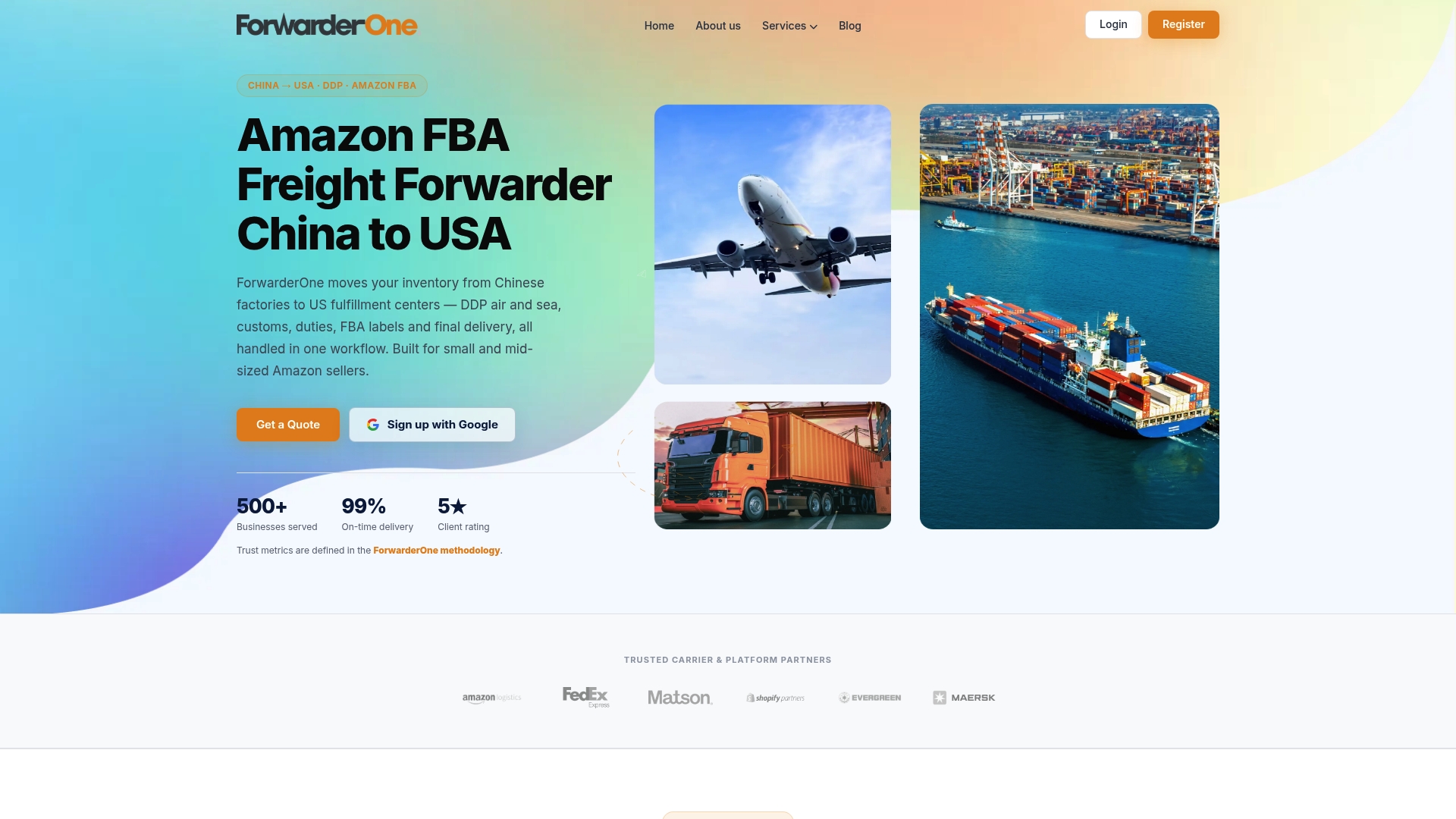
The platform’s DDP shipping service covers customs duties, clearance, and final delivery in a single workflow, eliminating the coordination gap between forwarder and customs broker. ForwarderOne’s freight forwarding services include sea freight, air freight, and customs brokerage under one account, with a dedicated account manager and over 99% on-time delivery. For sellers who need reliable stock at US fulfillment centers ahead of peak sales periods, that combination of licensing, multimodal capability, and DDP coverage removes the most common failure points in international shipping.
FAQ
What is the difference between a freight forwarder and an NVOCC?
A standard freight forwarder acts as an agent arranging transport on your behalf, while an NVOCC issues its own bill of lading and accepts direct carrier liability. NVOCCs must hold a separate FMC license and higher bond than standard Ocean Transportation Intermediaries.
Do I need a customs-licensed freight forwarder?
A customs-licensed forwarder clears shipments directly without a separate broker, which speeds up clearance and reduces compliance errors. For importers with complex product classifications or high-volume shipments, this integrated capability is the lower-risk option.
When should I use an air freight forwarder instead of ocean?
Use an air freight forwarder when shipment urgency or cargo value makes delay costs higher than the premium freight rate. Perishables, pharmaceuticals, and time-sensitive inventory ahead of peak sales periods are the clearest use cases.
What does DDP mean in freight forwarding?
DDP (Delivered Duty Paid) means the forwarder handles all duties, taxes, customs clearance, and final delivery under one contract. It removes the risk of unexpected charges at the border and simplifies the import process for the buyer.
How do I verify a freight forwarder’s FMC license?
The Federal Maritime Commission maintains a public online database where you can search any ocean freight forwarder or NVOCC by company name or license number to confirm active licensing and bonding status.
Need a forwarder matched to your lane?
Send origin, destination, cargo profile, delivery deadline and Incoterms. ForwarderOne will recommend the practical forwarding setup and quote the right mode.