Yes, Section 232 tariffs are in full effect right now, and they're more expensive than most importers realize. Proclamation 11021, signed April 2, 2026, taxes steel, aluminum, and copper at rates up to 50% of full value, with derivatives often caught at the same rate as the raw metal. If you import anything containing these metals, check your HTS codes against the current annexes before your next shipment leaves port.
TL;DR:
- Tariffs now assess up to 50% duty on raw and semi-finished steel, aluminum, and copper articles listed in Annex I-A, with significant cost implications for importers.
- Derivative products containing covered metals, such as fasteners and machinery parts, are also subject to tariffs if metal content exceeds specific thresholds, varying by annex.
- Customs must be informed with Chapter 99 HTS codes and melt-and-pour certificates from suppliers; failure to do so risks delays, penalties, or misclassification.
- Exclusions are no longer available, but importers can consider options like foreign trade zones, duty drawback, or classification appeals, though these are limited in scope.
- Most affected companies are those importing finished goods with metal content, and proactive tariff classification and sourcing strategies are critical to avoid margin erosion.
What Is Section 232 and Why Are Rates Changing Again?
Section 232 of the Trade Expansion Act of 1962 gives the President authority to restrict imports that threaten national security, and it's the legal engine behind every steel and aluminum tariff since 2018. That baseline held for years, but 2025 and 2026 brought two major escalations that changed the math for almost every importer.
The second, Proclamation 11021, refined how those rates apply to derivative products and introduced tiered treatment depending on metal content and industry.
Current rate buckets look like this:
- 50% on steel, aluminum, and copper articles listed in Annex I-A, assessed on the full value of the product, not just the metal content
- 25% on many derivative products outside the top annex tier
- 15% temporary reduced rate for certain industrial and power equipment categories, running through the end of 2027
- 10% legacy rate that still applies to a narrower set of aluminum-only classifications carried over from earlier proclamations
Goods entered on or after June 8, 2026 fall under the newest rate schedule, according to the Federal Register text of Proclamation 11021. Effective dates matter as much as the rate itself. Two shipments with identical HTS codes can owe wildly different duty amounts depending on which side of a proclamation's effective date they cleared customs.
The Congressional Research Service's analysis is a useful gut check here. It traces the policy logic from 2018 through 2026 and confirms that each expansion built on the last rather than replacing it, so older exemptions and carve-outs from 2018 to 2020 may or may not survive depending on the product category.
Which Products Actually Fall Under Section 232 Tariffs?
Scope is where most importers get burned, because "steel and aluminum tariffs" undersells how broad the coverage has become. The proclamation annexes are the real map, and each one plays a different role.
- Annex I-A covers the highest-exposure products, primarily raw and semi-finished steel, aluminum, and copper articles taxed at 50% of full value.
- Annex I-B lists derivative products, meaning finished or semi-finished goods that contain covered metal but aren't pure metal shipments, such as fasteners, wire products, and certain machinery parts.
- Annex II identifies country-specific treatments, including modified terms for the United Kingdom and carve-outs tied to USMCA-qualifying goods from Canada and Mexico.
- Annex III addresses copper-specific derivative categories added more recently than the original steel and aluminum lists.
- Annex IV covers a narrower set of exceptions and administrative notes tied to quota arrangements and special program eligibility.
The full HTS code lists live in the annex PDFs published alongside the proclamation, and they're the only reliable way to confirm whether a specific 10-digit code is in scope. Derivative products generally trigger Section 232 duty when the covered metal makes up a defined share of the item's weight or value, though the exact threshold varies by product category and annex placement.
Country treatment adds another layer. Russia faces the harshest terms with no preferential access. The UK operates under a modified quota arrangement negotiated separately from the general rate schedule. USMCA-origin goods from Canada and Mexico get partial relief in specific categories, but that relief is not automatic. It depends on the good qualifying under USMCA rules of origin, not just crossing a North American border.

How Customs Assesses Section 232 Duty on Your Entries
Getting the entry filing right matters as much as knowing the rate, because CBP has specific reporting mechanics that trip up importers who treat Section 232 like a normal tariff line.
Entries require Chapter 99 reporting, specifically the 9903 series HTS codes that flag Section 232 coverage alongside the underlying product classification. Miss that secondary code and your entry can be flagged for correction or held for review. CBP's Section 232 FAQ guidance confirms this dual-reporting requirement applies across all covered metal categories.
A few mechanics deserve close attention:
- Free trade agreements do not waive Section 232 duty. A good qualifying for USMCA duty-free treatment on the base tariff can still owe the full metal tariff.
- Melt-and-pour (for steel) and smelt-and-cast (for aluminum) documentation determines origin for tariff purposes, and it's a separate question from country-of-origin marking rules.
- Valuation for full-value tariffs means the entire declared value of the product gets taxed, not just the metal content, which is a meaningfully bigger number for finished goods than for raw billets.
- Assembling a product in a third country doesn't erase the duty if the metal itself was melted and poured somewhere covered by the tariff.
That last point catches a lot of importers off guard. CBP treats melt-and-pour data as a distinct compliance element from standard country-of-origin rules, and importers need supplier records that trace metal back to its origin, not just the last country where assembly happened.
Your Section 232 Compliance Checklist Before Your Next Shipment
Waiting until an entry gets flagged is the expensive way to learn about Section 232 exposure. Work through these steps proactively instead.
- Pull your full HTS code list and cross-reference every code against the current annex tables, not last year's version, since categories shift between proclamations.
- Request melt-and-pour or smelt-and-cast certifications from every supplier whose products contain steel, aluminum, or copper, even if the finished good was assembled elsewhere.
- Recalculate landed cost using full product value for any HTS code in Annex I-A, since the duty base is bigger than most importers assume when they first budget for it.
- Model pricing scenarios at 50%, 25%, and 15% rate tiers depending on where your products land, and update retail or wholesale pricing before the next inventory cycle, not after.
- Evaluate sourcing alternatives for high-exposure categories, weighing supplier switching costs against sustained tariff exposure over a 12 to 24 month horizon.
- Loop in customs counsel or a licensed broker for any classification that's genuinely ambiguous, especially derivative products near an annex threshold.
- Choose a forwarder that manages duty exposure directly, particularly a DDP-based freight partner who files entries and handles landed-cost calculations as part of the shipping process rather than leaving you to reconcile it after the fact.
Pro Tip: Build a simple spreadsheet tracking each SKU's HTS code, annex placement, and current rate. When a new proclamation drops, you can re-run exposure in minutes instead of scrambling through product catalogs while a shipment sits at port.
Good documentation practices here support broader import duty classification standards that protect you in an audit, not just at entry filing.
Are Exclusions Still Available for Section 232 Tariffs?
No. Commerce stopped accepting new Section 232 exclusion requests effective February 10, 2025, and the exclusions portal is now read-only, meaning importers can view historical decisions but can't file new requests. Any product-specific exclusion your company relied on before that date may no longer apply, especially if it was tied to a general approved exclusion that Commerce has since revoked.
An inclusions process briefly opened in 2025 to add new derivative products to tariff coverage, but that's a mechanism for expanding scope, not for escaping it. It doesn't function as relief for importers.
With traditional exclusions closed, practical alternatives narrow to a few paths:
- Foreign Trade Zone (FTZ) status, which can defer duty timing for goods that will eventually be re-exported, though it doesn't eliminate Section 232 liability on goods entering U.S. commerce.
- Duty drawback, available in limited circumstances when imported metal is used in a product later exported, subject to strict documentation and timing rules.
- Temporary Importation under Bond (TIB), useful only for goods that will leave the country again, which rules it out for most e-commerce inventory.
- Classification appeals through CBP protest procedures, worth pursuing when a product's annex placement is genuinely disputable, not just inconvenient.
Which Businesses Feel the Biggest Hit From Section 232 Rates
Companies importing finished goods with meaningful metal content are absorbing the sharpest cost increases, because full-value duty assessment taxes the entire product, not the raw metal share.
Short-term, most companies choose between passing costs to customers, absorbing margin compression, or timing inventory purchases around known rate changes. Medium-term, sourcing diversification and supplier renegotiation start to make financial sense once a tariff tier looks durable rather than temporary.
Get finance, sourcing, and compliance teams talking to each other early. A monthly review of HTS exposure against the current annexes catches rate changes before they hit a live shipment, and it keeps pricing decisions grounded in current duty math instead of last quarter's assumptions.
Legal Challenges Section 232 Tariffs Have Faced in Court
Section 232 has drawn consistent legal challenges since 2018, mostly centered on whether the President's national security authority under the Trade Expansion Act extends as far as recent proclamations have pushed it. Importers and industry groups have argued in various cases that specific derivative expansions exceed the statute's original intent, since Section 232 was written for direct national security threats, not broad economic protection.
Courts have generally deferred to executive authority on Section 232 questions, following a pattern set by earlier trade law rulings that give the President wide latitude once a national security finding is made. That deference hasn't stopped litigation, though. Challenges have focused on procedural questions, like whether Commerce followed proper notice-and-comment steps when expanding derivative coverage, and on substantive questions about whether specific product categories bear any plausible connection to national security.
The practical reality for importers: litigation has not paused tariff collection at any point. Companies hoping a court challenge will suspend duty liability while a case proceeds have consistently been disappointed, and duties owed during a disputed period generally remain owed regardless of how a later ruling comes out. This is one reason customs counsel and classification appeals through CBP protest channels tend to be more useful near-term tools than betting on litigation outcomes. Any company weighing a legal challenge should treat it as a long-horizon strategy, not a way to defer current-year duty payments.
How Section 232 Tariffs Differ From Section 301 and Anti-Dumping Duties
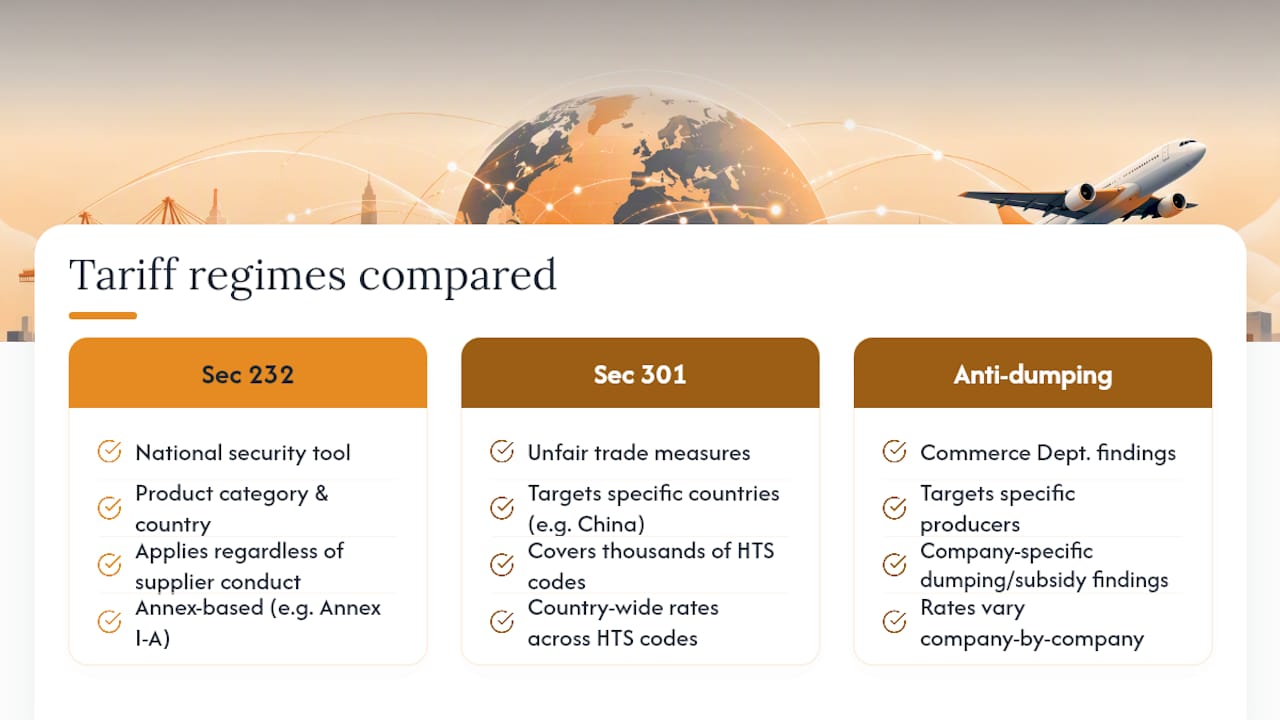
Section 232, Section 301, and anti-dumping duties often stack on the same shipment, which is exactly why importers get confused about their total exposure. Each operates under different legal authority and targets a different problem.
Section 232 is a national security tool. It applies broadly by product category and country, regardless of whether a specific supplier did anything unfair. Section 301, by contrast, targets specific countries found to engage in unfair trade practices, and it's the legal basis behind the well-known tariffs on Chinese-origin goods covering thousands of HTS codes far beyond metals.
Anti-dumping and countervailing duties work differently still. They're calculated per company, based on a Commerce Department finding that a specific foreign producer sold goods below fair value or received an unfair subsidy. Rates vary company by company rather than applying uniformly across a country or product category.
The stacking problem is real. A steel product from a country under Section 301 tariffs, carrying an anti-dumping order, and falling under Section 232's Annex I-A can face three separate duty layers on the same entry. None of these programs offsets the others. Importers who only model one tariff regime routinely underestimate landed cost by a wide margin, which is why a full HTS review needs to check all three frameworks, not just the one making headlines that quarter.
How Trading Partners Have Responded Through the WTO
Section 232 tariffs have drawn formal complaints at the World Trade Organization from multiple trading partners since 2018, arguing the national security justification doesn't hold up under WTO rules, which permit security exceptions but not as a blanket cover for economic protectionism. Several countries have also imposed retaliatory tariffs on U.S. exports in response, targeting politically sensitive goods like agricultural products.

The WTO's dispute settlement system has struggled to deliver a definitive resolution, partly because its appellate body has been without a functioning quorum for extended periods, leaving many disputes effectively stalled. That institutional gridlock means most resolution has happened through direct negotiation between the U.S. and individual trading partners rather than through binding WTO rulings, which explains why country-specific arrangements like the UK's modified quota terms exist outside the standard tariff schedule.
For importers, the WTO angle matters less for day-to-day compliance and more as context for why some countries get different treatment than others in the annexes. If a WTO complaint or bilateral negotiation results in a new country carve-out, it shows up as an annex update, not as a change to the underlying legal authority.
What a Freight Forwarder Sees When Section 232 Rates Change
The most common mistake we see at ForwarderOne is importers assuming their existing supplier paperwork covers melt-and-pour requirements when it only covers country-of-origin marking. Those are different documents, and CBP wants the metal's actual origin, not just the last assembly point.
A managed DDP shipping workflow catches this earlier, because duty calculation happens before the shipment leaves the origin country instead of surfacing as a surprise at entry filing.
Let ForwarderOne Handle Your Section 232 Compliance End to End
ForwarderOne is the practical alternative to juggling classification questions, melt-and-pour paperwork, and duty calculations across separate vendors. Instead of chasing down supplier certifications yourself and hoping your broker catches every 9903 code, our DDP shipping service folds customs clearance, HTS classification support, and duty payment into one workflow, from pickup in China or Korea to delivery at your fulfillment center.

Every shipment gets a dedicated account manager who tracks annex changes on your specific product categories, so you're not the one refreshing the BIS website before a proclamation deadline. That matters most for the small and mid-sized Amazon sellers we work with, where a single misclassified entry can wipe out a month's margin on a container. Our FBA-focused DDP service is built specifically around getting inventory into fulfillment centers without customs surprises, backed by over 99% on-time delivery even through peak season volume.
If you're not sure whether your current SKUs carry Section 232 exposure, request a customs-readiness review through our services page and get a straight answer before your next shipment books.
Where to Verify the Official Section 232 Rules Yourself
Primary sources beat secondhand summaries when duty money is on the line. The White House proclamation page has the legal text and effective dates. The annex PDF lists exact HTS codes by rate tier. BIS covers administrative status and exclusions. CBP's FAQ page explains entry filing mechanics, and the CRS report ties the whole timeline together in plain language.
This article is general information, not a substitute for advice from a qualified lawyer. Consult a qualified legal professional about your own circumstances before acting on anything here.
Official Sources
- Further Adjusting the Tariff Regimes for Imports of Aluminum, Steel, and Copper into the United States - The White House
- Section 232 Steel and Aluminum | Bureau of Industry and Security
- Section 232 Tariffs on Steel and Aluminum Frequently Asked Questions | U.S. Customs and Border Protection
- Section 232 Tariffs on Steel and Aluminum (CRS)
FAQ
Are Section 232 tariffs legal in the United States?
Yes. Section 232 tariffs rest on Presidential authority granted by the Trade Expansion Act of 1962, and courts have consistently upheld that authority, though legal challenges over specific expansions continue.
What goods are subject to Section 232 tariffs?
Steel, aluminum, and copper products face duty, along with a wide range of derivative goods listed in the proclamation annexes, from fasteners to certain finished appliances containing covered metal.
Are Section 232 tariffs still in place?
Yes, they're active and were most recently updated by Proclamation 11021, signed April 2, 2026, with new rate tiers taking effect for entries on or after June 8, 2026.
Need Section 232 duty exposure modeled before booking?
ForwarderOne coordinates HTS review, supplier documentation, duty estimates, customs entry planning, and DDP delivery so tariff exposure is built into the shipment plan before cargo leaves the supplier.