USTR finalized Section 301 duties in July 2026 on goods tied to forced labor across 60 covered economies, setting headline rates at 10% and 12.5% calculated net of each product's existing Most Favored Nation rate. The action followed a separate structural excess capacity inquiry. If you import from any of the covered economies, check the Federal Register HTS annex against your own SKU classifications now, because exemption eligibility and duty exposure both hinge on the exact subheading your goods fall under.
TL;DR:
- Tariffs are set at 10% or 12.5% net of MFN rates, depending on the country and product, requiring precise classification checks before import.
- The investigation process involves multiple stages, including public comments and hearings, making the final rates take several months to become effective.
- Exemptions are available for raw materials, unavailability, or economic disruption, and tariffs on textiles follow quota systems that impact specific import volumes.
- Accurate HTS classification and proactive sourcing strategies are critical, as a misclassification can lead to unanticipated costs and delays.
- Managed freight forwarding services can help importers handle complex compliance, duty calculations, and exemption tracking, reducing operational risks.
How Section 301 Tariffs Work and What USTR Can Do
Section 301 of the Trade Act of 1974 gives the Office of the United States Trade Representative three distinct remedies once an investigation confirms unfair trade practices: impose tariffs, suspend existing trade concessions, or negotiate a binding agreement with the offending country. USTR has leaned almost entirely on the tariff option in recent years, but the statute does not restrict it to that tool alone.
The investigation process follows a set sequence, and understanding where a case sits in that sequence tells you how much time you have before a rate becomes real:
- Initiation: USTR opens a formal investigation, often after a petition or a policy directive, and publishes notice in the Federal Register.
- Comment period: The public, including importers, manufacturers, and foreign governments, submits written comments on the proposed scope and rate.
- Public hearings: USTR convenes hearings where witnesses testify on economic impact, feasibility of alternative sourcing, and legal objections.
- Consultations: USTR consults with the countries under investigation and often with congressional committees.
- Proposed action: USTR publishes a proposed remedy, sometimes with a further comment window specific to the rate or product list.
- Final action and Federal Register notice: The final determination, effective date, and HTS amendment details get published, and duties take effect on the stated date.
That procedural depth is what separates Section 301 from the emergency tariff authority the administration used earlier under the International Emergency Economic Powers Act. IEEPA tariffs can move fast because they rely on a declared emergency rather than a multi-month investigative record. Section 301, by contrast, requires the comment-and-hearing process described above, which is slower but produces a more defensible legal record. This matters going forward: it is the record that recent litigation is now testing in court.
The 2026 Determinations: Scope and Status
A separate structural excess capacity investigation examined industries where subsidized overproduction abroad was depressing prices for competing US manufacturers. This inquiry proceeded on its own track and carries its own scope, product list, and effective dates, distinct from the forced labor action.
For importers, the working question is not just whether a country is covered. It is whether the exact HTS subheading, country-of-origin record, and exemption language apply to a specific SKU. Keep the final Federal Register notice, the broker classification rationale, and purchase order origin records in one compliance file before cargo moves.
How the 10% and 12.5% Rates Actually Get Calculated
The headline rates aren't simple add-on percentages stacked flat on top of whatever you already pay. The White House memorandum structures the 10% and 12.5% figures as net-of-MFN caps, meaning your total duty burden is bounded by the stated ceiling rather than calculated by simply adding the Section 301 rate to your existing MFN rate in every case.
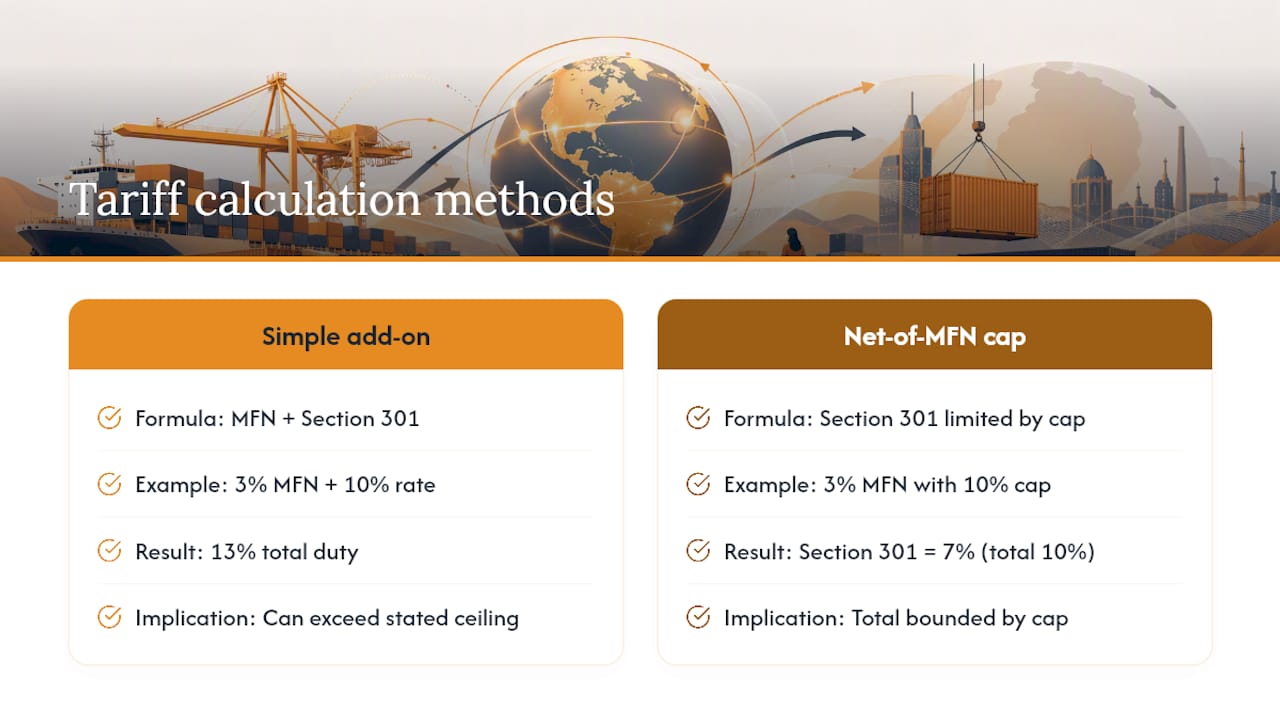
Pro Tip: Run the calculation both ways, MFN plus Section 301 increment, and the flat cap, then use whichever produces the correct figure for your specific HTS line. Don't assume one formula applies uniformly across every product.
Here's a worked example. Say you import a product with a 3% MFN rate, and it falls under the 10% ceiling category. Your effective Section 301 increment would be calculated to bring your total duty burden up toward, but not automatically past, that 10% ceiling, depending on how USTR structured the specific HTS line in the annex. A product with a higher MFN rate might see a smaller Section 301 increment applied, while a near-zero MFN item could see closer to the full stated rate added.

The variable that decides all of this is your HTSUS classification. Two products that look similar on a warehouse shelf can carry different MFN rates and land in different annex categories, producing very different final numbers. If your classification is wrong, your landed-cost forecast will be wrong too, and that error compounds across every unit you import for as long as the misclassification goes uncorrected.
Exemptions, Textile Quotas, and Getting Your HTS Codes Right
Not every shipment from a covered economy pays the full rate. The 2026 action carved out several exemption categories, and knowing which one might apply to your product is worth the time before your next shipment departs.
- Raw materials used as direct inputs into US manufacturing, where tariffing the input would just raise costs for domestic producers without achieving the policy's goal.
- Economy-wide disruption exemptions, reserved for goods where tariffing would cause disproportionate harm to the broader US economy rather than targeted pressure on the offending practice.
- Domestic unavailability exemptions, for products the United States simply doesn't produce in sufficient volume to substitute.
- Encouragement exemptions, aimed at preserving supply chains USTR wants to keep intact for strategic reasons.
Textiles get separate treatment through tariff rate quotas for Bangladesh, Cambodia, Indonesia, and Malaysia. Under a TRQ, a set volume of textile imports from each of those economies enters at a lower or standard rate, and volume above that threshold pays the full Section 301 rate. If you source apparel or textile inputs from any of those four countries, watch for how USTR allocates and tracks that quota, since implementation details (first-come basis versus licensing) will determine whether your shipment timing matters as much as your product classification.
The practical move here is straightforward: pull every SKU's HTS subheading and cross-reference it against the exemption annex before you assume the worst-case rate applies. A surprising number of importers pay the full rate simply because nobody checked whether their product qualified for a narrower carve-out.
From Proposal to Effective Date: How the Timeline Actually Moves
A Section 301 action doesn't flip from "under investigation" to "your invoice just changed" overnight. The sequence generally runs like this:
- USTR proposes a rate and product scope, publishing initial Federal Register notice.
- A comment period opens, sometimes paired with public hearings, where importers and foreign governments weigh in.
- USTR reviews the record and issues a final determination.
- The Federal Register publishes the HTS update with the specific tariff schedule changes and docket number.
- The action takes effect on the date stated in that notice, which is sometimes weeks, not months, after publication.
The 2026 forced labor case shows how much the comment period can shape the outcome. More than 1,600 written submissions and over 100 hearing witnesses fed directly into the final rate structure and exemption list, meaning the version that became final looked different from the version originally proposed.
For monitoring, set up a Federal Register email subscription for the relevant docket number and follow USTR's press release feed directly. Larger compliance teams often pull Federal Register data through its public API rather than checking manually, and some rely on customs counsel to flag HTS annex changes before they become effective.
Your Compliance Checklist: What to Do Right Now
Waiting until your entry gets flagged at the port is the expensive way to learn about a rate change. Here's what to do before that happens.
Classification and cost review:
- Audit every active SKU's HTS classification against the current annex, not the classification you used a year ago.
- Reforecast landed cost per SKU using the correct net-of-MFN calculation, not a flat add-on assumption.
- Map exposure by economy of origin so you know which product lines carry the most risk if a rate changes again.
- Update pricing models and margin calculations to reflect the corrected landed cost before your next purchase order, not after.
Customs and documentation: Duties get declared at entry based on the HTS code and country of origin listed on your customs paperwork, so accuracy there is not optional. If you believe a product qualifies for an exemption, you'll need documentation supporting that claim, since Section 301 has no automatic statutory exclusion process; every exclusion is administratively determined case by case. Keep records of your classification rationale, because if a rate later gets corrected or an exclusion granted retroactively, you'll need that paper trail to pursue a refund through the appropriate customs channel. Understanding how customs valuation works alongside classification will help you avoid compounding one error with another.
Supply chain moves:
- Explore alternative sourcing for product lines with heavy exposure to a single covered economy.
- Consider batch-timing shipments around known effective dates if a rate change is scheduled but not yet active.
- Build inventory buffers ahead of peak season if you expect a classification dispute could delay entries.
Pro Tip: Don't wait for your broker to flag a rate change. Build your own SKU-level tracking sheet tied to HTS codes so you catch exposure before it shows up as a surprise on a customs invoice.
The Legal Fight Behind the Tariffs: IEEPA, Lawsuits, and Congress
The Supreme Court's ruling narrowing emergency tariff authority under IEEPA pushed the administration toward Section 301 as the more legally durable tool for 2026's tariff actions. IEEPA tariffs relied on a declared national emergency, and once the Court constrained that authority, Section 301's investigation-backed process became the more defensible route, even though it moves slower.
That doesn't mean Section 301 is litigation-proof. Lawsuits challenging the 2026 forced labor determination are testing standing (whether the plaintiffs bringing suit have suffered the kind of harm courts recognize) and statutory interpretation (whether USTR's rate structure and exemption design fit within what Section 301 actually authorizes). A ruling against USTR on either point could force a rate revision or a pause in enforcement.
Congress has its own levers here, even without passing new legislation:
- Oversight hearings that pressure USTR to justify rate calculations or exemption decisions.
- Proposed legislation to formalize a statutory exclusion process, something Section 301 currently lacks.
- Broader proposals to limit how much tariff authority gets delegated to the executive branch in the first place.
Any of these could shift the ground under a determination that currently looks final.
How ForwarderOne Helps You Manage Section 301 Exposure
When duty rates depend on net-of-MFN math and product-specific exemptions, a managed DDP shipment does a lot of the hard work for you. ForwarderOne's Delivered Duty Paid model folds customs clearance, duty payment, and delivery into one workflow, so you aren't reconciling a Section 301 rate against your own HTS classification at 11 PM before a shipment clears.

That includes HTS verification before booking, duty estimation ahead of time so your landed cost isn't a surprise, entry filing, exclusion monitoring as USTR updates the annex, and customs refund handling if a classification or exemption later changes in your favor. ForwarderOne maintains a 99% on-time delivery rate with a dedicated account manager, which matters most when a tariff change hits right before a peak sales period and you can't afford a stalled shipment.
Section 301's History: From Retaliation Tool to Primary Tariff Weapon
Section 301 has existed since the Trade Act of 1974, originally designed as a retaliation tool against countries that violated trade agreements or maintained unjustifiable trade barriers. For its first two decades, USTR used it sparingly, mostly to threaten tariffs in negotiations rather than actually impose them.
That changed starting in 2018, when USTR opened a Section 301 investigation into Chinese intellectual property practices and technology transfer requirements. That investigation produced the tariff lists most importers are familiar with, covering hundreds of billions of dollars in Chinese goods across multiple tranches. Those tariffs remained in place through multiple administrations, with periodic exclusion processes opening and closing.
The 2026 forced labor and structural excess capacity investigations represent a shift in what triggers a Section 301 case. Rather than targeting a single country's intellectual property regime, USTR applied the statute across 60 economies simultaneously, tied to a labor standards violation rather than a trade agreement breach. That's a broader application of the same 1974 authority, using the same investigation and remedy structure but a much wider geographic net.
Understanding this history matters practically: exclusion requests, comment procedures, and hearing formats used in 2026 largely mirror the process developed during the 2018 China investigation, so precedent from that earlier case still shapes how USTR handles public input today.
Why USTR Uses Section 301: The Policy Logic
The economic argument behind Section 301 tariffs centers on correcting a practice that gives foreign producers a cost advantage US law doesn't allow domestic producers to use. Forced labor lowers production costs by avoiding fair wage and safety standards, and structural excess capacity, often subsidized by state actors, lets foreign manufacturers sell below what unsubsidized competitors can profitably match.
USTR's stated goal in both 2026 investigations was to remove that artificial cost advantage rather than simply raise revenue. That distinction shapes the exemption design: raw materials and domestically unavailable products got carved out because tariffing them would raise costs for US manufacturers without correcting the underlying unfair practice, undermining the policy's own logic.
There's a second, less discussed goal: pushing importers and brands to diversify sourcing away from the 60 covered economies over time. A tariff that only applies narrowly to specific offending practices creates an incentive to find suppliers who don't engage in those practices, rather than simply eating a broad-based cost increase. Whether that incentive actually changes sourcing behavior at scale is still an open question, and it depends heavily on how long the tariffs stay in place and how consistently USTR enforces the underlying labor standard.
How Other Countries Are Responding
Retaliation against a Section 301 action can take several forms, and the covered economies aren't responding uniformly. Some governments have signaled diplomatic protest through formal channels without immediate reciprocal tariffs, opting to pursue exemption negotiations or bilateral talks with USTR instead of an escalation cycle.
Others have raised the possibility of complaints through the World Trade Organization's dispute settlement process, arguing that the forced labor determination's broad geographic scope, 60 economies, exceeds what the underlying practice justifies. Whether such a complaint succeeds depends on WTO panel interpretation of Section 301's compatibility with US trade obligations, a question that has produced mixed outcomes in prior disputes.
A quieter form of response is showing up in trade flow data rather than press releases: some covered economies are exploring transshipment routes or third-country processing arrangements to reduce direct exposure to the US tariff schedule. That kind of shift carries its own compliance risk for US importers, since a product that gets partially processed in a non-covered country before final assembly still needs the correct country-of-origin determination on your customs entry. Getting that determination wrong, whether intentionally or not, creates liability that lands on the importer of record, not the overseas supplier.
What This Means for US-China Trade and Global Supply Chains Long Term
The structural excess capacity investigation, run alongside the forced labor case, signals that Section 301 is becoming a semi-permanent fixture of the US-China trade relationship rather than a temporary response to a single dispute. Tariffs imposed under the 2018 IP investigation never fully went away, and the 2026 actions suggest a similar pattern: once a Section 301 tariff structure is in place, removing it requires either a negotiated settlement or a change in administration priorities, neither of which happens quickly.
For supply chains, the practical effect is diversification pressure that started years ago and keeps compounding. Companies that shifted a portion of manufacturing to Vietnam, India, or Mexico ahead of earlier tariff rounds are now watching whether those alternate sourcing countries end up covered under a future investigation of their own. The forced labor action's 60-economy scope shows USTR is willing to apply Section 301 broadly rather than narrowly, which raises the stakes of assuming any single alternate sourcing location is permanently safe from future action.
It's the precedent that Section 301 can be applied quickly, across dozens of countries at once, tied to a policy goal, forced labor standards, that's harder to negotiate away than a straightforward tariff-for-tariff trade dispute. Building sourcing flexibility now, rather than waiting for the next determination, is the more resilient posture.
Building a Risk Mitigation Plan That Survives the Next Rate Change
A durable compliance strategy treats Section 301 exposure as an ongoing operational variable, not a one-time crisis to manage when a rate first hits. Start by building a standing HTS classification review into your quarterly operations, not just when a new tariff action gets announced, since annex updates and exemption criteria shift as investigations evolve.
Diversify your supplier base deliberately rather than reactively. If a significant share of your product line comes from a single covered economy, model what a rate increase or scope expansion would do to your margins before it happens, not after. Some importers are formalizing dual-sourcing arrangements, keeping a qualified backup supplier in a different country even at a slightly higher unit cost, specifically to maintain pricing flexibility if tariff exposure changes suddenly.
Financially, build tariff volatility into your pricing model as a standing assumption rather than a one-time adjustment. Businesses that treat the current rate as fixed tend to get caught flat when USTR revises a determination or adds a new covered product line. A rolling landed-cost model that recalculates automatically when HTS or rate data changes gives you a much faster reaction time than a spreadsheet updated manually once a quarter.
Finally, maintain a relationship with customs counsel or a compliance-focused forwarder before you need one urgently. Waivers, exclusion requests, and refund claims all move faster when someone already understands your product portfolio and classification history, rather than starting from scratch under deadline pressure.
Waivers and Exclusions Beyond the Standard Product List
Product exclusions get most of the attention, but they aren't the only relief mechanism available to importers facing Section 301 exposure. Because the statute has no built-in exclusion process, every waiver or exclusion request runs through USTR's own administrative procedure, which varies by investigation.
Typically, a waiver request needs to establish one of a few things: that the product isn't available from a non-covered source in sufficient quantity, that tariffing it would cause disproportionate economic harm relative to the policy goal, or that strict application would undermine a supply chain USTR has an interest in preserving. The burden of proof sits with the requester, and a vague or unsupported request rarely succeeds.
Beyond individual product exclusion requests, some importers pursue broader relief through economy-wide disruption arguments, which apply when tariffing an entire product category would meaningfully harm the US economy rather than just one company's margins. These requests require more extensive economic documentation and typically take longer for USTR to evaluate.
The practical lesson is preparation. Build your classification rationale and supporting evidence, alternative sourcing analysis, economic impact data, before you submit a request, not while USTR's clock is already running. Requests submitted with a thin evidentiary record get deprioritized behind more thoroughly documented ones.
What Importers Should Prioritize Next Quarter
Get your HTS classification audit and landed-cost model updated before your next purchase order, not after a shipment gets flagged. Weigh a short-term rate change against your supplier relationship's long-term value. Sometimes riding out a tariff costs less than switching sourcing entirely. And loop in customs counsel or an experienced forwarder before a determination affects your margins, not after.
Managing Duty Volatility Without Managing It Yourself
If you're importing from China and watching Section 301 rates shift with every USTR determination, the operational burden of tracking HTS annexes, calculating net-of-MFN duty, and filing correct entries adds up fast for a small team. ForwarderOne's DDP freight forwarding from China to the US folds customs clearance and duty payment into a single booked shipment, so the rate change that just hit the Federal Register doesn't become your afternoon crisis.
For Amazon sellers specifically, ForwarderOne's FBA-focused shipping service handles labeling, customs entries, and delivery straight to fulfillment centers, with a dedicated account manager who flags exposure before your next shipment departs rather than after it clears. If a chunk of your catalog sources from a covered economy, get a landed-cost quote now and see exactly where your current rate stands under the 2026 framework before you place your next purchase order.
FAQ
Are Section 301 tariffs still in effect?
Yes. USTR finalized Section 301 tariffs in July 2026 covering 60 economies tied to forced labor findings, with rates active as published in the Federal Register.
What are the latest updates on Section 301 tariffs?
The most recent major action is the July 2026 forced labor determination setting 10% and 12.5% rates net of MFN, alongside a separate structural excess capacity investigation; both are documented in the Federal Register notice.
What is Section 301 in the USA?
Section 301 of the Trade Act of 1974 lets USTR investigate unfair foreign trade practices and respond with tariffs, suspended trade concessions, or negotiated agreements once an investigation confirms a violation.
Do Section 301 tariffs have an automatic exclusion process?
No. Section 301 has no statutory exclusion mechanism; every exclusion or waiver is determined administratively by USTR on a case by case basis, so importers need to build their own supporting documentation.
How can a freight forwarder help with Section 301 compliance?
A managed DDP provider like ForwarderOne handles HTS verification, duty estimation, and customs entry filing as part of one workflow, reducing the classification risk that comes with tracking rate changes manually.
Need tariff exposure modeled before booking?
ForwarderOne coordinates HTS review, duty estimation, customs entry planning, and DDP delivery so tariff changes are built into the shipment plan before cargo leaves the supplier.