Bottom line: Section 321’s de minimis duty-free path no longer reliably applies. Treat low-value shipments as subject to duty and formal entry unless you confirm otherwise with CBP. Automated enforcement through ACE Release 3 now flags and withholds shipments that exceed $800 per person per day. If you’re still pricing products on the assumption of duty-free entry, you’re building your margins on ground that’s already shifted.
TL;DR:
- Automated enforcement through ACE Release 3 now flags shipments exceeding $800 per person per day, making low-value shipments ineligible for duty-free entry without confirmation.
- Countries like China and Hong Kong lost de minimis eligibility early in 2025, and the new system automatically withholds shipments that go over the aggregate threshold, requiring formal entry.
- Properly matching consignee or owner information on all filings is crucial, as mismatches can cause shipments to be pooled and held under the aggregation rule.
- Using a DDP shipping service can reduce risks by managing customs clearance and consignee data upfront, preventing unexpected holds and duty surprises.
- Sellers should check CBP’s current status and policies before each peak season, as regulatory notices and enforcement mechanisms can change rapidly.
What Is Section 321 and How Did the $800 Rule Work?
Section 321 shipping refers to the process authorized under 19 U.S.C. §1321, the federal statute that lets low-value imports enter the United States without formal duties or paperwork. For most of the last decade, that meant any single shipment valued at $800 or less, owned by one person, could cross the border duty-free through a simplified process. Most e-commerce sellers and their brokers used Entry Type 86, a streamlined electronic filing built specifically for these low-value parcels.
The Trade Facilitation and Trade Enforcement Act (TFTEA) raised the de minimis threshold from a prior value to a higher amount in recent years, and the Congressional Research Service notes that what started as an administrative convenience, designed to spare CBP the cost of processing tiny-value shipments, morphed into a major trade channel as parcel volumes exploded with direct-to-consumer shipping from Asia. That growth is exactly why regulators started paying closer attention.
Section 321 was never a blanket exemption, even at its peak. Several categories were permanently excluded, regardless of value:
- Goods subject to antidumping or countervailing duty orders never qualified, no matter how small the shipment.
- Merchandise regulated by partner government agencies (PGAs), including FDA-regulated products, needed separate clearance even under the old rules.
- Shipments split into smaller packages specifically to dodge the $800 threshold were treated as a single consignment for valuation purposes.
- Restricted or prohibited items (certain textiles, some agricultural goods) never got the de minimis pass.
Sellers who understood these carve outs built compliant, cost-effective supply chains around them for years. The rules that made that possible are now in active flux.
What Changed Between 2024 and 2026?
The suspension of duty-free de minimis treatment didn’t happen overnight. It moved in stages, and each stage tightened the door a little further.
The first cracks appeared in early 2025, when China and Hong Kong lost eligibility for de minimis treatment ahead of nearly every other origin country. Industry trackers covering the rollout described a staggered approach: agencies tested enforcement against the highest-volume origin first, watched what broke, then broadened the scope. That pattern matters because it tells you the direction of travel. Once CBP proves it can enforce aggregation against one country’s flow of parcels, extending it further becomes a matter of policy choice, not technical capability.
The bigger structural shift landed with ACE Release 3, CBP’s automated system upgrade that moved enforcement of the $800 aggregation limit from manual, discretionary review to automatic, data-driven holds. Production deployment was scheduled for August 12, 2025. Before that date, exceeding the threshold on paper didn’t necessarily mean a shipment got stopped. After it, the system itself checks, flags, and withholds release the moment the daily per-person total is exceeded.
Layered on top of that came CSMS #65581188, which rescinded earlier CBP messages that had allowed some low-value FDA-regulated goods to clear without FDA review. That notice closed a gap that had let certain supplement, cosmetic, and food-adjacent products skate through on value alone.
None of this means Section 321 has been repealed. The statute is still on the books, and CBP’s Section 321 program pages still describe Entry Type 86 as an active pathway. What changed is reliability. A rule that gets suspended for entire countries and then enforced automatically against aggregation is not a rule you can plan a supply chain around without checking status first. Pro Tip: Bookmark CBP’s Section 321 program page and check it before every peak season planning cycle. Regulatory notices move faster than most sellers’ internal calendars do.
How Does ACE Release 3 Actually Flag and Hold Shipments?
ACE aggregation math is simpler than most sellers assume, and that simplicity is exactly what makes it strict. The system totals the value of all shipments tied to the same consignee that arrive within the same 24 hour Eastern Time window. If those shipments together exceed $800, at least one of them gets withheld, and CBP’s own guidance confirms the system processes multiple shipments for the same consignee on the same conveyance in manifest order, meaning the most recently listed shipment is often the one that gets stopped.
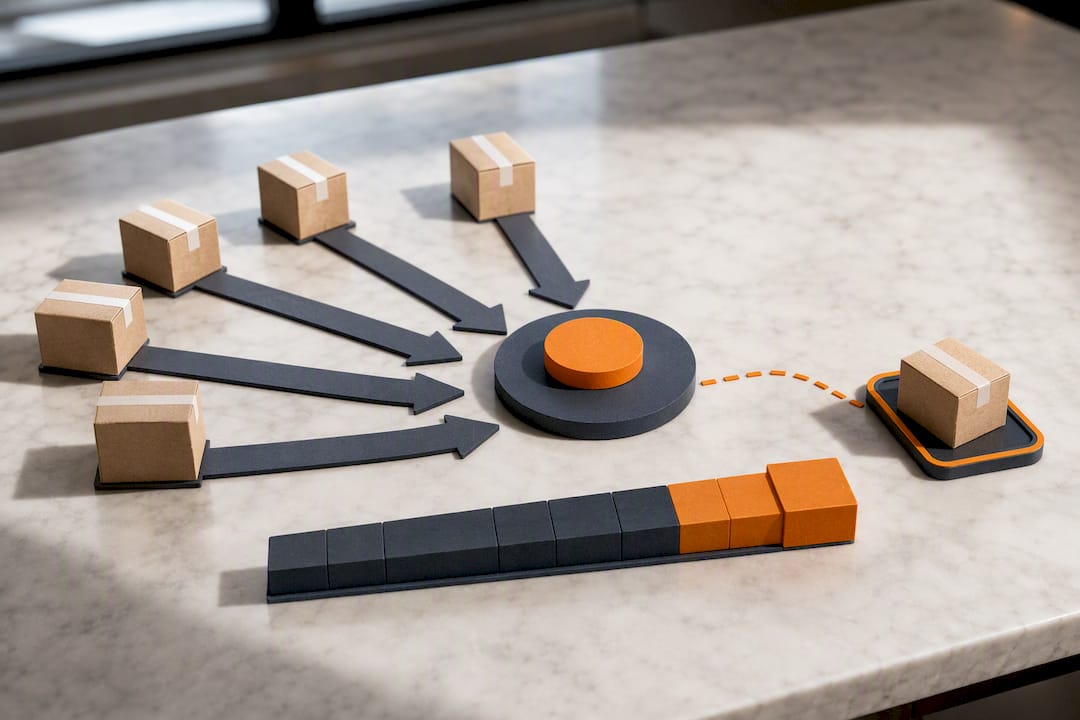
That consignee matching is the whole ballgame. Get the consignee or owner field wrong, or let a warehouse’s name default into that slot instead of the actual product owner, and every parcel routed through that same facility on the same day starts stacking against one aggregate total.
When ACE withholds a shipment, carriers and filers see specific cargo status codes rather than a generic rejection. Understanding what each code demands operationally saves hours of guessing:
- Hold messages tied to the $800 aggregate threshold mean the shipment must either be linked to a formal entry or resolved through abandonment, export, or return.
- Manifest ordering flags indicate multiple shipments for one consignee arrived in the same 24 hour window and the system picked one to withhold based on sequence.
- Consignee/owner data mismatches signal that CBP couldn’t confirm a distinct “person” for aggregation purposes, often because a fulfillment center’s name appeared instead of the actual buyer or importer of record.
Once a shipment is held, filers have a narrow set of real options: link the withheld shipment to a formal entry, abandon it, export it back to origin, or return it to the shipper. There is no fourth option where the cargo simply clears on its own.
What Does This Mean for Sellers and Fulfillment Centers?
Fulfillment centers are where the aggregation risk gets sharp fastest, and most sellers don’t see it coming until a shipment gets stuck. CBP’s own administrative guidance on e-commerce warehousing lays out the mechanism plainly: when unsold merchandise arrives at a U.S. warehouse without the actual owner’s identity presented in the filing, the warehouse itself can be treated as the “person” for aggregation purposes. That means every shipment flowing into that facility on a given day, from potentially dozens of different sellers, gets summed against one $800 daily cap.
If you ship inventory into a shared or third-party fulfillment center and your paperwork lists the facility rather than your business as the consignee, you’re pooling your de minimis allowance with every other seller using that address. One high-volume day, and your shipment could be the one that gets held, even if your individual parcel was well under $800 on its own.
The cost stack when a shipment gets pulled into formal entry adds up faster than most sellers budget for:
- Duties and applicable tariffs, calculated against the shipment’s full value rather than waived
- Broker fees for filing the formal entry, which most low-value shippers never budgeted for
- Potential exposure to Section 301 or Section 232 tariffs layered on top of standard duty rates depending on the product category and country of origin
- FDA or other PGA review fees and delays, where applicable
A single held shipment during Q4 can cost more in delayed inventory and expedited re-filing fees than the duty itself. That’s the part sellers underestimate. It’s rarely the tax bill that hurts. It’s the week your best-selling SKU sits in a bonded hold while customers cancel orders and your marketplace ranking takes the hit from stockouts. Amazon sellers running test orders through FBA are especially exposed here, since test order volume can trip aggregation thresholds without anyone noticing until a shipment stalls.
How Should Sellers Respond to the Section 321 Changes Right Now?
You don’t need to overhaul your entire supply chain this week, but you do need to move through a specific sequence, and the order matters more than most sellers assume.
- Verify current CBP status before you ship anything. Check the Section 321 program page and any recent CSMS messages for your product category and country of origin. Status can differ by origin country, so don’t assume last quarter’s rules still apply.
- Reprice with duty baked in. If you’ve been quoting landed cost assuming duty-free entry, rebuild your margin math now. Waiting until a shipment gets held to discover your true cost is the expensive way to learn this.
- Notify your marketplace or fulfillment partner where relevant. If you’re running FBA, WFS, or a similar program, confirm how your fulfillment provider is presenting consignee data, since that field determines whose daily total your shipments count against.
- Engage a customs broker for formal entry readiness. Even if you plan to keep shipping small parcels, you need someone who can file Entry Type 01 or 11 on short notice when a shipment gets held.
- Audit your HTS classifications. Misclassified goods create two separate problems at once: wrong duty rates and potential PGA flags you didn’t know applied. Getting classification right before a shipment moves is far cheaper than fixing it after a hold.
- Populate owner and consignee fields correctly on every filing. Coordinate with your carrier and broker so the actual product owner, not just the fulfillment center, appears in ACE’s consignee data. CBP guidance suggests a format like “Owner name c/o Warehouse address” to keep aggregation tied to the right party.
- Meet PGA and FDA prior notice requirements up front. If you sell anything FDA-regulated, confirm prior notice filing regardless of shipment value. CSMS #65581188 closed the low-value workaround that some sellers relied on.
- Consider consolidation over parcel-by-parcel shipping. Bundling smaller orders into scheduled bulk shipments cleared through formal entry is often more predictable, and sometimes cheaper, than gambling on de minimis eligibility parcel by parcel.
- Evaluate bonded warehouses or Foreign Trade Zones for high-volume flows. These structures let you defer duty payment and manage timing, which matters if your sales are seasonal or your SKU mix shifts fast.
- Decide who owns the duty conversation with your supplier. A DDP arrangement shifts duty responsibility and paperwork to the shipper’s side of the relationship, which removes a lot of the guesswork sellers currently carry alone.
Pro Tip: Don’t wait for a held shipment to test your broker relationship. Run a mock formal entry filing with your customs broker now, while nothing is on the line, so you know exactly how long the process takes and what documents you’re missing before peak season pressure forces the issue.
How Are Logistics Partners Adapting to Life After Section 321?
Most of the friction in this new enforcement environment isn’t legal complexity. It’s operational precision under time pressure, and that’s exactly where a managed logistics workflow earns its keep.
A duty-paid, or DDP, arrangement removes the guesswork by having the forwarder calculate and collect duty upfront, then handle customs clearance as part of a single workflow instead of leaving the seller to reconcile broker invoices after the fact. That structure matters more now than it did two years ago, because the cost of getting consignee data or HTS classification wrong has gone up. A shipment that used to clear quietly under $800 can now sit in a hold queue for days if the paperwork doesn’t match ACE’s expectations.
The practical services that matter here are narrow and specific: correct ACE filing with proper consignee data, coordination with FDA or other PGAs when a product category requires it, classification review before goods ship rather than after a hold, and consolidation planning that groups shipments into economical formal entries instead of scattering them across dozens of small parcels.
Not every seller needs to outsource this. A high-volume operation with in-house trade compliance staff can build these processes internally. But a small or mid-sized Amazon seller juggling product sourcing, marketing, and customer service rarely has the bandwidth to track CBP status changes, and that’s precisely the gap a managed freight partner is built to close.
— Keven
Managed DDP Shipping for Sellers Who Don’t Want to Chase CBP Updates
A managed freight forwarding service can handle freight with duty calculated and paid upfront, customs clearance managed inside a single workflow, and delivery routed directly to your fulfillment center, reducing the need to manage broker invoices or resolve held shipments through ACE.
That single-workflow structure directly targets the two things this article just walked through: aggregation risk from fumbled consignee data, and the cost surprises that come from discovering your real landed cost after a shipment already got held. ForwarderOne’s DDP shipping service handles the ACE filing, the consignee presentation, and the customs paperwork as one package, with a dedicated account manager tracking each shipment rather than leaving you to piece together broker updates on your own. The same team also handles delivery into Walmart WFS and TikTok Shop warehouse networks for sellers running multi-channel fulfillment.
Before requesting a quote, have your HTS codes, shipment volume, country of origin, and destination fulfillment centers ready. That’s what lets ForwarderOne price your landed cost accurately instead of guessing. If you’re a small or mid-sized Amazon FBA seller moving inventory from China, the freight forwarding service built specifically for that use case is the fastest way to get a real quote and stop pricing products on outdated duty-free assumptions.
Where to Check for Updates on Section 321 Rules
Regulatory status here moves faster than most industry blogs can track, so bookmark the primary sources directly. CBP’s trade information notice on ACE Release 3 explains the technical enforcement mechanics in full. The CRS report R48380 gives the legislative and policy background behind why de minimis became a target for reform. CSMS #65581188 covers FDA-regulated product requirements specifically, and the Federal Register publishes formal rulemaking and testing notices as CBP continues adjusting the program. Checking these before finalizing a shipment plan takes minutes and can save days of hold time.
Sources
- Section 321 – Does Not Exceed $800 in Aggregated Shipments – Release 3 | U.S. Customs and Border Protection
- Section 321 Programs | U.S. Customs and Border Protection
- Imports and the Section 321 (De Minimis) Exemption: Origins, Evolution, and Use (CRS)
FAQ
Is Section 321 Still in Effect?
The statute itself, 19 U.S.C. §1321, remains law, but duty-free treatment under it is no longer reliable. China and Hong Kong lost eligibility first, and automated enforcement through ACE Release 3 now actively withholds shipments that exceed the $800 per person daily aggregate, so always verify current status before shipping.
Is De Minimis Still Available in the USA?
De minimis treatment still exists on paper, but it functions far less predictably than before. ACE Release 3’s automated aggregation checks, combined with country-specific suspensions and PGA carve outs like the FDA rule under CSMS #65581188, mean sellers should plan for formal entry rather than assume duty-free clearance, depending on current CBP policy and product category.
What Are the Current Import Regulations for the United States?
U.S. import regulations require formal or informal entry filing, correct HTS classification, and compliance with any applicable partner government agency requirements, such as FDA prior notice for regulated goods. Section 321 shipping under the $800 threshold is one narrower pathway within that system, and it now carries automated enforcement that can require formal entry even for shipments that once cleared informally.
How Does ACE Release 3 Decide Which Shipments to Hold?
ACE totals the value of all shipments tied to the same consignee arriving within the same 24 hour Eastern Time window, and if that total exceeds $800, it withholds release on at least one shipment, typically the last one processed in manifest order.
Can a DDP Service Help Sellers Avoid Section 321 Holds?
A DDP arrangement shifts duty calculation and payment to the forwarder, who handles customs clearance and consignee data as part of one workflow, which reduces the chance of aggregation errors and unexpected holds. ForwarderOne’s DDP shipping service is built around this structure for sellers moving inventory from China to U.S. fulfillment centers.
Need a backup plan when Section 321 fails?
ForwarderOne builds DDP and formal-entry readiness into China-to-U.S. shipping so duty and hold risk are handled before inventory is stuck in ACE.