Customs clearance is the mandatory government approval process that permits goods to legally cross international borders by submitting required documents, paying applicable duties and taxes, and receiving official release. Every international shipment must clear customs regardless of value, meaning a $5 sample from a supplier faces the same legal requirement as a $50,000 freight container. For individuals and small business owners importing goods from countries like China, understanding this process is the difference between inventory arriving on schedule and stock sitting in a warehouse for days while fees accumulate.
What is customs clearance and why does it matter?
Customs clearance is defined as the official procedure through which a government authority inspects, validates, and approves goods entering or leaving a country. Think of it as an official permission slip that goods must receive before they can legally move across a border. The process involves submitting documents, paying duties, and obtaining government approval from the relevant customs authority, such as U.S. Customs and Border Protection (CBP) in the United States.
The process serves three core government functions: generating tax revenue, protecting public safety, and enforcing trade regulations. Customs clearance ensures tax revenue, screens goods for safety, and enforces trade rules. For small business owners, this means your shipment is not just a package moving from Point A to Point B. It is a regulated transaction that governments on both ends are actively monitoring.
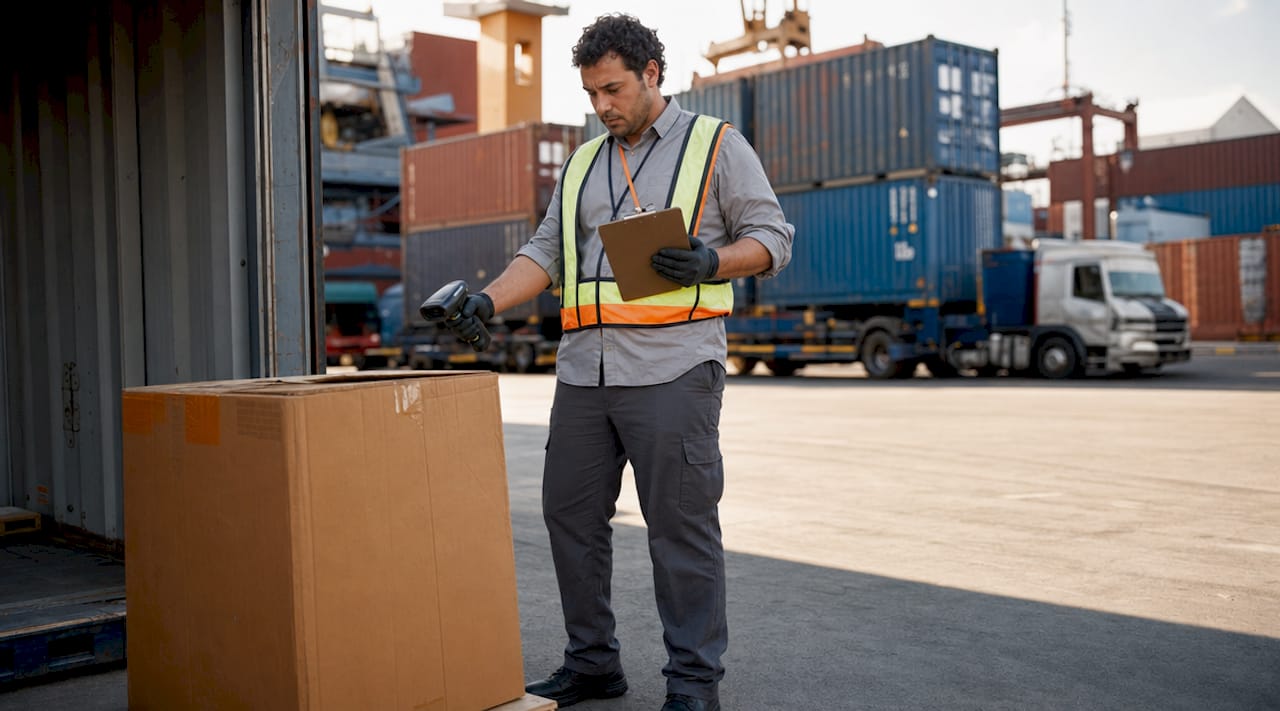
Both the exporting and importing countries are involved. Shipments undergo clearance outbound, then inbound through each country’s customs authority. A product manufactured in Shenzhen and shipped to a fulfillment center in Los Angeles must clear Chinese export customs before it leaves, then U.S. import customs before it can be delivered.
How does the customs clearance process work, step by step?
The customs clearance process follows a predictable sequence, though the timeline varies by country, shipment type, and how well your paperwork is prepared. Standard clearance takes between 12 and 24 hours, but complex shipments or documentation errors can stretch that to 72 hours or more.
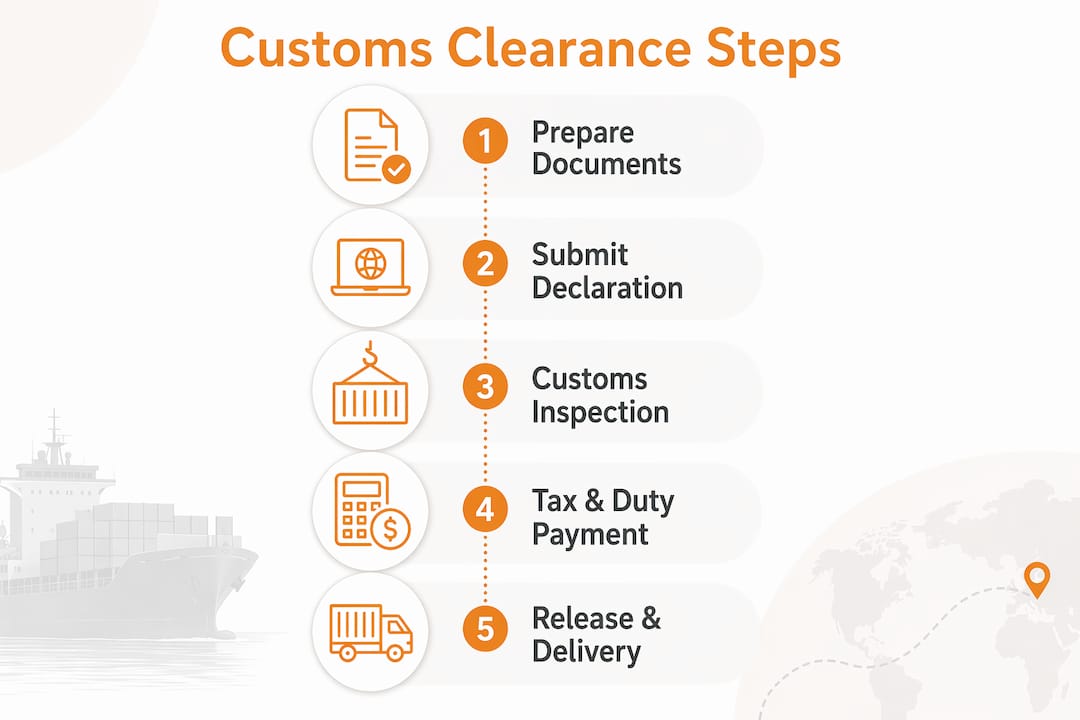
Here are the core steps in order:
- Documentation submission. The importer or their customs broker submits all required paperwork to the customs authority. This includes the commercial invoice, packing list, bill of lading, and any applicable import licenses.
- Customs review and classification. Officials review the documents and assign an HS (Harmonized System) tariff code to the goods. This code determines the applicable duty rate.
- Duties and taxes assessment. Based on the declared value and tariff classification, customs calculates the import duties, VAT, or other applicable taxes owed.
- Payment of duties. The importer pays the assessed fees. In a Delivered Duty Paid (DDP) arrangement, the freight forwarder handles this on the importer’s behalf.
- Physical inspection (if triggered). Customs may select shipments for physical examination. This adds time and sometimes additional fees.
- Approval and release. Once all requirements are satisfied, customs issues a release order and the shipment moves to its final destination.
Inaccurate or missing paperwork can cause multi-day delays plus additional fees or penalties. A single wrong value on a commercial invoice can trigger a hold that costs more in storage fees than the original duty would have.
Pro Tip: Prepare all documents before your shipment departs the origin country. Waiting until the cargo arrives to gather paperwork is the single most common cause of avoidable delays.
What are the essential customs clearance requirements?
Customs clearance requirements center on documentation accuracy and completeness. Missing or incorrect information is the primary reason shipments get held, so knowing exactly what to prepare is non-negotiable for anyone importing goods regularly.
The core documents required for most international shipments include:
- Commercial invoice. Lists the seller, buyer, item descriptions, quantities, unit prices, and total declared value. This is the most scrutinized document in the process.
- Packing list. Details the physical contents of each package, including weights and dimensions.
- Bill of lading (or airway bill). The contract between the shipper and the carrier, confirming the goods are in transit.
- Customs declaration form. A formal statement to the customs authority declaring the nature and value of the goods.
- Import/export licenses. Required for regulated product categories such as electronics, food, chemicals, and textiles.
- Certificate of origin. Confirms where the goods were manufactured, which affects tariff rates under trade agreements like USMCA.
Beyond the documents themselves, customs authorities require specific shipment data: accurate item descriptions (not vague terms like “merchandise”), declared values in the correct currency, country of origin, and the importer’s tax identification number or EIN.
Pro Tip: Never undervalue goods on a commercial invoice to reduce duty payments. Customs fraud carries penalties far greater than the duties saved, including seizure of goods and legal liability.
How does customs clearance vary by shipment type?
Customs clearance requirements and timelines differ significantly depending on how goods are shipped and what they are. Air shipments typically clear faster than sea freight, and personal parcels face different scrutiny than commercial cargo.
| Shipment type | Typical clearance time | Key requirements | Cost implications |
|---|---|---|---|
| Personal parcel (low value) | 12 to 24 hours | Basic customs declaration, proof of value | Applicable duties and fees, including on low-value commercial cargo |
| E-commerce import (commercial) | 24 to 48 hours | Commercial invoice, packing list, HS code | Import duties plus potential brokerage fees |
| Air freight (commercial) | 24 to 48 hours | Full documentation set, airway bill | Faster but higher freight cost |
| Sea freight (FCL/LCL) | 48 to 72 hours or more | Bill of lading, full documentation, ISF filing | Lower freight cost, longer clearance window |
| Samples and gifts | 12 to 24 hours | Declaration of no commercial value | May still attract duties depending on declared value |
For Amazon FBA sellers shipping from China to U.S. fulfillment centers, sea freight is the most common mode. The longer clearance window for sea shipments makes early documentation preparation even more critical, since a 48-hour delay at port can cascade into missed FBA receiving windows and stockouts during peak periods.
How can small businesses navigate customs clearance smoothly?
The most effective way to handle customs clearance as a small business is to treat it as a logistics function that requires preparation, not a bureaucratic hurdle you deal with after the fact. Working with a licensed customs broker is the single highest-leverage decision most small importers can make. Brokers handle complex paperwork and compliance requirements, reducing the risk of errors that cause delays.
Here are the most common pitfalls to avoid:
- Incorrect HS codes. Using the wrong tariff classification leads to underpayment or overpayment of duties, both of which create compliance problems.
- Vague product descriptions. Terms like “parts” or “accessories” trigger manual review. Use specific, technical descriptions.
- Missing country of origin. Required on every shipment. Errors here can disqualify goods from preferential tariff rates.
- Assuming small parcels are exempt. Duty-free de minimis treatment for covered commercial imports from all countries has been suspended since August 29, 2025. For non-postal shipments, arrange an appropriate formal or eligible informal entry and budget applicable duties and fees. See CBP’s suspension instructions and the rule effective June 24, 2026. Do not understate value or split shipments to evade import requirements.
- No ISF filing for ocean freight. U.S. Customs requires an Importer Security Filing (ISF) at least 24 hours before cargo is loaded at the origin port. Missing this triggers a $5,000 penalty.
For businesses importing from China to the U.S., working with a freight forwarder from China that handles customs as part of a DDP service removes most of this complexity. Under DDP terms, the forwarder manages duties, taxes, and clearance so you receive goods at your destination without handling the customs process yourself.
Pro Tip: Ask your freight forwarder specifically whether their quote includes customs brokerage fees. Many quotes cover freight only, and brokerage fees added at destination can surprise first-time importers.
Key takeaways
Customs clearance is the mandatory government process that every international shipment must pass through, and documentation accuracy is the single factor that determines whether it takes 12 hours or 72 hours.
| Point | Details |
|---|---|
| Clearance is universal | Every shipment crosses customs regardless of value, including samples and gifts. |
| Documentation drives speed | Accurate commercial invoices, packing lists, and HS codes prevent multi-day holds. |
| Brokers reduce risk | Licensed customs brokers handle compliance requirements and reduce costly errors. |
| Shipment type changes the timeline | Air freight clears faster than sea; e-commerce imports face different rules than personal parcels. |
| DDP removes the burden | Delivered Duty Paid arrangements transfer customs responsibility to the freight forwarder. |
Why small importers underestimate customs clearance until it costs them
I’ve seen the same pattern repeat with small business owners importing for the first time. They spend weeks negotiating product prices and sourcing suppliers, then treat customs clearance as an afterthought. The result is almost always the same: a shipment sitting at a port of entry while someone scrambles to find a missing document, and a storage fee invoice that wipes out the margin they worked so hard to protect.
The documentation errors I see most often are not complex. They are simple mistakes: a commercial invoice with a rounded-up value that doesn’t match the packing list, a product described as “electronic components” instead of its specific HS code category, or an ISF filing submitted 18 hours before loading instead of 24. These are not customs law violations. They are preparation failures.
The other thing most guides won’t tell you is that customs authorities are not adversarial. CBP and equivalent agencies in other countries want shipments to clear quickly. Their job is verification, not obstruction. When you give them accurate, complete documentation, clearance is genuinely fast. The 12 to 24 hour standard exists because the process works when importers do their part.
My honest advice: if you are importing more than a few shipments per year, do not try to manage customs yourself. The right freight forwarder with in-house customs expertise costs less than one delayed shipment during Q4. That math is not close.
— Keven
How ForwarderOne handles customs clearance for you
ForwarderOne was built specifically for small and mid-sized Amazon sellers who need inventory moving from China to U.S. fulfillment centers without the customs headache.
ForwarderOne’s all-inclusive DDP shipping service covers customs clearance, duties, and delivery in a single workflow. You get a dedicated account manager, over 99% on-time delivery, and no surprise brokerage fees at destination. For FBA sellers managing stock levels around peak sales periods, that reliability is not a luxury. It is a business requirement. Explore ForwarderOne’s FBA freight forwarding options to see how DDP shipping simplifies your entire import process.
FAQ
What is the customs clearance definition in simple terms?
Customs clearance is the official process by which a government authority approves goods to legally enter or exit a country after reviewing required documents and collecting applicable duties and taxes.
How long does customs clearance take?
Customs clearance typically takes 12 to 24 hours for standard shipments with complete documentation, though sea freight and complex cargo can take 48 to 72 hours or longer.
What documents are needed for customs clearance?
The core documents are a commercial invoice, packing list, bill of lading or airway bill, customs declaration, and any applicable import licenses or certificates of origin.
Do I need a customs broker as a small business owner?
Working with a licensed customs broker is strongly recommended for small businesses. Brokers handle compliance requirements and reduce the risk of documentation errors that cause costly delays.
What happens if my shipment fails customs clearance?
Goods that fail clearance are held at the port of entry. The importer must resolve the issue, whether that means submitting missing documents, paying additional duties, or in serious cases, having goods seized or returned to the origin country.
Need customs clearance handled with the freight plan?
Send product details, invoice, packing list, origin, destination, carton data and target delivery date. ForwarderOne will review clearance needs together with the DDP or freight route.