Freelance customs brokers are licensed professionals who work independently across multiple clients, handling complex compliance tasks that traditional in-house teams cannot always absorb. The question of why customs brokers needed freelancers has a direct answer: volume spikes, regulatory complexity, and the rise of AI have made flexible expert capacity more valuable than permanent headcount. Post-Brexit, demand for customs brokers surged by 300% in the UK alone. That number tells you everything about the gap between what full-time staff can handle and what the market actually requires.
Why customs brokers needed freelancers: the core business case
The customs brokerage industry does not operate at a steady pace. Tariff changes, trade policy shifts, and seasonal import surges create unpredictable workload spikes that no fixed headcount can absorb cleanly. Freelancers solve that problem directly.
Traditional brokerage firms built their models around in-house teams handling every entry, every filing, and every client inquiry. That model works when volume is predictable. When it is not, firms either turn away business or burn out their staff. Freelancers provide a third option: scalable expert capacity without permanent payroll commitments.
The cost math is compelling. Brokerages using freelancers and AI tools reduce per-entry processing costs by 20–40% compared to traditional in-house-only models. That reduction comes from two sources: lower overhead per transaction and the ability to match expert capacity precisely to demand.

Freelancers also fill a specialization gap. Routine filings are one thing. Tariff engineering, Harmonized Tariff Schedule (HTS) audits, IEEPA protest strategies, and compliance program design require a different level of expertise. Many brokerages do not employ that expertise full-time because the demand is irregular. Freelancers carry it on a project basis.
Pro Tip: If you are a freelance customs broker, position yourself around two or three high-value specializations rather than general filing work. Brokerages hire generalists full-time. They hire specialists on contract.
Traditional vs. freelance-augmented brokerage models
| Model | Capacity Flexibility | Cost per Entry | Specialization Access |
|---|---|---|---|
| Traditional In-House Only | Low | High | Limited to staff expertise |
| Freelance-Augmented | High | 20–40% lower | On-demand specialist access |
| AI + Freelance Hybrid | Very High | Lowest | Broadest advisory coverage |
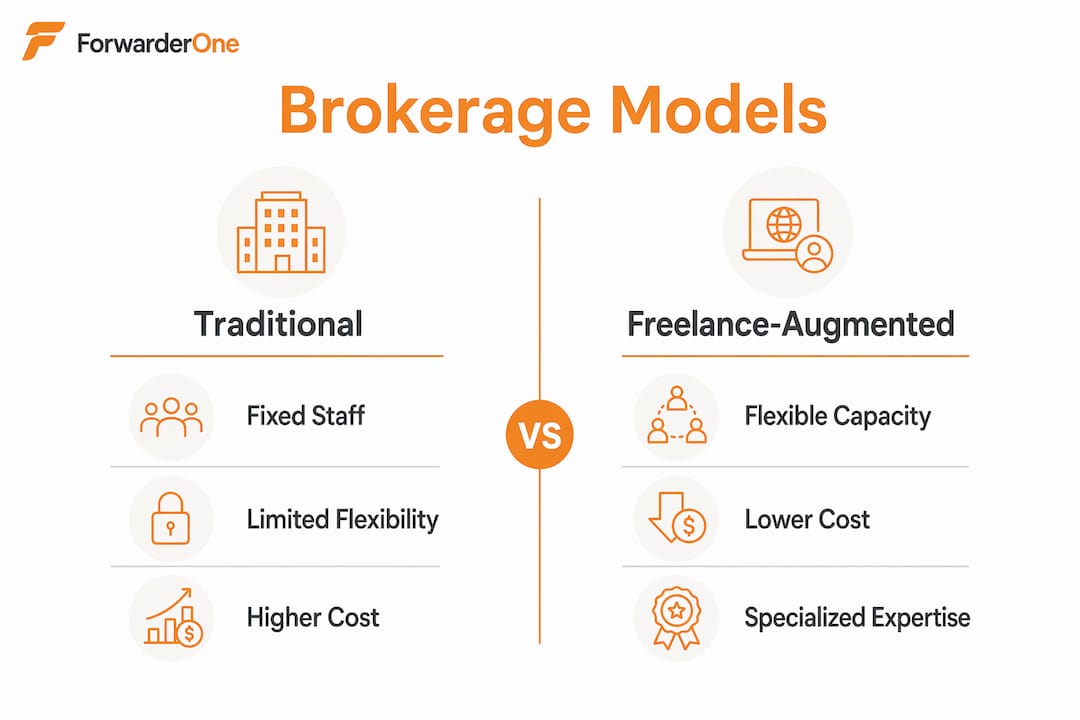
The freelance-augmented model wins on every dimension except one: consistency of relationship. That is why the best brokerages combine a core in-house team with a vetted pool of freelance specialists they can activate quickly.
How AI is reshaping the freelance customs broker role
AI has not replaced customs brokers. It has changed what they spend their time on, and that shift directly increases the value of freelance specialists.
AI currently handles 60–70% of the manual research tasks that brokers previously performed. That includes pulling tariff schedules, cross-referencing country-of-origin rules, and flagging potential classification errors. The work that remains requires judgment, context, and regulatory expertise that no algorithm currently replicates.
Here is what that means in practice for freelancers in customs:
- Classification disputes: AI flags ambiguous HTS codes. A freelance specialist resolves them with documented legal reasoning.
- Tariff engineering: Identifying lawful product modifications or sourcing changes to reduce duty exposure requires strategic analysis, not automation.
- Compliance audits: Reviewing a client’s import program for systemic errors requires human pattern recognition across thousands of entries.
- Post-summary corrections: Filing corrections with U.S. Customs and Border Protection (CBP) after entry requires both technical knowledge and procedural precision.
- Training development: Building internal customs training programs for importer staff is a high-value freelance task that AI cannot perform.
Modern brokerages that combine AI platforms with freelance experts attract stronger talent because the work is more intellectually demanding. Brokers who once spent eight hours a day on manual data entry now focus on advisory work. That career shift makes the profession more appealing and raises the quality of the freelance talent pool.
Pro Tip: Learn to work with AI-assisted customs platforms like CargoWise or Descartes. Freelancers who can interpret AI outputs and correct them are worth significantly more than those who only know manual processes.
What are the key benefits of hiring freelance customs brokers?
The importance of customs brokers who work on a freelance basis comes down to access. Importers and logistics businesses get expert-level compliance support without the cost structure of a full-service firm or a full-time hire.
For importers
- Specialized knowledge on demand: You can hire a freelance broker specifically for an HTS audit or a Section 301 refund strategy without retaining a full brokerage firm.
- Cost transparency: Freelancers typically charge project or hourly rates. You know exactly what you are paying for, unlike bundled brokerage fees.
- Risk reduction: Automated filings in ACE have increased penalties for errors. A freelance compliance specialist conducting a “reasonable care” review before filing can prevent costly CBP enforcement actions.
- Flexible engagement: You can engage a freelance broker for a single classification project, an ongoing compliance retainer, or a one-time audit. The scope matches your actual need.
For customs brokerages
- Capacity without commitment: Brokerages scale using freelancers to manage peak volumes without adding permanent headcount.
- Access to niche expertise: A brokerage specializing in consumer goods can bring in a freelance expert for a client’s aerospace parts shipment without hiring a full-time specialist.
- Competitive differentiation: Offering advisory services through freelance partners lets smaller brokerages compete with large firms on scope.
Consider a practical scenario: a mid-sized importer of electronics receives a CBP audit notice. Their filing broker handles entries but has no experience with audit response strategy. A freelance customs compliance specialist steps in, reviews the entry history, prepares the response, and identifies a classification error that, if corrected proactively, reduces the penalty exposure. That is a task that requires deep expertise and takes two to four weeks. No full-time hire is justified. A freelance engagement is exactly right.
How freelancers fit into customs workflows in 2026
Freelance customs brokers do not just fill gaps. They participate in structured workflows that make the entire compliance process more reliable. Here is how that typically unfolds:
- Initial scope assessment: The brokerage or importer identifies a compliance gap, a classification question, or a capacity bottleneck and defines the project scope.
- Freelancer selection: Based on the specific need, a freelancer with relevant HTS chapter expertise or regulatory experience is engaged.
- Data access and review: The freelancer receives entry data, product specifications, and relevant correspondence through the brokerage’s platform, often CargoWise or a similar system.
- Analysis and deliverable: The freelancer produces a classification ruling request, audit response, protest filing, or training curriculum depending on the engagement type.
- Review and filing: The brokerage reviews the deliverable, the licensed broker of record signs off, and the work is submitted to CBP or delivered to the client.
- Knowledge transfer: The freelancer documents findings so the in-house team can apply the logic to future similar entries.
Freelancers also develop internal customs training programs and support Authorized Economic Operator (AEO) certifications, tasks that full-time clerks rarely have the bandwidth or expertise to handle.
Freelance tasks vs. in-house broker roles
| Task | Freelance Broker | In-House Broker |
|---|---|---|
| Routine entry filing | Rarely | Primary responsibility |
| HTS classification audits | Primary responsibility | Occasionally |
| Protest and correction filings | Primary responsibility | Rarely |
| Compliance program design | Primary responsibility | Rarely |
| Client training development | Primary responsibility | Rarely |
| Daily client communication | Rarely | Primary responsibility |
The advisory separation between filing brokers and compliance consultants is the defining structural shift in customs brokerage right now. Importers who understand this distinction can build a more cost-effective compliance program by using both types of professionals for what they do best.
Key takeaways
Freelance customs brokers are the most cost-effective way for importers and brokerages to access specialized compliance expertise without permanent overhead.
| Point | Details |
|---|---|
| Demand is structural, not cyclical | Post-Brexit volume surges and ACE enforcement increases make freelance capacity a permanent need, not a temporary fix. |
| AI creates freelance opportunity | AI handles 60–70% of manual research, shifting freelancer value toward high-expertise advisory work. |
| Cost savings are measurable | Freelancer and AI-augmented models cut per-entry processing costs by 20–40% versus in-house-only operations. |
| Importers can hire directly | Importers can engage freelance brokers for project-based advisory work without contracting a full-service firm. |
| Specialization is the differentiator | Freelancers who focus on tariff engineering, audit response, and compliance program design command the highest fees and most consistent demand. |
The shift I have watched happen in real time
I have spent years watching customs brokerage firms struggle with the same problem: they are built for steady-state volume, and the world does not deliver steady-state volume. Every major trade policy change, from Section 301 tariffs to IEEPA actions, creates a wave of compliance work that overwhelms in-house teams. The firms that handled those waves best were not the ones with the most full-time staff. They were the ones with the strongest freelance networks.
What surprises most importers is how much advisory work they are leaving on the table. They pay a brokerage to file entries. They assume compliance strategy is included. It rarely is. Filing and advising are genuinely different skills, and the best freelance brokers I have seen specialize hard in one or two advisory areas and become indispensable to the brokerages that know how to use them.
My advice to freelancers is direct: stop competing on filing speed and start competing on classification depth. The customs clearance process is increasingly automated. Your value is in the judgment calls that automation cannot make. Build a track record on three or four HTS chapters, get comfortable with protest procedures, and learn how to write a reasonable care memo. That skill set will keep you busy regardless of what AI does next.
For importers, the practical move is to separate your filing relationship from your advisory relationship. Your filing broker handles daily entries. A freelance compliance specialist handles audits, classification reviews, and penalty responses. You will pay less overall and get better outcomes on the work that actually matters.
— Keven
How ForwarderOne supports your customs and shipping strategy
Customs compliance is only one piece of the import puzzle. Getting your goods from China to a U.S. fulfillment center reliably and affordably is the other. ForwarderOne handles that side of the equation for small and mid-sized Amazon sellers, with DDP shipping from China that covers customs, duties, and delivery in a single workflow.
If you work with a freelance customs broker for compliance strategy, ForwarderOne fits naturally alongside that relationship. Your broker handles the classification and advisory work. ForwarderOne handles the freight, the customs clearance coordination, and the last-mile delivery to your fulfillment center. With over 99% on-time delivery and a dedicated account manager, ForwarderOne gives FBA sellers the logistics reliability they need to keep inventory moving during peak seasons.
FAQ
What does a freelance customs broker actually do?
A freelance customs broker is a licensed professional who handles specialized compliance tasks such as HTS classification audits, protest filings, tariff engineering, and compliance program design on a contract basis. Unlike in-house brokers, they work across multiple clients and are typically engaged for high-value advisory projects rather than routine daily filings.
Why do customs brokerages hire freelancers instead of more staff?
Brokerages hire freelancers to manage volume spikes and access specialized expertise without adding permanent payroll. Freelancer and AI-augmented models reduce processing costs by 20–40% compared to in-house-only operations.
Can importers hire freelance customs brokers directly?
Yes. Importers can engage freelance brokers directly for project-based advisory work, including classification framework development, audit responses, and refund strategies, without contracting a full-service brokerage firm.
How does AI affect freelance customs broker demand?
AI increases demand for freelance specialists rather than reducing it. Because AI handles 60–70% of routine research tasks, the remaining work requires the kind of expert judgment and strategic analysis that freelance specialists provide.
What compliance risks make freelance brokers worth hiring?
ACE enforcement upgrades have raised penalties for filing errors significantly. A freelance compliance specialist conducting a reasonable care review before or after filing can prevent CBP enforcement actions that cost far more than the consultant’s fee.
Need freight and customs coordination in one workflow?
Send your cargo details, HS code assumptions, supplier location, and Amazon delivery target. ForwarderOne will coordinate freight, customs clearance, duties, and last-mile delivery before pickup.