Delivered Duty Paid (DDP) is the only Incoterm where the seller assumes full responsibility for customs duties, taxes, and delivery costs before the buyer ever sees the package. That single shift explains why DDP simplifies seller shipping more than any other trade term available to cross-border e-commerce operators. Platforms like Shopify and services like DutyPilot have built entire workflows around DDP because the data is clear: sellers who adopt it see fewer delays, lower cart abandonment, and more predictable costs. For Amazon sellers moving inventory from China to the US, DDP is not a luxury. It is the operational standard that separates scalable businesses from those stuck firefighting customs problems.
Why DDP simplifies seller shipping at the customs level
Customs clearance is where most international shipments lose time, and DDP solves this at the source. When duties are prepaid by the seller, customs agents process packages faster because there is no outstanding payment to collect. DDP speeds up customs clearance by up to 60%, saving 2–5 days in transit compared to DDU (Delivered Duty Unpaid) or DAP (Delivered At Place). That time savings is not trivial for sellers managing replenishment cycles or peak-season inventory.
Under DDU or DAP, carriers hold packages until the buyer pays import fees. That creates a chain of problems: customer service tickets, delayed deliveries, and refused packages. DDP cuts that chain entirely. The seller pays upfront, the package clears customs without a hold, and the buyer receives their order on the expected date.

Pro Tip: If you ship to markets with high import duty rates, like the EU or Canada, prepaying duties under DDP also protects you from exchange rate fluctuations that can inflate buyer-side costs unpredictably.
Consider a seller shipping electronics from Shenzhen to a customer in New Jersey. Under DAP, the carrier contacts the buyer for a $38 duty payment. The buyer ignores the notice. The package sits in a warehouse for five days, then gets returned. Under DDP, that scenario does not exist. The duty is already paid, the package clears, and the customer gets their order. That is the practical mechanics of why DDP works.
Does DDP actually reduce total seller costs?
The counterintuitive truth about DDP is that paying more upfront often costs less overall. DDP centralizes all taxes and duties into one upfront quote, reducing total landed costs by 10–15% through minimized carrier disbursement fees. Carrier disbursement fees are the charges carriers add when they advance duty payments on behalf of buyers. Those fees typically run 2–3% of the shipment value, and they add up fast across hundreds of orders.
DDP also makes landed cost calculation straightforward. Instead of estimating duties, brokerage fees, and carrier surcharges separately, you get one number. That number goes directly into your product pricing, your margin calculations, and your cash flow forecast.
DDP vs. DDU: a direct cost comparison
| Cost Factor | DDP | DDU |
|---|---|---|
| Customs duties | Paid by seller upfront | Collected from buyer at delivery |
| Carrier disbursement fees | Eliminated | 2–3% of shipment value |
| Customs hold risk | None | High, depending on buyer responsiveness |
| Landed cost predictability | Fixed and calculable | Variable and often unknown |
| Return rate from refused packages | Low | Significantly higher |
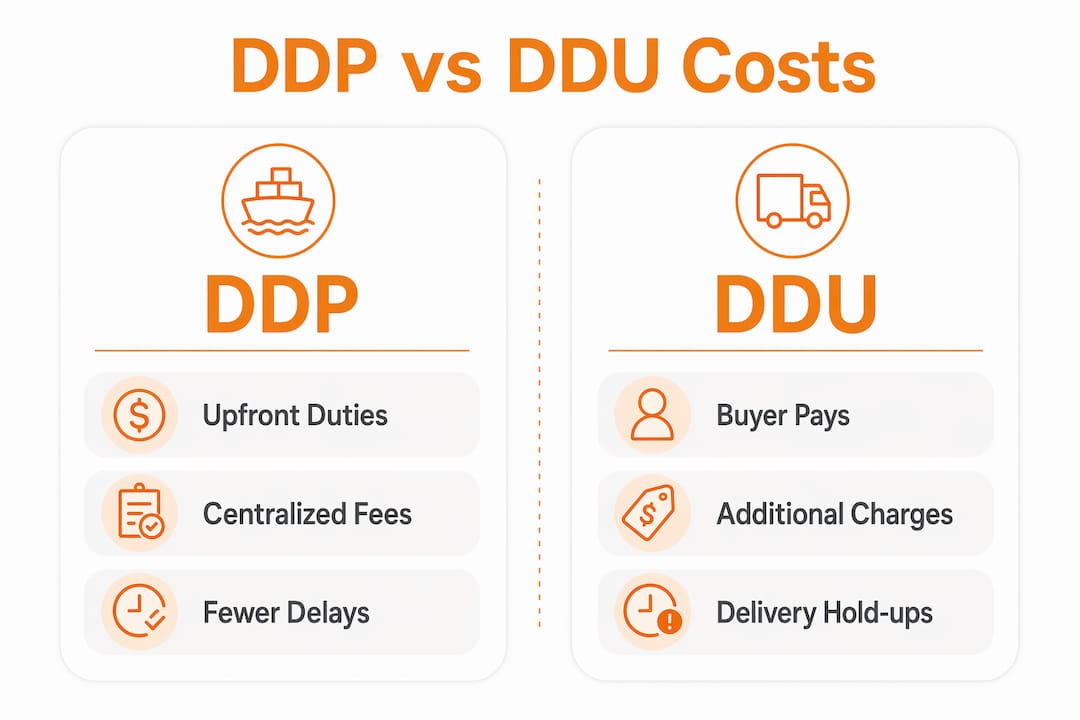
The table above shows why sellers who run the full numbers often find DDP cheaper in practice. Refused packages alone can cost $15–$50 each in return shipping and restocking fees. Eliminate those, and the math shifts quickly in DDP’s favor.
Pro Tip: When building your DDP pricing model, use a landed cost calculator tool like DutyPilot to pull accurate HS code-based duty rates by destination country. Guessing duty rates is the fastest way to erode your margins.
How does DDP improve customer experience and sales?
Buyer behavior data makes the case for DDP better than any seller testimonial. Implementing DDP increases checkout conversion rates by 15–30% and reduces international cart abandonment by up to 47% by eliminating unexpected fees at delivery. Those numbers reflect a simple psychological reality: buyers abandon carts when they cannot predict the final cost of their purchase.
Cart abandonment accounts for 41% of lost international sales. DDP directly attacks that number by showing buyers the complete, all-inclusive price at checkout. No surprise duty notice at the door. No “pay before we release your package” message from the carrier.
The customer experience benefits extend beyond the first purchase:
- Repeat purchase rates increase because buyers trust that the price they see is the price they pay.
- Customer service volume drops. DDP reduces duty-related customer service inquiries by 25% and cuts “Where Is My Order” tickets by 3x.
- Brand reputation strengthens in competitive marketplaces where one bad delivery experience generates a public review.
“Customers prefer predictable all-inclusive pricing over lower initial prices with hidden fees.” This finding from DutyPilot’s 2026 research explains why displaying duties upfront increases conversion by 18%, even when the displayed price appears higher than a competitor’s DDU price.
The practical implication for sellers is clear. A $45 product with a $52 all-inclusive DDP price converts better than a $45 product with an unknown duty fee waiting at delivery. Buyers are not irrational. They are risk-averse. DDP removes the risk.
DDP also matters specifically for Amazon marketplace compliance. Amazon requires DDP shipping on many international routes to maintain the customer experience standards that match domestic Prime shopping. Sellers who ship DDU on Amazon risk shipment holds, negative feedback, and account health penalties.
Is one vendor better than managing multiple logistics partners?
Traditional cross-border shipping forces sellers to coordinate at least four separate parties: the supplier, the freight forwarder, the customs broker, and the last-mile carrier. Each handoff is a potential failure point. Each vendor has different communication standards, invoicing systems, and accountability structures.
DDP consolidates this into one accountable vendor, shifting the entire logistics chain under a single relationship. For sellers without a dedicated logistics team, this consolidation is not just convenient. It is operationally necessary.
Here is what that single-vendor model looks like in practice:
- Supplier pickup: Your DDP freight forwarder collects inventory directly from your Chinese supplier.
- Consolidation and export: The forwarder consolidates your shipment, handles export documentation, and books the freight.
- Customs clearance: The forwarder files the import entry, pays duties, and clears the shipment on your behalf.
- Last-mile delivery: The forwarder delivers to your Amazon FBA fulfillment center or directly to customers.
Every step sits under one contract, one invoice, and one point of contact. When something goes wrong, you call one person. That accountability structure is what makes DDP genuinely manageable for small and mid-sized sellers.
Pro Tip: When evaluating DDP freight forwarders, ask specifically whether customs brokerage is in-house or subcontracted. In-house brokerage means faster clearance and fewer communication gaps when customs agents have questions about your shipment.
Understanding varying customs laws by destination is the seller’s primary responsibility under DDP. A good DDP partner handles execution, but you need to know the duty rates and restricted product categories for your target markets. Ignorance of customs rules does not protect you from delays or penalties.
Services like ForwarderOne’s China shipping agent handle supplier pickup and consolidation as part of an integrated DDP workflow, which removes one more coordination burden from the seller’s plate.
Key takeaways
DDP simplifies seller shipping by consolidating customs, duties, and logistics under one upfront payment and one accountable vendor, reducing delays, costs, and buyer friction simultaneously.
| Point | Details |
|---|---|
| Customs clearance speed | DDP prepaid duties cut clearance time by up to 60%, saving 2–5 days per shipment. |
| Total landed cost reduction | Centralizing duties eliminates carrier disbursement fees, cutting landed costs by 10–15%. |
| Conversion rate impact | DDP increases international checkout conversion by 15–30% and cuts cart abandonment by up to 47%. |
| Vendor consolidation | One DDP partner replaces four separate logistics relationships, reducing failure points. |
| Marketplace compliance | Amazon requires DDP on many international routes to protect customer experience standards. |
Why I think DDP is non-negotiable for sellers who want to scale
Sellers often ask me whether DDP is worth the added complexity on their side. My answer is always the same: the complexity does not go away under DDU. It just moves to your customer, and that is far more damaging.
What I have seen consistently is that sellers who resist DDP are usually underestimating the hidden costs of the alternative. Refused packages, customer service escalations, negative reviews from surprise duty bills, and Amazon account health warnings are all real costs. They just do not show up on a single invoice, so they are easy to ignore until they compound into a serious problem.
The sellers who scale past $1 million in international revenue almost always have one thing in common: they treat landed cost as a fixed, known number before they price a single unit. DDP is the mechanism that makes that possible. Transparent pricing is not just a customer experience feature. It is a financial discipline that forces you to understand your true margins before you commit to a market.
My practical advice: start with one destination market, build your DDP landed cost model using a tool like DutyPilot, and run it for 90 days. The conversion and return rate data will make the decision for you.
— Keven
How ForwarderOne makes DDP shipping work for Amazon sellers
ForwarderOne’s DDP freight forwarding services are built specifically for small and mid-sized Amazon sellers shipping from China, Korea, and Mexico to US fulfillment centers. The platform manages customs clearance, duty payment, and last-mile delivery under one all-inclusive workflow, so sellers never coordinate between separate brokers and carriers.
With over 99% on-time delivery and a dedicated account manager for every account, ForwarderOne gives sellers the reliability they need during peak periods like Q4. If you are ready to move from fragmented logistics to a single, accountable DDP shipping partner, ForwarderOne is built for exactly that transition. Reach out to get a tailored quote for your shipping lanes.
FAQ
What does DDP mean in shipping?
DDP stands for Delivered Duty Paid, an Incoterm where the seller covers all customs duties, taxes, and delivery costs to the buyer’s location. It is the only Incoterm that places zero customs payment responsibility on the buyer.
How does DDP reduce cart abandonment?
DDP eliminates surprise import fees at delivery by including all duties in the checkout price. Research shows this reduces international cart abandonment by up to 47% and increases conversion rates by 15–30%.
Is DDP more expensive than DDU for sellers?
DDP can appear more expensive upfront, but it reduces total landed costs by 10–15% by eliminating carrier disbursement fees and return costs from refused packages. Most sellers find DDP cheaper when all costs are counted.
Do Amazon sellers need DDP shipping?
Amazon requires DDP on many international shipping routes to maintain customer experience standards. Sellers who ship DDU risk shipment holds, negative feedback, and account health issues on the platform.
How do I find a reliable DDP freight forwarder?
Look for a forwarder with in-house customs brokerage, a dedicated account manager, and a documented on-time delivery rate. ForwarderOne, for example, reports over 99% on-time delivery for Amazon FBA shipments from China to the US.
Ready to simplify DDP shipping?
Share your supplier city, carton count, cargo value, HS code, destination market and Amazon delivery target. ForwarderOne will build an all-inclusive DDP quote with customs, duties and final delivery mapped before pickup.