
Air freight from China is the right call when your inventory can’t wait for a 30-day ocean transit and the cost premium fits your margin. For most U.S. importers and Amazon sellers in 2026, standard air cargo costs range in the lower single-digit dollars per kilogram with door-to-door transit times of several days for express and about one to two weeks for standard air cargo. Add duties, a Chinese VAT, and any applicable U.S. tariffs to get your true landed cost. The fastest path to predictable landed cost is a forwarder offering DDP (Delivered Duty Paid) and FBA-ready workflows, so customs, duties, and last-mile delivery arrive as one fixed number rather than a series of surprise invoices.
Key numbers to anchor your planning:
- Express air (courier-level): $8–$20/kg, 3–5 business days door-to-door
- Standard air cargo: $4–$8/kg, 7–14 business days door-to-door
- Customs clearance: typically adds 1–4 business days when paperwork is complete
- Regulatory bodies to know: U.S. Customs and Border Protection (CBP) governs U.S. import clearance; IATA sets air-cargo safety and handling standards globally
- ForwarderOne fit: ForwarderOne, which reports high on-time delivery performance and offers an all-in DDP workflow built for Amazon sellers
What types of air freight service can you ship from China?
The service type you choose shapes everything: cost, transit time, and how much hand-holding your shipment gets at each checkpoint.
Express (courier-level) covers services like DHL Express, FedEx International Priority, and UPS Worldwide Express. These move door-to-door in 3–5 business days and include integrated customs brokerage. They cost the most per kilogram, but for a high-value, low-weight shipment — a product sample, a small FBA restock to prevent a stockout, or a prototype — the premium is often worth it. Express couriers are typically the most expensive option for heavier shipments once dimensional weight is applied.
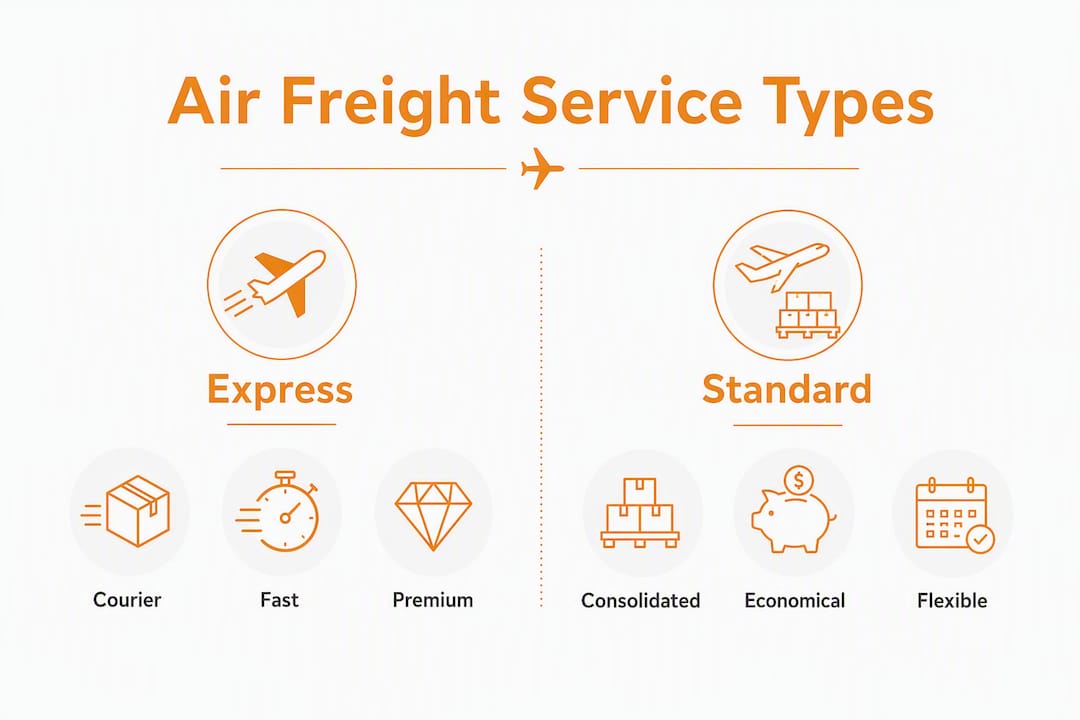
Standard air cargo (consolidated airfreight) is what most importers mean when they say “air freight.” A freight forwarder consolidates your cargo with other shippers’ goods into a single airline ULD (Unit Load Device), which cuts the per-kg rate significantly. Transit runs about one to two weeks door-to-door. This is the practical choice for FBA restocks that aren’t yet critical, seasonal inventory builds, and shipments in the 50–500 kg range.
Charter air freight is reserved for very large or time-critical loads where you need the entire aircraft or a guaranteed block of space. Think: a factory’s full production run ahead of peak season, or a product launch requiring simultaneous delivery to multiple fulfillment centers. Costs are negotiated directly and vary widely.
Special cargo categories worth knowing:
- Temperature-controlled: Requires GDP-compliant packaging, pre-conditioned containers, and airline approval. Common for supplements, cosmetics, and electronics with thermal sensitivity.
- Dangerous goods (hazmat): Must comply with IATA Dangerous Goods Regulations. Lithium batteries (common in electronics) require UN38.3 test reports and specific labeling before any airline will accept the shipment.
- High-value cargo: Typically requires a declared-value surcharge and may need dedicated security handling or an armored transfer at the destination airport.
How air freight pricing works and what your invoice will actually include
Air freight quotes look simple until the invoice arrives. Here’s what actually drives the number.
The pricing components you’ll see on every quote
Chargeable weight is the first thing to understand. Airlines bill on whichever is greater: actual gross weight or dimensional weight. Dimensional weight is calculated as (L × W × H in cm) ÷ 6,000 for most carriers. A light but bulky shipment — foam packaging, for example — can double your chargeable weight versus actual weight. Irregular dimensions add surcharges on top of that.
Beyond the base rate, a standard air freight invoice includes:
- Security surcharge: — Fixed per-kg fee mandated by IATA
- Customs brokerage: — Per-entry fee for filing the ISF and CBP entry
Sample landed-cost calculation
| Cost Component | Example (100 kg shipment, $5/kg air rate) |
|---|---|
| Base air freight (100 kg × $5) | $500 |
| AWB + handling | $50 |
| Customs brokerage (U.S. entry) | $120 |
| Destination delivery (to FBA) | $80 |
| Cargo insurance (0.4% of $3,000) | $12 |
| Per-kg landed cost | $11.22 |
That $5/kg headline rate becomes $11.22/kg once everything lands. Model this before you compare air to sea freight — the sea vs. air cost comparison often surprises sellers who only look at the base rate.
How to reduce per-unit air freight cost
Consolidation is the single most effective lever. When you ship with a forwarder who consolidates multiple clients’ cargo, you access wholesale airline rates rather than retail spot pricing. Booking 2–3 weeks ahead of your ready date also matters: last-minute bookings during peak season can push rates 30–50% higher. West Coast origin points (California hubs) consistently offer more direct flight options and lower rates to major Chinese export gateways than East Coast origins.
What transit times should you expect from China to U.S. gateways?
Typical door-to-door windows by service type
| Origin Hub | Destination | Express (days) | Standard Air Cargo (days) |
|---|---|---|---|
| Shanghai (PVG) | Los Angeles (LAX) | 3–5 | 7–10 |
| Shenzhen (SZX) | Los Angeles (LAX) | 3–5 | 7–10 |
| Guangzhou (CAN) | Los Angeles (LAX) | 4–6 | 8–11 |
| Shanghai (PVG) | New York (JFK) | 4–6 | 7–14 |
| Shenzhen (SZX) | Chicago (ORD) | 4–6 | 7–14 |
| Guangzhou (CAN) | New York (JFK) | 5–7 | 10–14 |
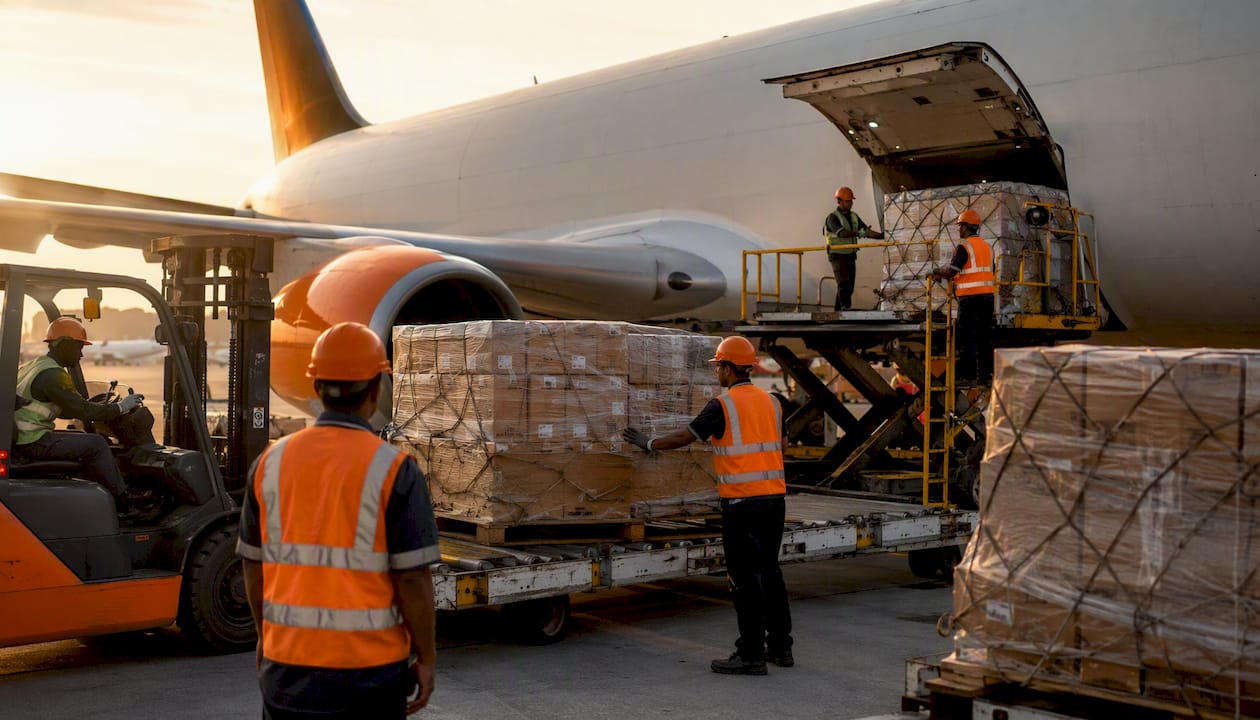
These are door-to-door estimates including 1–4 business days for U.S. customs clearance when documentation is correct. Add a day or two for secondary inspection if CBP selects your shipment for exam.
Routing patterns and why they matter
Most standard air cargo from southern China (Shenzhen, Guangzhou) routes through Hong Kong International Airport (HKG) or Guangzhou Baiyun (CAN) before connecting to U.S. gateways. Shanghai cargo typically flies direct to LAX or connects through Tokyo Narita (NRT). Direct flights are faster but less frequent; connecting itineraries add 12–24 hours but offer more departure options when direct space is tight.
Seasonality hits hard twice a year. Pre-holiday (October through mid-December) and the weeks before Chinese New Year (late January/early February) both compress available capacity and push spot rates sharply higher. Book 3–4 weeks ahead during these windows, or lock in space with a forwarder who holds block-space agreements with carriers. Check carrier service alerts before booking any time-sensitive shipment, since route suspensions and surcharge changes happen with little notice.
What paperwork does a China-to-U.S. air shipment require?
Getting customs clearance right the first time saves days. Here’s the complete document set for a commercial air shipment:
- Commercial invoice: — Must include a detailed description of goods (not “samples” or “gifts”), declared value in USD, HS code, country of origin, and both parties’ business tax IDs. Vague descriptions trigger inspections — CBP expects specificity.
HS codes determine your duty rate and whether your goods require additional documentation. Confirm the correct 10-digit HTS code with your customs broker before booking, not after. A wrong code discovered at clearance means reclassification, potential penalties, and a delay that can cost more than the air freight itself.
Incoterms and who pays: Under DDP (Delivered Duty Paid), your forwarder handles all duties, taxes, and clearance costs, and you receive one all-in price. Under DDU (Delivered Duty Unpaid, also called DAP), you or your customs broker handle clearance and pay duties separately. For FBA shipments, DDP is almost always the cleaner choice — Amazon’s receiving centers won’t accept shipments held at customs. The China Sourcing to U.S. Delivery Checklist covers the full document workflow for sellers.
How should you pack and palletize air cargo?
Air cargo has strict acceptance standards, and rework at the origin warehouse costs time and money.
- Carton integrity: Use double-wall corrugated boxes rated for the gross weight of contents. Overpacked or bulging cartons are rejected at airline acceptance.
- Palletization: For shipments over 200 kg, palletize on standard 120×100 cm or 120×80 cm skids. Band and shrinkwrap tightly; loose cargo on a pallet fails airline ULD build standards.
- Dimensional weight discipline: Measure every carton after packing, not before. Void fill adds volume without adding value. Switching from foam peanuts to molded pulp or air pillows often reduces dimensional weight by 10–15% on bulky SKUs.
- Hazmat labeling: Lithium batteries require UN3481 or UN3480 labels depending on whether they’re packed with or inside equipment. Missing labels mean the airline won’t load the shipment.
- Temperature-controlled cargo: Pre-condition packaging to the required temperature range before sealing. Include a calibrated temperature data logger inside each pallet for proof of chain-of-custody.
- High-value items: Use tamper-evident seals on cartons and declare value accurately. Underdeclaring to reduce insurance cost is a customs violation and voids your cargo insurance.
Pro Tip: Before your supplier books the pickup truck, have them send you the packed carton dimensions and gross weight for every SKU. Run the dimensional weight calculation yourself. Suppliers often pack to their convenience, not your chargeable weight — catching a packing inefficiency before the shipment leaves the factory is the cheapest fix you’ll ever make.
How do you get an accurate air freight quote and book a shipment?
What information to provide for an instant, firm quote
Forwarders re-quote when information changes. Give them everything upfront:
- Origin address (factory or warehouse in China, including city and province)
- Carton count, dimensions (L × W × H in cm), and gross weight per carton
- Total shipment weight and volume
- HS code (10-digit HTS for U.S. import)
- Commodity description and declared value in USD
- Incoterm (DDP or DDU)
- Cargo ready date
- Destination: door delivery address or FBA center code (e.g., ONT8, MDW2)
- Special handling requirements (hazmat, temperature, high-value)
Booking steps from quote acceptance to delivery
- U.S. customs clearance — at destination gateway (1–4 business days; forwarder files CBP entry)
Use a live rate calculator for parcel-level comparisons, but for inventory shipments, call or message your forwarder directly. Calculators don’t account for consolidation rates, DDP bundling, or FBA-specific labeling requirements. Also check carrier service-alert pages before booking time-sensitive cargo — route suspensions happen, and a forwarder with block-space agreements can reroute faster than a spot booking.
How do you choose the right freight forwarder for China-to-U.S. air?
The decision checklist
- DDP capability: Can they handle duties, taxes, and customs clearance as a single bundled cost? If not, you’re managing two vendors.
- FBA experience: Do they know Amazon’s labeling, carton, and pallet requirements? A forwarder who’s never shipped to a fulfillment center will cost you in prep fees and rejected deliveries.
- Integrated customs brokerage: In-house brokerage is faster and cheaper than outsourcing to a third-party broker.
- Cargo insurance: Do they offer declared-value coverage, and what’s the claims process?
- Assigned account manager: A named contact who knows your account beats a ticket queue every time.
- On-time delivery metrics: Ask for a number. Any forwarder worth using tracks this.
Questions to ask before you sign
- What surcharges are included in your quote, and which ones can change after booking?
- How do you handle consolidation cut-off dates, and what happens if my cargo misses the cut?
- What’s your claims process for damaged or lost cargo, and what’s the average resolution time?
- Can you provide references from sellers shipping similar SKUs on the same lane?
- How do you handle CBP exam fees if my shipment is selected for inspection?
Red flags to walk away from
- A quote with no line-item breakdown — you can’t verify what you’re paying for
- No assigned contact person; all communication goes through a generic inbox
- Slow response on documentation requests (over 24 hours during business hours)
- Refusal to provide on-time delivery metrics or client references
- “All-in” pricing that excludes duties and taxes without clearly stating so
The freight forwarder selection guide covers additional criteria for vetting China-based agencies.
How ForwarderOne handles air freight from China to the U.S.
ForwarderOne is built specifically for small and mid-sized Amazon sellers moving inventory from China to U.S. fulfillment centers. The service covers the full workflow: pickup from your Chinese supplier, export clearance, air freight, U.S. customs clearance under DDP, FBA labeling, and last-mile delivery to the fulfillment center. You get one landed cost, not a stack of invoices from four different vendors.
Key service elements:
- All-in DDP pricing: Duties, taxes, and customs brokerage are bundled into the quote. No surprise invoices at the destination port.
- FBA-ready delivery: ForwarderOne handles Amazon’s carton labeling, pallet requirements, and appointment scheduling at fulfillment centers.
- Cargo insurance: Declared-value coverage is available on every shipment, with a clear claims process.
- Dedicated account manager: Every client gets a named contact who knows their SKUs, their suppliers, and their FBA center assignments.
- Reportedly high on-time delivery rates: That metric matters most during Q4 and Chinese New Year, when a missed delivery window means stockouts and lost Buy Box position.
The FBA-ready DDP forwarding service is the practical starting point for sellers who want to stop managing logistics piecemeal. The China supplier to FBA workflow guide walks through the full booking-to-delivery sequence.
Key Takeaways
Air freight from China to the U.S. delivers predictable landed cost and fast transit when you use a DDP-capable forwarder with FBA experience, correct HS codes, and efficient packing.
| Point | Details |
|---|---|
| Choose DDP for landed-cost clarity | DDP bundles duties, taxes, and clearance into one price, eliminating surprise invoices at the U.S. gateway. |
| Verify HS codes before booking | A wrong HS code at clearance triggers reclassification, penalties, and delays that exceed the cost of the air freight itself. |
| Pack to minimize dimensional weight | Reducing void fill and carton size cuts chargeable weight; switching to efficient fill can reduce dimensional weight by 10–15% on bulky SKUs. |
| Reserve express only for urgent cargo | Express air runs $8–$20/kg versus $4–$8/kg for standard; the premium is justified for stockout prevention, not routine restocks. |
| Use ForwarderOne for FBA shipments | ForwarderOne’s all-in DDP workflow, over 99% on-time delivery, and dedicated account managers make it the direct option for Amazon sellers shipping from China. |
The cost-vs-speed tradeoff is more nuanced than most guides admit
Most air freight guides frame the decision as simple: pay more, go faster. The real calculus is different, and sellers who treat it as binary tend to either overspend on express or underestimate how much a stockout costs.
The metric that actually matters is the cost of being out of stock versus the premium for air over sea. For a high-velocity SKU generating substantial daily revenue, ocean transit delays can translate into significant lost sales. Paying a premium for air freight to restock may be cost-effective in such cases. However, for slow-moving SKUs with ample inventory on hand, standard sea freight is generally the more economical choice, and using air freight budget in these cases is often unnecessary.
The other thing most guides understate is the operational value of a dedicated account manager. When a shipment hits a CBP exam or a supplier misses the cut-off date, the difference between a forwarder with a named contact and one with a ticket queue is measured in days, not hours. That’s the real reason DDP with an assigned manager is worth the slight premium over the cheapest spot rate you can find on a rate calculator.
Confirm your HS codes at the SKU level before you book anything. It’s the single step most sellers skip, and it’s the one that causes the most expensive delays.
Get a ForwarderOne DDP air freight quote for your next China shipment
ForwarderOne gives Amazon sellers and ecommerce importers a single, all-in DDP price from your Chinese supplier’s door to your FBA fulfillment center. No separate customs broker, no surprise duty invoices, no chasing four vendors for updates.
To get a fast, accurate quote, have your carton dimensions, gross weight, HS code, cargo ready date, and destination FBA center code ready. ForwarderOne’s team responds with a firm landed-cost quote, not an estimate that grows after booking. Every shipment comes with a dedicated account manager and over 99% on-time delivery backing it up.
Request your DDP air freight quote or review the full FBA and DDP forwarding services to see how the workflow fits your supply chain.
Need a clearer landed-cost plan?
ForwarderOne coordinates supplier pickup, DDP customs clearance, duty payment, FBA prep details, and final delivery under one shipment plan.