Sea freight and air freight are the two primary shipping methods for Amazon FBA sellers, each built around a different trade-off between cost and delivery speed. Sea freight moves large volumes cheaply but slowly, while air freight delivers fast at a steep price premium. Choosing the wrong mode for your shipment type can either eat your margins or leave your Amazon listings out of stock at the worst possible time. This guide breaks down the sea freight vs air freight FBA decision across costs, transit times, product fit, and execution so you can ship smarter in 2026.
How do costs compare between sea freight and air freight for FBA?
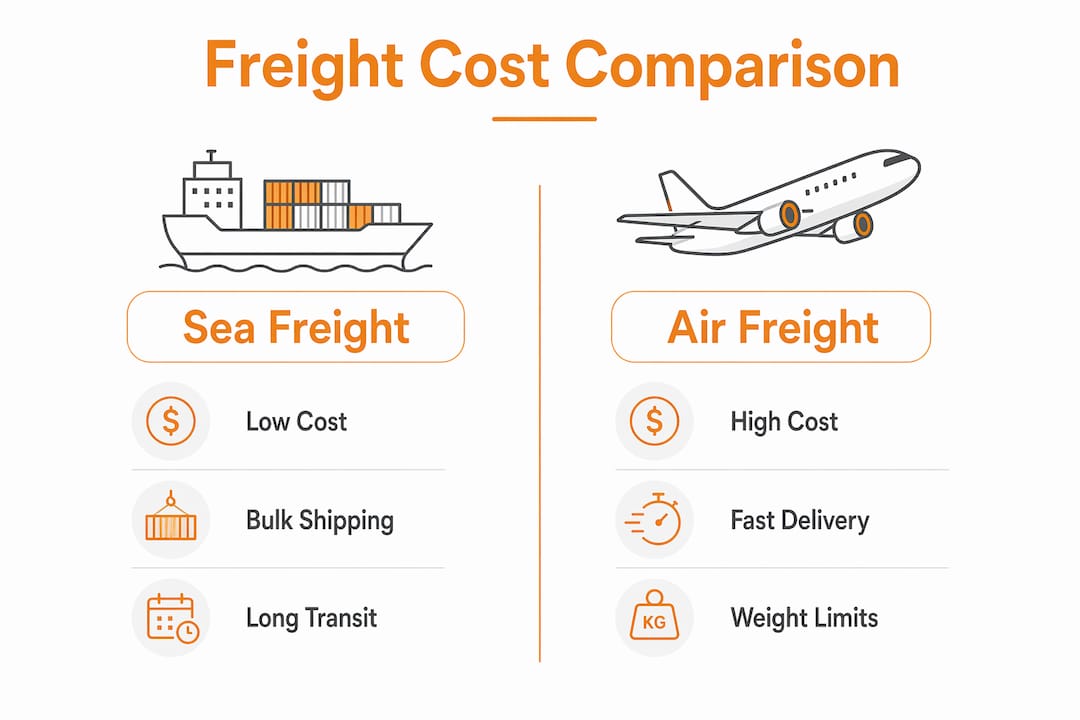
Sea freight spreads shipping costs across large container loads, making it the most cost-efficient option for bulk FBA shipments. A full container load (FCL) or less-than-container-load (LCL) shipment from China to a US Amazon fulfillment center costs a fraction of what air freight charges per kilogram. The freight cost factors that drive your final bill include fuel surcharges, port handling fees, customs duties, and inland delivery.
Air freight charges by chargeable weight, which is the greater of actual weight and volumetric weight. That formula punishes bulky, lightweight goods and rewards dense, compact products. A concrete example makes this clear: an 85 kg shipment costs roughly $400 by sea and $600 by air. That $200 gap may seem manageable on one shipment, but it compounds fast across a full year of restocks.

Air freight is economically viable only when shipping costs stay below 15–20% of the product’s total value. That threshold is the clearest rule of thumb in FBA logistics. If your product sells for $10 and weighs 500 grams, air freight will almost certainly destroy your margin. If it sells for $200 and weighs 300 grams, air freight can make sense.
Pro Tip: Use ForwarderOne’s shipping cost calculator to compare sea and air freight quotes side by side before booking. Plug in your actual dimensions and weight to get a realistic chargeable weight figure.
| Cost factor | Sea freight | Air freight |
|---|---|---|
| Base rate structure | Per CBM or container | Per kg (chargeable weight) |
| Fuel surcharges | Moderate, route-dependent | Higher, more volatile |
| Customs and duties | Applies to both modes | Applies to both modes |
| Best for | Bulk, heavy, low-margin goods | Light, high-value, time-sensitive goods |
| Typical cost advantage | Significantly lower per unit | Justified only above a value threshold |
What are transit times and reliability like for each mode?
Transit time is where the two modes diverge most sharply. Air freight delivers in 1–3 days, while sea freight from China to US Amazon warehouses typically takes 2–6 weeks depending on the route and port of entry. That gap is not just a scheduling detail. It determines how much safety stock you need to hold, how far in advance you must place purchase orders, and how exposed you are to stockouts.
Sea freight reliability depends on several variables you cannot fully control:
- Port congestion at major hubs like Los Angeles or Long Beach can add days or weeks to your timeline without warning.
- Customs clearance delays at the US border affect both modes but hit sea freight harder because the longer transit already stretches your planning window.
- Weather disruptions cause occasional delays on ocean routes, though modern vessels are rarely stopped outright.
- Carrier schedule reliability on ocean lanes has improved since the supply chain disruptions of 2021–2022, but variability remains.
Air freight has its own reliability risks. Fixed cargo capacity and sensitivity to weather disruptions mean that a single storm or high-demand period can push your shipment to the next available flight. During peak seasons like Q4, air cargo space gets tight and rates spike.
Digital visibility tools and strategic forecasting significantly reduce the risk of sea freight delays. Sellers who track their ocean shipments in real time and build buffer stock into their reorder points turn sea freight from a liability into a reliable supply chain pillar. ForwarderOne’s freight tracking systems give sellers live shipment visibility so they can react before a delay becomes a stockout.
Which products and shipment types fit each mode?
The right freight mode depends on what you are shipping, not just how much it costs. Sea freight remains the preferred mode for large, heavy, or low-margin products where cost per unit is the primary concern. Air freight earns its premium for products where speed directly protects revenue.
Products that fit sea freight well:
- Heavy or oversized items such as furniture, fitness equipment, or large kitchen appliances
- Seasonal inventory ordered well in advance of peak periods like Q4 or Prime Day
- Low-margin, high-volume goods where air freight would eliminate profit entirely
- Initial bulk orders when launching a new product and cash flow is a priority
Products that fit air freight well:
- High-value, lightweight goods such as electronics accessories, jewelry, or premium cosmetics
- Urgent restocks when your FBA inventory is critically low and you cannot wait weeks
- New product launches where speed to market matters more than per-unit shipping cost
- Small test orders to validate demand before committing to a full container
Pro Tip: If your product is on the BFCM peak season calendar, plan your sea freight departure at least 8 weeks before your target in-stock date. Missing that window forces you into air freight at the worst possible time, when rates are highest.
Air freight carries restrictions on hazardous materials, lithium batteries, and certain chemicals. If your product falls into these categories, confirm compliance with IATA dangerous goods regulations before booking. Sea freight handles a broader range of restricted goods, though it has its own documentation requirements.
How to plan and execute FBA shipments by sea or air
Execution is where most small sellers lose time and money. The planning steps differ by mode, but the documentation requirements overlap significantly.
-
Gather your core documents. Both sea and air freight require a commercial invoice, packing list, and bill of lading (sea) or air waybill (air). Your supplier in China typically prepares these, but you are responsible for accuracy. Errors in declared value or HS codes trigger customs holds.
-
Choose the right freight forwarder. Not every forwarder understands Amazon FBA requirements. FBA warehouses have strict receiving windows, pallet and carton labeling rules, and appointment scheduling requirements. Work with a forwarder who has direct FBA experience. ForwarderOne’s guide on choosing a freight forwarder as an Amazon seller covers exactly what to look for.
-
Decide between FCL, LCL, or air consolidation. FCL (full container load) is cheapest per CBM but requires enough volume to fill a 20-foot or 40-foot container. LCL (less-than-container-load) consolidates your cargo with other shippers and suits smaller shipments. Air freight consolidation works similarly for smaller air shipments.
-
Select your delivery terms. DDP (Delivered Duty Paid) means your forwarder handles customs clearance, import duties, and final delivery to the Amazon warehouse. DAP (Delivered at Place) leaves customs and duties to you. DDP is almost always the better choice for FBA sellers who want one clean workflow.
-
Book early and confirm FBA receiving appointments. Amazon’s fulfillment centers require advance shipping notifications (ASNs) and appointment slots. Your forwarder should coordinate these directly. Missing an appointment can mean your shipment sits in a dock queue for days.
| Step | Sea freight | Air freight |
|---|---|---|
| Lead time to book | 2–4 weeks before departure | 3–7 days before departure |
| Key document | Bill of lading | Air waybill |
| Delivery terms | DDP recommended | DDP recommended |
| FBA label requirement | Required on all cartons | Required on all cartons |
| Common mistake | Underestimating port delays | Ignoring chargeable weight calculation |
Key Takeaways
Sea freight delivers the lowest cost per unit for bulk FBA shipments, while air freight is the right call only when speed protects revenue or shipping costs stay below 15–20% of product value.
| Point | Details |
|---|---|
| Cost threshold for air freight | Air freight is viable only when shipping costs stay below 15–20% of the product’s total value. |
| Sea freight suits bulk orders | Large, heavy, or low-margin products ship most profitably by ocean, especially with advance planning. |
| Air freight fills urgent gaps | Use air freight for critical restocks, high-value lightweight goods, or time-sensitive launches. |
| DDP simplifies both modes | Delivered Duty Paid terms remove customs complexity and keep your FBA workflow clean. |
| Digital tracking reduces sea freight risk | Real-time visibility tools turn ocean freight into a reliable supply chain option, not just a cheap one. |
What I’ve learned from watching sellers pick the wrong mode
The most common mistake I see small FBA sellers make is treating air freight as a backup plan rather than a deliberate tool. They under-order by sea, run low on stock, then panic-ship by air at Q4 rates. That single decision can wipe out months of margin. The sellers who avoid this pattern share one habit: they plan their sea freight departures first and treat air freight as a premium option they use intentionally, not reactively.
The other thing worth saying plainly is that sea freight has gotten more reliable, not less, for sellers who use the right forwarder and the right tracking tools. The horror stories from 2021 and 2022 were real, but the market has adjusted. Investing in digital tracking and forecasting genuinely improves ocean freight reliability. Sellers who dismissed sea freight after those years and defaulted to air are paying a significant cost penalty they do not need to carry.
My practical advice: run the 15–20% rule on every product before you book. If air freight costs more than 20% of your product’s value, sea freight is almost always the right call. If you are within that window and stock risk is high, air freight earns its price. The ocean vs air freight comparison is not a one-time decision. Revisit it every time your product mix, order volume, or sales velocity changes.
— Keven
ForwarderOne’s freight services for Amazon FBA sellers
Small and mid-sized Amazon sellers need a forwarder who already knows FBA rules, not one learning them on your shipment. ForwarderOne handles both sea and air freight from China, Korea, and Mexico to US fulfillment centers, with all-inclusive DDP pricing that covers customs, duties, and warehouse delivery in a single quote.
ForwarderOne’s FBA freight forwarding services include a dedicated account manager, real-time shipment tracking, and over 99% on-time delivery. Whether you are booking your first LCL ocean shipment or need an urgent air freight restock before a peak sales period, ForwarderOne gives you one point of contact for the entire process. Get a quote at forwarderone.com and see what your next shipment actually costs before you commit.
FAQ
What is the main cost difference between sea and air freight for FBA?
Sea freight costs significantly less per kilogram than air freight, making it the standard choice for bulk FBA shipments. Air freight is economically justified only when shipping costs stay below 15–20% of the product’s total value.
How long does sea freight take from China to US Amazon warehouses?
Sea freight from China to US FBA warehouses typically takes 2–6 weeks depending on the route, port of entry, and customs clearance speed. Air freight covers the same route in 1–3 days.
Is air freight better for Amazon FBA product launches?
Air freight suits product launches when speed to market matters more than per-unit shipping cost, particularly for lightweight, high-value items. For heavy or low-margin launch inventory, sea freight ordered well in advance is the more profitable choice.
What does DDP mean for FBA shipments?
DDP (Delivered Duty Paid) means your freight forwarder handles customs clearance, import duties, and final delivery to the Amazon warehouse on your behalf. It removes the most complex parts of international shipping from your workflow and is the standard term used by experienced FBA forwarders like ForwarderOne.
Which freight mode has a lower environmental impact?
Ocean freight has a significantly smaller carbon footprint than air freight, making it the more sustainable option for FBA sellers who factor environmental impact into their logistics decisions.
Need sea and air options compared for your FBA shipment?
Send your carton count, dimensions, destination warehouse, and target in-stock date. ForwarderOne can compare DDP ocean, air, and hybrid restock options before you book.