The China supplier to FBA workflow is the end-to-end process of sourcing products from Chinese factories, preparing them to Amazon’s standards, and delivering them to US fulfillment centers ready for sale. Most sellers who fail at this process don’t fail at marketing. They fail because they never calculated their full landed costs before placing an order, which means freight, duties, inspection fees, prep costs, and Amazon fees all eat into margins they assumed were healthy. Getting this workflow right from the start separates sellers who scale from sellers who stall.
What are the prerequisites for the China to FBA workflow?
Before a single unit ships, you need several things locked in. Sellers who skip this setup phase pay for it later with rejected shipments, labeling errors, and customs delays.
Documents and Amazon requirements:
- Amazon shipment plan created and confirmed in Seller Central
- FNSKU labels printed and ready to send to your supplier or prep center
- Commercial invoice template with accurate HS codes, declared values, and product descriptions
- Packing list template showing carton dimensions, weights, and unit counts
- Supplier contact sheet with factory name, address, and authorized contact
Tools and contacts to have ready:
- A sourcing agent or freight forwarder with China-to-FBA experience
- A quality control inspector contact for pre-shipment checks
- Access to Amazon’s Seller Central shipment workflow
- A spreadsheet tracking landed costs per unit
Sellers typically create the Amazon shipment plan first, print FNSKU labels, and then send those labels to the manufacturer or prep service. That sequence matters because your supplier cannot apply the correct labels without them. Reversing the order causes delays that can push your inventory weeks behind schedule.
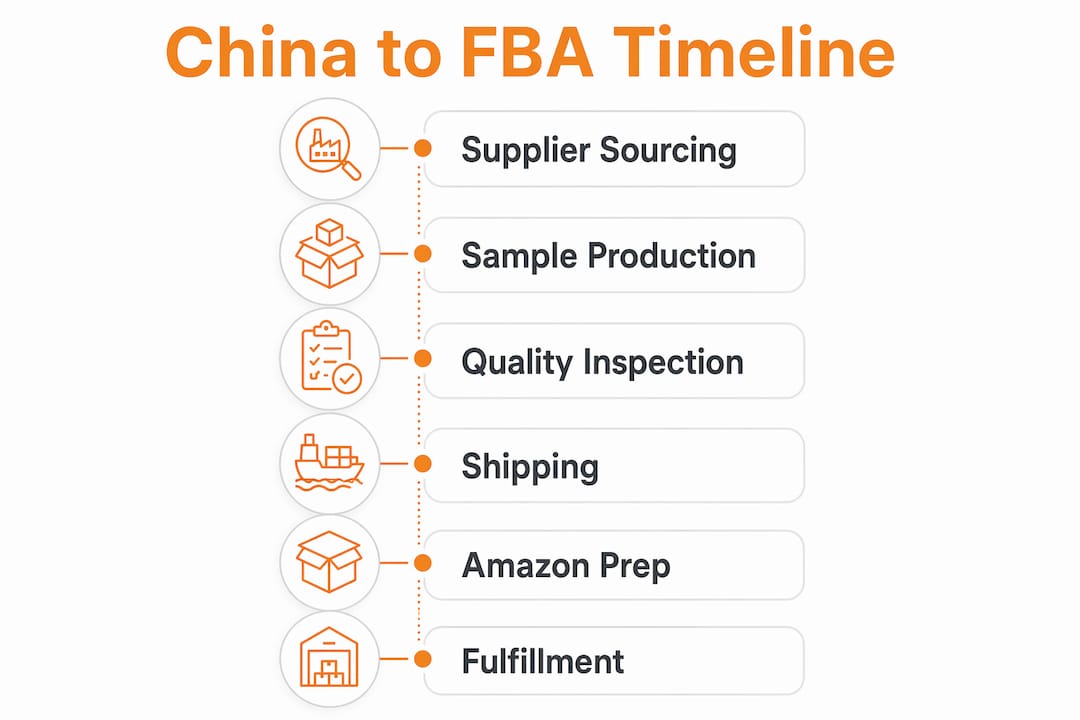
The standard timeline from factory matching to product ready for Amazon FBA runs about 45 days, with samples arriving in roughly 14 days. Build that into your planning calendar before you commit to any launch date.
| Stage | Typical Timeframe |
|---|---|
| Supplier sourcing and shortlisting | 2–3 business days |
| Sample production and delivery | 14 days |
| Full production run | 20–30 days |
| Freight and customs clearance | 15–30 days (sea) |
How do you vet and select reliable China suppliers for Amazon FBA?
Supplier selection is where most FBA sourcing processes either succeed or collapse. The goal is not to find the cheapest factory. The goal is to find a factory you can trust with your brand, your inventory, and your cash.
-
Request a sourcing report. A detailed supplier sourcing report lets you compare 3–5 factory options in 2–3 business days. That comparison should include production capacity, certifications, minimum order quantities, and sample lead times.
-
Verify credentials and physical addresses. Authorized distributors must provide distributor agreements and have verifiable physical addresses. A supplier who cannot produce these documents is a red flag, regardless of how competitive their pricing looks.
-
Prioritize Brand Direct or Authorized Distributor suppliers. Treat these as your top tier. Avoid suppliers who cannot provide legitimate documentation. The risk of counterfeit goods, quality failures, and account suspension is too high.
-
Order samples before committing to production. Evaluate samples against your product specification sheet. Check dimensions, materials, packaging, and labeling placement. Never approve a supplier based on photos alone.
-
Place small test orders with multiple suppliers. Testing small initial orders with several suppliers monthly builds a flexible sourcing workflow. It also gives you backup options if your primary supplier has production issues.
-
Use sourcing agents for market intelligence. A good sourcing agent knows which factories have recent quality problems, which ones are expanding capacity, and which ones are known for cutting corners on materials.
Pro Tip: Ask every potential supplier for three references from current Amazon seller clients. A factory that regularly works with FBA sellers will understand labeling requirements, export documentation, and prep standards without needing extensive hand-holding.
The most common failure in the China-to-FBA sourcing process is not a bad supplier. It is a seller who never calculated full landed costs before ordering. Run your numbers with freight, duties, inspection, prep, and Amazon fees included before you approve any factory.

How do you prepare and label products for Amazon FBA shipments?
Packaging and labeling compliance is non-negotiable. One seller’s shipment had 30% of boxes crushed due to missing FNSKU labels and improper packaging. Amazon rejected the entire shipment. That kind of error costs you weeks of lost sales and hundreds of dollars in rework fees.
Unit-level requirements:
- Apply FNSKU labels to every individual unit, covering any existing barcodes
- Poly bag items that could be damaged by moisture or dust
- Bubble wrap fragile items with a minimum of 2 inches of cushioning on all sides
- Ensure labels are scannable and not placed on curved surfaces or seams
Carton-level requirements:
- Label every carton with the Amazon shipment ID and carton number
- Include a packing list inside each carton
- Use double-walled corrugated boxes for heavy or fragile products
- Keep carton weight under 50 lbs unless the product requires otherwise
Quality control before shipment:
- Conduct a pre-shipment inspection when production is 80% complete
- Check a random sample of units for defects, label placement, and packaging integrity
- Confirm carton dimensions and weights match your packing list exactly
Pro Tip: Send your FNSKU label file and a detailed prep instruction sheet to your supplier in writing. Include photos showing correct label placement on the unit and carton. Verbal instructions get misunderstood. Written instructions with visuals get followed.
Amazon-compliant packaging that includes poly bagging, bubble wrapping, and clear labeling at both the unit and carton level reduces damage rates and improves acceptance at fulfillment centers. Skipping any of these steps creates problems that compound through the entire FBA logistics management chain.
What are the best shipping methods from China to Amazon FBA?
Choosing the right shipping method depends on your product weight, your timeline, and your margin. Each option involves different tradeoffs between cost, speed, and customs complexity.
-
Sea freight (LCL or FCL): The most cost-effective option for heavy or bulky products. Less-than-container load (LCL) works for smaller volumes. Full container load (FCL) makes sense when you ship enough to fill a container. Transit time from China to US ports runs 15–30 days depending on the origin port and destination.
-
Air freight: Faster than sea, typically 5–10 days, but significantly more expensive per kilogram. Best for high-value, lightweight products or urgent restocks.
-
Express courier (DHL, FedEx, UPS): The fastest option, with door-to-door delivery in 3–5 days. Cost-prohibitive for large shipments but practical for samples or small emergency orders.
Booking with DDP incoterms is the clearest path for most sellers. DDP (Delivered Duty Paid) shipping means your freight forwarder handles export customs in China, import customs in the US, duties, and final delivery to the Amazon warehouse. You pay one all-in price and avoid the complexity of managing customs brokers separately.
The China FBA shipping process also requires accurate export documentation from your supplier, including a commercial invoice, packing list, and bill of lading. Errors on these documents cause customs holds that can delay your shipment by weeks.
Tracking and delay management:
- Get a tracking number from your freight forwarder at booking confirmation
- Monitor milestones: factory pickup, export customs clearance, vessel departure, arrival at US port, import clearance, and final delivery
- Build a 5-day buffer into your restock timeline to absorb minor delays
How do you troubleshoot common issues in ongoing FBA logistics?
Even a well-built workflow hits problems. Knowing how to respond quickly protects your inventory levels and your seller metrics.
-
Labeling errors discovered after shipment: Contact your freight forwarder immediately. Some forwarders can relabel at a bonded warehouse before customs clearance. If the shipment reaches Amazon with wrong labels, you will need to file a removal order and pay for relabeling.
-
Damaged goods on arrival: Document everything with photos before accepting delivery. File a claim with your freight insurer and notify your supplier. A pre-shipment inspection report strengthens your claim significantly.
-
Amazon IPI score pressure: Using local warehousing in China as an inventory buffer lets you hold bulk production locally and ship to FBA in smaller, timed batches. This approach manages your IPI score limits and improves cash flow by delaying duty payments until each batch ships.
-
Supplier relationship management: Schedule quarterly account reviews with your key suppliers. Review quality metrics, lead times, and pricing. Suppliers who know you are a serious, repeat buyer give you priority during peak production seasons.
-
Demand forecasting and reorder cycles: Track your sell-through rate weekly. Set reorder triggers based on your lead time plus a safety stock buffer. Sellers who wait until stockout to reorder consistently lose ranking and revenue during the restocking gap.
Understanding Amazon FBA warehouse locations also helps you plan shipments more efficiently. Amazon distributes inventory across multiple fulfillment centers, so knowing where your products land affects your replenishment strategy.
Key Takeaways
A successful China supplier to FBA workflow requires verified suppliers, compliant packaging, accurate documentation, and a freight strategy built around DDP terms to eliminate customs surprises.
| Point | Details |
|---|---|
| Calculate landed costs first | Include freight, duties, inspection, prep, and Amazon fees before approving any supplier. |
| Verify every supplier | Require distributor agreements and physical addresses; prioritize Brand Direct or Authorized Distributor status. |
| Label before production ends | Send FNSKU labels and written prep instructions to your supplier before production completes. |
| Use DDP shipping terms | DDP incoterms transfer customs and duty responsibility to your forwarder, reducing clearance risk. |
| Buffer with China warehousing | Hold bulk inventory locally in China and ship to FBA in batches to protect IPI scores and cash flow. |
What I’ve learned after watching sellers get this wrong repeatedly
The sellers who struggle most with importing from China to FBA are not the ones who chose the wrong shipping method. They are the ones who treated supplier selection as a one-time task instead of an ongoing relationship. I have seen sellers with solid products lose their entire margin because they switched to a cheaper factory without auditing it first, and that factory shipped units with the wrong labeling, wrong dimensions, and no quality control documentation.
The labeling piece deserves more attention than most guides give it. FNSKU compliance is not just about sticking a barcode on a box. It is about making sure that barcode is on the right surface, covers the right existing barcode, and is scannable under warehouse lighting conditions. Suppliers who have never worked with Amazon before will get this wrong without detailed written instructions and photo references.
My strongest recommendation is to use a freight forwarder who specializes in FBA shipping from China. A generalist forwarder will move your goods. A specialist will catch labeling problems before they reach customs, flag documentation errors before they cause holds, and know which Amazon fulfillment centers have specific receiving requirements. That difference shows up in your on-time delivery rate and your stress level.
The sellers who build reliable, repeatable workflows treat their forwarder as a partner, not a vendor. They share their launch calendars, their restock schedules, and their growth plans. That transparency lets the forwarder allocate capacity and flag potential bottlenecks before they become problems.
— Keven
ForwarderOne makes China to FBA shipping straightforward
Running a reliable China-to-FBA operation means every link in the chain has to perform. ForwarderOne is built specifically for small and mid-sized Amazon sellers who need freight forwarding that handles customs, duties, and delivery in one workflow.
ForwarderOne’s DDP freight service covers export customs in China, import clearance in the US, and final delivery to your Amazon fulfillment center. You get a dedicated account manager, over 99% on-time delivery, and no surprise fees at the border. For sellers who want to protect their inventory levels during peak seasons without managing a dozen vendors, ForwarderOne handles the logistics so you can focus on selling.
FAQ
What is the China supplier to FBA workflow?
The China supplier to FBA workflow is the full process of sourcing products from Chinese factories, preparing them to Amazon’s standards, and shipping them to US fulfillment centers. It covers supplier vetting, packaging, labeling, freight, and customs clearance.
How long does it take to ship from China to Amazon FBA?
The standard timeline from factory matching to FBA-ready inventory runs about 45 days. Sea freight transit alone takes 15–30 days, while air freight cuts that to 5–10 days at a higher cost.
What does DDP mean for Amazon FBA shipments?
DDP (Delivered Duty Paid) means your freight forwarder manages export customs, import duties, and delivery to the Amazon warehouse. It simplifies the process by consolidating all costs and responsibilities into one arrangement.
Why do Amazon FBA shipments get rejected?
The most common causes of FBA shipment rejection are missing or incorrect FNSKU labels, improper packaging, and documentation errors on the commercial invoice or packing list. A pre-shipment inspection catches most of these issues before they reach Amazon.
How do I protect my IPI score when importing from China?
Use local warehousing in China to hold bulk inventory and ship to FBA in smaller, timed batches. This prevents overstocking at Amazon fulfillment centers and keeps your Inventory Performance Index score within acceptable limits.
Ready to simplify China-to-FBA logistics?
Share your supplier city, carton plan, Amazon destination, and restock deadline. ForwarderOne will map the DDP freight path and documentation checklist before pickup.