Anti-dumping duties on Chinese imports are extra tariffs Commerce imposes when it finds a Chinese exporter selling below normal value in a way that hurts a U.S. industry. If your product falls under an active order, CBP will collect a cash deposit at the border tied to the estimated dumping margin, and that liability sits with you, the importer of record, not your supplier. Check your HTS code against current orders before you place your next purchase order.
TL;DR:
- Importers should verify their HTS codes against active anti-dumping orders before placing purchases to avoid unexpected deposits and liabilities.
- Cash deposits are based on preliminary determinations, so proactive budgeting is essential once a case is filed, even before a final order is issued.
- Surrogate-value methodology can produce higher dumping margins for Chinese goods, especially if exporters do not cooperate with investigations.
- Handling AD compliance through a managed forwarder reduces the risk of shipment delays or detention during peak sales periods by managing documentation and deposits.
- Non-compliance with AD duties can lead to retroactive assessments, penalties, and inventory hold-ups, significantly increasing costs and operational disruptions.
How Anti-Dumping Duties China Rules Actually Work
The legal authority for all of this comes from the Tariff Act of 1930, specifically the provisions dealing with dumping determinations and duty assessment. Duties equal the gap between an imported product’s “normal value” (roughly, what it would sell for in a fair market) and its actual U.S. export price, a mechanism laid out in Commerce and ITC procedures. Three federal bodies split the work, and each one matters to your shipment differently:
- Commerce (Department of Commerce) calculates whether dumping is happening and sets the margin, the percentage that becomes your duty rate.
- ITC (International Trade Commission) decides whether the dumped imports are actually hurting a U.S. industry. Both findings have to come back affirmative for an order to stick.
- CBP (Customs and Border Protection) is the agency that touches your cargo. It enforces suspension of liquidation, collects your cash deposits, and issues the final bill years later when the case closes out.
The World Trade Organization’s Anti-Dumping Agreement sets the procedural floor every WTO member, including the United States, has to follow: transparency requirements, limits on provisional measures, and a default five-year sunset clock on any order.
What Are the Stages of an Anti-Dumping Investigation?
Every case follows the same sequence, and knowing where you are in it tells you what kind of financial exposure you’re facing.
- Petition filed. A domestic industry or union files with Commerce and the ITC alleging dumping and injury.
- Commerce and ITC preliminary determinations. Commerce estimates a dumping margin; the ITC checks for a reasonable indication of injury. This stage typically runs a few months after filing.
- Provisional measures begin. If Commerce’s preliminary finding is affirmative, CBP starts suspending liquidation and collecting cash deposits, generally within four to six months of the case opening, per Trade.gov final-determination guidance.
- Final determinations. Commerce and the ITC issue final rulings on margin and injury.
- AD order published. If both are affirmative, Commerce publishes a final order in the Federal Register, and cash deposit rates lock in.
- Administrative reviews. Annual reviews can adjust the rate up or down for specific exporters.
- Sunset review. Every five years, the order gets reassessed and either revoked or continued.
The date that matters most to your bottom line is the entry date, not the invoice date. Goods that are in transit or sitting in a bonded warehouse when provisional measures kick in can face retroactive assessment on entries that haven’t liquidated yet, so tracking exact filing and publication dates is not optional paperwork. It is cash-flow planning.
How Are Dumping Margins Calculated for Chinese Goods?
A dumping margin is the percentage difference between normal value and export price. When that gap is positive, you owe a duty roughly equal to it. The tricky part with China is how “normal value” gets built in the first place.
- Non-Market Economy (NME) treatment. Because Commerce treats China as a non-market economy for AD purposes, it generally can’t use Chinese domestic prices to establish normal value.
- Surrogate-value methodology. Instead, Commerce may build normal value using market-economy surrogate values when Chinese domestic prices are not accepted. That can move the margin sharply, especially when an exporter does not provide clean cost and sales data.
- Company-specific vs. “all-others” rates. Exporters that cooperate fully with Commerce’s questionnaires get an individual rate, which is often lower. Exporters that don’t cooperate, or aren’t identified, get lumped into a China-wide “all-others” rate, which tends to be punishingly high.
That last point is the one that trips up importers most. If your supplier’s name never made it into the record, you may be paying the all-others rate by default, even if your actual factory had qualified for something lower.
What Should Importers Do Right Now to Manage AD Risk?
Treat this as a recurring operational checklist, not a one-time legal review.
- Verify the full 10-digit HTS code for every SKU and cross-check it against active AD/CVD scope language, since orders are often written around narrow product descriptions rather than clean tariff lines.
- Confirm your actual producer and exporter identity in writing. If your supplier is a trading company, find out who really manufactured the goods, because that determines which rate applies.
- Set aside cash or bond capacity before an order publishes. Deposits can run into double or triple digits as a percentage of value, and CBP will not release cargo without them.
- Check the Federal Register daily for your product categories, or subscribe to Commerce’s AD/CVD case announcements directly.
- Participate in administrative reviews when Commerce requests information. Silence often defaults you into a worse rate than cooperation would.
- Update supplier contracts to reflect where cost risk sits, while remembering that importer-of-record liability doesn’t transfer no matter what the contract says.
Pro Tip: Don’t wait for a final order to start budgeting. Preliminary determinations already trigger cash-deposit requirements, so the moment a petition is filed against your product category, start modeling the worst-case rate into your landed cost.
Supplier documentation is your best defense here. Duty liability attaches to you as the importer of record based on HTS classification and country of origin, and a supplier’s promise that “we’ve got this covered” carries no legal weight with CBP.
Recent Cases That Show How Fast Duties Can Hit
Three recent proceedings illustrate the pattern better than any abstract explanation.
- Fiberglass door panels from China. Commerce issued both antidumping and countervailing duty orders in 2026, with the Federal Register notice instructing CBP to suspend liquidation and collect cash deposits tied to the preliminary determination date, not the final order date.
- Twist ties. Commerce and the ITC walked through the full investigation sequence for this product, a useful real-world illustration of how preliminary and final determinations actually unfold on paper.
- Adipic acid (EU parallel case). The EU’s approach to a Chinese chemical import shows how surrogate methodology plays out in duty-rate tables, a pattern that mirrors how U.S. surrogate calculations tend to inflate margins.
The consistent lesson across these cases: publication dates and preliminary-determination dates, not the headline “final order” date, are what actually start your clock.
Managing Landed Cost When AD Duties Hit Your Supply Chain
When an order lands on your product category, the operational scramble is real: cash deposits due at entry, documentation that has to match Commerce’s scope language exactly, and coordination with CBP that most small importers have never had to do before.
- DDP arrangements organize the customs burden. A managed freight forwarder coordinates cash-deposit planning, duty payment workflow, HTS review, and country-of-origin documentation as part of the shipment, rather than leaving you to interpret CBP’s suspension-of-liquidation instructions mid-transit.
- Documentation accuracy is the whole game. Getting the producer and exporter identity right on customs paperwork is what determines whether you land on a company-specific rate or the punitive all-others rate.
- Visibility matters as much as speed. A logistics partner that tracks Federal Register notices for your product categories gives you lead time most importers don’t get on their own.
- A dedicated account manager means someone is actually watching your specific SKUs, not just processing generic freight.
If you’re evaluating a forwarder for AD-exposed shipments, ask directly about their process for confirming producer identity and their track record with customs clearance timing. That single question separates operators who understand AD/CVD mechanics from ones who don’t.
What Happens If You Don’t Comply With Anti-Dumping Duties?
Non-compliance gets expensive fast, and the penalties compound in ways many importers don’t anticipate until it’s too late.
The most immediate consequence is retroactive assessment. If you undervalued or misclassified goods to dodge a known order, CBP can go back and reassess duties on entries you thought were closed out, often with interest attached. Beyond the duty itself, CBP can impose civil penalties for negligence, gross negligence, or fraud under customs law, and the penalty multiplier climbs sharply depending on which category your conduct falls into. A negligent misclassification might cost you the unpaid duty plus a modest penalty. A fraudulent one, where CBP can show intent to evade, can result in penalties worth multiples of the duty owed, on top of the duty itself.
There’s also a cargo-level risk. CBP can hold, examine, or refuse to release shipments that lack proper AD/CVD documentation, which means a compliance gap doesn’t just cost money, it stalls your inventory during exactly the season you need it moving. For Amazon sellers running tight replenishment cycles, a held container during Q4 is often worse than the duty itself.
Repeated violations can also trigger heightened scrutiny on future shipments, meaning your entire import pipeline gets slower even after you’ve cleaned up the underlying issue. The message from CBP’s enforcement pattern is consistent: proactive HTS verification and honest producer disclosure cost you far less than getting caught after the fact.
How Do Anti-Dumping Duties Change Your Pricing and Competitiveness?
A dumping margin isn’t a rounding error. Margins on Chinese goods under NME/surrogate methodology often run high enough to erase a product category’s entire margin structure overnight, which forces a real pricing decision, not a cosmetic one.
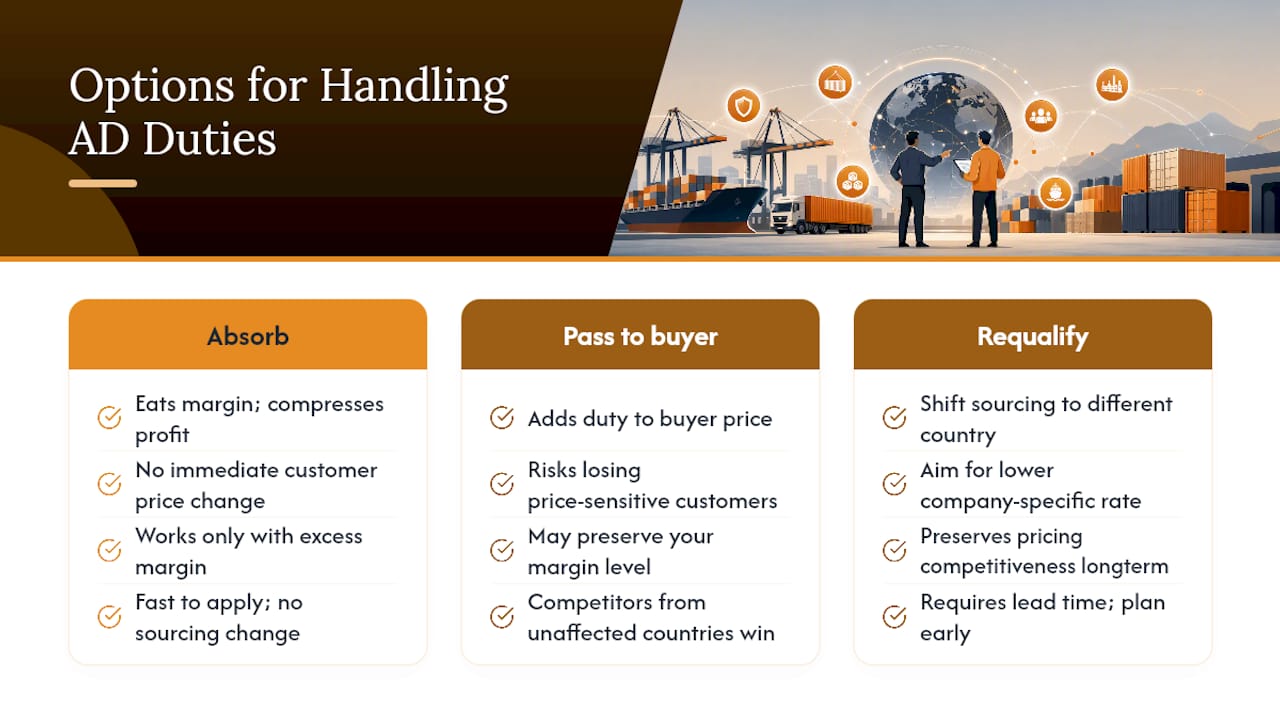
You generally have three options, and each has a real cost. First, absorb the duty and eat the margin compression, which works only if your existing margin has room. Second, pass the cost to your buyer, which risks losing price-sensitive customers to competitors sourcing from countries not under order. Third, requalify: shift sourcing to a different country or find a supplier whose cost structure keeps you under a lower company-specific rate rather than the China-wide all-others rate.
The competitive dynamic gets more interesting at the category level. When an entire product line from China gets hit with an AD order, U.S.-based manufacturers and importers sourcing from unaffected countries suddenly get a pricing window they didn’t have before. That’s the exact intent of the remedy: AD measures exist to neutralize unfair pricing, not to punish trade broadly, so the policy is designed to level a specific playing field rather than close a market.
For sellers on tight-margin platforms like Amazon FBA, the practical move is often diversifying supplier geography before an order hits, not after. Waiting until a petition is filed to start sourcing alternatives puts you months behind competitors who saw the exposure coming and requalified their supply chain early.
Can You Appeal or Challenge an Anti-Dumping Determination?
Yes, and there are several distinct paths depending on what you’re challenging and when.
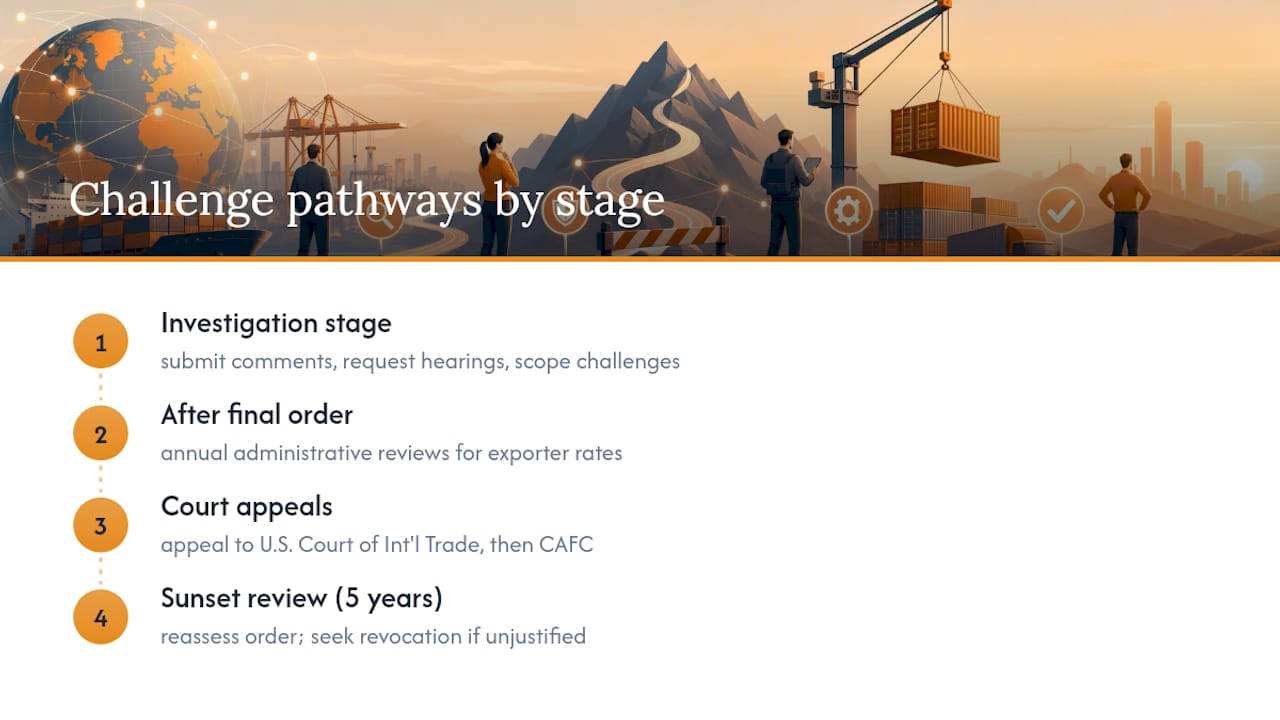
During the investigation itself, interested parties, including importers, can submit comments, request hearings, and challenge Commerce’s scope language before a final order publishes. Scope challenges are particularly useful: if your product is arguably outside the written description of what’s covered, you can petition Commerce for a formal scope ruling rather than accepting default coverage.
After a final order, administrative reviews are your main tool for individual relief. If your specific exporter’s actual pricing has changed, or if you can document that the original all-others rate no longer reflects reality, a review request can move your rate down for future entries. These reviews happen annually and require active participation. Commerce doesn’t reduce rates on its own initiative.
For broader legal challenges, parties can appeal Commerce or ITC determinations to the U.S. Court of International Trade, and from there potentially to the Court of Appeals for the Federal Circuit. This route is slow and expensive, generally reserved for cases with significant dollar exposure or a genuine legal error in the agency’s methodology.
The sunset review process offers one more avenue: every five years, an order faces reassessment under the WTO Anti-Dumping Agreement’s procedural framework, and interested parties can argue the order should be revoked if conditions no longer justify it. Most importers never pursue direct litigation, but knowing these paths exist changes how you negotiate with suppliers and plan sourcing shifts while a case is active.
Treating AD Risk as an Ongoing Cost, Not a One-Time Event
The mistake importers make is treating anti-dumping duties as a legal problem that gets resolved once and then goes away. Rates shift in administrative reviews, orders get revisited at sunset, and new petitions target new categories every year. Build tariff risk into your SKU-level margin math the same way you model freight and FX, and pair Federal Register monitoring with a logistics partner that already handles customs and deposits for a living.
— Keven
ForwarderOne: A Managed Path Through AD-Related Customs Complexity
Handling an anti-dumping case in-house means tracking Federal Register notices, verifying HTS codes against scope language, and managing cash deposits at the exact moment your cargo needs to clear. That’s a lot to run alongside actually growing your Amazon business. ForwarderOne is the alternative to building that customs muscle yourself: our DDP shipping service manages customs clearance, duty payments, and delivery in one workflow, backed by a dedicated account manager who tracks your specific shipments rather than handing you off to a call queue.
If your product category is anywhere near an active or pending AD/CVD order, a managed forwarder that already handles customs documentation daily reduces the odds of a held container during a peak sales window. For sellers moving inventory to FBA fulfillment centers, that reliability matters most exactly when duties are unsettled. Get a quote through our FBA freight forwarding service and find out what your landed cost actually looks like before your next purchase order ships.
Where to Track Official Anti-Dumping Notices
Watch the Federal Register for publication dates and case orders, Commerce’s AD/CVD case pages for margin details, and the ITC’s injury determinations for whether a case clears the injury threshold. The WTO Anti-Dumping Agreement explains the procedural rules behind every one of these steps.
This article is general information, not a substitute for legal, customs, or tax advice. Consult a qualified professional about your own circumstances before acting on anything here.
Sources
- U.S. Antidumping and Countervailing Duties — USITC
- Fiberglass door panels from the People’s Republic of China: Antidumping duty order and countervailing duty order — Federal Register
- Final determinations in AD/CVD investigations - Trade.gov
- WTO — Trade topics — Anti-dumping
FAQ
What Is the Current Tariff Rate China Has on U.S. Goods?
There isn’t one flat rate. Tariffs on Chinese goods vary by product category and include standard duty rates and, where applicable, product-specific anti-dumping and countervailing duty orders that stack on top of the baseline rate.
What Are Anti-Dumping Tariffs in the United States?
They’re special duties Commerce and the ITC impose when a foreign producer sells goods in the U.S. below normal value in a way that injures a domestic industry, with CBP collecting the resulting cash deposits and duties at entry.
What Anti-Dumping Duties Currently Apply to Imports From China?
Active orders cover a wide range of products, from fiberglass door panels to various chemicals and hardware items, and each order is scoped narrowly by product description in its own Federal Register notice, so you need to check your specific HTS code and product description against current case listings.
What Is the Import Duty Rate for Chinese Goods Under an AD Order?
Rates vary significantly by exporter and case. Cooperating exporters typically get individual, lower rates, while uncooperative or unidentified exporters often fall under the China-wide all-others rate, which tends to run substantially higher.
Does ForwarderOne Handle Anti-Dumping Duty Payments for My Shipments?
ForwarderOne’s DDP service manages customs clearance and duty payment as part of the shipping workflow, which includes duties tied to active AD/CVD orders on covered products, so you get a single landed cost rather than a surprise deposit bill.
Need anti-dumping exposure checked before cargo moves?
ForwarderOne coordinates HTS review, supplier documentation, landed-cost planning, customs entry handoffs, and DDP delivery so AD/CVD risk is part of the shipment plan before cargo leaves the supplier.