CBM (cubic meter) equals length times width times height, all measured in meters, multiplied by the number of units in your shipment. A carton measuring 60cm x 40cm x 40cm converts to 0.6m x 0.4m x 0.4m, which works out to about 0.1 CBM per box. Multiply that by 50 cartons and you're booking a shipment volume based on that multiplication with your forwarder.
TL;DR:
- Most errors in calculating CBM come from measuring the product instead of the fully packed carton and neglecting pallet height, which can significantly skew the volume.
- Converting dimensions to meters before multiplying prevents common mistakes caused by mixing different units, especially inches or centimeters.
- Carrier pricing depends on whether volume or weight generates more revenue for the shipment mode, with sea freight billing on the greater of CBM or weight, and air freight primarily on volume.
- For light, bulky cargo such as foam or plastics, volume-based charges can easily exceed the actual weight, especially in air and courier shipping.
- Verifying measurements against the supplier's packing list and re-measuring before booking reduces the risk of costly surcharges caused by miscalculations.
How Do You Calculate CBM Step by Step?
Getting the number right starts with where you put the tape measure. Measure the outer dimensions of the packed carton, not the product inside it. Include any pallet the carton sits on if it ships palletized, and always measure to the longest point, even if that means a slightly bulging box edge.
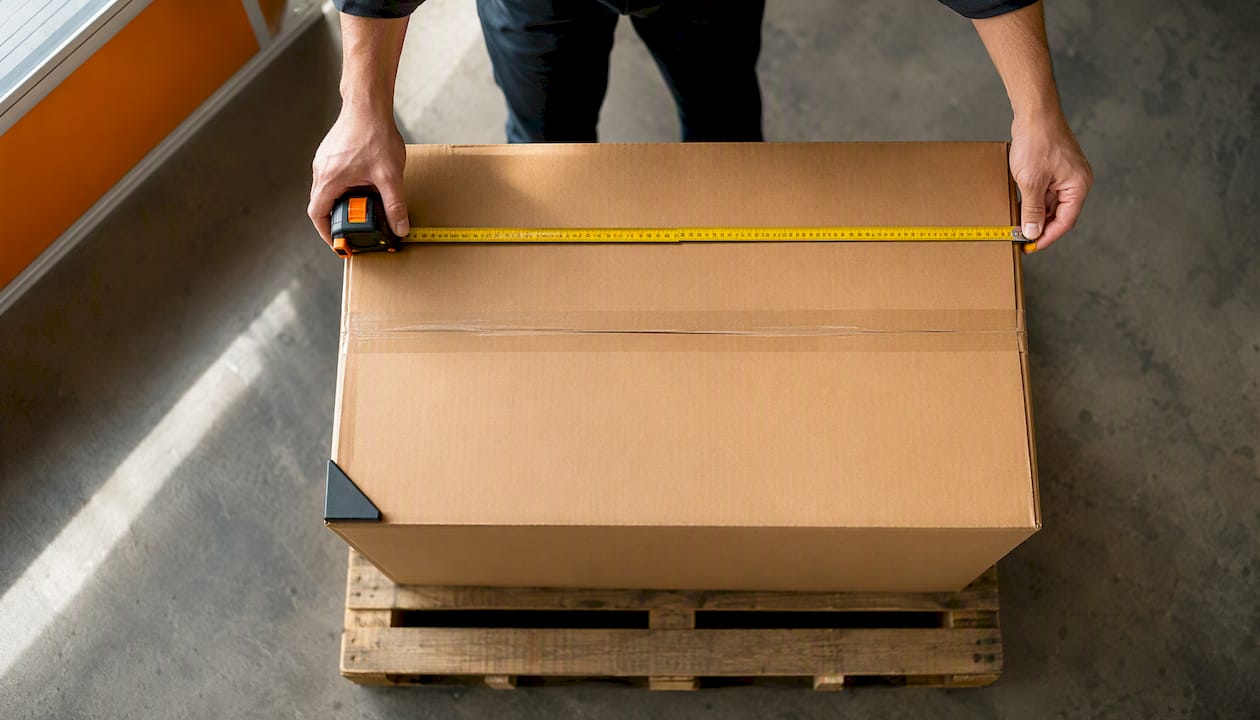
Convert every dimension to meters before you multiply anything. Mixing units (an inch measurement multiplied against a centimeter measurement) is the single most common way a CBM figure ends up wrong.
Here's the reliable sequence:
- Measure length, width, and height of the fully packed carton, including any outer packaging.
- Convert each measurement to meters (see the conversion section below).
- Multiply the three dimensions to get CBM for one unit.
- Multiply that result by total carton quantity for shipment CBM.
- Cross-check the total against your supplier's packing list before booking.
Watch for these mistakes: measuring the product instead of the finished carton, forgetting to add pallet height when goods ship on pallets, and rounding dimensions too early in the math instead of at the final step. Suppliers often list "nominal" carton sizes that don't match what actually rolls off the production line, and small per-carton rounding errors compound fast across a few hundred units, leaving you underquoted or overquoted at scale.
What Are the Key Unit Conversions for CBM?
Every CBM calculation eventually runs into the inch-versus-centimeter problem, so keep these constants handy:
- 1 inch = 0.0254 meters
- 1 foot = 0.3048 meters
- 1 cubic meter = 35.3147 cubic feet
- 1 CBM = 1,000 liters
Pro Tip: If your supplier gives you dimensions in centimeters, multiply length x width x height in cm, then divide the result by 1,000,000 to get CBM directly. It skips the meter-conversion step entirely and reduces the chance of a decimal error.
Cubic feet still show up constantly in US warehouse contracts and some LTL freight quotes, while ocean and air freight almost universally price in cubic meters. If a US freight quote lands in cubic feet, divide by 35.3147 to get back to CBM and compare it against your own math.
How Does CBM Affect Shipping Costs by Mode?
Carriers don't just charge by weight. They charge by whichever number, weight or volume, generates more revenue for the space your cargo occupies. Each shipping mode uses a different formula to make that comparison, and knowing which one applies to your shipment tells you whether volume or weight will actually drive your invoice.
- Sea LCL (less than container load): Carriers apply a weight-or-measurement rule where one revenue ton equals either 1 CBM or 1,000 kg, whichever is greater. A 3 CBM shipment weighing 1,800 kg gets billed on 3 revenue tons, since 3 CBM beats 1.8 tons of actual weight.
- Air freight: The IATA convention divides volume in cubic centimeters by 6,000, which works out to roughly 167 kg per CBM. Light, bulky cargo almost always gets billed on volume here, not actual weight.
- Express courier: Most couriers use a tighter divisor, around 5,000 cm3/kg, equating to about 200 kg per CBM. That's a stricter volumetric penalty than air freight's standard divisor.
- Road/groupage: Typically runs closer to 3,000 cm3/kg, making volume the deciding factor even more often on trucked freight.
Say you're shipping 2 CBM at 150 kg actual weight by air. Divide 2 CBM by the 167 kg/CBM air equivalent and you get a chargeable weight of about 334 kg, more than double the actual scale weight. That gap is exactly why light, boxy products (think foam displays or plush toys) often cost more to fly than their scale weight suggests.
How Much Cargo Fits in a Standard Container?
Container specs look simple until payload limits get in the way of your volume math. CarPulse's guide to container options and specifications provides additional context when comparing containers for business use. A container's theoretical cubic capacity and what you can actually stuff inside it are two different numbers, and the gap between them usually comes down to carton shape, stacking pattern, and how close your cargo's weight sits to the container's legal payload limit.
Those container capacities assume well-stacked, uniform cartons. Irregular shapes, air gaps around pallets, and safety stacking limits routinely knock a container down toward that 80% floor rather than the 90% ceiling.
- Dense cargo (metal parts, liquids, canned goods) often hits the weight limit before the cube fills up, so volume stops being the constraint.
- Light, bulky cargo (apparel, foam, plastics) usually fills the cube first, leaving unused payload capacity on the table.
- As a rough breakeven guide, once your shipment crosses roughly 12 to 15 CBM, it's worth running an LCL quote against a full 20' container rate for your specific lane, since container pricing can undercut LCL per-CBM rates past that point.
- Palletized cargo gets measured and billed on the full pallet footprint and stack height, not the cartons stacked inside it.
Three Worked CBM Examples You Can Reuse
Single carton: A box measures 24in x 18in x 16in. Convert to meters: 24 x 0.0254 = 0.61m, 18 x 0.0254 = 0.457m, 16 x 0.0254 = 0.406m. Multiply: 0.61 x 0.457 x 0.406 = 0.113 CBM per carton.
Multi-SKU shipment: When you're combining several product lines into one booking, sum the CBM per SKU rather than averaging dimensions.
| SKU | Carton Dimensions (cm) | CBM per Carton | Quantity | Total CBM |
|---|---|---|---|---|
| A | 50 x 40 x 30 | 0.060 | 100 | 6.0 |
| B | 60 x 45 x 35 | 0.0945 | 80 | 7.56 |
| C | 40 x 30 x 25 | 0.030 | 150 | 4.5 |
Total shipment: 18.06 CBM.
Palletized load: A pallet loaded with cartons measures 120cm x 100cm x 160cm total height including the pallet base. That's 1.2m x 1.0m x 1.6m = 1.92 CBM per pallet, billed on the full footprint regardless of gaps between boxes.
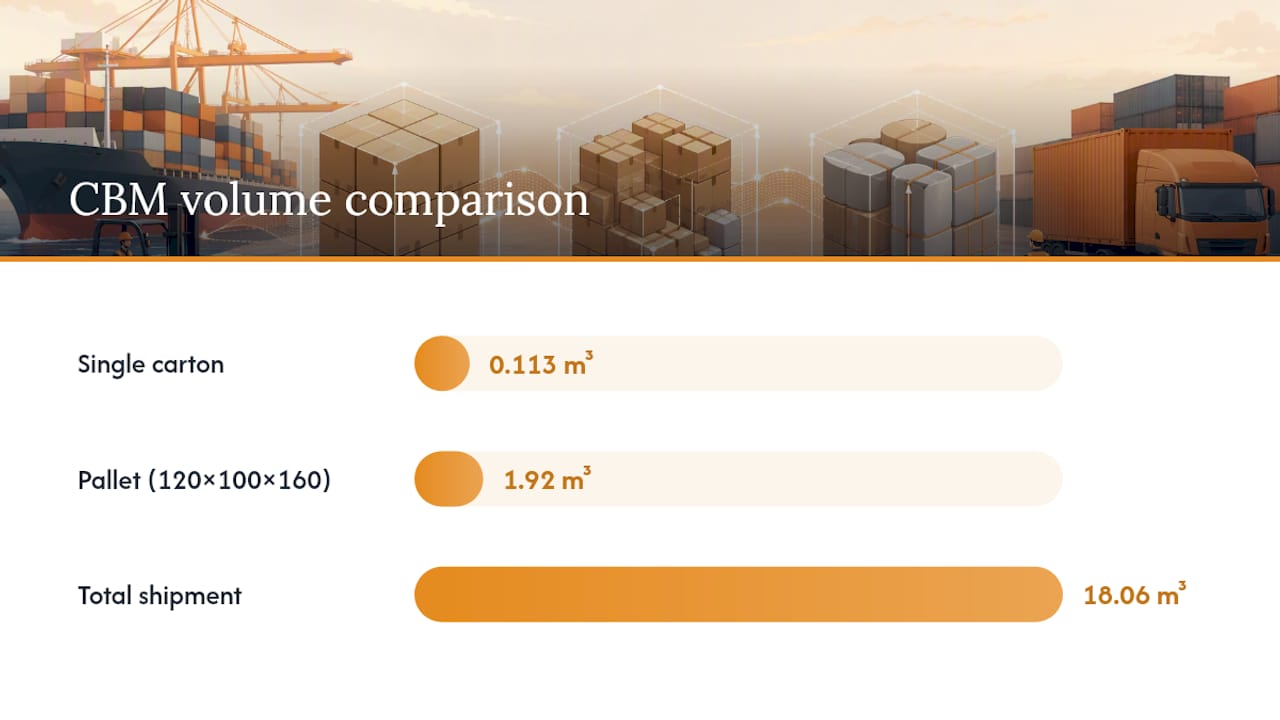
Before booking, run this checklist: 1) Confirm you measured packed cartons, not product dimensions. 2) Verify pallet height includes the pallet itself. 3) Re-add your SKU totals to catch transposition errors. 4) Compare your total against the supplier's packing list.
How Forwarders Use Your CBM Numbers When Quoting
A forwarder doesn't just take your CBM total at face value. Most run a sample measurement against your packing list, check pallet footprints separately from carton counts, and verify declared weight against declared volume before locking a quote. That verification step is what keeps FBA inbound shipments and ocean bookings from hitting surprise charges at the port.
What Shippers Get Wrong About CBM
Most CBM errors don't come from bad math. They come from measuring the wrong thing entirely, usually the product instead of the finished, packed carton that actually occupies space on a vessel or plane. I'd also push back on treating CBM as a single universal number: a shipment's chargeable weight shifts depending on whether it moves by sea, air, or courier, so the same 2 CBM box can cost wildly different amounts depending on mode.
The habit worth building is re-measuring a production sample before every booking, not trusting the spec sheet from six months ago. Carton dimensions drift as suppliers change packaging materials or box vendors, and that drift is exactly the kind of quiet cost creep that eats margins over a year of shipments.
- Keven
Get Your CBM Numbers Right Before You Book
Running the math yourself is worth doing, but a wrong CBM figure on a booking form still turns into a surcharge invoice weeks later. ForwarderOne handles the verification step for you: DDP shipping that bundles customs, duties, and delivery into one workflow, with a dedicated account manager reviewing your carton counts, pallet footprints, and chargeable weight before your shipment ever leaves the origin warehouse.

That matters most for Amazon FBA sellers moving inventory from China, where a miscalculated CBM can mean a rejected inbound shipment or a rebilled invoice right before a peak sales window. If you've already run your numbers using the formulas above, get a freight quote from ForwarderOne's China to USA DDP service and have your booking confirmed against verified figures instead of guesswork.
Sources
- How to Calculate CBM for Ocean Freight and Container Shipping - FreightFigures
- CBM Calculator & Shipping | Freightos
- Cubic Meters to Cubic Feet (m3 to ft3) conversion calculator
FAQ
How Many CBM Fit in a 20-Foot Container?
A standard 20-foot container holds about 33.2 CBM internally, though practical stuffing usually reaches only 80 to 90% of that, roughly about 80 to 90 percent of internal volume, depending on carton shapes and stacking.
Is CBM the Same as a Cubic Meter?
Yes. CBM is simply the shipping-industry abbreviation for cubic meter, calculated the same way: length x width x height in meters.
How Much Does 1 CBM Cost in Ocean Shipping?
Cost per CBM varies by lane, carrier, and season, but ocean LCL freight is billed using a weight-or-measurement rule where 1,000 kg is treated as the equivalent of 1 CBM, whichever figure is greater for your shipment.
How Do I Calculate Cubic Meters for a Shipment?
Measure length, width, and height of each packed carton in meters, multiply the three dimensions, then multiply that result by your total carton quantity to get shipment CBM.
Need CBM and chargeable weight checked before booking?
ForwarderOne reviews packed-carton dimensions, pallet footprints, mode-specific chargeable weight, customs duties, and final delivery requirements before your China or Korea shipment leaves the origin warehouse.