For most shipments entering the United States, a commercial invoice is required and must include the detailed description, quantities, purchase price, currency, itemized charges, and country of origin set out in 19 U.S.C. §1481 and 19 CFR §141.86. Before you ship, confirm freight, insurance, and packing costs are broken out as separate line items and that a named responsible individual signs off. Skip either step and Customs and Border Protection (CBP) can hold your cargo at the port.
TL;DR:
- A detailed description with model, material, and brand is essential to prevent delays and ensure clear customs review.
- Itemized charges for freight, insurance, and packing must be separate lines; burying them in totals can trigger re-appraisal.
- The responsible individual’s name must be reachable and knowledgeable about the shipment, not just a company stamp.
- A commercial invoice is legally required for most shipments, with exceptions for low-value, gift, or sample shipments that still need description and value.
- ForwarderOne reviews invoice data before shipment to ensure compliance and minimize customs hold risks.
What US Commercial Invoice Requirements Actually Say
The legal foundation sits in two places: 19 U.S.C. §1481, which sets the statutory baseline, and 19 CFR §141.86, which spells out exactly what CBP wants on the page. Together they answer the question every new importer asks: what actually counts as a compliant invoice?
The statute requires invoices to state the port of entry, the time and place of sale, and who was involved as buyer, seller, and shipper. It also demands a detailed description using the item’s commercial name, along with its grade or quality and any identifying marks or numbers on the packages themselves.
CBP’s regulation gets more granular. Under §141.86, your invoice needs:
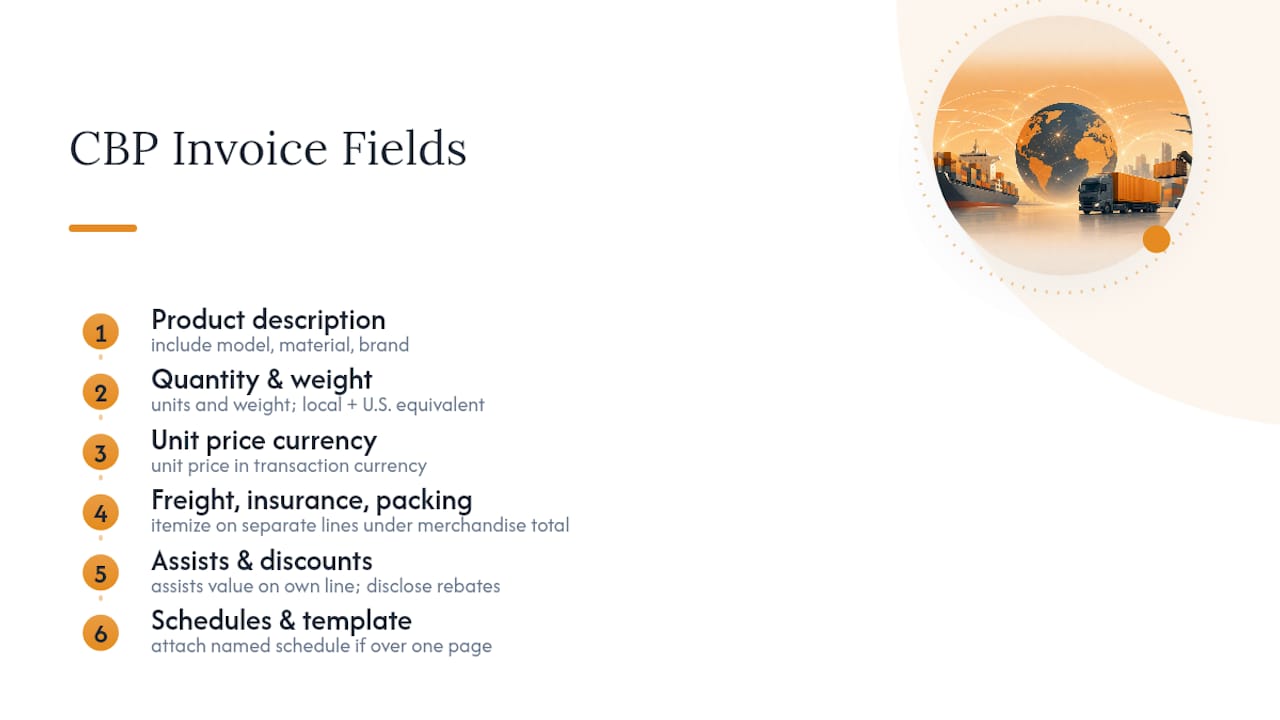
- A detailed description of the merchandise, including the commercial designation, grade, and quality.
- Quantities in both the weights and measures used at origin and their U.S. equivalents.
- The purchase price of each item, stated in the currency of the transaction.
- All charges itemized separately, including freight, insurance, commissions, and packing costs.
- Country of origin for each item on the invoice.
- Any rebates, drawbacks, or bounties allowed on the exportation.
- The name of a responsible individual who can answer CBP’s questions about the shipment.
That last requirement trips up more sellers than any other. CBP does not just want a company name stamped at the bottom. It wants a person, reachable, who actually knows the transaction. A CBP help article on invoice requirements reiterates that omissions here are a common reason entries get flagged for further review.
One nuance worth knowing: the required information does not have to fit on a single page. CBP accepts attached schedules, packing lists, or continuation sheets, as long as everything cross-references clearly back to the invoice itself.
When Do You Need a Commercial Invoice, and What Are the Exceptions?
19 CFR §141.83 sets the baseline rule: a commercial invoice is required for every shipment unless a specific exemption applies. That said, a few practical carve-outs exist.
- Shipments valued under the informal entry threshold may qualify for simplified documentation, though a description and value are still needed.
- Copies of an invoice, rather than the original, can sometimes be accepted, but only under the conditions §141.85 describes, and CBP can still demand the original later.
- Non-purchased shipments, gifts, or samples with no commercial value often use a modified format, but they still need a description and stated value for admissibility screening.
- Goods sold in transit require both the original invoice and any resale documentation, since ownership changed hands before the goods landed.
Miss the deadline or skip the exemption paperwork, and your goods sit in a bonded warehouse while the clock runs on storage fees.
How to Fill Each Field the Way CBP Expects
Generic descriptions cause more delays than any other single issue on a commercial invoice. “Electronics” or “gift item” will not clear a port officer’s review. Write what the U.S. import guidelines actually call for: model number, material, and brand if one exists. “Stainless steel kitchen knife set, model KS-450, Brand: Culinex” tells the examiner what they are looking at and what tariff classification applies.
Quantities need both the unit count and the weight, shown in the seller’s local measurement and its U.S. equivalent. If your supplier in Shenzhen invoices in kilograms, convert to pounds on the same line rather than forcing the broker to do it later.
For pricing, state the purchase price per unit in the currency actually used in the transaction, not a converted U.S. dollar estimate. Freight, insurance, and packing belong on separate lines beneath the merchandise total. Burying them inside a “total price” figure is exactly what triggers a re-appraisal, since CBP guidance on invoice valuation treats itemization as central to an accurate duty assessment.
Assists, meaning tools, molds, or materials you supplied to the factory at no charge, need their own line with an estimated value. Rebates and related-party discounts also require disclosure. When any of these details push the invoice past a single page, attach a schedule and reference it by name in the main invoice body.
Pro Tip: Give suppliers a fill-in-the-blank invoice template with every required field pre-labeled. It cuts back-and-forth emails by half and keeps the wording consistent across every shipment they send you.
Pro Forma vs. Commercial Invoice: What’s the Real Difference
A pro forma invoice is an estimate. A commercial invoice is the binding record CBP uses to assess duties. Confusing the two at entry is one of the fastest ways to stall a shipment.
- Pro forma invoices state expected prices and terms before a sale is finalized, according to the International Trade Administration, and carriers often use them for quoting purposes only.
- A pro forma can temporarily stand in for a missing commercial invoice, but only under the narrow conditions in §141.85, and CBP will still expect the real invoice to follow.
- Once the actual sale completes, convert every pro forma figure into final numbers. Do not just relabel the document header and resubmit the same estimate as your commercial invoice.
What Happens if the Invoice Is Missing or Incomplete
CBP will accept an entry without the full invoice under specific conditions, but the leeway is narrow and time-bound. Expect these remedies:
- A written declaration explaining why the invoice is unavailable, paired with a pro forma invoice showing your best available figures.
- A bond covering the entry, since eCFR Part 141 Subpart F allows conditional release while the real document is produced.
- A defined production window for the missing invoice. Miss it and CBP can assess liquidated damages against the bond.
- Clear communication with your broker the moment you know a document will be late. Waiting until the shipment lands to raise the issue removes most of your options.
Supplier-Ready Commercial Invoice Checklist
A one-page checklist you can hand a supplier saves more clearance headaches than any single field-level fix. Cover these items before goods leave the factory:
- Detailed item description, quantities, unit price, and total value in the transaction currency.
- Freight, insurance, and packing charges itemized on separate lines.
- Country of origin per item, plus package marks and numbers.
- Name and contact information for a responsible individual at the shipper’s company.
- Invoice number, date, and reference to any attached packing list for customs.
- English-language text throughout. Attach a certified translation if the original is in another language.
Order the fields so buyer, seller, and shipment details appear first, followed by the itemized goods, then the charges breakdown. That sequence mirrors what most U.S. import guidelines and CBP officers expect to see, which shortens review time. For anyone still mapping out the broader entry process, this customs clearance overview for e-commerce importers walks through where the invoice fits alongside other required documents.
What ForwarderOne Sees Go Wrong on Real Shipments
Small and mid-sized sellers most often lose time over two things: unitemized packing charges and missing assists. Both give CBP grounds to re-appraise a shipment’s value, which slows release and can trigger a broader compliance review of future entries from the same supplier.
Under DDP workflows, invoice fields should be checked against CBP requirements before the shipment leaves origin, not after it lands. Account managers can review the paperwork stack, including customs valuation details, to catch discrepancies while there’s still time to fix them. For suppliers who consistently under-document assists or bundle freight into the item price, a standing invoice template can help solve the problem permanently rather than fixing it shipment by shipment.
Why Most Invoice Guides Miss the Point
Most advice on commercial invoices treats the paperwork as a formality, something to fill out correctly and forget. That framing is backwards. The invoice is the primary document CBP uses to assess duty liability, and errors on it do not just cause delays. They create an audit trail that can trigger closer scrutiny on your next ten shipments.
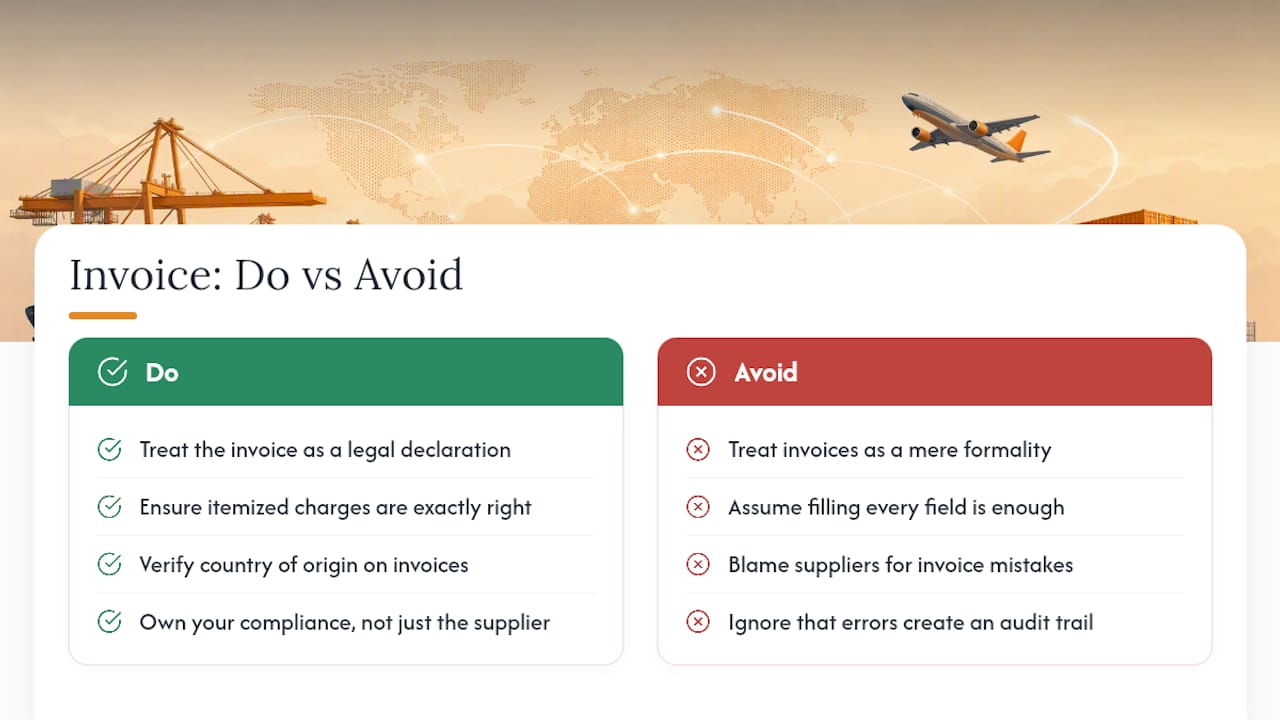
The conventional wisdom says “just include everything the form asks for.” That’s technically true and practically useless. The real skill is knowing which fields CBP examiners actually scrutinize, itemized charges and country of origin chief among them, and getting those exactly right even if other fields are slightly imperfect.
If you take one thing from the statutes and regulations covered here, make it this: treat the invoice as a legal declaration, not a packing slip with prices attached. Small sellers who adopt that mindset early, before their first flagged shipment forces the lesson, spend far less time explaining themselves to a port officer later. The businesses that struggle are almost always the ones treating invoice accuracy as the supplier’s problem instead of their own compliance responsibility.
— Keven
Get Invoice Compliance Built Into Your Shipping Process
Chasing suppliers for missing invoice fields after a shipment already left the factory is the wrong time to catch the problem. ForwarderOne’s DDP shipping from China to the USA builds commercial invoice review into the workflow before cargo moves, so customs, duties, and delivery run as one process instead of three separate headaches you manage yourself.
Shipments can benefit from account managers who check invoice fields, itemized charges, and country of origin details against what CBP expects before departure, rather than after a hold notice arrives. That’s part of why ForwarderOne reports over 99% on-time delivery for the Amazon sellers and ecommerce brands it works with. If you’re moving inventory from China or Korea to a U.S. fulfillment center, start with a quote on FBA freight forwarding and get your next shipment’s paperwork reviewed before it ever reaches the port.
Sources
- § 141.86 Contents of invoices and general requirements. | Electronic Code of Federal Regulations (e-CFR) | LII / Legal Information Institute
- 19 USC 1481: Invoice; contents
- eCFR :: 19 CFR Part 141 Subpart F – Invoices
- What value should be on the commercial invoice submitted to U.S. Customs and Border Protection?
FAQ
What Are the US Customs Requirements for Commercial Invoices?
CBP requires the description, quantity, purchase price, currency, itemized charges, and country of origin under 19 CFR §141.86, along with the name of a responsible individual for the shipment.
What Are the Legal Requirements for an Invoice in the US?
The controlling statute is 19 U.S.C. §1481, which requires details on the port of entry, the parties involved, item descriptions, quantities, and pricing, all stated in English.
What Is Required in a Commercial Invoice?
At minimum: a detailed item description, quantities and weights, purchase price in the transaction currency, itemized freight and insurance charges, country of origin, and a named responsible contact, per 19 CFR §141.86.
How Is a Commercial Invoice Different From a Regular Invoice?
A commercial invoice is the legal document CBP uses to assess duties and clear goods through customs, while a standard sales invoice or a pro forma invoice serves only as an internal record or price estimate with no binding customs authority, according to the International Trade Administration.
Does ForwarderOne Check Commercial Invoices Before Shipment?
Yes. ForwarderOne’s DDP workflow includes invoice field review as part of its standard process, catching missing charges or descriptions before cargo departs rather than after CBP flags it. Current service pricing is listed on the ForwarderOne site.
Need commercial invoices checked before pickup?
ForwarderOne reviews invoice fields, charge breakdowns, origin details, and DDP handoffs before freight leaves the supplier.