You need three things for any dangerous goods shipment: a shipping paper with a correctly sequenced Basic Description, a Shipper’s Declaration for air freight where it applies, and emergency response information with a monitored phone number. Before anything leaves your dock, verify the ISHP order (identification number, shipping name, hazard class, packing group) is exact and that the emergency contact is reachable around the clock. Both the IATA DGR and 49 CFR Part 172 treat this sequence as non-negotiable.
TL;DR:
- Accurate sequencing of the Basic Description is critical, with identification number, proper shipping name, hazard class, and packing group always in that order.
- The same documentation format applies across transport modes, but specific forms and acceptance rules vary between air, sea, road, and mail shipments.
- A missing or unmonitored emergency response phone number, incorrect package counts, or misplaced ISHP elements are common causes of rejected paperwork.
- Small errors caught before handoff through a quick verification process drastically reduce delays and rejection risks at acceptance points.
- Working with a freight forwarder simplifies compliance by handling classification, documentation, and monitoring, especially for high-volume or complex shipments.
The Core Documents You Need and When
Dangerous goods documentation isn’t one form. It’s a small stack that changes depending on how the shipment moves and what’s inside it.
- Shipping paper (shipping document): Required for any hazmat shipment by road, rail, or vessel in the US. It must carry the Basic Description in ISHP order.
- Shipper’s Declaration for Dangerous Goods: Required for air shipments under IATA DGR rules, with both fillable and non-fillable PDF versions and e-DGD options available.
- Emergency response information: Must accompany the shipping paper and stay accessible to the driver or handler, with a phone number that’s actually staffed.
- Acceptance checklists: Not legally required but heavily used by airlines and forwarders to catch errors before a shipment gets rejected at the counter.
None of these need a proprietary form. An invoice or bill of lading works fine as a shipping paper if it contains the required fields in the correct order, and you can grab official templates directly from IATA’s download page.
Getting the Shipping Paper and Shipper’s Declaration Right
The single biggest cause of rejected paperwork isn’t missing information. It’s information in the wrong order. Regulators care about sequence as much as content, and the Basic Description has to follow ISHP every time, no exceptions.
- Identification number. The UN or NA number assigned to the substance, pulled straight from the Hazardous Materials Table.
- Proper shipping name. The exact regulatory name, not a trade name or internal product code, listed exactly as it appears in the HMT.
- Hazard class (and subsidiary hazard). The primary class number goes first, with any subsidiary hazard listed afterward in parentheses.
- Packing group. Roman numerals (I, II, or III) when the substance requires one, placed immediately after the hazard class.
Beyond the four ISHP elements, you also need the total quantity with units, the number and type of packages, and a technical name in parentheses when the HMT flags it as required (this happens with certain “N.O.S.” entries where the generic shipping name alone doesn’t identify the actual chemical). An emergency response telephone number has to be listed too, and it has to be monitored, not a number that rings to voicemail after hours.
Here’s the part shippers often miss: none of this demands a specific proprietary form. Federal guidance confirms that a bill of lading, invoice, or even a typed sheet of paper satisfies the requirement, as long as it carries the right information in the right sequence. That flexibility matters for smaller shippers who don’t want to license specialized software just to move a handful of hazmat shipments a year.
How Documentation Changes by Transport Mode
The paperwork skeleton stays the same across modes. The forms and formatting rules around it don’t.
- Air: Requires the IATA Shipper’s Declaration, available as a fillable PDF (Adobe Acrobat 6 or 7 needed to save entries) or through electronic e-DGD submission. Airlines run their own acceptance checklists on top of the base form, and e-DGD acceptance still depends on whether the destination’s civil aviation authority and the specific trade lane support paperless processing.
- Road and ground: Governed by 49 CFR Part 172 Subpart C, which sets the ISHP sequencing rule and allows electronic shipping papers as long as the driver can access them en route.
- Sea: Follows the IMDG Code, which shares the same basic classification logic as the HMR but layers on its own container and stowage documentation.
- Postal and mail: USPS applies its own restrictions on top of standard hazmat rules, and many dangerous goods categories simply can’t move through the mail regardless of paperwork.
If you’re shipping the same product by air one month and by ocean the next, don’t assume last month’s paperwork transfers over. The Basic Description content usually holds, but the surrounding form and acceptance checklist almost never do.
Building a Correct Basic Description Step by Step
Most documentation failures trace back to skipping a step here, not to a lack of knowledge about the rules.
- Look up the item in the Hazardous Materials Table. This gives you the identification number and proper shipping name, both taken verbatim rather than paraphrased.
- Add the hazard class and any subsidiary hazard. Subsidiary hazards go in parentheses right after the primary class number.
- Add the packing group if the entry requires one. Use Roman numerals, placed immediately after the hazard class information.
- Add quantity, package count, and technical name if required. Quantities need units attached (kg, L, etc.), and technical names belong in parentheses when the HMT calls for them.
Once the description is assembled, run three checks: the ISHP order is unbroken, the stated quantity matches what’s actually on the package labels, and the emergency response number is one someone will actually pick up.
Pro Tip: Keep a laminated ISHP reference card at the packing station. Compliance teams that check sequence at the point of packing, not just before carrier pickup, catch far more errors than teams that review paperwork only at the end.
Who Signs Off, and How Long You Keep the Paper Trail
The consignor, meaning the shipper, carries the legal responsibility for classifying the material correctly, packaging it to standard, and certifying the shipping paper or Shipper’s Declaration. Signing that declaration is not a formality. You’re stating the shipment has been prepared according to applicable regulations, and that statement is what regulators and carriers rely on.
Carriers check for completeness and obvious errors at acceptance. They’re not re-verifying your chemistry, but a missing emergency phone number or an out-of-sequence Basic Description will usually get a shipment turned back before it ever loads.
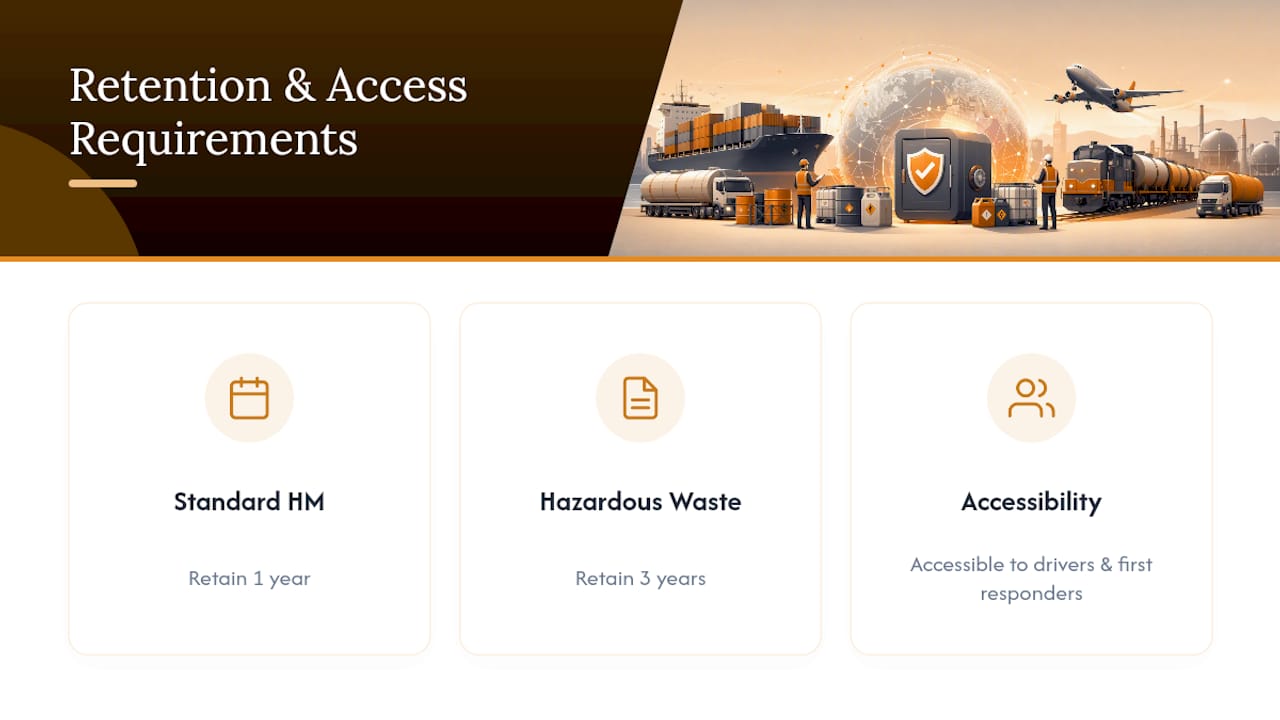
Retention periods matter more than most shippers realize. FMCSA guidance sets the standard hazardous materials shipping paper retention at one year, stretching to three years for hazardous waste shipments specifically. Motor carriers also have to keep those papers accessible to drivers and first responders, not filed away in an office three states over.
For general packaging materials and terminology, see this packaging supplies guidance alongside the dangerous goods requirements for your shipment.
Common Mistakes and a Pre-Handoff Checklist
Small errors cause most rejections, not missing paperwork. IATA’s own guidance points to minor discrepancies as the leading cause of shipments getting bounced at the acceptance counter.
- ISHP sequence broken or elements listed out of order.
- Emergency response phone number missing, wrong, or unmonitored.
- Package count or quantity that doesn’t match what’s on the physical labels.
- Packing group or technical name omitted when the HMT requires it.
Pro Tip: Run every shipment through an official IATA acceptance checklist before it leaves your facility, not after the carrier flags it. A five-minute check against the checklist catches the same errors an airline agent will, just without the delay.
Why Working With a Freight Forwarder Simplifies This
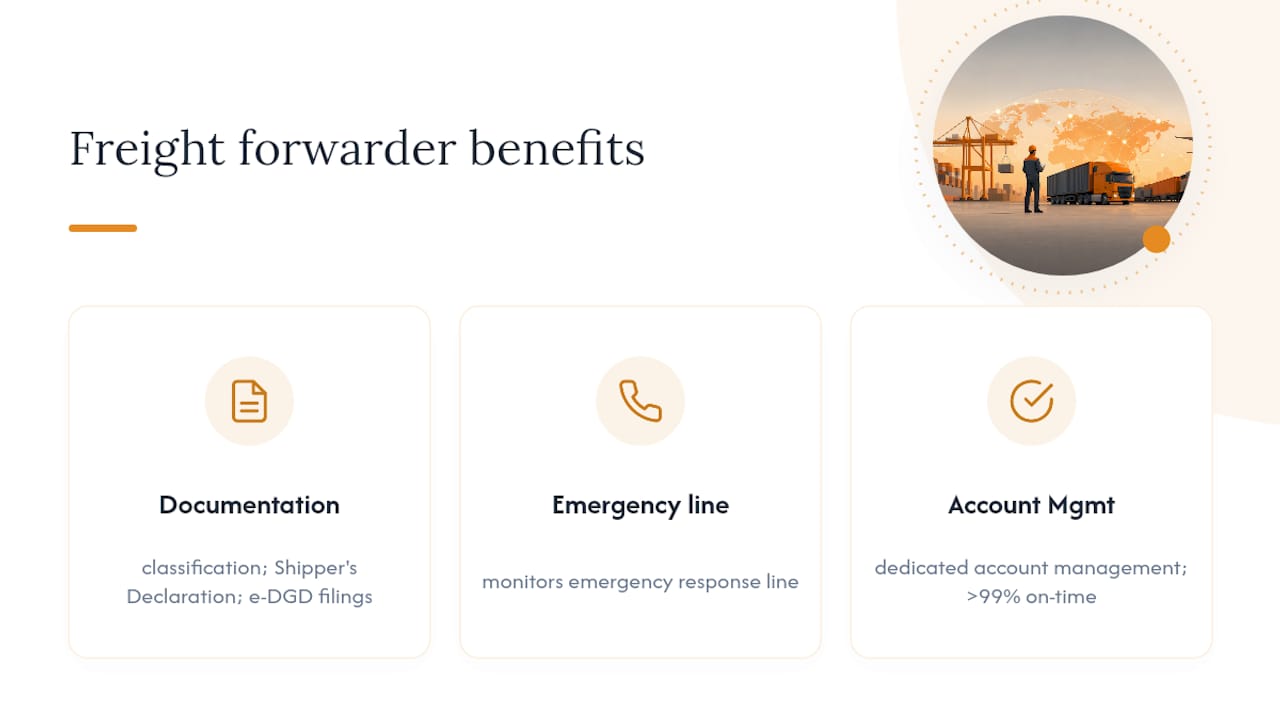
A logistics partner handles classification, prepares the Shipper’s Declaration, submits e-DGD filings, and monitors the emergency response line so nothing lapses. ForwarderOne pairs that with dedicated account management and a track record of over 99% on-time delivery, which matters most on complex or high-volume cross-border lanes.
What Actually Prevents Citations and Delays
The habit that saves the most time isn’t a bigger checklist. It’s a two-minute verification pass before handoff, every single time, checking ISHP order, the emergency phone number, and that package counts match the labels. Skip it once on a low-risk shipment and you’ll skip it on the one that gets flagged.
— Keven
A Managed Option for Sellers Moving Inventory From China
If you’re a small or mid-sized Amazon seller juggling classification, e-DGD filings, and carrier acceptance checklists on top of running your business, handling all of it in-house eats hours you don’t have. Some providers build this into an all-inclusive DDP process: customs clearance, duty payment, and delivery move through a single workflow, with support from a dedicated account manager who tracks shipment documentation from pickup through the fulfillment center.

That matters most during peak season, when a single rejected declaration can knock a restock out of position for weeks. Some approaches fold compliance checks into the shipping process itself rather than treating it as a separate hurdle handled alone. If you’re moving inventory from China to a US or Mexico fulfillment center, see how ForwarderOne’s freight services handle documentation alongside customs and delivery, or check out the dedicated FBA freight forwarding service built specifically for Amazon sellers shipping DDP from China.
Sources
- IATA - Shipper’s Declaration
- 49 CFR Part 172 Subpart C (Shipping Papers)
- FMCSA Hazardous Materials (shipping papers guidance)
FAQ
What documents are required for dangerous goods?
You need a shipping paper with a correctly sequenced Basic Description, an emergency response information sheet with a monitored phone number, and for air shipments, an IATA Shipper’s Declaration.
Is there a PDF version of the dangerous goods declaration form available?
Yes. IATA offers both fillable and non-fillable PDF versions of the Shipper’s Declaration, plus e-DGD options for electronic submission where the trade lane supports it.
How long do you have to keep dangerous goods shipping documents?
FMCSA guidance sets standard retention at one year for hazardous materials shipping papers, extending to three years for hazardous waste shipments.
Who fills out a dangerous goods declaration?
The consignor, or shipper, is responsible for classifying the material, packaging it correctly, and signing or certifying the declaration. Many sellers hand this off to a freight forwarder like ForwarderOne when shipment volume or complexity makes in-house preparation impractical.
Need dangerous goods paperwork aligned?
ForwarderOne coordinates supplier documents, broker handoffs, customs clearance, and final delivery so regulated shipments do not fail at acceptance.