Freight forwarding service tiers are defined classifications that group providers and service levels by scale, speed, and specialization. Understanding these tiers is the fastest way to stop overpaying for logistics or receiving service that does not match your shipment’s needs. The examples of freight forwarding service tiers fall into two distinct categories: provider tiers based on company size and market reach, and operational tiers based on transit speed and handling priority. Business owners and logistics managers who grasp both categories make sharper decisions on cost, reliability, and carrier selection.
1. What are the examples of freight forwarding service tiers?
The freight forwarding market segments into two parallel tier systems: provider tiers and operational service tiers. Provider tiers classify forwarders by their global reach and business scale. Operational tiers classify the actual service product by speed, priority, and price.
Knowing only one system leaves gaps. A business that picks a Tier 1 global forwarder but books a Standard service may still face slow transit times. A business that books Priority service through a Tier 3 local specialist may get speed but lose coverage on complex cross-border routes. Both dimensions matter equally.

2. The three provider tiers in freight forwarding
The global freight forwarder market divides into three provider tiers: Tier 1 global giants, Tier 2 regional specialists, and Tier 3 niche or local experts. Each tier serves a distinct customer profile.
Tier 1: Global integrated giants
Tier 1 forwarders hold 55–60% of market share and operate across every major trade lane. That dominance reflects their infrastructure, not necessarily their service quality for smaller clients. Multinational corporations with complex, multi-leg shipments across dozens of countries are the natural fit for Tier 1 providers.
Tier 2: Agile regional specialists
Tier 2 providers focus on high-growth trade corridors and deliver rapid responses with real customization for smaller clients. SME e-commerce sellers often receive better rates and more attentive service from Tier 2 forwarders than from Tier 1 giants, because they are not competing for attention against enterprise accounts. These providers specialize in lanes like China to USA, Southeast Asia to Europe, and similar high-volume corridors.
Tier 3: Niche and local experts
Tier 3 specialists offer hyper-local expertise and personalized service but lack global reach. They are the right choice for businesses with region-specific shipments or commodity-focused cargo such as perishables, art, or industrial equipment requiring specialized handling.
- Tier 1: Best for multinationals with complex global networks
- Tier 2: Best for e-commerce sellers, SMEs, and fast-growing brands on defined trade lanes
- Tier 3: Best for niche cargo, regional specialists, or businesses with unique compliance needs
Pro Tip: Before contacting any forwarder, write down your top three shipping lanes and your average shipment volume. That single exercise tells you which provider tier to target before you read a single quote.
3. How operational freight forwarding service levels differ
Operational tiers describe the actual service product a forwarder sells, independent of their company size. DHL Freight standardizes its road freight products into three clear tiers: Standard, Priority, and Direct. That structure has become a useful reference model across the industry.
Standard service
Standard is the cost-effective, deferred option. Transit times are longer, and shipments move when capacity allows. This tier suits non-urgent cargo where price is the primary concern.
Priority service
Priority guarantees defined transit times and prioritized handling at pickup and delivery. Priority tiers cost 30–50% more than Standard tiers. That premium buys transit guarantees, earlier pickup slots, and in many cases a money-back guarantee if the deadline is missed.
Direct service
Direct dedicates a vehicle or aircraft to a single shipment. No consolidation, no shared space, no stops for other cargo. Direct is the fastest and most expensive option, reserved for time-critical or high-value cargo.
| Service tier | Transit time | Cost level | Best use case |
|---|---|---|---|
| Standard | Longest | Lowest | Non-urgent, price-sensitive cargo |
| Priority | Defined, guaranteed | 30–50% above Standard | Time-sensitive shipments with deadlines |
| Direct | Shortest | Highest | Critical, high-value, or urgent cargo |
Standardizing into clear tiers like Standard, Priority, and Direct greatly improves customer decision-making and service transparency. Businesses can now compare apples to apples instead of decoding vague service descriptions.
Pro Tip: If your product sells out during peak season and a stockout costs you more than the Priority premium, book Priority every time. The math is straightforward.
4. Examples of freight forwarding service tiers by shipping mode
The provider and operational tier frameworks apply across every shipping mode. Here are concrete freight service examples by mode.
Sea freight
- LCL (Less than Container Load) Standard: Your cargo shares a container with other shippers. Transit is slower due to consolidation and deconsolidation at ports. Cost per cubic meter is low.
- FCL (Full Container Load) Priority: You book an entire container. Transit is faster because there is no consolidation delay. Forwarders can guarantee vessel departure dates.
- FCL Direct: A dedicated container moves on the fastest available vessel with no transshipment stops. Used for high-value electronics, pharmaceuticals, or time-sensitive seasonal inventory.
Air freight
- Economy deferred air: Cargo travels on available belly space across multiple flights. Cheapest air option, but transit can stretch to 7–10 days.
- Express air: Cargo moves on the next available flight with priority loading. Transit drops to 2–4 days. Cost is significantly higher.
- Chartered air: A full aircraft is dedicated to one shipment. Used for outsized cargo, emergency medical supplies, or high-value goods where no delay is acceptable.
Road freight
- LTL (Less than Truckload) Standard: Cargo shares truck space. Multiple stops and consolidation points extend transit.
- FTL (Full Truckload) Premium: A dedicated truck moves your cargo point to point. Faster, more secure, and better suited for fragile or high-value goods.
Specialized shipments
Hazardous materials, perishables, and oversized cargo require specialized freight handling that sits outside standard tier structures. These shipments typically require Tier 2 or Tier 3 providers with commodity-specific licenses and equipment.
5. How to choose the right freight forwarding tier for your business
Choosing the wrong tier leads to higher costs or poor service performance. Matching your business profile to the right tier is the single most effective way to control logistics costs without sacrificing reliability.
- Assess your shipment volume. High-volume shippers with consistent lanes get better rates from Tier 1 or established Tier 2 providers. Low-volume or irregular shippers benefit from the flexibility of Tier 2 or Tier 3 specialists.
- Define your speed requirements. If stockouts cost you more than a Priority premium, book Priority. If your cargo has a flexible delivery window, Standard saves money without meaningful risk.
- Map your geographic coverage needs. Businesses shipping across 20+ countries need Tier 1 infrastructure. Businesses focused on one or two trade lanes get better service from a Tier 2 specialist on those exact routes.
- Factor in cargo complexity. Standard cargo moves through any tier. Hazardous materials, temperature-controlled goods, and oversized freight require providers with specific certifications, regardless of their tier ranking.
- Evaluate responsiveness, not just brand size. A forwarder that answers your call in two hours and knows your lane is worth more than a global brand that routes you through a call center. Test responsiveness before you commit.
- Consider DDP (Delivered Duty Paid) services. For e-commerce sellers shipping internationally, DDP removes customs and duty complexity from your workflow entirely. ForwarderOne’s DDP shipping solutions handle customs, duties, and final delivery in one process, which is a direct match for Amazon FBA sellers on the China to USA lane.
- Avoid tier mismatch. Selecting a Tier 1 global forwarder for simple, high-volume e-commerce shipments can hurt service quality because smaller accounts receive lower prioritization than enterprise clients. A Tier 2 specialist on your exact lane will outperform a Tier 1 generalist in most SME scenarios.
For Amazon sellers specifically, ForwarderOne’s guide on choosing a freight forwarder walks through the exact criteria to apply when evaluating providers for FBA shipments.
Key takeaways
The most effective approach to freight forwarding tier selection is matching both your provider tier and operational service tier to your shipment profile, budget, and speed requirements simultaneously.
| Point | Details |
|---|---|
| Two tier systems exist | Provider tiers rank forwarders by scale; operational tiers rank services by speed and cost. |
| Tier 1 is not always best | SMEs and e-commerce sellers often get better rates and service from Tier 2 specialists. |
| Priority costs 30–50% more | That premium buys guaranteed transit times and prioritized handling at pickup and delivery. |
| Mode shapes tier choice | LCL, FCL, LTL, FTL, and air options each carry Standard, Priority, and Direct variants. |
| Mismatch is expensive | Choosing the wrong tier leads to either overpaying or receiving service below your needs. |
Why bigger is not always better in freight forwarding
The assumption that larger freight forwarders deliver better service is the most common and costly mistake I see business owners make. I have watched small Amazon sellers sign contracts with Tier 1 giants, then spend months chasing account managers who are juggling hundreds of enterprise clients. The service was technically there. The attention was not.
What I have found actually works is evaluating providers on lane expertise first, then responsiveness, then price. A Tier 2 forwarder that ships China to USA 50 times a week knows every port delay pattern, every customs flag, and every carrier quirk on that route. A Tier 1 generalist knows the route exists.
The operational tier decision is equally underrated. Most logistics managers focus entirely on finding the right provider and then default to Standard service without running the stockout math. If a delayed shipment costs you $10,000 in lost sales and the Priority upgrade costs $800, the decision is not a logistics question. It is a finance question.
My advice: use the provider tier framework to shortlist candidates, then use the operational tier framework to select the right service product. Treat them as two separate decisions made in sequence, not one combined choice.
— Keven
ForwarderOne’s freight forwarding services for Amazon sellers
Amazon FBA sellers shipping from China to the USA face a specific tier decision that most general logistics guides ignore. The right provider is a Tier 2 specialist with deep expertise on that exact lane, not a Tier 1 giant that treats your account as a rounding error.
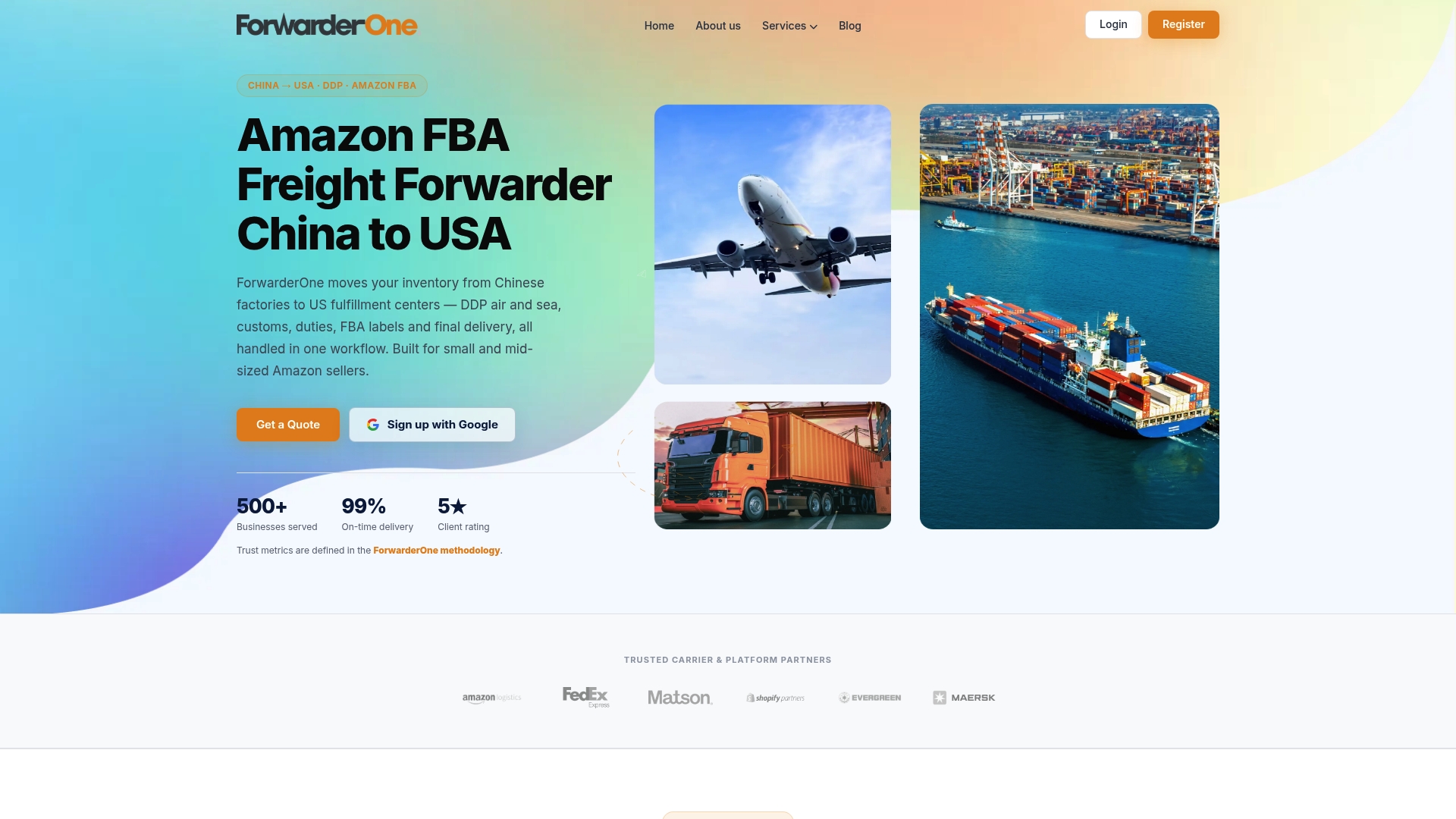
ForwarderOne operates across Standard and Priority service levels with an all-inclusive DDP freight forwarding service that covers customs, duties, and delivery in a single workflow. With over 99% on-time delivery and a dedicated account manager for every client, ForwarderOne gives small and mid-sized sellers the attentiveness of a Tier 2 specialist with the reliability metrics of a much larger operation. Contact ForwarderOne to match your shipment profile to the right service tier and stop leaving money on the table.
FAQ
What are the main types of freight forwarding service tiers?
Freight forwarding service tiers fall into two categories: provider tiers (Tier 1 global giants, Tier 2 regional specialists, Tier 3 niche experts) and operational tiers (Standard, Priority, and Direct). Both categories must align with your shipment profile for the best results.
How much more does Priority freight service cost than Standard?
Priority service costs 30–50% more than Standard service. That premium covers guaranteed transit times, prioritized pickup and delivery, and in many cases a money-back guarantee.
Which freight forwarding tier is best for small Amazon sellers?
Tier 2 regional specialists are the best match for most small Amazon sellers. SME e-commerce sellers receive better rates and more attentive service from Tier 2 providers than from Tier 1 giants, which prioritize enterprise accounts.
What is the difference between LCL and FCL in freight service levels?
LCL (Less than Container Load) is a Standard-tier sea freight option where your cargo shares container space with other shippers, resulting in longer transit. FCL (Full Container Load) is a Priority or Direct option where you book the entire container, delivering faster and more predictable transit times.
When should a business use Direct freight service?
Direct service is the right choice when cargo is time-critical, high-value, or cannot tolerate any delay from consolidation or transshipment. It is the most expensive operational tier and is typically reserved for emergency replenishment, pharmaceuticals, or chartered air shipments.
Need the right freight tier for an Amazon shipment?
Send your lane, cargo specs, deadline, and target landed cost. ForwarderOne will compare Standard, Priority, Direct, and DDP options before you overpay for speed.