A freight insurance claim is a formal written demand for financial compensation when cargo is lost, damaged, or stolen during transit. This process differs from a standard carrier liability claim, and confusing the two costs shippers real money. Under the Carmack Amendment, shippers must file within 9 months of delivery for total loss claims. Cargo insurance, by contrast, is a first-party contract that covers the full commercial value of goods regardless of who caused the damage. Knowing the difference, and knowing how to file correctly, determines whether you recover your losses or absorb them.
What is a freight insurance claim and how does it work?
A freight insurance claim is the official process by which a shipper or consignee requests reimbursement from an insurer for cargo that was lost, damaged, or stolen in transit. Unlike a carrier liability claim, which requires you to prove the carrier was at fault, cargo insurance covers the full commercial value of your goods regardless of fault. That distinction matters enormously when your shipment arrives crushed and the carrier disputes responsibility.
Carrier liability is limited by law. Under the Carmack Amendment, carriers typically pay based on cargo weight, not actual value. A pallet of electronics worth $20,000 might yield a carrier payout of a few hundred dollars. Cargo insurance closes that gap by indemnifying the cargo owner for the actual declared value.

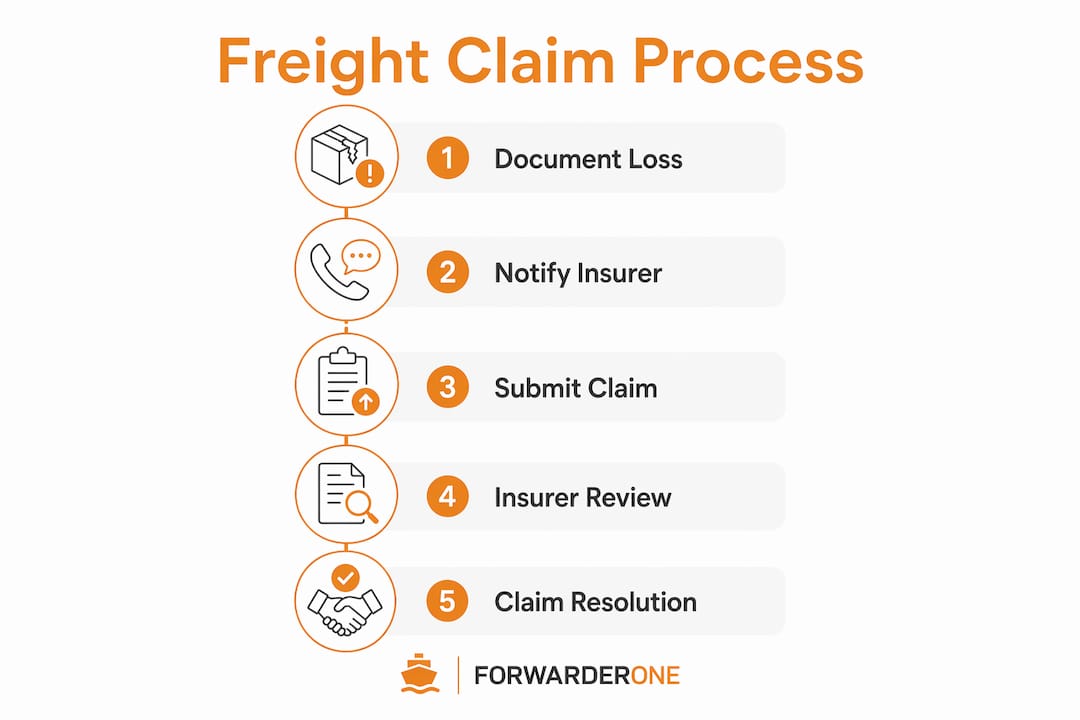
The freight insurance process involves three core phases: documenting the loss at delivery, notifying the insurer promptly, and submitting a complete claim package with supporting evidence. Each phase has strict requirements. Missing one step can void an otherwise valid claim.
What documents do you need to file a freight claim?
Successful freight insurance claims depend entirely on documentation. Required documents include the Bill of Lading (BOL), a signed Proof of Delivery (POD) with damage exceptions noted, the commercial invoice, photographs of the damage, and repair or replacement estimates. Missing any one of these gives insurers grounds to delay or deny payment.
The BOL and POD are the two most critical documents. The BOL establishes the shipment’s condition when it left the origin. The POD confirms what arrived. If you sign a clean POD without noting visible damage, you effectively confirm the goods arrived in good condition. That makes proving a claim nearly impossible.
Concealed damage requires even faster action. Concealed damage must typically be reported within 5 days of discovery. That window is short. Open every shipment promptly and inspect thoroughly, even when the outer packaging looks intact.
Key documents to gather immediately after discovering damage:
- Bill of Lading with original shipment details
- Proof of Delivery with damage exceptions written clearly before signing
- Commercial invoice showing declared cargo value
- Photographs of damaged goods, packaging, and labels from multiple angles
- Repair or replacement estimates from a qualified vendor
- Packing list confirming contents and quantities
- Original packaging preserved for insurer inspection
Pro Tip: Never discard damaged goods or original packaging before the insurer completes their inspection. Premature disposal is one of the most common reasons valid claims get automatically rejected.
Carrier liability vs. freight insurance: what is the real difference?
Carrier liability and cargo insurance are not the same thing, and treating them as interchangeable is an expensive mistake. Carrier liability is a legal obligation imposed on carriers under laws like the Carmack Amendment. It covers only a fraction of actual cargo value, calculated by weight. Cargo insurance is a separate financial product that covers the full declared commercial value of your goods.
The practical difference shows up at claim time. Carrier claims require you to prove the carrier was negligent. Insurers, operating under a first-party contract, pay based on the policy terms without requiring fault attribution. Cargo insurers are also more motivated to settle quickly because their business model depends on it.
Here is how the two approaches compare across key factors:
| Factor | Carrier liability | Cargo insurance |
|---|---|---|
| Compensation basis | Weight-based limits | Full declared commercial value |
| Fault requirement | Must prove carrier negligence | No fault required |
| Settlement speed | Up to 120 days by law | Typically faster |
| Coverage scope | Limited by law | Defined by policy terms |
| Who pays | Carrier | Your insurer |
Pro Tip: For high-value shipments, never rely on carrier liability alone. Freight claims filed against carriers often recover only minimal amounts based on weight, making cargo insurance the only reliable protection for full value.
How to file a freight insurance claim step by step
Filing a freight insurance claim correctly requires following a specific sequence. Skipping steps or missing deadlines forfeits your right to recover, regardless of how clear-cut the damage is.
-
Document damage at delivery. Before the driver leaves, inspect the shipment. Note every visible issue on the POD. Never sign a clean POD if damage is visible. Write specific descriptions, not just “damaged.”
-
Photograph everything immediately. Take photos of the outer packaging, inner packaging, and damaged goods from multiple angles. Include the shipping labels and any markings on the boxes.
-
Notify your insurer within 24–48 hours. Most policies require prompt notification. Contact your insurer or freight forwarder the same day you discover damage.
-
Preserve all evidence. Keep damaged goods, original packaging, and all shipping documents until the insurer completes their inspection. Do not repair or discard anything.
-
Submit a written claim with full documentation. Include the BOL, POD, commercial invoice, photos, and repair estimates. Submit to both the carrier and your insurer in writing.
-
Track the carrier’s response timeline. Carriers have up to 120 days to respond or settle a claim. Follow up in writing if you receive no response within 30 days.
-
Escalate if denied. If the carrier denies the claim, respond in writing with counter-evidence. If the insurer denies it, review the policy exclusions and request a formal reconsideration.
The 9-month filing deadline under the Carmack Amendment is the hard outer limit for carrier claims. That deadline sounds generous, but documentation degrades fast. File as soon as you have your evidence package ready.
Why do freight insurance claims get denied?
Claim denials follow predictable patterns. Understanding them lets you avoid the same traps. Carriers deny claims most often for four reasons: late filing, insufficient packaging, a clean POD with no damage noted, and missing documentation.
The most avoidable denial is the clean POD. Signing without noting damage is the single biggest mistake shippers make. Once you sign a clean POD, proving negligence becomes extremely difficult, and most claims collapse at that point.
Packaging disputes are the second most common denial. Carriers argue the damage resulted from inadequate packing, not their handling. Counter this by keeping detailed packaging specifications and photos taken before shipment. Providing packaging specs and pre-shipment photos showing compliance directly challenges these denials.
Common denial triggers to avoid:
- Signing a clean POD without noting visible damage
- Filing after the 9-month Carmack Amendment deadline
- Discarding damaged goods or packaging before inspection
- Submitting incomplete documentation packages
- Failing to report concealed damage within 5 days of discovery
- Using packaging that does not meet carrier standards
Pro Tip: If a carrier denies your claim citing packaging, respond with your original packing list, photos taken before shipment, and any industry packaging standards your goods met. A documented counter-response changes the outcome far more often than shippers expect.
When should you buy freight insurance and what does it cover?
Freight insurance is worth purchasing any time the cargo value significantly exceeds what carrier liability would pay. For high-value goods, international shipments, or routes with elevated risk, freight insurance premiums typically range from 0.3% to 1% of declared cargo value. That cost is minimal compared to absorbing a total loss.
Two main coverage types exist. All-risk policies cover loss or damage from any external cause, but all-risk policies exclude improper packaging, inherent vice, and delay. Named peril policies cover only the specific risks listed, such as fire, theft, or collision. All-risk is broader but not unlimited.
International shipments add another layer of complexity. Under CIF (Cost, Insurance, and Freight) Incoterms, sellers provide only minimum coverage under Clause C, which covers major catastrophes only. Buyers receiving CIF shipments should purchase their own supplemental coverage for high-value goods rather than assuming the seller’s policy is adequate.
For Amazon sellers shipping inventory from China to US fulfillment centers, understanding freight payment terms and who holds insurance responsibility at each leg of the journey is critical. A gap in coverage at any point creates uninsured exposure. Reviewing your cargo insurance options before booking a shipment, not after a loss, is the only reliable approach. Sellers who want to understand how insurance premiums factor into their total landed cost can use an Amazon fee calculator to model the full picture.
Key Takeaways
A freight insurance claim is a formal written demand for cargo compensation that requires strict documentation, legal deadline compliance, and clear separation from carrier liability claims.
| Point | Details |
|---|---|
| Definition matters | A freight insurance claim covers full cargo value; a carrier liability claim covers only weight-based limits. |
| Documentation is decisive | Always note damage on the POD before signing and preserve all packaging for insurer inspection. |
| Deadlines are hard limits | File carrier claims within 9 months under the Carmack Amendment; report concealed damage within 5 days. |
| Denials are preventable | Most denials result from clean PODs, late filing, or discarded evidence. All three are avoidable. |
| Insurance beats carrier liability | Premiums of 0.3%–1% of cargo value provide full commercial coverage that carrier liability cannot match. |
What I’ve learned from watching shippers lose claims they should have won
After years of working in freight forwarding, the pattern I see most often is not negligence. It is a knowledge gap. Shippers assume that because damage clearly happened, the claim will succeed. That assumption is wrong.
The Carmack Amendment gives you 9 months to file, but the real deadline is the moment you sign the POD. Once you sign clean, the legal ground shifts under you. I have seen six-figure claims collapse because a driver was in a hurry and the receiver did not want to cause a scene. That moment costs more than any awkward conversation.
The other gap I see constantly is the confusion between carrier liability and insurance. Shippers think they are covered because they have a carrier. They are not. Carrier liability is a legal minimum, not a financial safety net. Cargo insurance is the actual protection. The difference between the two is the difference between recovering $300 on a $15,000 shipment and recovering the full value.
My strongest advice: treat every delivery as a potential claim. Inspect before signing. Photograph before the driver leaves. Notify your insurer the same day. These habits take five minutes and save thousands.
— Keven
How ForwarderOne helps shippers manage freight insurance
Freight insurance claims are easier to win when you have the right support from the start. ForwarderOne works with Amazon sellers and importers to handle the documentation, customs, and logistics details that determine whether a claim succeeds or fails.
ForwarderOne’s freight forwarding services include DDP shipping from China to US fulfillment centers, with dedicated account managers who guide clients through cargo insurance requirements and claims documentation. With over 99% on-time delivery, ForwarderOne reduces the risk of transit losses before they become claims. For sellers who want reliable logistics support and clear guidance on protecting their inventory, ForwarderOne provides the expertise to keep shipments moving and claims manageable.
FAQ
What is a freight insurance claim?
A freight insurance claim is a formal written request for financial compensation when cargo is lost, damaged, or stolen during transit. It is filed with an insurer under a cargo insurance policy and covers the full declared commercial value of the goods.
How long do you have to file a freight claim?
Under the Carmack Amendment, shippers have 9 months from delivery or expected delivery to file a written freight claim against a carrier. Concealed damage must typically be reported within 5 days of discovery.
What does freight insurance cover?
All-risk freight insurance covers loss or damage from any external cause, excluding improper packaging, inherent vice, and delay. Named peril policies cover only the specific risks listed in the policy, such as theft, fire, or collision.
Why do freight insurance claims get denied?
The most common denial reasons are signing a clean Proof of Delivery without noting damage, filing after the legal deadline, discarding damaged goods before insurer inspection, and submitting incomplete documentation.
Is freight insurance worth the cost?
Freight insurance premiums typically range from 0.3% to 1% of declared cargo value. That cost is far lower than absorbing a total loss on a high-value shipment, making insurance the practical choice for any shipment where carrier liability limits fall short of actual cargo value.
Need cleaner shipment records before a claim?
ForwarderOne keeps customs, delivery and milestone documentation tied to each shipment so sellers have clearer records when cargo value needs protection.