Freight payment terms are defined as the contractual obligations that specify who pays shipping charges and when payment is due in a freight transaction. The three primary categories recognized by the FHWA are Prepaid, Collect, and Third-Party, and every freight contract falls into one of these buckets. Getting these terms wrong costs real money. ForwarderOne works with Amazon sellers daily who discover mid-shipment that they misread a payment term and owe fees they never budgeted for. Understanding freight payment terms before you sign a contract is the single most effective way to control your shipping costs.
What is freight payment terms and how do the main types differ?
Freight payment terms define financial responsibility between the shipper, carrier, and buyer. The FHWA classifies shipping cost responsibility into three core types, each with distinct cash flow and risk implications.
- Prepaid: The shipper pays all freight charges before the goods move. This is the most common arrangement for sellers who want full control over carrier selection and pricing. The buyer receives goods without any freight invoice.
- Collect: The receiver pays freight charges upon delivery. Buyers who want to use their own carrier accounts or negotiate their own rates typically request collect terms. The risk here is that a buyer may refuse delivery and leave the carrier unpaid.
- Third-Party: A party other than the shipper or receiver pays the freight bill. This is common in large retail supply chains where a parent company or logistics provider handles all freight invoicing centrally.
Each term shifts financial exposure differently. Under prepaid terms, the seller carries the cost upfront and may or may not recover it through product pricing. Under collect terms, the buyer controls the payment relationship with the carrier. Third-party billing adds a layer of complexity because the billing party must be pre-approved by the carrier before the shipment moves.
Pro Tip: Always confirm third-party billing authorization with your carrier before the shipment departs. Carriers can and do reject third-party billing at pickup if the account is not pre-approved, which converts the charge to collect or prepaid without warning.

What are the standard payment timelines for freight invoices?
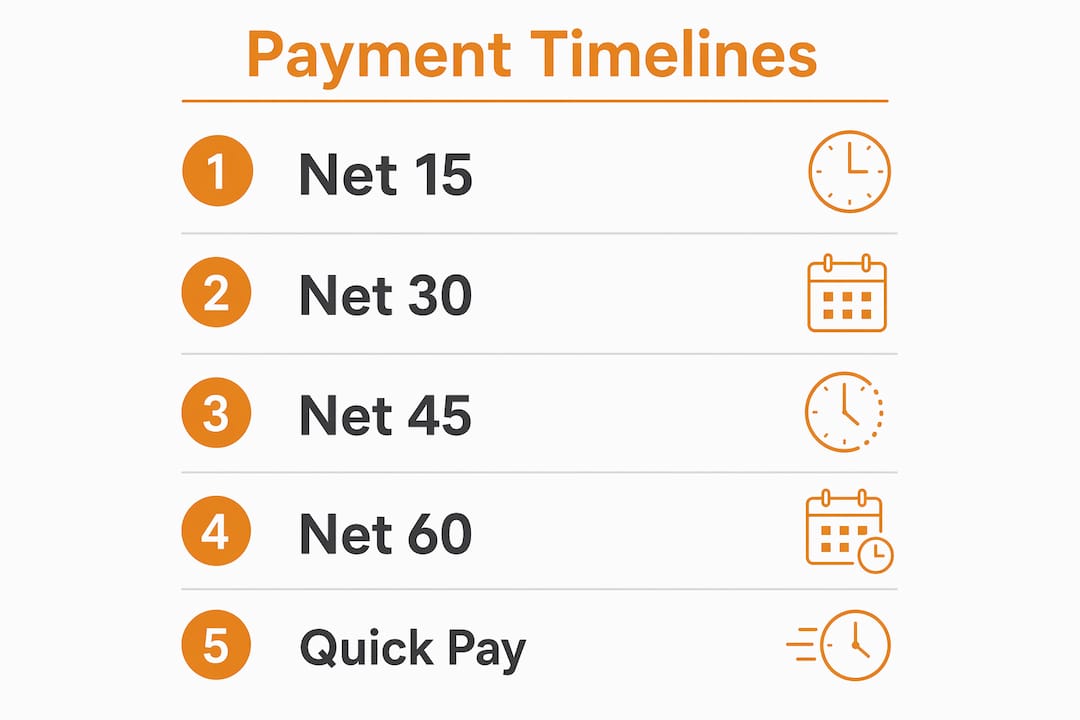
Payment timelines in freight are governed by net terms, which specify how many days after invoice date a payment is due. Net 30, Net 45, and Net 60 are the most common windows used between shippers, brokers, and carriers in the US market. Each number represents calendar days, not business days, unless your contract explicitly states otherwise.
Here is how the standard timeline works in practice:
- Invoice issuance: The carrier or broker sends an invoice after delivery confirmation, typically within 24–72 hours of delivery.
- Invoice review period: The shipper or accounts payable team audits the invoice for accuracy, checking against the bill of lading and rate confirmation.
- Payment window opens: The net term clock starts on the invoice date, not the delivery date. A Net 30 invoice dated june 1 is due june 30.
- Payment sent: The shipper releases payment via ACH, wire, or check within the agreed window.
- Late fees apply: Contracts typically specify a late fee of 1.5% per month on overdue balances, though this varies by carrier.
Cash flow reality check: Net 60 terms benefit the buyer’s cash position but put real pressure on carriers and brokers who have already paid drivers and fuel costs. Carriers often price Net 60 accounts higher than Net 30 accounts to compensate for the extended float. If you negotiate longer payment windows, expect your rate quotes to reflect that cost.
Shorter net terms give you more negotiating leverage on rates. Carriers price risk into every quote, and a shipper who pays in 15 days is a better credit risk than one who pays in 60. Finance teams that treat freight payment management as a supply chain efficiency tool consistently negotiate better lane rates than those who treat it as a back-office function.
How do FOB and CIF terms affect payment and liability?
FOB and CIF are freight contract terms that go beyond who pays. They define exactly when ownership and risk transfer from seller to buyer, which directly affects insurance responsibility and payment timing.
FOB Origin vs. FOB Destination
FOB Origin means the buyer assumes ownership and risk the moment goods leave the seller’s facility. The buyer is responsible for freight costs, insurance, and any damage that occurs in transit. This term favors sellers because their liability ends at the loading dock.
FOB Destination means the seller retains ownership and pays all shipping costs until goods arrive at the buyer’s location. If the shipment is lost or damaged in transit, the seller absorbs the loss. This term favors buyers and is common in retail vendor agreements.
| Term | Who pays freight | Risk transfers at | Favors |
|---|---|---|---|
| FOB Origin | Buyer | Seller’s dock | Seller |
| FOB Destination | Seller | Buyer’s dock | Buyer |
| CIF | Seller | Destination port | Buyer |
CIF in international shipping
Under Incoterms 2020, Cost, Insurance and Freight (CIF) requires the seller to arrange and pay freight and the required insurance to the named destination port. Delivery and risk transfer occur when the goods are on board the vessel at the port of shipment. CIF applies to sea and inland waterway transport. See ICC’s sea and inland waterway rules.
CIF creates a common misunderstanding for e-commerce sellers importing from China. The seller covers freight to the destination port, but the buyer still pays import duties, customs clearance, and last-mile delivery from the port to the warehouse. Many sellers assume CIF means door-to-door delivery and are surprised by the additional costs waiting at the port.
Pro Tip: For China-to-USA shipments, DDP (Delivered Duty Paid) is a cleaner alternative to CIF. Under DDP, the seller handles customs, duties, and delivery to your door. ForwarderOne’s DDP freight forwarding service covers this entire chain in a single workflow, eliminating the port-side surprise costs that CIF leaves on the buyer.
What freight payment options and technologies matter in 2026?
The freight payment process has moved well beyond paper checks. Digital payment integration through ACH, wire transfer, and instant pay platforms speeds up cargo release and reduces supply chain delays. Faster payment directly correlates with faster cargo release at ports and terminals, which matters enormously for Amazon sellers managing tight restock timelines.
- ACH transfers: Standard for most domestic freight payments. Typically settle in 1–3 business days. Low cost and widely accepted.
- Wire transfers: Used for large international payments or urgent settlements. Same-day or next-day settlement, but fees apply on both ends.
- Instant pay platforms: Freight-specific payment networks that settle in minutes. Common in trucking for carriers who need immediate cash flow.
- Quick pay programs: Brokers offer carriers early payment in exchange for a discount. Quick pay fees typically run 2.5% to 4% of the invoice amount. Carriers accept this cost for the cash flow benefit, but it reduces their margin on every load.
Automating freight payment auditing reduces errors and scales operations without adding headcount. Manual invoice auditing misses duplicate charges, incorrect accessorial fees, and rate discrepancies. Automated systems flag these issues before payment goes out, which directly protects your margin.
The tradeoff with quick pay is real. A carrier accepting a 3% quick pay discount on a $5,000 invoice loses $150 per load. At scale, that adds up fast. As a shipper, you can use quick pay programs as a negotiating tool. Offering faster payment in exchange for lower rates is a legitimate tactic that benefits both sides.
How does understanding freight terms improve cost control?
Freight payment terms are a cost control tool, not just paperwork. Sellers who treat them as administrative details consistently pay more than those who negotiate them deliberately.
- Negotiate accessorial charges upfront. Unclear accessorial terms add 10–20% to shipping costs. Fuel surcharges, liftgate fees, residential delivery charges, and detention fees are all accessorial. Get them defined as prepaid or excluded in writing before the shipment moves.
- Match payment terms to your cash cycle. If your inventory turns every 45 days, Net 30 freight terms align well. If you are importing from China with 60-day lead times, Net 45 or Net 60 gives you room to receive and sell before the freight bill is due.
- Use third-party billing to consolidate invoicing. Sellers with multiple suppliers can route all freight charges through a single third-party account. This simplifies reconciliation and gives you a single point of contact for disputes.
- Audit every invoice before payment. Carriers and brokers make billing errors. Rate mismatches, duplicate charges, and incorrect weight classifications are common. Reviewing invoices against your rate confirmation before paying catches these errors before they become disputes.
Pro Tip: Build a freight cost line item into every product’s landed cost calculation. Include the freight payment term, expected accessorial charges, and payment timing. This gives you an accurate picture of true product cost and prevents margin erosion from surprise fees. ForwarderOne’s freight cost breakdown guide walks through this calculation for international shipments.
Key Takeaways
Freight payment terms define who pays shipping costs and when, and choosing the wrong term without negotiating accessorial charges can add 10–20% to your total shipping spend.
| Point | Details |
|---|---|
| Three core term types | Prepaid, Collect, and Third-Party define who pays the carrier in every freight contract. |
| Net terms drive cash flow | Net 30, Net 45, and Net 60 set payment deadlines; shorter terms often earn better rate quotes. |
| FOB and CIF shift risk | FOB Origin transfers risk at the seller’s dock; CIF covers freight to port but not final delivery. |
| Accessorial charges add up | Unspecified accessorial fees add 10–20% to shipping costs; negotiate them in writing before shipment. |
| Automation reduces errors | Automated freight payment auditing catches duplicate charges and rate mismatches before payment goes out. |
Why most sellers get freight terms wrong until it costs them
I have watched sellers lose thousands of dollars not because they chose the wrong carrier, but because they signed contracts without reading the payment term section. The term “FOB Origin” appears in almost every supplier contract from China, and most sellers accept it without realizing they just agreed to own the goods the moment they leave the factory. If the shipment is damaged at sea, that is their problem, not the supplier’s.
The other mistake I see constantly is treating net terms as fixed. They are not. Carriers and brokers negotiate payment terms the same way they negotiate rates. A seller who pays reliably and on time has real leverage to ask for better terms. Most sellers never ask.
The future of freight payment is moving toward dynamic terms, where payment windows adjust automatically based on shipment status, delivery confirmation, and buyer credit scores. Platforms that integrate payment with tracking data will make manual invoice auditing obsolete. Sellers who build clean payment processes now will adapt to that shift easily. Those who rely on spreadsheets and manual checks will struggle.
Transparency in negotiation is the most underrated tactic in freight. Tell your carrier or broker what payment terms you need and why. Most will work with you if you are honest about your cash cycle. The ones who won’t are not the right partners anyway.
— Keven
How ForwarderOne handles freight payment complexity for you
Managing prepaid, collect, and third-party freight terms across multiple suppliers and carriers is genuinely complicated. ForwarderOne’s DDP shipping services consolidate the entire payment chain into a single workflow, covering customs, duties, and delivery from China to your US fulfillment center.
ForwarderOne’s all-inclusive DDP model means you pay one predictable cost with no port-side surprises, no accessorial fee disputes, and no customs clearance bills arriving separately. With over 99% on-time delivery and a dedicated account manager, ForwarderOne gives Amazon sellers the freight cost clarity they need to plan inventory and protect margins. Explore freight forwarding for small sellers to see how the service fits your shipping volume.
FAQ
What is the difference between prepaid and collect freight terms?
Prepaid means the shipper pays freight charges before the goods move. Collect means the receiver pays upon delivery. The choice determines who controls the carrier relationship and who carries the upfront shipping cost.
What does FOB Origin mean for e-commerce sellers?
FOB Origin means the buyer assumes ownership and risk once goods leave the seller’s facility. The buyer is responsible for all freight costs and any damage that occurs during transit.
How do net payment terms affect my freight costs?
Shorter net terms, such as Net 15 or Net 30, often result in lower rate quotes because carriers price risk into longer payment windows. Paying faster is a legitimate way to negotiate better freight rates.
What are accessorial charges and why do they matter?
Accessorial charges are fees added to base freight rates for services like liftgates, residential delivery, or detention time. Unspecified accessorial fees can add 10–20% to your total shipping cost if not negotiated in writing upfront.
What is CIF and how does it differ from DDP?
CIF (Cost, Insurance, and Freight) covers the seller’s cost to the destination port, but the buyer still pays import duties and last-mile delivery. DDP (Delivered Duty Paid) covers everything to the buyer’s door, making it a more predictable option for international e-commerce shipments.
Want freight terms translated into one all-in quote?
Share your supplier terms, shipment specs, and destination. ForwarderOne can price DDP options with customs, duties, and delivery responsibilities clearly assigned.