
Door-to-door, a shipment from China to the U.S. varies widely in transit time depending entirely on which shipping method you choose. Express courier (DHL, FedEx, UPS) delivers quickly within a typical range of a few days. Air freight typically takes 5–14 days door-to-door. Sea freight FCL generally takes multiple weeks door-to-door. LCL can be longer due to consolidation and deconsolidation processes. Rail is not a viable China-to-U.S. option.
The number most people quote, the 14–18 day sailing time from Shanghai or Shenzhen to the Port of Los Angeles / Long Beach, is port-to-port only. Adding export pickup, customs clearance, and inland trucking extends that same shipment to a considerably longer door-to-door timeframe.
Quick method guide:
- Samples or urgent parcels: Express courier takes a few days, with the highest cost per kg
- Time-sensitive inventory under 500 kg: Air freight door-to-door commonly runs 5–14 days
- Full-container restocks: Sea FCL typically takes 18–45 days door-to-door, with the lowest cost per kg
- Partial loads: Sea LCL can take significantly longer—25–60+ days door-to-door—and requires budgeting for consolidation waits
- FBA inventory with customs included: DDP service through a forwarder like ForwarderOne, which handles clearance and final delivery in one workflow
Pro Tip: Always count from your goods-ready date, not your order date. Supplier lead time and shipping transit time are two separate clocks.
How long does a shipment from China take by shipping method?
The table below covers the five main shipping families. Port-to-port is the sailing or flight time only. Door-to-door adds export handling, import customs clearance, and inland delivery.
| Shipping Method | Port-to-Port (days) | Door-to-Door (days) | Common Use Case |
|---|---|---|---|
| Express courier (DHL, FedEx, UPS) | a few days | 3–7 days | Samples, urgent small parcels |
| Air freight | a few days (flight) | 5–14 days | Time-sensitive inventory, high-value goods |
| Sea/air hybrid | about one to two weeks | about two to three weeks | Mid-urgency, cost-sensitive |
| Sea FCL | about two to four weeks | 18–45 days | Full-container restocks, bulk inventory |
| Sea LCL | 14–30 | 25–60+ | Partial loads, mixed cargo |
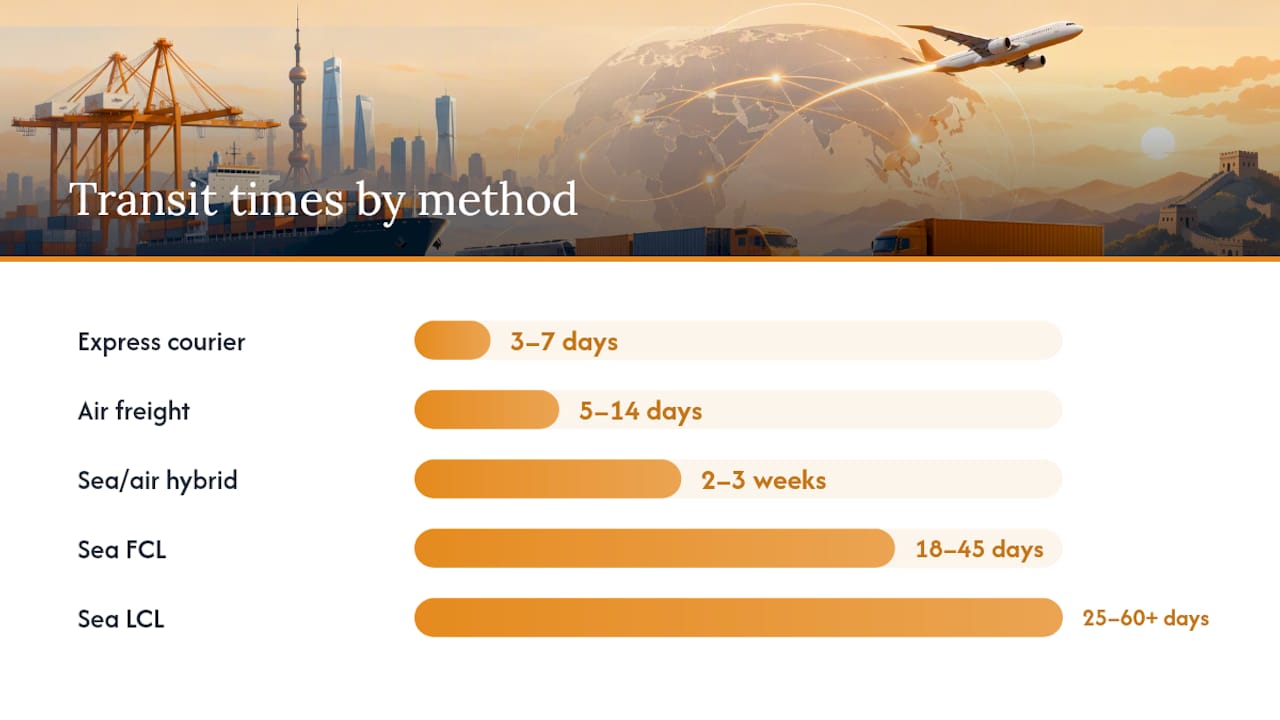
LCL shipments are consistently slower than FCL because cargo waits for consolidation at the origin warehouse and then goes through deconsolidation at the U.S. destination. Those two operational waits are easy to overlook when you’re estimating an ETA, and they’re the reason LCL’s door-to-door ceiling is so much higher than its sailing time suggests.
Weight and volume thresholds matter. Express courier becomes expensive fast above 30–50 kg due to volumetric weight charges. Air freight is generally cost-effective up to roughly 500 kg, with door-to-door times typically in the 5–14 day range; above that, sea freight’s lower cost per kg usually wins even accounting for the longer transit. For a detailed cost comparison, the sea freight vs air freight cost guide breaks down the crossover points for FBA shipments specifically.
Schedule frequency also varies. DHL, FedEx, and UPS offer daily departures from major Chinese hubs like Shanghai and Yantian. Air freight out of Shanghai Pudong runs multiple weekly departures. Ocean freight from Shanghai Port, Shenzhen/Yantian, Ningbo, and Qingdao operates on weekly vessel rotations, so missing a cutoff adds 7 days before the next available sailing.
Pro Tip: When comparing quotes, ask whether the transit time is port-to-port or door-to-door. A forwarder quoting 18 days and one quoting 30 days may be describing the same shipment at different stages of the journey.
What actually adds days to your quoted transit time?
A quoted transit time is almost always the best-case scenario. Here’s what turns it into a longer number in practice:
- U.S. customs clearance: — Standard entry processing takes 1–3 business days when documentation is clean. An exam (physical or X-ray) adds 3–10 days and sometimes longer.
The clearest illustration: a 14–18 day sailing from Shanghai becomes 25–45 days door-to-door once all pre- and post-sailing steps are counted. That gap is where most planning errors happen.
Pro Tip: Around Chinese New Year (late January/early February) and peak season (August through October), add a minimum 10–21 day buffer to any quoted transit time. Book cargo space 4–6 weeks earlier than you normally would.
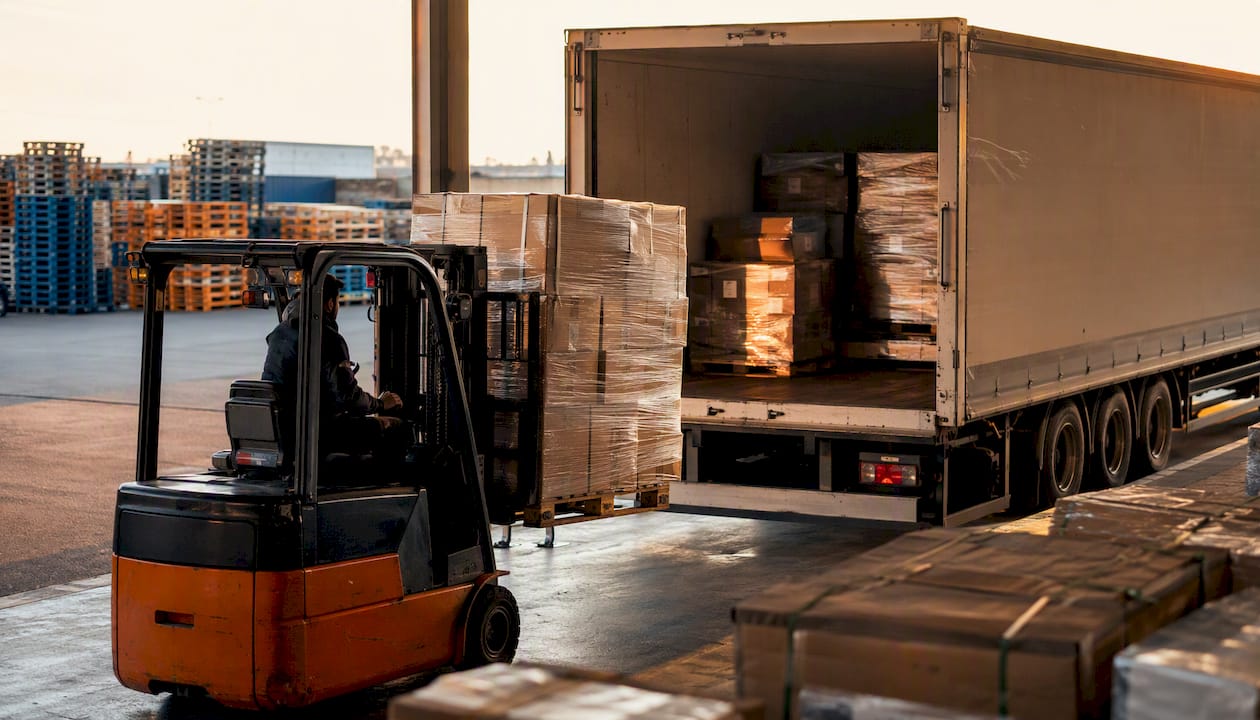
How to calculate an ETA for your shipment
ETA is a sum of components, not a single number a carrier gives you. The formula:
ETA = Goods-ready date + Export handling + Main carriage + Import handling + Inland delivery
Each component:
- Import customs clearance: 1–3 business days for a clean entry; 5–14 days if CBP selects the shipment for examination. ForwarderOne’s customs clearance timeline guide breaks down each step in detail.
Worked example: Shanghai → Los Angeles, FCL, sea freight
| Component | Days |
|---|---|
| Goods-ready to port (export handling) | 4 |
| Terminal dwell, Shanghai Port | 3 |
| U.S. customs clearance | 2 |
| Drayage, LA port → warehouse | 2 |
That’s the clean-run scenario. Add a blank sailing or a customs exam and you’re at 35–40 days without anything going seriously wrong.
Buffer guidance: add 7–14 days for sea freight in normal conditions, 14–21 days during peak season or around Chinese holidays. For air freight, a 2–5 day buffer is usually enough outside of peak periods.
Pro Tip: Run this calculation in a spreadsheet with your goods-ready date as the input. Update it each time a component changes. A live ETA tracker beats a static quote every time.
How ForwarderOne reduces transit-time uncertainty for China-to-U.S. shipments
ForwarderOne’s China-to-USA freight forwarding service covers air, sea, and express courier, all under a DDP structure that includes customs clearance, duties, and final delivery in a single workflow. For Amazon sellers, that means no separate customs broker, no surprise duty bills on arrival, and no cargo sitting at the port waiting for paperwork.
ForwarderOne achieves over 99% on-time delivery across its China-to-U.S. shipments, a figure that reflects both the DDP structure and the dedicated account manager model, where one person manages your shipment from pickup in China to delivery at the fulfillment center.
The FBA freight forwarding service handles FBA-specific requirements: FNSKU labeling, carton marking, and compliance with Amazon’s receiving requirements. That matters because a shipment rejected at the fulfillment center door adds 5–10 days and a re-delivery cost that erases any savings from a cheaper forwarder.
A typical small Amazon seller flow with ForwarderOne: goods are ready at a Shenzhen factory, ForwarderOne arranges pickup, handles export clearance, books the vessel or flight, manages U.S. customs entry under DDP, and delivers directly to the designated FBA fulfillment center. The seller tracks the shipment through a single account manager rather than coordinating between a factory, a freight broker, a customs broker, and a trucking company separately.
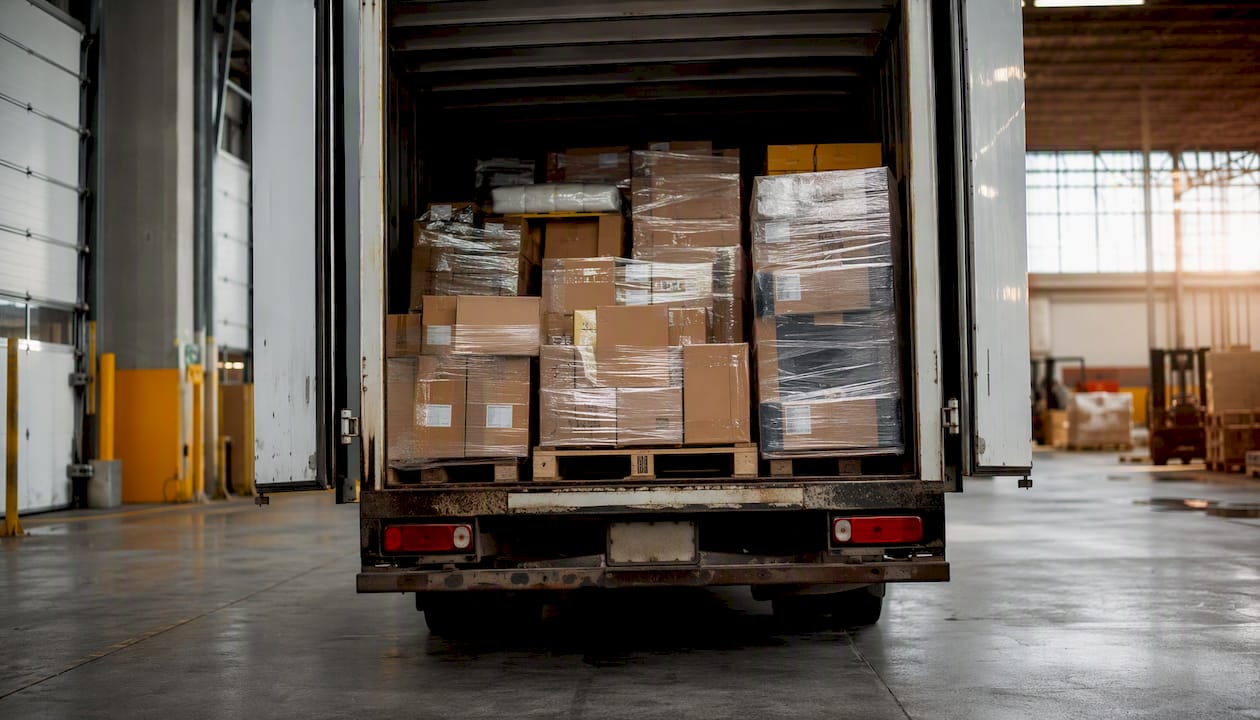
For sellers who want to understand the customs clearance component in detail before booking, ForwarderOne publishes a step-by-step breakdown of the customs clearance timeline for Amazon sellers, covering each stage from entry filing to final release.
Key Takeaways
Door-to-door shipping time from China to the U.S. typically ranges from 3–7 days (express courier) to 60+ days (LCL sea freight), and the gap between a quoted sailing time and actual delivery is where most planning errors occur.
| Point | Details |
|---|---|
| Express courier range | DHL, FedEx, and UPS deliver door-to-door in 3–7 days; best for samples and urgent parcels. |
| Air freight range | Door-to-door runs 5–14 days; cost-effective for time-sensitive inventory under 500 kg. |
| Sea freight FCL vs LCL | FCL takes 18–45 days door-to-door; LCL adds consolidation waits and can reach 25–60+ days. |
| Port-to-port vs door-to-door | A 14–18 day Shanghai-to-LA sailing commonly expands to 25–45 days once all handling steps are counted. |
| ForwarderOne DDP advantage | ForwarderOne’s all-in DDP service covers customs, duties, and FBA delivery with over 99% on-time delivery. |
The gap between a quoted transit time and what actually happens
Most shippers get burned the same way: they plan around the sailing time and forget everything else. The factory says “ready in two weeks,” the forwarder quotes “18 days to LA,” and the seller pencils in a delivery date 32 days from now. Then the vessel misses a cutoff, customs pulls the container for examination, and the shipment arrives 50 days after the goods-ready date.
The real problem isn’t that transit times are unpredictable. It’s that planners consistently undercount the components. Export handling, terminal dwell, customs clearance, and inland trucking are not edge cases. They happen on every shipment. The 14–18 day sailing is the middle of the journey, not the whole thing.
What actually works: build your ETA from the goods-ready date using the component formula in this guide, add a realistic buffer for the season, and use DDP to remove the most variable piece (customs clearance) from your control. Sellers who do this consistently hit their restock windows. Sellers who plan around the sailing time alone are the ones posting in Amazon seller forums about stockouts.
One more thing most guides skip: the East Coast routing penalty is real and often underestimated. If your fulfillment center is in New Jersey or Georgia, the extra 10–15 days compared to a West Coast delivery is a fixed cost of your supply chain. Either plan for it with earlier order cycles or use a West Coast port with inland trucking. Neither is wrong; both require an honest accounting of the full door-to-door time.
Need a clearer landed-cost plan?
ForwarderOne coordinates supplier pickup, DDP customs clearance, duty payment, FBA prep details, and final delivery under one shipment plan.