Customs clearance is defined as the period between a shipment’s arrival at a US port of entry and its official release by US Customs and Border Protection (CBP) after regulatory review and duty payment. For Amazon sellers and e-commerce importers, this window determines whether your inventory hits an FBA fulfillment center on schedule or sits in a warehouse eating into your margins. The customs clearance timeline explained here covers every stage of the process, from manifest filing through final release, with real numbers for each shipment type. Understanding this process is the difference between stocking out during peak season and maintaining healthy inventory levels year-round.
What are the key steps in the customs clearance process?
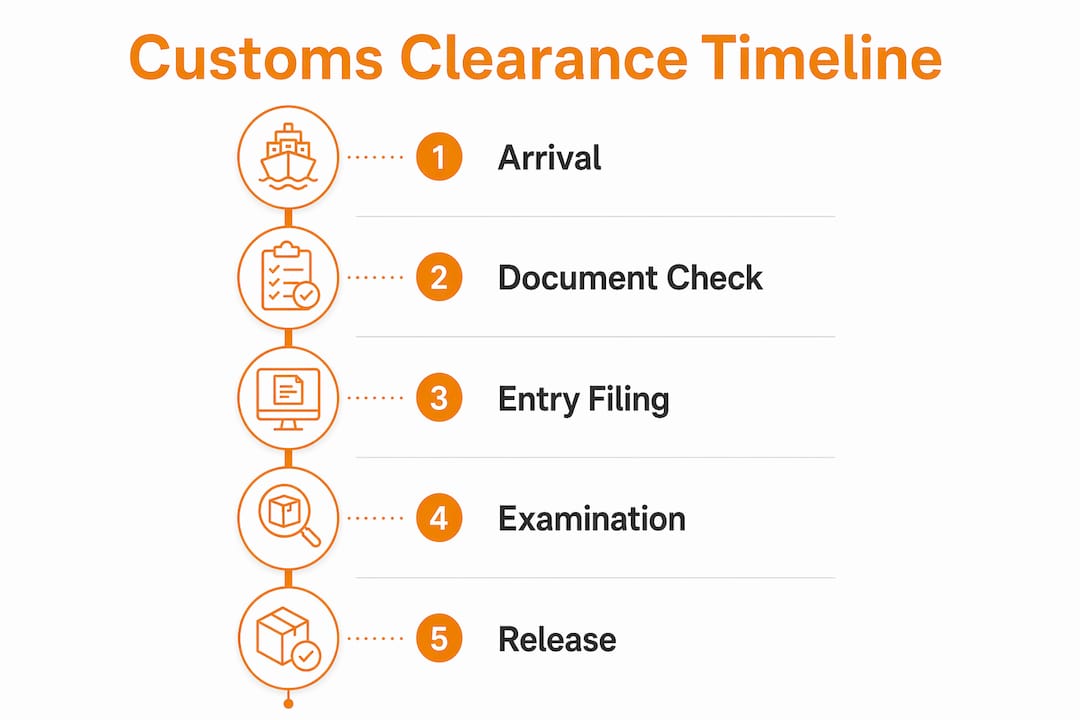
The customs clearance process follows a structured six-step sequence: manifest filing, ISF match, entry filing, exam selection, duty payment, and release. Each step adds time to your total clearance window, and a failure at any single stage can stall the entire shipment.
Here is how each step works in practice:
- Manifest filing. The carrier submits the cargo manifest to CBP before the vessel or aircraft arrives. For ocean freight, this happens 24 hours before loading at the foreign port. For air cargo, it is filed four hours before arrival.
- Importer Security Filing (ISF). Ocean shipments require an ISF 10+2 filing submitted at least 24 hours before loading. Missing this deadline triggers penalties up to $5,000 per violation and raises your inspection risk significantly.
- Entry filing via ACE. Your customs broker submits the formal entry through CBP’s Automated Commercial Environment (ACE) portal. This includes your commercial invoice, packing list, bill of lading, and HS code classification.
- Exam selection. CBP’s automated targeting system reviews the entry and assigns a risk score. Most shipments receive an administrative review only. A smaller percentage get flagged for X-ray or physical inspection.
- Duty and tax payment. Once CBP approves the entry, duties and applicable taxes must be paid before release is granted.
- Final release. CBP issues the release notification, and your freight forwarder or broker coordinates delivery to your warehouse or FBA center.
Pro Tip: Pre-filing your ACE entry at least 24 hours before arrival is the single highest-leverage action you can take. Pre-arrival declarations submitted 48 hours ahead clear 45% faster than those filed on arrival.
The step most sellers underestimate is exam selection. CBP does not announce its targeting criteria, but incomplete documentation and unfamiliar importers consistently draw higher scrutiny. Your first few shipments from a new supplier carry more risk than your tenth.

How long does customs clearance take by shipment type?
Clearance times vary widely depending on how your goods travel and whether your paperwork is complete. The table below shows typical median timelines under normal conditions.
| Shipment Type | Typical Clearance Time | Key Condition |
|---|---|---|
| Express courier (DHL, FedEx, UPS) | 24–72 hours | Automated processing, pre-filed data |
| Air cargo | 4–24 hours with pre-filing; 1–3 days if issues arise | Entry filed before arrival |
| Ocean FCL (full container) | 2–5 business days | Complete documentation |
| Ocean LCL (less than container) | 3–7 business days | Consolidation adds time at deconsolidation depot |
| Low-value commercial cargo | Depends on entry process and customs review | Formal or eligible informal entry; applicable duties and fees |
| CBP intensive physical exam | 5–15+ business days | Container unloaded, lab testing possible |
Standard ocean freight clears in 1–5 business days when entries are pre-filed and documentation is complete. Air cargo with pre-filed entries typically clears in 4–24 hours. These are best-case numbers. Any request for additional documentation or a hold notification resets the clock.
Duty-free de minimis treatment for covered commercial imports from all countries has been suspended since August 29, 2025. For non-postal shipments, arrange an appropriate formal or eligible informal entry and budget applicable duties and fees. See CBP’s suspension instructions and the rule effective June 24, 2026. Do not use historical automated de minimis clearance times to forecast a current shipment.
Physical intensive examinations are the worst-case scenario. They require the container to be fully unloaded, inspected item by item, and sometimes sent for lab testing. The cost of an intensive exam ranges from $200 to over $5,000 in unexpected fees, on top of the 5–15 business day delay. Budget for this contingency before your first ocean shipment.
What causes delays in customs clearance?
Delays in customs clearance are rarely random. They are almost always caused by paperwork inaccuracies or documentation gaps. Knowing the specific triggers lets you eliminate most of them before your shipment leaves the factory.
The most common causes of delay include:
- Inaccurate commercial invoices. The declared value, product description, and country of origin must match exactly what is in the container. Discrepancies trigger manual review.
- Wrong HS codes. An incorrect Harmonized System code can result in the wrong duty rate, a compliance flag, or an automatic hold. Use the CBP online tools or a licensed broker to verify codes before filing.
- Late or missing ISF filings. Filing the ISF after the 24-hour deadline or not at all is one of the fastest ways to generate a $5,000 penalty and a guaranteed exam flag.
- Missing packing lists. CBP cross-references the packing list against the manifest. A missing or incomplete list creates a documentation mismatch that requires manual resolution.
- No pre-filing of entry documents. Shipments where the entry is filed after arrival wait in queue behind pre-filed entries. This alone can add one to three days to your clearance time.
- Slow response to hold notifications. When CBP issues a hold, the clock keeps running. Uploading requested documentation within 12–24 hours of the hold notification reduces total detention time by multiple days.
Pro Tip: Work with a licensed customs broker who specializes in your product category. A broker familiar with accurate HS code classification will catch errors before they reach CBP, not after.
The pattern here is clear. Every delay on this list is preventable with preparation. Sellers who treat documentation as an afterthought pay for it in detention fees and stockouts.
How can sellers proactively manage customs timelines?
Proactive management of your customs timeline means building compliance into your shipping workflow, not reacting to problems after they appear. These steps apply whether you are shipping one container or ten per month.
- Pre-file ACE entries 24 hours before arrival. Pre-filing is the most direct way to cut clearance time. Entries filed 48 hours ahead clear up to 45% faster and face lower inspection rates. Build this into your standard operating procedure with your broker.
- Monitor cargo status at 24, 48, and 72 hours post-arrival. Check the ACE portal regularly. If a hold appears, respond immediately. Checking the ACE portal regularly allows timely issue resolution before minor holds become multi-day delays.
- Maintain digital archives of all shipping documents. Keep commercial invoices, packing lists, bills of lading, and supplier certificates organized and accessible. CBP audits can happen months after clearance, and missing records create compliance problems.
- File the Entry Summary (Form 7501) within 10 days of release. Post-release compliance is a step many sellers miss. Filing Form 7501 within 10 days and paying duties on time protects your importer record and avoids penalties that affect future shipments.
- Build inspection contingencies into your supply chain calendar. If your ocean shipment has a 5-day standard clearance window, plan for 15 days when setting FBA restock deadlines. This buffer prevents stockouts during Q4 when inspection rates tend to rise.
- Use a freight forwarder with customs brokerage capabilities. A forwarder who handles both freight and customs clearance steps in one workflow eliminates the communication gaps that cause most preventable delays.
Integrating customs planning into your overall supply chain calendar is the step that separates sellers who consistently hit their restock dates from those who scramble every cycle. Treat customs clearance as a scheduled phase with a known duration, not an unpredictable black box.
Key takeaways
Customs clearance timelines are predictable and manageable when sellers pre-file documentation, use accurate HS codes, and respond to CBP holds within 24 hours.
| Point | Details |
|---|---|
| Pre-filing cuts clearance time | ACE entries filed 48 hours before arrival clear up to 45% faster than post-arrival filings. |
| Shipment type sets the baseline | Express couriers clear in 24–72 hours; ocean FCL takes 2–5 days; intensive exams add 5–15+ days. |
| Documentation errors cause most delays | Inaccurate invoices, wrong HS codes, and missing packing lists trigger the majority of preventable holds. |
| Post-release compliance matters | Filing Form 7501 within 10 days of release protects your importer record and avoids future penalties. |
| Inspection contingency is non-negotiable | Budget $200–$5,000 in unplanned fees and 15 days of buffer time for any ocean shipment. |
The part of customs clearance nobody talks about
Most sellers I work with come in focused on transit time. They want to know how many days from the factory to the FBA warehouse. What they do not account for is that customs clearance is not a single event. It is a sequence of decisions made by CBP, and each decision point is an opportunity for delay if your paperwork is not airtight.
The mistake I see most often is treating the commercial invoice as a formality. Sellers copy a template from their supplier, change the dollar amount, and call it done. CBP’s automated targeting system flags inconsistencies between the invoice value, the declared HS code, and the historical pricing data for that product category. A $500 discrepancy on a $10,000 shipment can trigger a full physical examination. That exam costs you two weeks and potentially thousands in fees.
The other thing sellers consistently underestimate is the value of a customs broker who knows your product. Generic brokers file entries. Specialized brokers catch problems before they reach CBP. For Amazon sellers shipping consumer goods from China, the difference in clearance outcomes between a generalist and a specialist broker is measurable in days per shipment.
My honest recommendation: stop viewing customs clearance as a cost center and start treating it as a performance metric. Track your average clearance time per shipment mode. If your ocean shipments are averaging seven days instead of three, something in your documentation workflow is broken. Fix the process, not just the individual shipment.
— Keven
Ship smarter with ForwarderOne DDP customs solutions
Customs delays cost Amazon sellers more than time. They cost ranking, revenue, and customer trust during the periods when stock availability matters most.
ForwarderOne handles the entire customs clearance workflow for small and mid-sized Amazon sellers shipping from China, Korea, and Mexico to US fulfillment centers. The all-inclusive DDP freight forwarding service covers duties, customs brokerage, and delivery in a single workflow, so you never face surprise fees or missed filing deadlines. With over 99% on-time delivery and a dedicated account manager on every shipment, ForwarderOne gives you the clearance predictability your FBA restocking schedule requires. Explore FBA shipping solutions built specifically for sellers who cannot afford to wait.
FAQ
What does “customs clearance timeline” mean?
The customs clearance timeline is the time between arrival and release by CBP. It depends on the permitted entry process, document readiness, duty arrangements and any examination or other agency review. Historical automated de minimis timings do not apply to the suspended commercial process.
How long does customs clearance take for ocean freight?
Standard ocean freight clears in 1–5 business days when documentation is complete and the entry is pre-filed. LCL shipments may take 3–7 days due to consolidation handling at the deconsolidation depot.
What is the fastest way to clear customs in the US?
Pre-filing your ACE entry at least 48 hours before arrival is the most effective method. Pre-arrival declarations filed 48 hours ahead clear up to 45% faster than those submitted after the shipment arrives.
What triggers a customs hold or inspection?
CBP holds are most commonly triggered by inaccurate commercial invoices, incorrect HS codes, missing ISF filings, and value discrepancies between the declared invoice and market pricing data. First-time importers and new supplier relationships also carry higher inspection risk.
Do I need a customs broker as an Amazon seller?
A licensed customs broker is not legally required for all shipments, but it is strongly recommended for ocean freight and any shipment valued over $2,500. Brokers who specialize in e-commerce and FBA imports reduce clearance times and catch documentation errors before they reach CBP.
Need predictable customs clearance?
Share your product category, HTS questions, supplier documents, shipment mode, and Amazon destination. ForwarderOne will plan the customs, duties, and delivery workflow before pickup.