Any poly bag with an opening of 5 inches or more when measured flat needs a suffocation warning under most retailer and state rules, and the same threshold applies to bags thinner than 1.5 mil. The safest default: print the long-form CPSC-style warning in legible type sized to your bag dimensions, and buy or spec bags at 1.5 mil or thicker whenever your product allows it. That combination clears Amazon’s requirements, satisfies most state statutes, and avoids the re-bagging fees that eat into margin.
TL;DR:
- Ensure all poly bags with a flat opening of 5 inches or more or thinner than 1.5 mil include a long-form suffocation warning in legible size and placement.
- Use a measurement method based on the L+W calculation and verify thickness with supplier documentation before ordering.
- Implement a unified packaging standard across all marketplaces that includes warning size, text, placement, and material thickness to avoid multiple rework efforts.
- Pre-printed warning bags or adhesive labels are the fastest compliance options, but always confirm specifications before mass production.
- Building packaging compliance into your inbound logistics process helps prevent delays, re-bagging fees, and inventory holds at fulfillment centers.
Does Your Poly Bag Need a Suffocation Warning?
The math is simpler than most sellers assume. Lay the bag flat and measure the opening. If it hits 5 inches or wider, a warning is expected under Amazon’s FBA packaging guidance and under most other retailers’ internal policies. Suppliers who quote dimensions differently sometimes use the length-plus-width (L+W) method instead, so if your 12x9 bag reads “21 L+W,” that’s the number your font-size bracket will key off later.
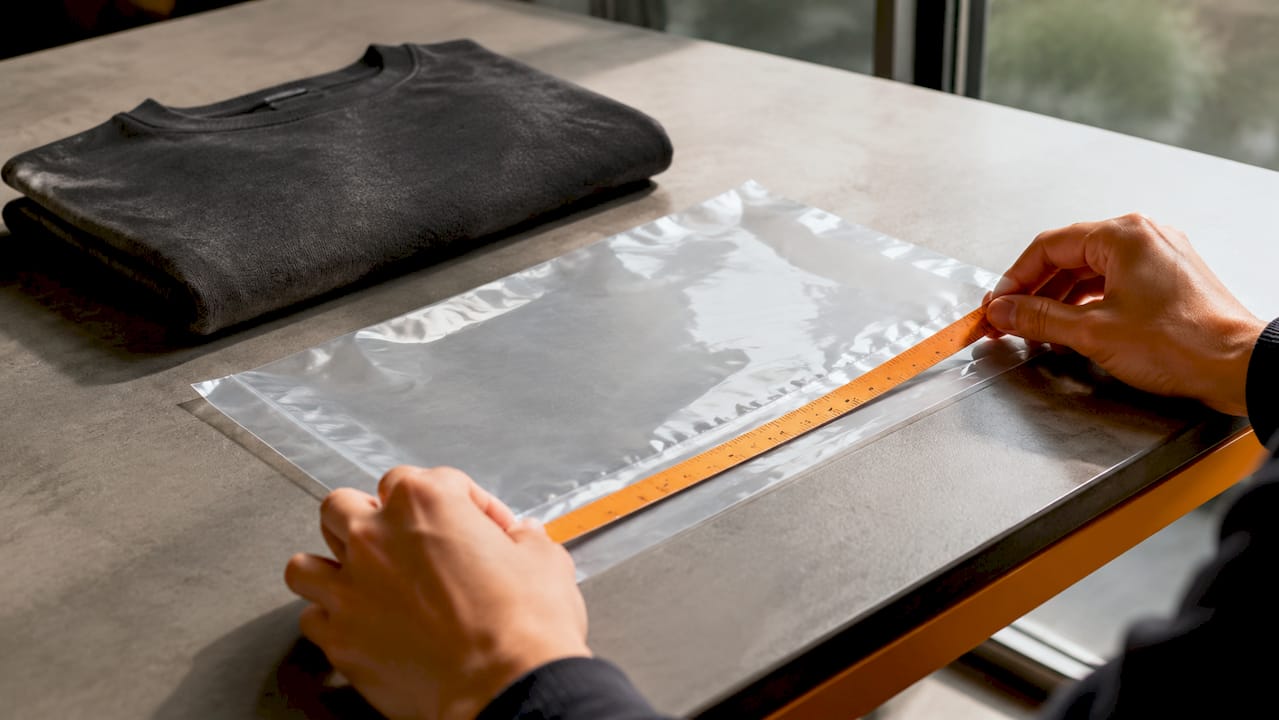
Thickness matters just as much as the opening. Bags under 1 mil draw the most scrutiny from state statutes, while bags at 1.5 mil or thicker sidestep many of those triggers entirely. Ask your supplier for a mil-thickness spec sheet before ordering, not after a shipment gets flagged.
A quick classification checklist for each SKU:
- Measure the opening flat, not stretched.
- Record L+W as a backup measurement for supplier quoting.
- Confirm mil thickness against the supplier’s spec sheet, not just the invoice description.
- Flag anything at 1 mil or below or with a 5-inch-plus opening as “warning required.”
What to Print, and How Big the Text Needs to Be
Most sellers overcomplicate the wording. The long-form CPSC-style warning is the safest universal choice: “WARNING: To avoid danger of suffocation, keep this plastic bag away from babies and children. Do not use this bag in cribs, beds, carriages, or playpens. This bag is not a toy.” A shorter version, something like “Warning: Keep Away From Children. This Bag Is Not a Toy,” works for smaller mailers where full text won’t fit legibly, but it’s less broadly accepted across states than the long form.
Font size scales with bag dimensions using L+W brackets:
- L+W under 30 inches: minimum 10 point type.
- L+W 30 to 40 inches: minimum 14 point type.
- L+W 40 to 60 inches: minimum 18 point type.
- L+W over 60 inches: minimum 24 point type, sometimes larger for oversized poly mailers.
Placement rules follow a similar logic. The warning needs to sit somewhere prominent and unobstructed, typically on the front or a top corner near the opening, and large bags (generally L+W over 40 inches) should repeat the warning roughly every 20 inches along the bag’s length. Bilingual text (English/Spanish) isn’t federally mandated, but some retailers and a handful of state guidance documents, including Massachusetts’s technical rules, favor it for consumer-facing packaging.
How Amazon, Walmart, and Target Rules Compare
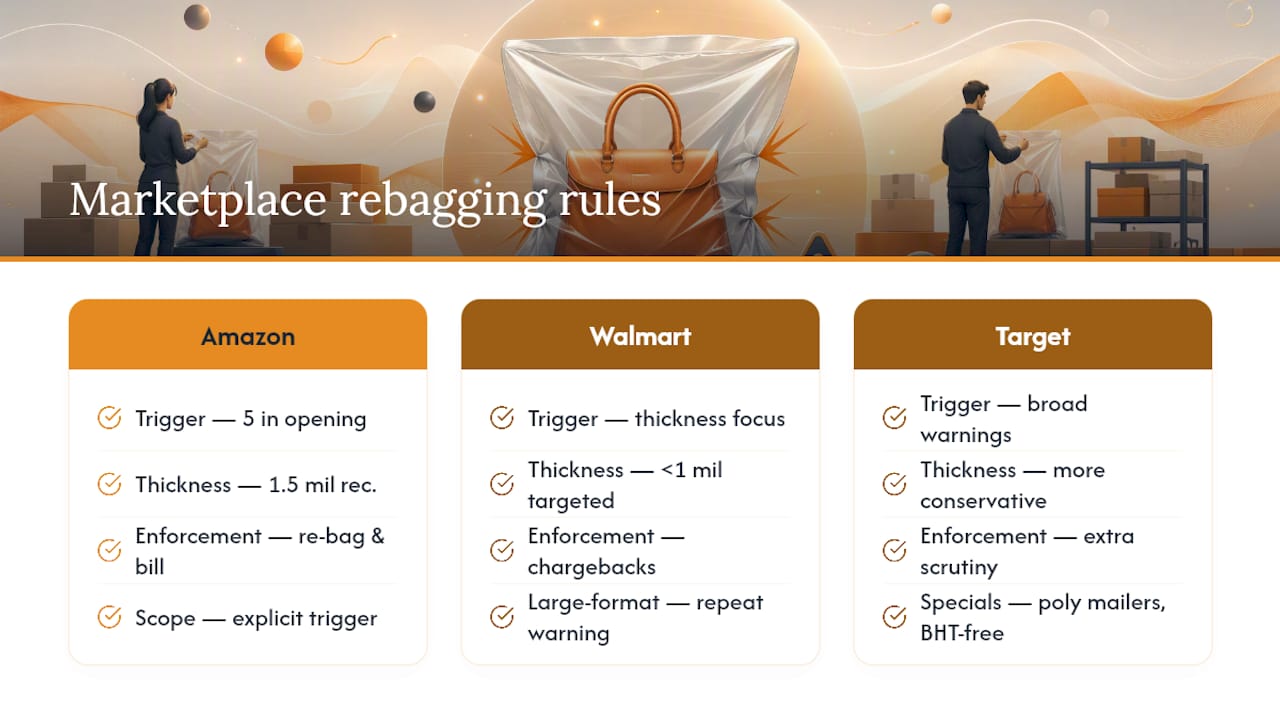
Sellers shipping across multiple marketplaces run into a frustrating reality: each retailer enforces its own version of the same basic rule, and the penalties differ. Amazon is the most explicit about its trigger. Any poly bag with a 5-inch or larger opening measured flat requires the warning, and Amazon recommends 1.5 mil as a practical thickness floor. Miss it, and the fulfillment center will re-bag your inventory and bill you for the labor, which is one of the more common inbound headaches for FBA sellers.
Walmart tends to focus enforcement on bags under 1 mil and adds a repeat-warning expectation for large-format bags, with chargebacks as the penalty rather than a straightforward re-bagging fee. Target’s expectations run more conservative across the board, applying warning requirements broadly and adding extra scrutiny for poly mailers and BHT-free film claims.
The unified spec that clears all three: long-form warning text, 1.5 mil minimum thickness, font sized to the strictest bracket for your bag’s L+W, and repeated placement on anything over 40 inches. Build to that spec once instead of reworking packaging per channel.
Which States and Cities Require Suffocation Warnings by Law?
Here’s something a lot of sellers get backward: there’s no single federal law requiring suffocation warnings on plastic bags. Instead, five states, California, Massachusetts, New York, Rhode Island, and Virginia, have their own statutes, each with its own scope and, in some cases, its own approved wording.
Virginia’s statute is the most specific example on the books. Virginia Code § 18.2-320 targets plastic bags used for freshly cleaned clothing, specifically bags 25 inches or longer and under 1 mil thick, and requires the warning in type no smaller than 36 point.
Notice what that statute doesn’t cover: a standard 1.5 mil polybag used for shipping a t-shirt or a phone case. Most seller compliance problems trace back to retailer policy, not state statute, precisely because thicker fulfillment-grade bags fall outside these state triggers.
Where to Buy Compliant Poly Bags or Add the Warning Yourself
You’ve got three practical paths, and the right one depends on volume and timeline. Pre-printed bags with the warning baked in are the fastest fix, especially for sellers who don’t need custom branding on the bag itself. Custom-printed bags cost more per unit and need longer lead times, but they let you fold the warning into your brand’s packaging design instead of bolting it on.
Adhesive labels solve the urgent-fix problem. If you already have a container of unprinted bags sitting in a warehouse, slapping on pre-printed warning labels is often cheaper than tossing the inventory or waiting on a reprint run.
- Pre-printed bags: fastest compliance, minimal design flexibility.
- Custom printing (flexo or screen): best for brand integration, needs longer lead time and higher minimums.
- Adhesive labels: ideal for low-MOQ runs or fixing existing stock fast.
- Always request a printed sample before mass production to confirm legibility at your chosen font size.
Your Compliance Checklist Before You Ship to FBA
Running this checklist before a shipment leaves your supplier’s dock saves far more time than fixing it after a fulfillment center flags it.
- Measure the bag’s opening flat and record the L+W total on your SKU spec sheet.
- Confirm mil thickness against the supplier’s documentation, not just the packing list.
- Choose long-form warning text and set font size using the correct L+W bracket.
- Pick your procurement path (pre-printed, custom, or adhesive label) and write the exact spec into your purchase order.
- Request timestamped photos of the printed bag before mass production, and keep the supplier’s confirmation on file.
- If a shipment gets flagged for re-bagging or a chargeback, use those photos and the PO spec to dispute it with the retailer.
Pro Tip: Keep one master spec sheet across every SKU that lists opening size, L+W, mil thickness, and warning status. When a supplier swaps material without telling you, that sheet is the fastest way to catch it before the shipment reaches an FBA fulfillment center.
Why Packaging Compliance Is an Inbound Logistics Problem, Not Just a Legal One
Non-compliant inner packaging rarely shows up as a legal fine. It shows up as a delay. A fulfillment center pulls a pallet, finds bags without the correct warning or below the thickness threshold, and re-bags the entire shipment before it’s stowed, which adds days and fees to what should have been a routine inbound delivery.
Sellers who avoid this treat packaging as part of their shipping workflow, not a separate afterthought handled by whoever placed the print order. A pre-shipment packaging audit, checking bag dimensions, thickness, and warning text against the retailer’s spec before the shipment leaves the origin warehouse, catches the problem while it’s still cheap to fix.
Practical mitigations worth building into any DDP shipping workflow:
- Require supplier photo verification of printed bags before mass production.
- Add a packaging spec line item to every purchase order, not just a verbal instruction.
- Run a physical audit at the consolidation warehouse before containers load, not after arrival.
- Flag mismatched thickness or missing warnings before customs clearance, when fixes are still cheap.
An Editorial Take on Getting This Right the First Time
Most compliance advice treats each retailer’s rulebook as a separate project. That’s backward, and it’s the single biggest reason sellers keep getting hit with re-bagging fees on repeat SKUs. The smarter move is building one packaging spec that clears the strictest requirement across every channel you sell on, then applying it everywhere, even to inventory headed for a marketplace with looser enforcement.
The conventional advice, “check each retailer’s policy before you print,” isn’t wrong, but it treats compliance as a paperwork exercise instead of a supply chain decision. The real cost of a poly bag suffocation warning mistake isn’t a fine. It’s the week your inventory sits in re-bagging limbo during a demand spike.
Prioritize thickness and measurement accuracy first. Font size and wording are easy to fix on a reprint; a bag that’s the wrong mil thickness or the wrong opening width means the whole batch gets flagged, not just the label. Get the physical spec right before you worry about which exact sentence to print.
— Keven
How ForwarderOne Helps You Avoid Packaging Delays at the Border
Packaging problems rarely surface until your shipment is already at a fulfillment center, and by then, the fix costs time you don’t have. ForwarderOne builds packaging spec checks directly into its DDP workflow, catching mismatched thickness, missing warnings, or illegible font sizes before your container ever clears customs, not after a retailer flags the pallet.
That’s the practical advantage over handling compliance separately from shipping: one dedicated account manager reviewing both your freight and your packaging spec means fewer surprises at the fulfillment center. Sellers moving inventory from China to US warehouses can add a pre-shipment packaging audit to an existing freight quote rather than managing it as a separate vendor relationship. If you’re prepping a shipment for FBA and want packaging compliance folded into your inbound logistics, request a quote and ask for the packaging-compliance check to be included in your DDP workflow.
Sources
- § 18.2-320. Sale, etc., of plastic bags; warning required
- What are poly bag suffocation requirements? | EcoEnclose help
- Amazon FBA packaging and prep guidance (Seller Central)
- Can You Explain Plastic Bag Suffocation Warning Requirements? | PackagingLaw
- 105 CMR 630.000: Plastic Bags and Plastic Film (Massachusetts)
FAQ
What Are the Requirements for a Suffocation Warning on a Poly Bag?
A warning is generally required when the bag’s opening measures 5 inches or more flat, or when the material is thinner than 1 mil under several state statutes. The safest spec uses long-form CPSC-style wording, 1.5 mil or thicker material, and font size scaled to the bag’s L+W measurement.
Where Can I Find Clear Poly Bags With a Suffocation Warning?
Pre-printed compliant bags are available through most poly bag suppliers and can typically ship faster than custom-printed options. For low-volume or urgent fixes, adhesive warning labels applied to existing unprinted stock are a practical stopgap.
What Happens When You Breathe In a Plastic Bag?
A thin plastic bag can seal against the nose and mouth, blocking airflow and cutting off oxygen quickly, which is why children are especially at risk. This is the underlying safety concern behind every suffocation warning statute and retailer policy.
What Size Bag Needs a Suffocation Warning From Amazon?
Amazon requires the warning on any poly bag with an opening of 5 inches or more when measured flat. Non-compliant bags can be re-bagged at the fulfillment center at the seller’s expense, so measuring correctly before shipment matters more than fixing it after a flag.
Need packaging compliance checked before FBA pickup?
ForwarderOne can review poly bag specs, FNSKU labels, carton counts, prep photos, customs paperwork, and final-mile delivery requirements before your China or Korea shipment leaves the origin warehouse.