
Solo sellers avoid customs mistakes by treating customs accuracy as an operational discipline, not paperwork you get to later. One transposed HS code or an undervalued invoice can freeze a shipment for weeks and trigger penalties that erase a season’s margin. Here’s what to do in the next 24 to 72 hours:
- Verify HTS/HS codes for your top five SKUs against the actual product specs, not what your supplier typed on the invoice.
- Pull your paperwork templates and confirm they list country of origin, unit value, and full product descriptions.
- Decide DDP or DDU for your next shipment before you book it, not after it gets held.
Pro Tip: Get these three things right and you’ll see fewer inspection holds, a landed cost you can actually price against, and none of the “surprise $200 duty bill” messages that turn a happy buyer into a refund request.
Key Takeaways
Solo sellers who verify HS codes, standardize invoices, and choose DDP for complex shipments avoid the delays and penalties that stall inventory and erode customer trust.
| Point | Details |
|---|---|
| Verify HS codes yourself | Classify from material composition and function, not the code your supplier hands you. |
| Standardize your paperwork | Use consistent invoice and packing list templates with matching quantities and values. |
| Know your liability | The party named as importer of record remains responsible even when a broker files the entry. |
| Act fast on errors | Contact your broker promptly and ask which correction or disclosure process fits the entry. |
| Scale with a managed DDP partner | ForwarderOne verifies classification and handles formal entry as shipment volume and complexity grow. |
Why Customs Accuracy Matters for Solo Sellers
A wrong customs value or a copied HS code doesn’t just risk a fine. It stalls inventory you already paid for, racks up broker correction fees, and can suppress your listings while stock sits in a bonded warehouse instead of your fulfillment center. For a solo seller running lean cash flow, a two-week hold during Q4 can mean missing the buying window entirely.
CBP requires complete and accurate entry information before goods clear for release. Missing or inconsistent data can trigger document requests, review, storage costs, and broker work to correct the entry.
A single mismatched HS code on a commercial invoice can cascade into a formal entry review, a multi-week customs hold, and a retroactive duty bill, because customs treats the discrepancy as a red flag for the entire shipment, not just one line item.
Picture a seller shipping silicone kitchen tools who reuses last year’s HS code after switching suppliers to a slightly different material blend. Customs flags the mismatch, the shipment sits, and the correction process alone can take longer than the original transit time.
Common Customs Mistakes Solo Sellers Make (And the Fix for Each)
Most customs problems trace back to a short list of repeat offenders. Fix these and you eliminate the majority of your risk.
-
Incomplete or inconsistent commercial invoice. A missing unit price, vague product description, or mismatched quantities between invoice and packing list is an automatic flag. Fix: require your supplier to itemize every SKU with a specific description, unit value, and total value that matches your purchase order exactly.
-
Copied or guessed HS/HTS codes. Suppliers often hand you a code they use for a similar product, not your actual product. HS codes determine both duty rate and regulatory treatment, so a wrong digit can change your duty rate or trigger an entirely different set of import rules. Fix: classify from the product’s actual material composition and function, not the supplier’s paperwork.
-
Missing or incorrect country of origin. This affects duty rate directly, especially with layered tariffs on goods from specific countries. Fix: confirm origin at the factory level, not the trading company level, since goods sometimes pass through multiple countries before you see them.
-
Undervalued declared value. Declaring a lower value to reduce duty is a real liability, not a savings hack. Customs can reassess value and assess penalties on top of back duties. Fix: declare the actual transaction value shown on your paid invoice.
-
Wrong Incoterms. Confusing who’s responsible for duties and clearance between buyer and seller creates disputes and clearance delays. Fix: state Incoterms explicitly on every commercial document, not just your freight quote.
-
Missing regulatory paperwork for restricted goods. Cosmetics, supplements, electronics with batteries, and food-adjacent items often need extra documentation. The FDA requires specific entry documentation for regulated products, and skipping it stops your shipment cold regardless of how clean the rest of your paperwork is. Fix: check FDA or relevant agency requirements before you place a supplier order, not after the goods ship.
-
Missing entry paperwork for small parcels. Duty-free de minimis treatment for covered commercial imports from all countries has been suspended since August 29, 2025. For non-postal shipments, arrange an appropriate formal or eligible informal entry and budget applicable duties and fees. See CBP’s suspension instructions and the rule effective June 24, 2026. Product restrictions and other requirements can affect informal-entry eligibility. Confirm the entry type and any bond before shipping.
Even a transposed HS digit can route a shipment to the wrong tariff provision. The practical control is simple: compare the final entry classification with the approved product-level code record before filing.
Who’s Legally Responsible, and Why Incoterms Change Everything
The party named as importer of record carries responsibility for accurate entries even when a broker files the paperwork. A broker can advise and file, but the importer should still review the entry data and keep the supporting records.
Duties get calculated from a few layered factors:
- The HS/HTS code, which sets the base tariff rate.
- The declared customs value, based on your actual transaction price.
- Add-on tariffs like Section 301 or Section 232 measures, plus any antidumping or countervailing duties that apply to specific product and country combinations.
| Factor | DDP (Delivered Duty Paid) | DDU (Delivered Duty Unpaid) |
|---|---|---|
| Who pays duties | Seller, prepaid before delivery | Buyer, often at the door |
| Importer of record | Usually the DDP provider or seller | Often the buyer, or seller by default |
| Customer experience | No surprise fees | Buyer may face unexpected charges |
| Common pitfall | Choosing an unreliable DDP partner | Buyer refuses delivery, return costs the seller |
Pre-calculating duties and choosing DDP removes the buyer-facing surprise that kills repeat purchases, which matters more for a solo brand than a marketplace giant with review volume to absorb the occasional bad experience. If you’re deciding between the two models for FBA shipments, DDP shipping mechanics are worth understanding before your next order ships.
Practical Controls to Put in Place Right Now
You don’t need an ERP system to fix most of this. You need a handful of disciplined habits applied consistently to every SKU.
- Build a product-level HS code database. One line per SKU, with the code, the reasoning behind it, and the date you confirmed it.
- Standardize your commercial invoice template with required fields: full product description, material composition, unit value, total value, and country of origin.
- Create a packing list template that matches invoice quantities line for line, no exceptions.
- Reconcile unit values against your actual purchase price before every shipment, not just the first one.
- Keep a landed-cost spreadsheet per SKU that includes duty, freight, and broker fees, so your pricing reflects reality instead of guesswork.
Pro Tip: Don’t accept your supplier’s HS code as fact. Ask for the material composition breakdown or spec sheet and classify the product yourself, or have a broker do it. Suppliers optimize for shipping speed, not your duty liability.
A simple pre-shipment validation step, checking the invoice against the HS database before goods leave the factory, catches most errors before they become customs holds. That single habit, applied to every shipment, prevents more problems than any software purchase.
If You Discover a Customs Error
Stop shipments of the affected SKU immediately, then gather your documentation before you contact anyone.
- Pull the original commercial invoice, packing list, and the broker’s filed entry to see exactly where they diverge.
- Contact your customs broker first. They can often identify whether the error is a documentation fix or a classification issue requiring formal correction.
- If the error involves misclassification or valuation, ask your customs broker or trade counsel which post-entry correction or disclosure procedure is appropriate.
- Pay any owed duties promptly once the correction is filed. Delayed payment compounds the problem with interest and can flag future shipments for extra scrutiny.
Call your broker the moment you notice a discrepancy, not after your next shipment leaves. Acting first, before CBP flags it, is consistently what limits both the penalty and the delay.
How Successful Solo Sellers Scale Their Compliance
Treat customs as a discipline that grows with your shipment volume, not a task you solve once. Sellers who avoid recurring errors typically follow a staged path:
- Start with a customs broker to learn the classification process and build your product-level HS database from their filings.
- Document every classification decision and the reasoning behind it, so you have a record if CBP challenges it later.
- Automate validation for repeat SKUs once your catalog stabilizes, checking new POs against your existing code database.
- Move to a DDP or managed partner once you cross real thresholds: more than four to six imports a month, multi-country VAT exposure, or rising correction fees eating into margin.
Recognizing when DIY clearance has been outgrown before it costs you a bad quarter is the actual skill here, not the classification itself.
What Sellers Wish They’d Known Sooner
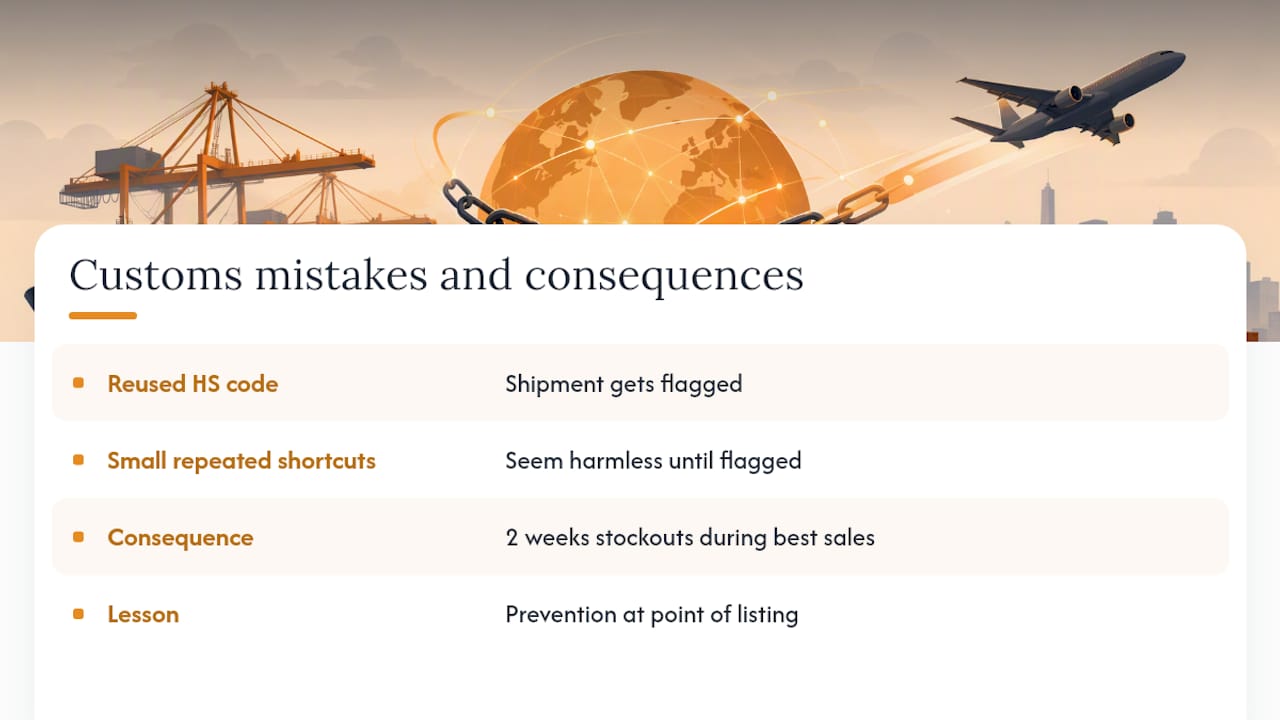
The mistakes that hurt most aren’t the dramatic ones. They’re the small, repeated shortcuts, like reusing an old HS code after your supplier quietly changed materials, that seem harmless until a shipment gets flagged. The financial hit is real, but the bigger cost is the two weeks of stockouts during your best sales period. Prevention at the point of listing, not correction after a hold, is the lesson that sticks.
How a Managed DDP Partner Removes Customs Risk
A managed DDP service reduces clearance mistakes by verifying classification and paperwork at origin, before your goods ever reach the port, instead of catching errors after a hold already started.
ForwarderOne coordinates classification inputs, duty estimates, customs clearance, shipment paperwork, and delivery through one managed workflow. The shipping plan should identify the importer of record, bond arrangement, and document responsibilities before pickup.
A dedicated account manager can review shipment inputs and surface missing paperwork before cargo moves. If you’re moving inventory from China or Korea into U.S. or Mexico fulfillment centers, start by pulling your product specs, supplier invoices, and current HS codes together, then request a shipping quote to see where a DDP setup would change your landed cost.
Frequently Asked Questions
Why do solo sellers avoid customs mistakes more carefully than larger companies? Solo sellers run on tighter cash flow and thinner staffing, so a single customs hold hits inventory availability and revenue harder than it would for a company with buffer stock and dedicated compliance staff.
What’s the fastest way to avoid customs issues as a solopreneur? Build a product-level HS code database confirmed against actual material specs, standardize your invoice template, and pre-calculate duties before you ship, not after a shipment gets flagged.
How do solo sellers manage customs without hiring full-time staff? Most start with a broker to learn classification, document their reasoning for each code, then move to a DDP or managed partner once shipment volume or complexity grows past what manual review can handle.
What happens if I use the wrong HS code on my shipment? A wrong code can trigger a formal entry review, a multi-week hold, and a corrected duty bill, sometimes at a significantly higher rate than what you originally paid.
Is DDP worth it for a solo seller shipping small volumes? DDP can reduce buyer-facing surprise fees and place clearance coordination in one shipping plan. Confirm the named importer of record, classification inputs, duty assumptions, and exclusions in the quote before deciding whether it fits your volume.
Avoid customs delays before they cost margin
ForwarderOne coordinates DDP customs clearance, duty estimates, shipment paperwork, FBA labeling, and final-mile delivery so solo sellers can keep inventory moving.