
A pre-shipment checklist covering correct HTS codes, a complete commercial invoice and packing list, timely ISF filing, and an FBA-aware customs broker prevents the vast majority of U.S. customs delays for Amazon FBA shipments.
Before you place your next PO, confirm every item below:
- Correct HTS code verified at the 10-digit level for every product in the shipment
- Commercial invoice and packing list complete with unit values, country of origin, currency, Incoterm, and EIN for the importer of record
- ISF filed at least 24 hours before vessel departure for all ocean shipments (late filing carries penalties up to $5,000 per violation)
- Licensed customs broker engaged before cargo is packed, not after it departs
- Accurate importer of record data with a valid EIN — Amazon is not the IOR for FBA shipments; that responsibility falls on you or your designated IOR
- Duties paid or DDP arranged so no payment hold stalls release at the port
- FNSKU labels applied per unit, matching the active Amazon shipment plan exactly
- Carrier appointment confirmed only after your broker confirms the customs release window
Lead-time buffer to add: For ocean shipments from China, build in at least 7–14 extra days beyond quoted transit time to absorb documentary review or exam risk. For air, add 3–5 days. Adjust upward for regulated product categories (electronics, food, cosmetics).
Pro Tip: Treat your customs broker the same way you treat your supplier — bring them into the conversation at the PO stage, not the booking stage. A broker who reviews your commercial invoice template before production starts catches classification and valuation errors when they are still cheap to fix.
Why do customs holds happen to Amazon FBA shipments?
Most holds are not random. They cluster around a small set of repeatable failures, and knowing which ones hit FBA sellers hardest lets you fix the right things first.
The most common causes:
- Missing or inconsistent documents. Discrepancies between the commercial invoice, packing list, and transport records are one of the leading operational triggers for CBP follow-up and physical exams.
- Wrong or vague HTS codes. Incorrect classification leads to holds, higher duty bills, and potential penalties. A description like "electronic component" on a commercial invoice is a red flag to CBP.
- Late or missing ISF. For ocean shipments, a late ISF filing increases exam probability and draws automatic scrutiny.
- Unpaid duties or no customs bond. If duties are not prepaid and no bond is in place, the shipment sits until payment is resolved.
- Labeling mismatch with the FBA shipment plan. A carton label pointing to the wrong fulfillment center, or FNSKU labels that do not match the active plan, causes rejection at Amazon's receiving dock even after customs clears the cargo.
- Carrier routing errors. Cargo routed to the wrong port of entry or wrong FC address on the entry form creates downstream reconciliation problems.
- Regulatory agency holds. Products subject to FDA, CPSC, or USDA oversight can be flagged for additional review regardless of how clean the customs paperwork is.
A real-world example: An FBA seller importing Bluetooth speakers classified them under a broad electronics HTS code rather than the specific subheading for wireless audio devices. CBP flagged the entry for a documentary review, which stretched into a 9-day hold. By the time the cargo cleared and reached the fulfillment center, the seller had missed a promotional window and had to expedite a second air shipment at roughly four times the ocean freight cost. The fix was a single correct 10-digit HTS code and a supplier component list kept on file.
The pattern behind most holds: Small data mismatches across the commercial invoice, packing list, and shipment plan are what trigger CBP follow-up. A unit count that differs by even one carton between the invoice and the packing list is enough to generate a query. Standardize your document templates and run a cross-check before every departure.
Pro Tip: Build a one-page "document consistency checklist" that your supplier signs off on before cargo is loaded. It should confirm that the invoice total, packing list unit count, and carton count all match the Amazon shipment plan. That single step eliminates the most common trigger for documentary holds.

What documents does every U.S. FBA import actually need?
Get these right before cargo leaves the origin country. A missing field on the commercial invoice is not a minor oversight — it is a reason for CBP to put your shipment in a queue.
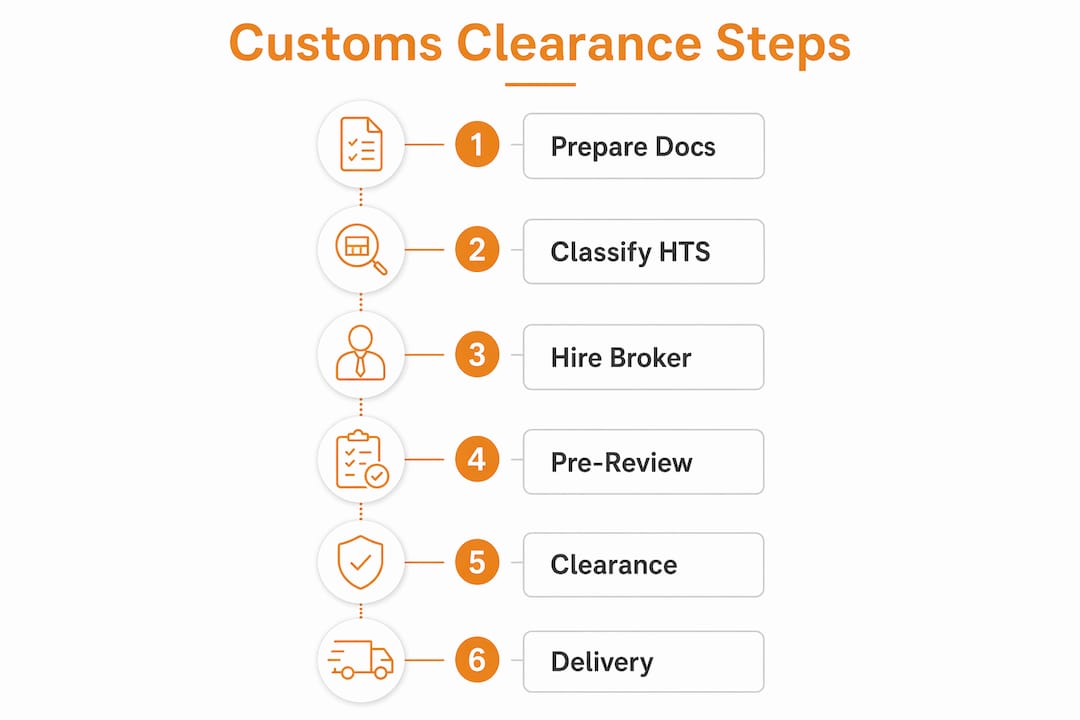
Document requirements at a glance
| Document | Required fields | Common errors to avoid |
|---|---|---|
| Commercial invoice | Seller/buyer name and address, EIN of IOR, description of goods, HTS code, country of origin, quantity, unit value, total value, currency, Incoterm | Vague descriptions ("parts," "accessories"), missing EIN, wrong currency, omitted Incoterm |
| Packing list | Carton count, units per carton, gross/net weight, dimensions, FBA shipment ID, carton labels matching Amazon plan | Unit count mismatch with invoice, missing FBA shipment ID, no carton dimensions |
| Bill of lading / air waybill | Shipper, consignee, notify party, port of loading/discharge, container/AWB number, commodity description, weight | Wrong consignee address (must match IOR, not Amazon FC), missing notify party |
| Certificate of origin | Country of manufacture, HS code, manufacturer name and address, authorized signature | Unsigned, missing HS code, wrong country listed |
| Product-specific certificates | FDA registration (food, cosmetics, devices), CPSC compliance (children's products), FCC ID (electronics) | Missing entirely, expired, or not referenced on the commercial invoice |
| Amazon inbound paperwork | FBA shipment ID on carton labels, FNSKU per unit, packing list uploaded to Seller Central | FNSKU not matching active plan, shipment ID missing from outer carton |
Before departure, verify:
- Every field in the commercial invoice is complete and matches the packing list exactly
- The EIN for the importer of record appears on the commercial invoice
- The FBA shipment ID appears on every outer carton label
- Product-specific certificates are attached and referenced on the invoice
- The declared value reflects the actual transaction value — under-declaring is customs fraud and leads to reassessments or penalties
Numbered pre-departure document check:
- Pull the commercial invoice and packing list side by side; confirm unit counts match to the piece.
- Verify the HTS code on the invoice against your classification record.
- Confirm the IOR's EIN appears on the invoice.
- Check that the consignee address on the bill of lading matches your IOR, not the Amazon FC address.
- Upload the packing list to Seller Central and confirm the FBA shipment ID is printed on every carton.
- Attach all product certificates and note their reference numbers on the invoice.
- Send the complete document package to your broker at least 5 business days before vessel cutoff.
How do you classify HTS codes correctly and avoid holds?
Correct HTS classification is the single highest-leverage action you can take before a shipment departs. Wrong or vague product descriptions and incorrect HTS codes are among the top causes of holds, higher duties, and penalties — and the fix costs nothing if you do it before the commercial invoice is printed.
Step-by-step classification process:
- Review the product's components and materials. What is it made of? What does it do? How is it used? A silicone phone case and a leather phone case fall under different HTS subheadings even though both are "phone cases."
- Consult the U.S. Harmonized Tariff Schedule. The Harmonized System provides the global 6-digit framework; the U.S. extends it to 10 digits for duty-rate precision. Use the USITC HTS search tool to identify the correct 10-digit code.
- Have your licensed broker verify the classification. Brokers carry legal liability for entries they file; a good one will push back if your code looks wrong.
- Maintain an evidence record. Keep the supplier's component list, product spec sheet, and your classification rationale in a single folder. CBP can audit entries up to 5 years after import, and a documented record is your defense.
Common pitfalls by FBA category:
- Electronics accessories: Sellers often use the broad "electrical apparatus" heading instead of the specific subheading for the device type (e.g., wireless earbuds vs. wired headphones carry different rates).
- Apparel: Fiber content and construction method (knit vs. woven) determine the correct heading. A 60% cotton / 40% polyester t-shirt and a 100% polyester t-shirt are classified differently.
- Home goods: Material composition matters more than function. A ceramic mug and a glass mug are in different chapters of the tariff schedule.
Pro Tip: Ask your supplier for a full bill of materials before you classify. Suppliers sometimes change component materials between production runs without telling you. A classification that was correct for your first order may be wrong for your third if the manufacturer switched from metal to plastic hardware.
When should you hire a customs broker or freight forwarder?
For any commercial FBA shipment, the answer is before you finalize the commercial invoice template, not after the cargo is on the water. A licensed customs broker can file entries, handle ISF, pay duties, respond to CBP questions, and arrange bonds — and one who knows FBA can prevent receiving rejections by matching entry data to Amazon shipment IDs. That last part matters more than most sellers realize.
Vetting checklist for a customs broker or forwarder:
- Confirmed experience with Amazon FBA shipments specifically (not just general import experience)
- ISF filing capability for ocean shipments, with a documented cutoff process
- Ability to handle CBP exams, including coordinating with the exam site and paying exam fees
- Importer of record options if you need a third-party IOR
- Stated turnaround SLAs for entry filing and document review
- Electronic data exchange (EDI or API) for real-time shipment status
- Transparent fee structure with no hidden exam or storage surcharges
Questions to ask before you hire:
- Do you file ISF for ocean shipments, and what is your cutoff relative to vessel departure?
- How quickly can you escalate to a CBP Center of Excellence and Expertise (COEE) if clearance stalls beyond 10 days?
- Can you match the FBA shipment ID on the customs entry to prevent receiving mismatches?
- What is your process when CBP requests additional documentation?
- Do you offer a pre-shipment document review as part of your standard service?
- How do you handle duty payments — do you advance funds or require prepayment?
The role of a customs broker goes well beyond paperwork. A broker who knows Amazon's inbound system is effectively an extension of your operations team.
Pro Tip: Make pre-shipment document review a contractual SLA item, not a favor. A broker who commits to reviewing your commercial invoice and packing list 5 business days before vessel cutoff will catch the errors that cause holds. If a broker won't commit to that, find one who will.

Does DDP or DAP actually speed up customs clearance?
DDP usually shortens clearance time because duties and taxes are prepaid and a single provider coordinates the entire entry. With DAP, the duty payment obligation shifts to the buyer at destination — which for FBA means you, the seller, are scrambling to arrange payment after the cargo has already arrived at the port. That gap is where delays live.
DDP vs. DAP: what actually changes
| Factor | DDP (Delivered Duty Paid) | DAP (Delivered at Place) |
|---|---|---|
| Who pays duties | Seller / forwarder (prepaid) | Buyer (seller) pays on arrival |
| Who files customs entry | Forwarder / broker on seller's behalf | Seller or their broker arranges on arrival |
| ISF filing | Coordinated by forwarder | Seller must arrange separately |
| Duty payment timing | Before or at entry filing | After arrival, creating a payment gap |
| Typical delay risk | Low — no payment hold | Higher — payment and entry coordination lag |
| Seller's operational burden | Low | High |
Real-world scenario: An FBA seller ships a 20-foot ocean container from Shenzhen under DAP terms. The cargo arrives at the Port of Los Angeles. The seller's broker files the entry, but the seller has not pre-arranged duty payment. CBP releases the entry, but the drayage carrier cannot pick up the container until the terminal releases it, and the terminal holds it pending duty confirmation. Three days pass. The seller pays a $450 container storage fee and misses the FC delivery appointment. Under DDP with a coordinated forwarder, the duty payment is wired before arrival, the entry is filed on arrival, and drayage is scheduled the same day as release.
Duty-free de minimis treatment for covered commercial imports from all countries has been suspended since August 29, 2025. For non-postal shipments, arrange an appropriate formal or eligible informal entry and budget applicable duties and fees. See CBP’s suspension instructions and the rule effective June 24, 2026. Confirm the importer, filing method and duty-payment arrangements before cargo moves; low value alone does not determine whether a formal entry is required.
What Amazon FBA requirements interact directly with customs?
Customs release is necessary but not sufficient. A shipment can clear CBP perfectly and still be refused at the Amazon fulfillment center if the labeling, carton contents, or pallet configuration do not match the active inbound shipment plan.
Amazon ended its in-house prep and labeling services recently, which means every unit must arrive fully prepped and labeled or risk rejection, return, or disposal at the seller's expense. That change makes the alignment between customs paperwork and Amazon's inbound requirements more critical than ever.
FBA items that interact with customs documentation:
- FNSKU per unit: Every unit needs a scannable FNSKU label applied before it enters the FC. The FNSKU must match the active shipment plan, not a previous or deleted plan.
- Carton labels: Each carton must display the FBA shipment ID, FC code (e.g., ONT8, JFK8), and carton number. The FC code on the carton must match the FC address on the customs entry.
- Pallet labels: For LTL or FTL shipments, each pallet needs Amazon's pallet label in all four corners.
- FBA shipment ID on customs documents: The shipment ID should appear on the commercial invoice and packing list so your broker can reference it when filing the entry.
- Restricted item checks: Products subject to FDA, CPSC, or other agency oversight need their certificates confirmed before the shipment plan is created, not after customs flags them.
- Packaging compliance: Poly bags require suffocation warning labels; transparent bags must be at least 1mm thick and completely sealed; fragile items need full bubble wrap with labels on the outside.
Checklist to align customs data with the Amazon shipment plan:
- Confirm the FC address on the commercial invoice matches the FC assigned in Seller Central.
- Verify the FBA shipment ID appears on every outer carton label and on the packing list.
- Cross-check FNSKU labels against the active shipment plan before cargo is sealed.
- Confirm carton count on the packing list matches the shipment plan exactly.
- Run a restricted-item check for the destination FC before booking.
Pro Tip: Before cargo departs the origin warehouse, take timestamped photos of labeled cartons, pallet configurations, and a sample of FNSKU-labeled units. Accurate box content records and photos are what make receiving discrepancy claims winnable — and they also give your broker a reference point if CBP asks about carton contents.
How long does U.S. customs clearance actually take?
Clearance time varies more than most sellers expect, and the variance is almost entirely driven by document quality, product category, and whether CBP selects the shipment for examination.
| Clearance scenario | Typical timeline | Primary cause |
|---|---|---|
| Electronic release (clean entry) | — | Complete, consistent documents; no exam flag |
| Documentary review | 2–7 business days | Minor discrepancies, missing certificates, or random review |
| Intensive exam (VACIS/X-ray) | 5–10 business days | Exam selection, port congestion, or flagged commodity |
| Physical exam (CET/tailgate) | 1–4+ weeks | Regulatory agency involvement, prior violation history, or high-risk commodity |
| Regulatory agency hold (FDA, CPSC) | 2–6+ weeks | Missing certificates, prior refusals, or new product category review |
For reorder lead-time planning, use this formula:
Reorder lead time = production days + transit days + customs buffer + FC receiving lag
- Ocean from China: add 10–14 days customs buffer for standard goods; 21+ days for regulated categories
- Air freight: add 3–5 days customs buffer for standard goods; 7–10 days for regulated categories
- FC receiving lag: add 3–7 business days after customs release before units are sellable
Common cost line items to budget:
- Import duties (rate varies by HTS code and country of origin)
- Customs bond (single-entry or continuous annual bond)
- Broker filing fee
- ISF filing fee (ocean)
- Container storage / demurrage if clearance is delayed
- Exam fees (CBP charges for physical exams; these can run several hundred dollars)
For a detailed breakdown of clearance timelines by route, including air vs. ocean comparisons, the timing differences are significant enough to affect your reorder point calculations.
Pre-shipment and in-transit checklist for every FBA shipment
Run through this in order. Each step has a timing milestone and an owner.
- At PO creation: Lock the HTS code for every SKU. Confirm with your broker. Document the classification rationale and file it.
- During production: Send the commercial invoice template to your broker for review. Confirm all fields are present: EIN, HTS code, unit value, Incoterm, country of origin.
- 5 business days before vessel cutoff: Submit the complete document package (commercial invoice, packing list, certificate of origin, product certificates) to your broker.
- At least 24 hours before vessel departure (ocean): Confirm ISF has been filed by your broker. Get written confirmation with the ISF transaction number.
- At cargo loading: Verify FNSKU labels, carton labels, and pallet labels against the active Amazon shipment plan. Take photos.
- After vessel departure: Obtain the bill of lading or air waybill. Confirm the consignee and notify party are correct. Send to broker immediately.
- On arrival at U.S. port: Confirm your broker has filed the formal entry. Ask for the entry number and estimated release date.
- After entry filing: Confirm customs bond is in place. If duties are not prepaid (non-DDP), arrange payment immediately.
- After customs release: Get written release confirmation from your broker. Only then schedule drayage and the FC delivery appointment.
- At FC delivery: Confirm the carrier has the correct FC address and delivery appointment. Verify carton count against the shipment plan before the driver departs.
Timing milestones at a glance:
- HTS codes locked: at PO creation
- Commercial invoice finalized: 7 days before vessel cutoff
- ISF filed: 24+ hours before vessel departure
- Document package to broker: 5 business days before cutoff
- Carrier appointment scheduled: only after broker confirms release window
Pro Tip: Assign a single owner for each step in a shared document. When a shipment has multiple handoffs between supplier, freight forwarder, customs broker, and carrier, accountability gaps are where delays hide. A one-page RACI for each shipment takes 10 minutes to build and saves days of back-and-forth when something goes wrong.
What mistakes cause the most customs delays for FBA sellers?
Most of these are fixable the same day you read this. The pattern is almost always a process gap, not a knowledge gap.
- Wrong FC on paperwork. The consignee address on the bill of lading or the delivery address on the customs entry does not match the FC assigned in Seller Central. Fix: pull the FC address from the active shipment plan and paste it directly into the document template every time.
- Mixed carton labels. Cartons from two different shipment plans get mixed in the same container. Fix: seal and label each shipment plan's cartons separately before loading, and photograph the separation.
- Missing FNSKU. Units arrive without FNSKU labels or with manufacturer barcodes covering the FNSKU. Fix: follow Amazon's prep guidance exactly — cover all manufacturer barcodes and apply FNSKU on a flat surface at 300 DPI minimum.
- Late ISF. The broker was not engaged until after booking, leaving no time to file before the 24-hour cutoff. Fix: engage your broker at PO creation, not at booking.
- Wrong HTS code. A code copied from a previous shipment or a competitor's invoice without verification. Fix: verify every code against the USITC tariff schedule for each new product.
- Undervaluation. The declared value on the commercial invoice is lower than the actual transaction price to reduce duties. This is customs fraud and leads to reassessments, penalties, and potential seizure. Fix: declare the actual transaction value every time.
- Missing certificates for regulated goods. Electronics without FCC ID documentation, children's products without CPSC compliance certificates, or cosmetics without FDA registration. Fix: confirm certificate requirements before production, not before shipping.
- Shipping to FBA before customs release. The carrier delivers to the FC while the entry is still open. Amazon refuses the delivery, and the cargo sits in a carrier yard accumulating storage fees. Fix: schedule the FC appointment only after your broker provides written release confirmation.
Pro Tip: Build a supplier scorecard that tracks documentation errors by shipment. After three shipments with the same supplier, you will see a pattern: some suppliers consistently miss the EIN field; others ship with wrong carton counts. A scorecard makes those conversations data-driven and gives suppliers a clear target to hit.
What do you do when your shipment is held by U.S. Customs?
A hold is not a crisis if you move quickly and systematically. Most holds resolve within a few days when the seller and broker respond with the right documentation immediately.
Step-by-step escalation plan:
- Day 1 — Confirm entry status. Contact your broker and ask for the CBP message or "reason for hold" detail. Get the entry number, port of entry, and name of the CBP officer or team handling the entry.
- Day 1 — Produce supporting documents. Pull the commercial invoice, packing list, certificate of origin, and any product certificates. If CBP is questioning classification, pull your HTS classification record and supplier component list.
- Day 2–3 — Broker responds to CBP. Your broker submits the requested documents and follows up directly with the port. If duties are in question, arrange payment or confirm the bond covers the amount.
- Day 3–5 — Physical exam preparation. If CBP schedules a physical exam, your broker coordinates with the exam site. You may need to pay exam fees. Provide the broker with a detailed packing list and photos of carton contents to speed the process.
- Day 10+ — Escalate to COEE. If clearance has stalled beyond 10 days with no resolution, your broker should escalate to the CBP Center of Excellence and Expertise for the relevant port. This is a formal escalation path and often breaks a stalled review loose.
- Parallel — Notify Amazon. If you have a scheduled FC delivery appointment, contact Amazon Seller Support's inbound team to explain the delay and request a reschedule. Do this early — rescheduling is easier than a missed appointment.
Contact list template for a held shipment:
- Customs broker: primary point of contact; escalate to their supervisor if response is slow
- Carrier / drayage company: notify them of the hold and ask them to hold the delivery appointment pending release
- Amazon Seller Support (inbound): use the "Contact Us" path in Seller Central under "FBA issue" to report the delay and request appointment reschedule
- CBP port of entry: your broker handles direct CBP contact, but ask for the port's public inquiry line as a backup
Pro Tip: Keep a single shared folder with timestamped versions of every document for each shipment. When CBP requests documents, the broker who can respond within two hours with a complete, organized package gets faster resolution than one who spends a day hunting for files. Version your documents — "Commercial Invoice v2 2026-03-15" — so there is never confusion about which is current.
Why managed DDP forwarding reduces customs delays: ForwarderOne's approach
Managed DDP consolidates entry filing, duty payment, and delivery coordination into one workflow. The handoff delays that cause most holds — a broker who does not know the shipment is arriving, a duty payment that has not been arranged, a carrier appointment booked before release — disappear when a single provider owns the entire chain.
What that looks like in practice: A seller shipping 500 units of a new home goods SKU from Shenzhen to an Amazon FC in Ohio uses ForwarderOne's DDP service. The account manager reviews the commercial invoice and packing list before cargo is loaded, flags a missing certificate of origin, and gets it corrected before vessel departure. ISF is filed the same day as booking. Duties are prepaid. On arrival at the Port of Los Angeles, the entry is filed within hours. The cargo clears in under 48 hours, drayage is scheduled immediately, and the FC delivery appointment is met on the first attempt. The seller's inventory is live and sellable before the reorder point is hit.
ForwarderOne trust signals:
- Dedicated account manager for every shipment, not a ticket queue
- Over 99% on-time delivery rate across FBA shipments
- Pre-shipment document review included in the workflow
- ISF filing, entry filing, and duty payment coordinated in a single process
- FBA labeling and palletization handled before cargo reaches the FC
- Audit trail with timestamped documents for every shipment
The operational case for DDP: When duties are prepaid and a single provider coordinates entry, drayage, and FC delivery, the window for a payment-gap hold closes entirely. For sellers who have experienced a missed FC appointment because a duty payment was not arranged in time, DDP is not a premium service — it is the baseline that prevents a repeatable, expensive mistake.
Pro Tip: *When evaluating a DDP forwarder, ask specifically whether they handle FBA labeling and palletization at origin. A provider who can manage FBA-compliant prep before cargo departs eliminates the single most common post-customs rejection reason: labeling that does not match the active shipment plan.*
Key Takeaways
Getting customs clearance right for Amazon FBA shipments requires correct HTS codes, timely ISF filing, complete documentation, and a broker engaged before cargo is packed — not after it departs.
| Point | Details |
|---|---|
| HTS accuracy prevents holds | Verify the 10-digit HTS code at PO creation and maintain a classification record for CBP audits. |
| ISF timing is non-negotiable | File ISF at least 24 hours before vessel departure; late filing carries penalties up to $5,000 per violation. |
| Broker engagement timing | Hire a licensed customs broker at the PO stage, not at booking, so document errors are caught before departure. |
| DDP removes payment-gap delays | Prepaid duties under DDP eliminate the most common post-arrival hold: a duty payment that has not been arranged. |
| Amazon labeling must match customs docs | The fulfillment center code on carton labels and the customs entry must match the active Seller Central shipment plan exactly. |
| ForwarderOne DDP service | ForwarderOne coordinates entry, duty payment, ISF, FBA labeling, and delivery in one workflow with a dedicated account manager. |
The rules that actually keep shipments moving
The conventional wisdom on customs compliance tends to focus on documents — get the paperwork right and you will be fine. That is true as far as it goes, but it misses the operational layer that actually determines whether a shipment clears on time.
The sellers who consistently avoid FBA customs delays are not the ones with the most complete document checklists. They are the ones who treat their customs broker as a standing partner rather than a vendor they call when something goes wrong. That distinction changes everything about how errors get caught and resolved.
Three rules worth adopting as standing operating procedure:
Document-first. No shipment gets booked until the commercial invoice template has been reviewed by the broker. Not "sent to the broker" — reviewed and confirmed. This one rule eliminates the majority of documentary holds before they happen.
Broker as partner. Your broker should know your product catalog, your HTS codes, and your typical FC assignments. If your broker is learning these details from the entry form after cargo departs, you have a vendor relationship, not a partnership. The difference shows up in clearance time.
Measure and reduce exceptions. Track every customs hold, every documentary query, and every receiving rejection by shipment and supplier. After six months, the data will tell you exactly where your process is leaking. Most sellers find that 80% of their delays come from two or three repeatable errors — and those are fixable.
The sellers who struggle most with FBA customs delays are usually the ones who treat each shipment as a one-off event rather than a repeatable process. Build the process, assign the owners, and measure the exceptions. The delays stop being surprises and start being solvable problems.
ForwarderOne handles the customs complexity so you can focus on selling
Customs delays cost more than storage fees and expedite charges. They cost you sales rank, stockout penalties, and the compounding effect of inventory that is not live when demand is highest.
ForwarderOne's DDP forwarding service is built specifically for small and mid-sized Amazon sellers shipping from China and Korea to U.S. fulfillment centers. The service covers every step that causes delays: pre-shipment document review, ISF filing, formal customs entry, duty payment, FBA labeling and palletization, and carrier coordination to the FC door. One account manager owns the entire shipment, which means no handoff gaps and no "that's not my department" when something needs to move fast.
With over 99% on-time delivery and a workflow designed around Amazon's inbound requirements, ForwarderOne removes the operational burden of customs compliance from your plate entirely. If you want to see how DDP forwarding fits your next shipment, get a quote or review the full service breakdown to find the right option for your volume and route.
Need customs risk checked before cargo moves?
ForwarderOne reviews documents, files ISF, manages duty payment, and coordinates Amazon-ready delivery before delays turn into stockouts.