For Amazon FBA inventory moving out of China, “pre shipment inspection” in the logistics sense means one thing: getting DDP pickup, export clearance, IOR compliance, duties, FNSKU labeling, and inland delivery locked down before the container leaves port. The fastest way to avoid a legal or receiving problem is to hire a DDP-capable forwarder that either legally handles Importer of Record duties itself or arranges a compliant IOR service, and that completes FBA prep in China. Some forwarders are built around that exact model, and Title 19 of the Code of Federal Regulations governs who can legally act as IOR.
TL;DR:
- Ensuring FBA prep and labeling occur in China before shipment reduces costs and prevents rejection issues at Amazon’s dock.
- Verify that your forwarder is a legitimate IOR, with a registered US presence, to avoid customs delays, detention, or misdeclared duties.
- Pre-shipment checks should confirm carton integrity, labeling accuracy, and documentation before export, saving time and avoiding costly corrections later.
- Shipping timelines range from 25 to 40 days by sea and 3 to 7 days by air, making blended logistics essential for high-velocity products.
- A comprehensive DDP service should include freight, duties, customs brokerage, FBA prep, and IOR verification with documented proof at each step.
What Is the Pre-Shipment DDP Workflow From China to FBA?
A shipment moves through seven distinct stages between your supplier’s dock in China and the moment Amazon scans it into inventory. Miss a document at any one of them and you risk a detained container, a rejected pallet, or duties billed to the wrong party.
- Pickup at the factory or consolidation warehouse in China, where cartons are counted and weighed against the commercial invoice.
- China export clearance, which requires a packing list, commercial invoice, and export declaration matched to the shipper’s business license.
- International transport by sea, air, or express courier, generating an airway bill or bill of lading that becomes the master document for customs on both ends.
- US import clearance, where a licensed broker files the entry using the bill of lading, invoice, and any product-specific permits.
- Duty and tax payment, handled under DDP so the seller never receives a surprise bill from a courier or broker at the border.
- Inland delivery from the port or airport to the fulfillment center, scheduled against Amazon’s appointment window.
- FBA receiving, where Amazon checks carton counts, labels, and condition before goods go live for sale.
At every stage, someone needs to verify a specific document: the commercial invoice for value and quantity, the packing list for carton breakdown, the bill of lading or AWB for chain of custody, and the customs entry paperwork for duty accuracy.
Here’s the part sellers overlook. FBA prep and FNSKU labeling should happen in China, before the container is sealed, not at a US warehouse after the fact. Doing it at origin costs less per unit and gives your forwarder a chance to catch labeling errors before they turn into a rejected shipment at Amazon’s dock.
Who Is Legally Responsible as Importer of Record?
This is where sellers get burned, usually without knowing it until a shipment is already stuck. Under Title 19 CFR Part 149, a foreign supplier generally cannot serve as Importer of Record unless it has a registered US business presence. If your factory or an unregistered agent in China claims they’ll “handle everything as IOR,” that claim usually doesn’t hold up legally, and you, as the seller bringing goods into US commerce, carry the liability if customs comes asking.
Statistic Callout: Missed Importer Security Filings and incorrect customs paperwork are among the most common causes of cargo delay and detention at US ports, according to CBP’s own trade guidance.
Before booking a shipment, verify your forwarder’s IOR approach directly:
- Ask for the US importer number they’ll file under, and confirm it’s tied to a real, registered US entity.
- Ask which licensed customs broker they partner with, and request a sample customs entry summary from a past shipment.
- Confirm in writing who bears liability if goods are misdeclared or duties are underpaid.
Red flag: any supplier, freight broker, or unnamed “agent” who claims IOR status without a documented US presence. Walk away from that quote, no matter how cheap it looks.
What Does Amazon Require Before Export?
Amazon’s receiving software checks specific things, and it does not negotiate. Fix these before the carton leaves China, not after it’s already in transit.
- FNSKU barcodes on every individual unit, scannable and unobstructed, following Amazon’s current label size specs.
- Poly bag compliance for units requiring suffocation warnings on bags with a 5-inch opening or larger, per Amazon’s packaging policy.
- Barcode coverage confirming the original manufacturer barcode is either covered or removed so scanners read only the FNSKU.
- Carton labels listing SKU, quantity, and destination fulfillment center, matched exactly to what’s inside the box.
- Carton content accuracy, meaning what’s declared on the label matches the physical count, every time, not just on the sample carton.
- Pallet stability and mixed-SKU rules, since Amazon flags pallets that mix SKUs without proper carton-level separation.
Pro Tip: Ask your prep center or forwarder for time-stamped photos of labeled cartons before the container is sealed. A five-minute photo review from your desk beats a two-week detention notice at the fulfillment center.
Require documentation and photo proof at the carton level, not just a packing list summary. A vendor who won’t send photos before sealing the container usually has something to hide, or hasn’t actually done the prep work they billed you for.
How Long Does Shipping From China to FBA Actually Take?
Sea freight and air freight sit at opposite ends of the cost-versus-speed tradeoff, and most sellers should be running both at once rather than picking one.
A realistic sea freight timeline runs pickup at 1 to 2 days, China export clearance at 1 to 3 days, ocean transit at 15 to 25-plus days, US import clearance at 1 to 4 days, inland delivery at 1 to 3 days, and Amazon receiving anywhere from 1 to 7 days depending on the fulfillment center’s backlog. Add it up and you’re often looking at 25 to 40 days door to shelf. Air freight compresses transit to roughly 3 to 7 days but costs several times more per kilogram.
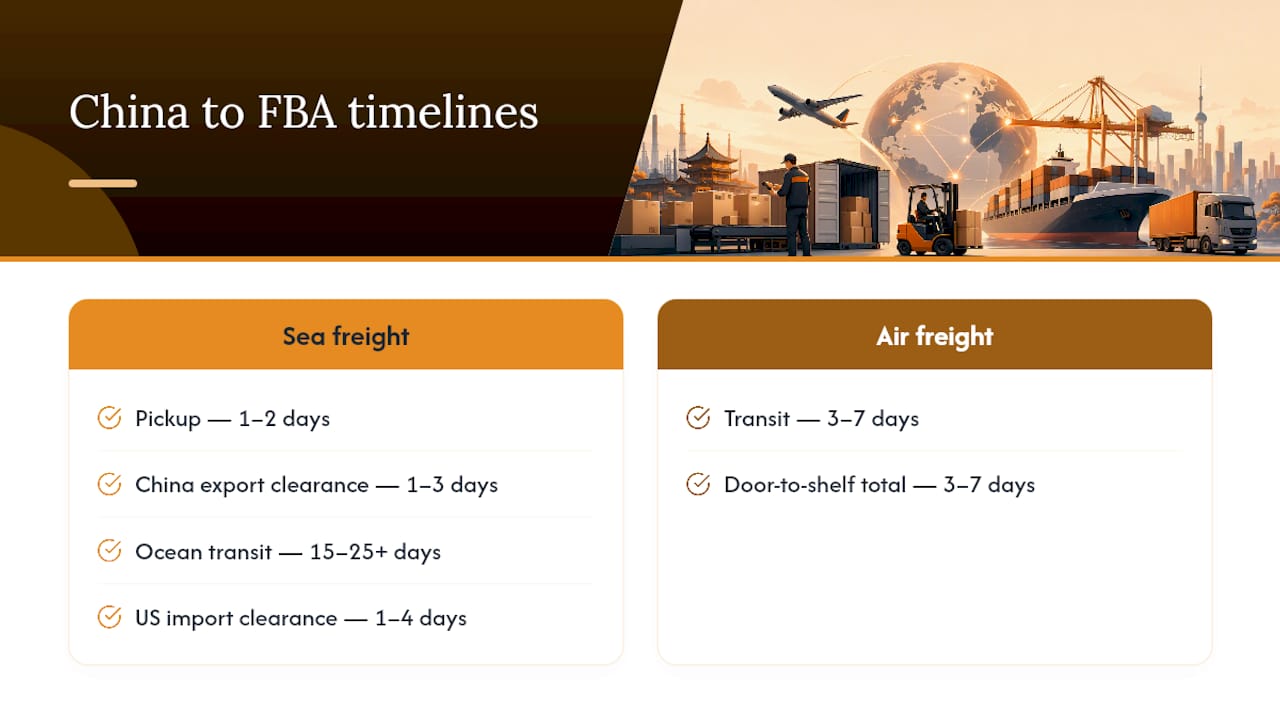
Statistic Callout: CBP’s own cargo inspection guidance confirms that appointment delays and random inspections are a normal part of the import process, not an edge case.
The smart play for high-velocity SKUs is blended shipping: air freight for the units you’ll sell out of in the next three weeks, sea freight for the replenishment stock behind it. Build in safety stock equal to at least one full sea freight cycle so a customs hold doesn’t turn into a stockout.
Cost components under a DDP quote should include ocean or air freight, duties and tariffs, customs brokerage fees, destination handling charges, FBA prep and labeling, and cargo insurance. Ask for a line-item breakdown rather than a flat number, because “all-inclusive” sometimes quietly excludes Amazon appointment fees or product-level prep.
How Do You Vet a DDP Forwarder Before Booking?
Ask these questions before you sign anything, not after the container is already loaded.
- Can they name their IOR structure specifically, and provide a sample customs entry from a previous FBA shipment?
- Do they perform FNSKU labeling and carton prep in China, or ship it unprepped and leave you exposed to rejection?
- What’s their track record on Amazon appointment scheduling and dock acceptance?
Demand a line-item DDP quote, a written IOR agreement, proof of a past customs entry, and a cargo insurance certificate before you commit inventory dollars. A forwarder worth using assigns a dedicated account manager, verifies carton counts against your packing list, and commits to a delivery window rather than a vague “it’ll get there eventually.”
Pro Tip: Treat your forwarder like a compliance partner, not a commodity vendor. The cheapest quote that skips IOR verification usually costs more once a shipment gets held.
What Is Pre-Shipment Inspection in the China Export Process?
In the context of moving Amazon inventory, pre-shipment inspection is the full set of pickup, export clearance, IOR, and prep checks a forwarder runs before your goods leave China, not a standalone quality audit performed by a separate agency. The purpose is straightforward: confirm the paperwork, the party legally responsible for import, and the physical readiness of the cartons all line up before the shipment is committed to a vessel or flight.
This distinction matters because sellers often confuse two different services. One is a factory-floor quality check on the product itself. The other, the one this guide covers, is the logistics readiness check: does the commercial invoice match the actual carton count, is the export declaration filed correctly, does the forwarder have a legitimate IOR path, and are the cartons labeled the way Amazon requires. Skipping this step is how sellers end up with goods stuck at a US port because the import paperwork was filed against the wrong entity, or with pallets rejected at a fulfillment center because carton labels didn’t match contents.
The practical purpose of running this check before export, rather than discovering the gap after arrival, is cost. Fixing a labeling error in China costs a few cents per unit and a short delay. Fixing the same error after a shipment lands at a US port or gets flagged at Amazon receiving can mean storage fees, a return shipment, or a blown launch date during a peak sales window.
What Standards Do These Pre-Export Checks Follow in China?
The checks that matter for FBA sellers fall into four practical categories, and each one maps to a different failure point in the supply chain.
Documentation and quantity checks confirm the commercial invoice, packing list, and export declaration all show matching numbers. This is the single most common source of customs delay, because a mismatch of even a few units between the invoice and the physical count can trigger a hold.
Packaging and carton integrity checks confirm cartons are sealed, labeled correctly, and packed to survive ocean or air transit without crushing. Pallet stability matters here too, since a shipment that arrives with shifted or damaged cartons often gets flagged before it ever reaches Amazon’s dock.
Compliance labeling checks confirm FNSKU barcodes, poly bag suffocation warnings, and carton content labels meet Amazon’s current specifications, not last year’s.
Export filing checks confirm the shipper of record on the export declaration matches a legitimate business license, which matters because a mismatched shipper name is one of the easier ways a shipment gets flagged for manual review at the Chinese port.
None of these standards are exotic. They’re closer to a pre-flight checklist than a laboratory audit, and a forwarder running FBA shipments regularly should treat them as routine, not optional.
How Do You Set Up These Checks With a Provider in China?
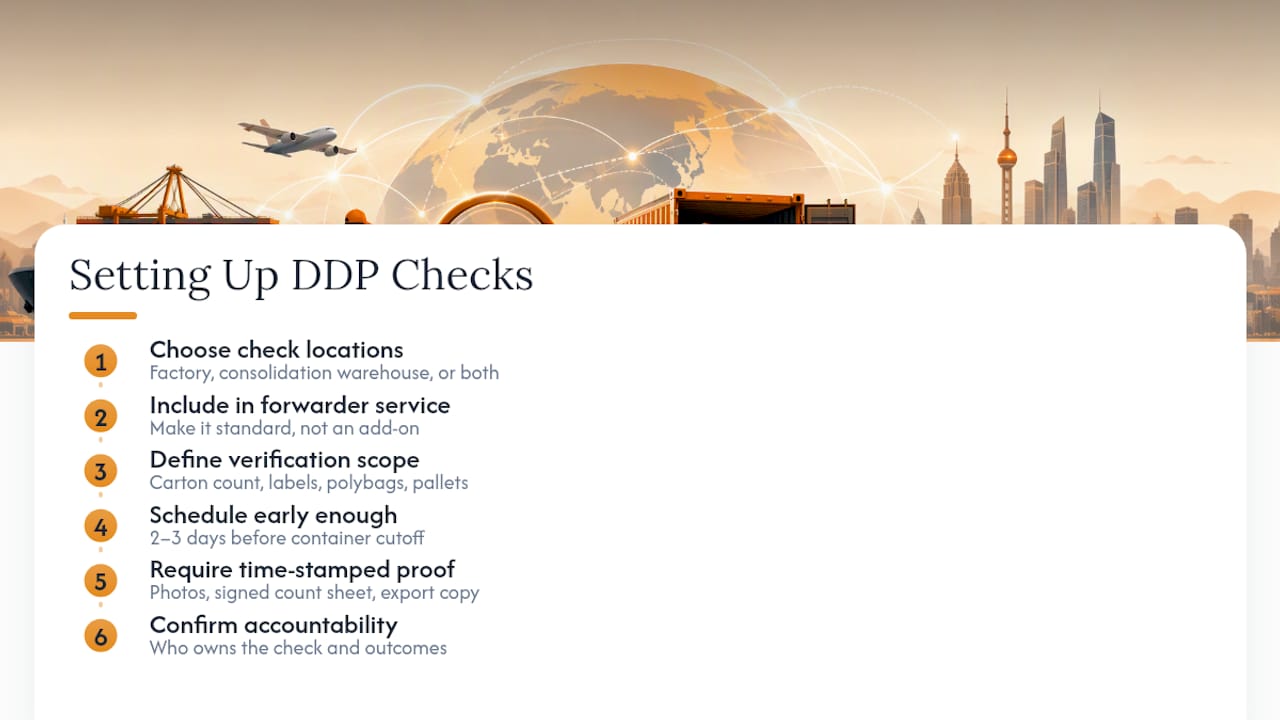
Start by asking whether the checks happen at the factory, at a consolidation warehouse, or both. A single check at the factory catches production errors; a second check at the consolidation warehouse, right before cartons go into the container, catches anything that shifted or got missed during transport from the factory floor.
Request the check as a standard part of your forwarder’s service rather than as a separate add-on you have to chase down. Ask specifically what gets verified: carton count against packing list, label placement and legibility, poly bag compliance, and pallet condition. If a provider can’t describe their process in that level of detail, that’s a signal to keep looking.
Timing matters just as much as scope. Schedule the check far enough before your container’s cutoff date that there’s room to fix a problem, not just report it. A check performed the morning the container is being loaded gives you no time to correct a labeling error; one performed two or three days earlier does.
Ask for proof, not just a summary email. Time-stamped photos of labeled cartons, a signed count sheet, and a copy of the export declaration give you something to point to if a dispute comes up later. A provider that resists sending photos or documentation is usually cutting corners somewhere in the process.
Finally, confirm who’s accountable if something is missed. A forwarder that owns the check as part of an end-to-end DDP service has more incentive to get it right than a third party paid a flat fee regardless of outcome.
What Exactly Gets Checked Before Cartons Leave China?
Run through this before you approve any shipment for export.
Product-level checks:
- Unit count matches the purchase order and commercial invoice exactly.
- FNSKU barcodes are applied, scannable, and not obscured by other labels.
- Poly bags meet suffocation warning requirements where applicable.
Packaging checks:
- Cartons are sealed, undamaged, and rated for the transit method (sea versus air).
- Carton labels show SKU, quantity, and destination fulfillment center accurately.
- Pallets are stacked to a stable height with no mixed SKUs unless clearly separated by carton.
Documentation checks:
- Commercial invoice value and quantity match the packing list line for line.
- Export declaration lists the correct shipper of record and matches the business license on file.
- Bill of lading or airway bill details match the booking confirmation, including weight and carton count.
Any mismatch in these three categories, product, packaging, or documentation, is worth stopping the shipment over. A ten-minute fix in China is dramatically cheaper than a delay discovered after the container is already at sea.
How Does This Affect Customs Clearance on Both Ends?
Get this right and customs clearance in China and the US becomes close to routine. Get it wrong and you’re looking at delays that cascade through the entire shipment.
On the China side, a mismatch between the export declaration and the physical cargo, wrong shipper name, wrong quantity, wrong value, can trigger a manual review that holds the container at port before it ever loads onto a vessel. That’s lost transit time you can’t get back once the shipping schedule has moved on without you.
On the US side, the stakes are different but just as real. If the IOR filing is invalid, or if the entry documents don’t match what’s actually in the container, customs can detain the shipment until the paperwork is corrected or the goods are re-exported. That’s storage fees accruing daily, and for a seller trying to hit a launch date or restock before a peak sales period, every day of detention is lost sales.
The upside is that clean documentation and accurate labeling checks at origin flow straight through to a smoother DDP clearance process. A forwarder who confirms carton counts and paperwork before export rarely gets flagged for the same issues on arrival, because the root causes were fixed before the container ever left China.
What Do These Checks Typically Cost?
Costs vary by shipment size and how thorough the check is, but the pattern is consistent across the industry: providers charge either a flat fee per shipment or a per-carton rate, with larger orders getting a lower per-unit cost.
Most sellers find that a check performed as part of a bundled DDP service, rather than booked separately with an outside provider, ends up costing less overall. That’s because the forwarder is already staffing the consolidation warehouse and running the export paperwork, so folding the check into that existing workflow avoids paying twice for overlapping labor.
The real cost comparison isn’t the check fee itself. It’s the check fee against the cost of skipping it: a rejected Amazon shipment, a detained container, or a mislabeled pallet that has to be re-worked at a US warehouse for several dollars per unit instead of a few cents per unit in China. Sellers who treat this as a line item to cut usually end up paying more somewhere else in the supply chain.
A Seller’s Perspective: What One Mislabeled Shipment Taught
A seller I spoke with while researching this topic had cartons labeled with the wrong FNSKU suffix on roughly a third of a shipment, caught only because their forwarder ran a carton check before the container sealed. Without that check, Amazon would have rejected the mismatched units on arrival, right before a holiday restock window.
The fix took two days in China. The alternative, catching it at a US fulfillment center, would have meant relabeling fees, a delayed restock, and lost sales during the exact week this seller needed inventory live. That’s the entire case for origin prep in one sentence: cheap and fast in China, expensive and slow everywhere else.
— Keven
How ForwarderOne Handles Pre-Shipment DDP for Amazon Sellers
Everything covered above, the IOR verification, the FNSKU labeling, the carton checks, the DDP cost breakdown, is what an effective forwarder builds into a single workflow for Amazon sellers. Instead of juggling a factory, a separate labeling vendor, and a customs broker, you get one point of contact who owns the whole chain from China pickup to FBA delivery.
Some forwarders run an all-inclusive DDP service that covers freight, duties, customs brokerage, and inland delivery under one quote, with FNSKU labeling and FBA prep completed in China before export rather than after arrival.
When you request a quote, ask for the same things this guide walks through: a line-item cost breakdown, the IOR structure they use, and confirmation of carton-level prep before the container ships. Start with the FBA freight forwarding services page or the dedicated small-seller DDP page to get a quote built around your specific SKU count and shipping schedule.
Sources
- Code of Federal Regulations, Title 19 — Customs Duties, Part 149
- Amazon FBA Shipping from China: Complete 2026 Guide - AllBestShipping
FAQ
What Does Pre-Shipment Inspection Mean for China Exports?
In this context, it refers to the DDP logistics checks, IOR verification, carton labeling, and documentation review that a forwarder runs before goods leave China, not a standalone product quality audit.
Can a Chinese Supplier Legally Act as Importer of Record?
Generally no. Under Title 19 CFR Part 149, foreign suppliers without a registered US business presence typically cannot serve as IOR, leaving the seller liable if the paperwork is wrong.
How Long Should I Budget for Shipping From China to FBA?
Sea freight typically runs 25 to 40 days door to shelf, while air freight compresses transit to roughly 3 to 7 days, according to industry shipping guides. Build in safety stock to cover at least one full sea freight cycle.
What Should Be Included in a DDP Quote?
A proper DDP quote itemizes freight, duties, customs brokerage, destination handling, FBA prep and labeling, and cargo insurance, rather than bundling everything into one vague number.
Does ForwarderOne Handle FBA Labeling in China?
Yes. ForwarderOne completes FNSKU labeling and FBA prep in China before export, alongside its all-inclusive DDP service and dedicated account manager support.
Need China FBA prep and DDP checks handled before pickup?
ForwarderOne coordinates supplier pickup, FNSKU labeling, carton verification, customs paperwork, DDP duties, and final FBA delivery in one managed workflow.