
If your company paid eligible IEEPA tariffs, those duties may be recoverable. The path runs through three immediate actions: confirm your ACE Portal access, enroll for ACH refund payments, and prepare a CAPE Declaration CSV for eligible entries. CBP’s CAPE system (Consolidated Administration and Processing of Entries) handles these refunds inside ACE, consolidating them by Importer of Record and liquidation date rather than processing each entry individually.
What to do in the next 24–72 hours:
- Log into the ACE Secure Data Portal and confirm your Importer sub-account is active
- Enroll for ACH refund payments and verify your U.S. bank account in ACE — no verified account means no refund
- Pull your entry list from ACE and identify unliquidated entries or entries still within the voluntary reliquidation window
Once CBP accepts your CAPE Declaration, valid refunds are generally issued within a few months, though entries requiring additional review or Treasury certification may take longer.
Key Takeaways
Recovering IEEPA tariffs requires ACE Portal access, verified ACH enrollment, and a correctly formatted CAPE Declaration CSV submitted through the CAPE tab — not ABI — before your entries reach final liquidation.
| Point | Details |
|---|---|
| ACH enrollment is the first priority | CBP issues no paper checks; a verified U.S. bank account in ACE must be on file before any refund is paid. |
| CAPE Declaration limits and batching | Each CAPE Declaration accepts up to 9,999 entries; submit multiple declarations for larger claim sets, grouped by liquidation date. |
| Typical refund timeline | Valid refunds are generally issued within 60–90 days after CAPE acceptance, with interest calculated under 19 U.S.C. § 1505. |
| Brokers file but IOR stays responsible | A customs broker can submit CAPE Declarations, but the Importer of Record retains legal responsibility for accuracy. |
| ForwarderOne for managed support | ForwarderOne assists Amazon sellers and importers with ACE setup, ACH enrollment, CSV preparation, and post-submission monitoring. |
What are IEEPA tariff refunds and what does CAPE do?
An IEEPA tariff refund is the return of duties collected under the International Emergency Economic Powers Act after a court or the Court of International Trade directed CBP to refund those charges. CBP built CAPE specifically to handle these refunds at scale rather than forcing importers to chase entry-by-entry corrections.
CAPE lives inside the ACE Portal. When you submit a CAPE Declaration (a CSV file uploaded through the CAPE tab), CBP validates the data, removes the IEEPA Chapter 99 HTS provisions from accepted entries, and then triggers liquidation or reliquidation. Refunds are consolidated by IOR or by the party you designate through CBP Form 4811, then paid as a single ACH deposit rather than dozens of separate checks.
The data flow looks like this: you or your broker exports eligible entry data from ACE and your own records, populates the CAPE CSV template, uploads it through the CAPE tab in the ACE Portal, receives an acceptance confirmation with a declaration ID, and then CBP processes the entries through its review and liquidation pipeline before Treasury certifies and releases the ACH payment.

Who can file, and which entries qualify?
Only the Importer of Record or an authorized customs broker associated with the entry’s ACE filer code prefix can submit a CAPE Declaration for those entries. If a broker filed the original entry under their own filer code, the broker must file the CAPE Declaration — the IOR cannot file independently for those entries without the correct ACE association.
Phase 1 entry scope covers two categories:
- Unliquidated entries — entries where CBP has not yet issued a final duty determination
- Entries within the voluntary reliquidation window — generally 80–90 days depending on CBP’s deployment schedule for that entry type
| Entry Status | Phase 1 Eligible? | Notes |
|---|---|---|
| Unliquidated | Yes | File CAPE Declaration before liquidation occurs |
| Within voluntary reliquidation window | Yes | Window is approximately 80–90 days per CBP deployment |
| Finally liquidated (outside window) | No (Phase 1) | Later phases expected to address these |
| Reconciliation-flagged entries | Yes (from June 29, 2026) | CAPE removes IEEPA provision; reconciliation entry still required |
| Warehouse entries | Conditional | Issued at liquidation; confirm status before filing |
Later phases will expand scope to finally liquidated entries, but CBP has not published a firm date for that expansion. If you have entries approaching final liquidation, consider filing a protest to preserve your rights while CAPE phases roll out.
The ACE Portal requires that your ACE filer code be properly associated before you can submit CAPE Declarations. Confirm this association before you build your CSV — a mismatch at submission is one of the most common rejection causes.
What accounts and documents do you need before filing?
Confirm your ACE Portal account and ACH bank information before anything else. Per Federal Register guidance, CBP issues all refunds electronically via ACH — there are no paper checks. A missing or unverified bank account is the single most common reason refunds stall.
Step-by-step account setup checklist:
- Log into the ACE Secure Data Portal and confirm your Importer sub-account exists and is active
- Verify your ACE filer code prefix is associated with the entries you plan to include
- Enroll for ACH refund payments in ACE and complete bank account verification — routing number and account number must match your bank’s records exactly
- Check whether a CBP Form 4811 (Special Address Notification) is needed to designate a refund recipient other than the IOR, or confirm your ACE notify-party mapping
- Decide who will file: IOR directly, or an authorized customs broker — document this decision internally
Data and documents to gather for each entry:
- Entry numbers and CBP Form 7501 entry summaries
- HTS codes and country of origin for each line item
- IEEPA duty amounts paid (separated from other duties)
- Liquidation status for each entry
- Any outstanding CBP debts for your IOR (CBP will net these against your refund)
Pro Tip: Before building your full CSV, run a small test batch of 5–10 entries through the CAPE template and upload it. Catching a routing-number mismatch or a column-format error on 10 rows is far less painful than discovering it after a 4,000-row file gets rejected. Also, review the ACE Portal and ACH refunds FAQs — CBP documents the most common enrollment errors there.
For large claim sets, plan your batching strategy before you start. Grouping entries by liquidation date or shipment month makes error isolation much faster if a batch fails validation.
How do you prepare and upload a CAPE Declaration?
Use the CAPE Declaration template available in the CAPE tab of the ACE Portal. Do not use ABI (Automated Broker Interface) for CAPE Declarations — the upload must go through the CAPE tab only. Each CAPE Declaration accepts up to 9,999 entries; if your claim set is larger, split it across multiple declarations.
Submission steps:
- Export your eligible entry data from ACE and your internal records
- Download the CAPE Declaration template from the CAPE tab in the ACE Portal
- Populate the template fields: entry number, IOR number, HTS codes, IEEPA duty amounts, country of origin, and liquidation status
- Validate the file locally — check for blank required fields, incorrect date formats, and entry numbers that do not match your ACE filer code association
- Log into the ACE Portal, navigate to the CAPE tab, and click the Upload button
- Upload your CSV and wait for the acceptance confirmation message, which includes a declaration ID
- Record the declaration ID and timestamp in your internal tracking system
When ACE accepts the declaration, it removes the IEEPA Chapter 99 HTS provisions from those entries. That triggers CBP’s review pipeline, which leads to liquidation or reliquidation and eventually to the batched ACH refund.
Common validation errors include: entry numbers formatted with the wrong prefix, HTS codes that do not match the original entry summary, and IOR numbers that do not align with the ACE filer code on file. If a batch fails, the error message in ACE will identify the problematic rows — fix those rows, re-validate locally, and resubmit. CBP’s CAPE demonstration video shows exactly where the CAPE tab sits in the Portal and what an acceptance message looks like, which is worth watching before your first upload.
How does CBP process your refund, and when does it arrive?
After CAPE acceptance, CBP aims to issue valid refunds within 60–90 days, though entries requiring additional compliance review or complex reliquidation will take longer. Treasury certification adds time on top of CBP’s internal processing.
Interest on refunded duties is governed by 19 U.S.C. § 1505, with rates set by the IRS quarterly and published in the Federal Register. That interest is included in your consolidated ACH refund — CBP does not send a separate interest payment.
Before your refund is released, CBP nets it against any outstanding debts your IOR has with CBP. If reliquidation changes a classification or value on an entry, it can produce a bill rather than a refund for that entry. Review your entry data carefully before filing to flag any entries where reclassification risk is high.
| Processing Stage | Typical Duration |
|---|---|
| ACE validation and CAPE acceptance | Hours to 1–2 business days |
| CBP internal review and reliquidation | 60–90 days (typical processing time) |
| Liquidation/reliquidation finalization | Varies by entry complexity |
| Treasury certification | Additional days after CBP completion |
| ACH deposit to verified bank account | 60–90 days after CAPE acceptance (typical) |
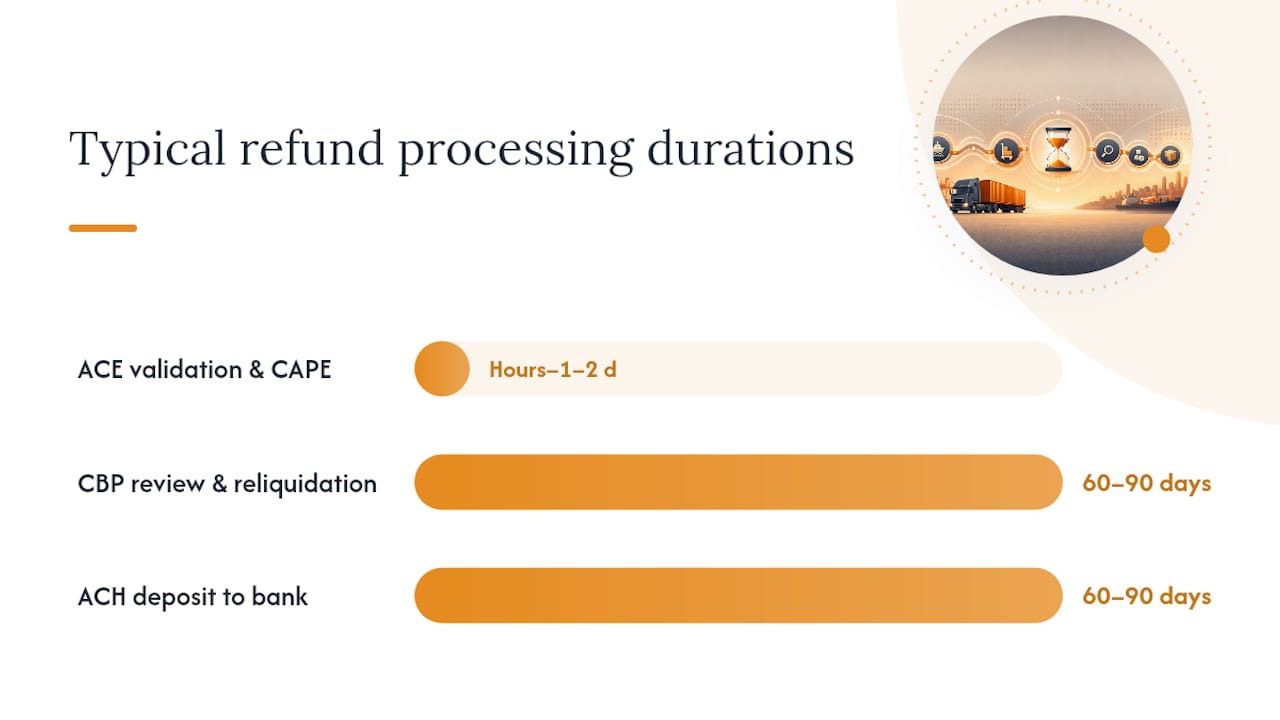
CBP batches refunds by liquidation date and IOR, so entries liquidated in different periods may arrive as separate ACH deposits. Keep your internal tracking system updated with declaration IDs and expected liquidation dates so your finance team can reconcile each deposit correctly.
Industry advisors describe CBP’s approach as a four-step pipeline: submission, mass recalculation, liquidation/reliquidation review, and refund issuance. Coordinate with your finance team early on how recovered tariff amounts and included interest should be treated under GAAP, since the accounting treatment for duty refunds and interest income can differ.
What special scenarios change eligibility or timing?
Not every entry follows the standard path. Several categories require extra handling, and missing them can cost you a refund or create an unexpected bill.
- Reconciliation-flagged entries: As of June 29, 2026, CAPE accepts entries flagged for reconciliation. CAPE removes the IEEPA provision, but you must still file the reconciliation entry separately. Skipping the reconciliation entry filing after CAPE acceptance will leave the entry incomplete.
- Warehouse entries: These are issued at liquidation rather than at entry. Confirm the liquidation status before including them in a CAPE Declaration — including a warehouse entry that has not yet liquidated can cause validation errors or incorrect refund calculations.
- Suspended or extended entries: Entries under a CBP suspension or extended review may not be eligible until the suspension lifts. Check entry status in ACE before filing.
- Entries nearing final liquidation: If an entry is close to its liquidation date and you have not filed a CAPE Declaration, consider filing a protest under 19 U.S.C. § 1514 to preserve your right to a refund while CAPE phases expand. A protest buys time; it does not guarantee a refund.
- Entries with classification or value disputes: Reliquidation that changes an HTS code or declared value can produce a bill. If you know an entry has a pending classification question, resolve it before including that entry in a CAPE Declaration.
For complex situations — particularly entries with ongoing litigation, large classification disputes, or multi-party IOR structures — consult a licensed customs attorney before filing. CAPE is an administrative tool, not a substitute for legal strategy.
What mistakes do importers make most often?
The most common reasons refunds are delayed or rejected are missing ACH enrollment, incorrect ACE filer-code association, and CSV formatting errors. These are all fixable before you submit.
- ACH not enrolled or bank details unverified: CBP will not pay until a verified U.S. bank account is on file. Check enrollment status in the ACE Portal before building your CSV. The Federal Register electronic refunds rule makes this non-negotiable.
- Filer code mismatch: If the ACE filer code on your CAPE Declaration does not match the code on the original entry, the declaration will be rejected. Verify the association in ACE before populating your template.
- CSV column errors: Extra spaces, wrong date formats, or misaligned columns cause batch rejections. Validate locally against the CAPE template before uploading.
- Oversized single files: Submitting one file with thousands of entries makes error isolation slow. Break large sets into smaller batches grouped by liquidation date.
- Assuming your broker will file automatically: Refunds are not automatic. Confirm in writing whether your broker plans to file CAPE Declarations on your behalf — and if so, which entries they will cover. The role of a customs broker is to act on your instructions, not to initiate filings independently.
Pro Tip: Watch for phishing emails and fake “IEEPA refund service” offers. CBP communicates through official .gov channels and the ACE Portal. Any third party claiming to guarantee a refund for an upfront fee, or asking for your ACE login credentials, is a scam. Report suspicious contacts to CBP’s trade fraud hotline.
If a CAPE Declaration is rejected, the ACE Portal error message identifies the specific rows and fields causing the problem. Fix only those rows, re-validate, and resubmit. You do not need to resubmit the entire entry set.
Pre-submission checklist: are you ready to file?
Run through these checks before uploading any CAPE Declaration.
- ACE Secure Data Portal login confirmed and Importer sub-account active
- ACE filer code association verified for all entries in your CSV
- ACH bank account enrolled and verified in ACE (routing and account numbers confirmed)
- Form 4811 notify party set if a party other than the IOR will receive the refund, or ACE notify-party mapping confirmed
- Entry list compiled with all required fields: entry number, IOR number, HTS codes, IEEPA duty amounts, country of origin, liquidation status
- CAPE CSV template downloaded from the CAPE tab and populated correctly
- Local validation run on the CSV — no blank required fields, no format errors
- Decision documented on who will file (IOR or authorized broker)
- Test batch of 5–10 entries submitted and accepted before full upload
Prioritize unliquidated entries and entries still within the 80–90 day voluntary reliquidation window. For entries approaching final liquidation, file a protest immediately to preserve your refund rights while you prepare the CAPE Declaration. For very large claim sets, assign internal tracking IDs to each batch so your finance team can match ACH deposits to specific declaration submissions.
What the CAPE process taught me about acting first
The biggest operational lesson from working through CAPE submissions is that the bottleneck is almost never the CSV. It’s the ACH enrollment. Importers spend days building a clean, validated CAPE Declaration, then discover their bank account in ACE was never verified — or was verified under a routing number that changed after a bank merger. CBP holds the refund until the account clears, and there is no workaround.
The second lesson: do not assume your customs broker is handling this. Brokers can file CAPE Declarations, but they will not do so automatically. The Importer of Record retains legal responsibility for the accuracy of every declaration, even when a broker submits it. Confirm the arrangement in writing, review the entry list your broker plans to include, and verify that the ACH account on file is yours — not the broker’s operating account.
Act on the ACH enrollment today, before you touch the CSV.
How ForwarderOne helps you recover IEEPA tariffs faster
Navigating ACE account setup, ACH enrollment, and CAPE CSV preparation takes time your operations team may not have. ForwarderOne works with Amazon sellers and small-to-mid-sized importers to handle the practical groundwork: confirming ACE sub-account status, walking through ACH enrollment, extracting and reconciling entry data, preparing and validating CAPE CSV files, and monitoring submission status after filing.

The customs clearance and DDP services ForwarderOne provides for China-to-USA shipments include compliance support that extends to post-entry work like CAPE preparation. For sellers moving inventory from China to FBA fulfillment centers, having one point of contact for both the forward shipment and the duty recovery process cuts the coordination overhead significantly.
ForwarderOne does not provide legal advice, and final responsibility for CAPE Declaration accuracy remains with the Importer of Record. For entries involving litigation, large classification disputes, or complex IOR structures, consult a licensed customs attorney. For the operational side — ACE setup, data extraction, CSV prep, and filing logistics — get a quote from ForwarderOne and confirm what managed support looks like for your entry volume.
Need customs data organized before your next filing?
ForwarderOne coordinates supplier pickup, DDP customs clearance, duty documentation, FBA prep details, and post-entry follow-up under one shipment plan.