An original bill of lading is the physical document of title that gives its holder legal control over cargo. A telex release is the carrier’s electronic instruction to hand that cargo over after the originals have already been surrendered, meaning it authorizes release but transfers no title. If a letter of credit, unpaid balance, or in-transit sale is involved, keep the original. If payment has cleared and the parties trust each other, telex release gets the cargo out faster.
TL;DR:
- Telex releases are faster and reduce courier costs but require full payment and trust, as they surrender cargo control once originals are surrendered.
- Using an original bill of lading is necessary for letter of credit transactions or when full control and resale rights are crucial before payment is confirmed.
- Surrendering originals prematurely can void bank guarantees and lead to disputes if the buyer has not fully paid or if customs or port practices vary.
- A telex release does not replace or digitally reissue the legal title attached to original bills, remaining an operational instruction under strict legal frameworks.
- Selecting the release method depends on payment certainty, control needs, and cargo value; managing timing through a logistics partner simplifies the process.
Telex vs Original BL: What Each Document Actually Does
An original bill of lading (OBL) is a paper transport document issued by the carrier, often made negotiable when consigned “to order.” Whoever properly holds and presents it controls the cargo. Banks accept it as collateral, buyers use it to resell goods mid-voyage, and customs offices treat it as proof of ownership.
A telex release is different in kind, not just in format. It’s the message a carrier’s origin office sends to its destination office confirming that the shipper has already surrendered all original bills of lading and authorizing cargo release without presenting paper. The UNCITRAL Model Law on Electronic Transferable Records makes the distinction plain: a telex release is an operational instruction, not a transferable record with legal title attached.
An express release (sometimes called a sea waybill) is a third, separate option. It’s chosen at the time of booking, before the carrier even issues a negotiable bill, and it’s non-negotiable from the start.
- Original B/L: negotiable, document of title, required for LC transactions
- Telex release: carrier authorization issued after originals are surrendered
- Express/sea waybill: non-negotiable, chosen upfront, no document control ever exists
Original Bill of Lading vs Telex Release: The Real Tradeoffs
The three options split along control, speed, and cost, and understanding where each sits changes how you plan a shipment.
Control and negotiability. An OBL can change hands multiple times before the ship even docks, which matters if you’re selling commodities or high-value goods in transit. A telex release removes that flexibility the moment originals are surrendered. An express release never had it to begin with.
Speed and cost. Original bills have to physically travel, usually by courier, from exporter to importer or through a bank. That can take days longer than the vessel’s transit time on short routes, and it’s a common cause of container demurrage at destination. Carrier and forwarder explainers consistently note that telex release cuts both the courier expense and the wait, since the destination office can release cargo the moment it verifies the instruction.
Bank and letter of credit implications. Under ICC UCP 600, banks financing a documentary credit typically require presentation of original bills before they release payment or documents to the buyer. Surrender an OBL for telex release before the bank has confirmed it no longer needs the paper, and you can unravel the entire payment structure.
Quick gut check: if a bank, letter of credit, or unpaid balance sits between you and your buyer, the paper trail still matters more than the time saved.
- Choose speed when payment is settled and the courier delay is the only remaining bottleneck.
- Choose control when the buyer hasn’t paid in full or the cargo could be resold mid-voyage.
How a Telex Release Actually Works, Step by Step
The mechanics are consistent across carriers, even when terminology differs slightly by trade lane.
- The carrier issues the full set of original bills of lading at origin.
- The shipper (or its agent) surrenders that complete set back to the carrier’s origin office, marked as surrendered rather than negotiable.
- The shipper requests the telex release and pays any applicable release fees.
- The origin office transmits a release instruction to its destination office or agent.
- The destination office verifies the instruction against its own booking records.
- Cargo is released to the consignee once customs clearance and terminal formalities are also complete.
That last step trips people up. A telex release satisfies the carrier’s requirement, but customs still has to clear the shipment and the terminal still has to process it, which is where commercial invoice accuracy starts to matter as much as the release itself.
The most common mistake is surrendering originals before confirming the bank or buyer no longer needs them for a documentary credit. The second is assuming every port accepts telex release the same way, when carrier and port practices vary by trade lane.
Pro Tip: Keep a written record of the release request, the surrendered originals, and the destination agent’s confirmation. If a dispute ever surfaces over who authorized release, that paper trail is your only real defense.
When Should You Use an Original BL Instead of Telex Release?
The decision usually comes down to how much leverage you’re willing to give up before you’re paid in full.
- Use an original B/L when a letter of credit governs the sale, when the buyer hasn’t fully paid, when the goods might be resold in transit, or when the cargo value is high enough that document control is worth the courier delay.
- Use telex release when payment has cleared, the buyer is an established and trusted party, and courier transit time would otherwise delay delivery or trigger demurrage charges.
- Use express or sea waybill when speed and simplicity matter from the start and no negotiable document was ever needed, such as intercompany shipments or repeat orders with a known consignee.
Whichever route you take, carrying cargo insurance rather than relying on document control alone gives you a second layer of protection if something goes wrong after release. Before requesting any telex release, confirm with your bank that the credit doesn’t require presented originals, verify the consignee’s identity independently, and keep the carrier’s release message on file.
UCP 600 and MLETR: The Legal Line Telex Release Doesn’t Cross
Documentary credits run on strict rules about paper. UCP 600 Article 17 governs how banks treat originals versus copies, and many credits require the full set of originals before funds move. Surrendering those originals for a telex release without the bank’s sign off can void the presentation entirely.
That’s also why a telex release isn’t a “digital bill of lading,” despite how it sometimes gets marketed. The UNCITRAL MLETR framework sets out what a true electronic transferable record needs: a reliable system guaranteeing singular control and integrity, not just an email or telex message between carrier offices.
A telex release message confirms that paper originals were surrendered. It does not create, replace, or digitally reissue the title those originals once carried. That distinction is exactly what separates a carrier convenience from a legal instrument.
What Actually Matters When You’re Choosing a Release Method
Most guidance on this topic treats telex release as the modern option and original bills as the outdated one. That framing gets the tradeoff backward. Telex release isn’t an upgrade to the original bill of lading; it’s a decision to stop needing one. The moment originals are surrendered, whatever leverage they gave you as a shipper is gone, and no amount of carrier efficiency brings it back.
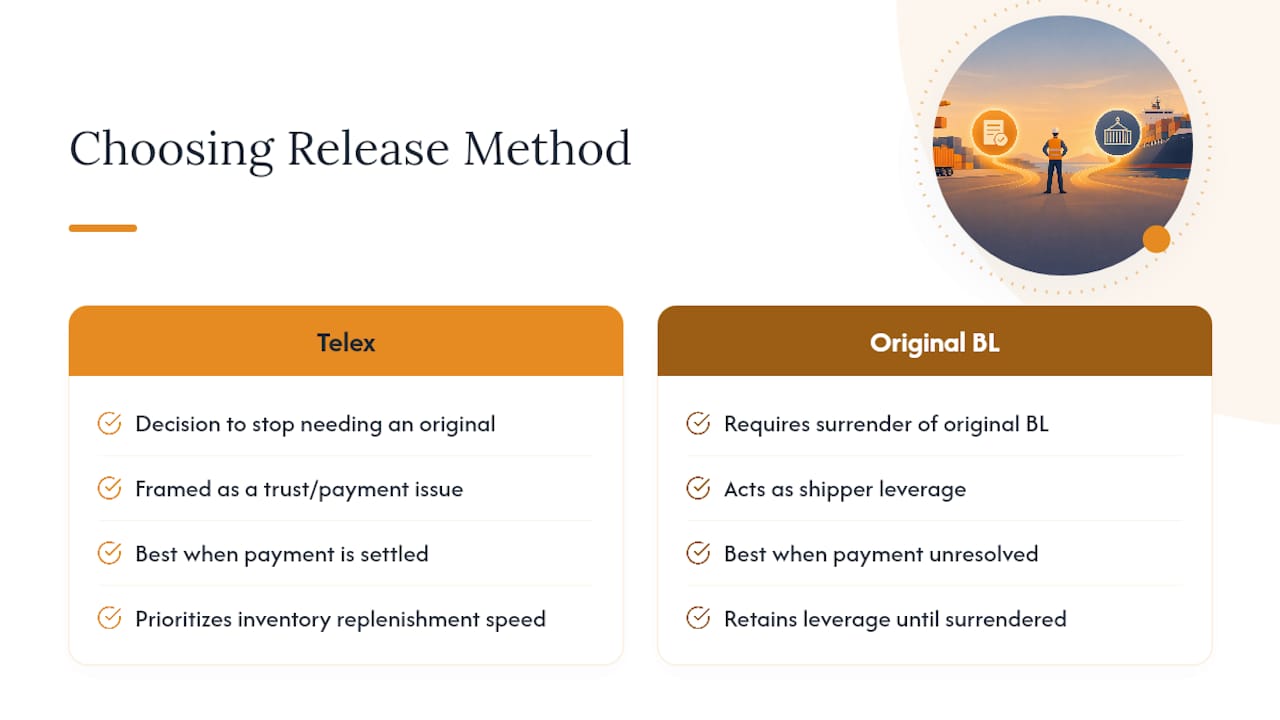
The bigger blind spot is treating this as a documentation question when it’s really a trust and payment question. Shippers who default to telex release because it’s faster, without confirming the buyer has actually paid in full, are the ones who end up in disputes. The paperwork was never the risk. The timing of payment relative to surrender was.
For time-sensitive FBA and ecommerce shipments, ForwarderOne typically sees telex release fit best once payment terms are settled and the priority shifts entirely to inventory replenishment speed, particularly heading into peak season stock builds.
Let ForwarderOne Handle the Release Timing for You
Deciding between an original bill of lading and a telex release gets a lot simpler when someone is managing the whole shipment on your behalf. ForwarderOne’s DDP shipping service handles customs, duties, and delivery in one workflow, so document release timing doesn’t become a separate fire to put out on top of everything else.

Accounts typically have an account manager who coordinates release instructions and tracks shipments through customs and final delivery. ForwarderOne reports over 99% on-time delivery, which matters most when a delayed release could mean an Amazon listing goes out of stock during a peak sales window. If you move inventory from China to US fulfillment centers regularly, check the Amazon FBA freight forwarding page and talk to an account manager about setting up a document-handling plan for your next shipment.
Sources
- UNCITRAL — Model Law on Electronic Transferable Records (MLETR)
- ICC — UCP 600 (Uniform Customs and Practice for Documentary Credits)
- SeaRates — Telex release, express release, and original B/L explainer
FAQ
What's the difference between an express release and an original bill of lading?
An express release (or sea waybill) is chosen at booking and is never negotiable, so no document of title ever exists to transfer. An original bill of lading is negotiable and must be physically presented or properly surrendered before the carrier releases cargo.
Are telex release and surrendered bill of lading the same thing?
They describe the same underlying action from two angles. “Surrendered B/L” refers to the shipper handing back the original documents, while “telex release” is the carrier’s resulting instruction to its destination office authorizing cargo release.
What's the difference between a draft bill of lading and an original bill of lading?
A draft B/L is a pre-issuance copy sent for review and correction before the carrier finalizes it. An original bill of lading is the signed, issued document that actually functions as a document of title once approved.
What are the three main types of bill of lading?
The three common categories are the negotiable original bill of lading, the telex-released bill (an original that has been surrendered and authorized for release), and the non-negotiable express release or sea waybill.
Does ForwarderOne handle telex release coordination?
Yes. ForwarderOne’s dedicated account managers coordinate release instructions directly with carriers as part of its DDP shipping service, and current service details are available on the ForwarderOne site.
Want a shipping plan built around your cargo?
ForwarderOne coordinates freight, customs, duties, and final delivery in one managed workflow for ecommerce and Amazon FBA shipments.