All-risk cargo insurance, written under Institute Cargo Clauses A, pays for physical loss or damage to your shipment unless a specific exclusion applies. Total-loss-only coverage pays out only when the cargo is actually, presumed, or constructively lost. Most Amazon sellers and e-commerce brands should buy all-risk for unit-value, high-handling freight and treat total-loss-only as a narrow, supplemental option for low-value bulk goods.
TL;DR:
- Most shipments with high value or multiple handling points should be insured under ICC (A) because it covers any physical loss or damage not explicitly excluded.
- Total-loss-only policies pay only when the cargo is completely destroyed, missing, or costs more to repair than worth, leaving partial damages or salvageable losses uncovered.
- Common exclusions for all-risk policies include inherent vice, improper packing, wear and tear, delays, and war risks unless specific endorsements are added.
- When choosing coverage, consider the cargo’s value, handling frequency, and whether partial damage is likely, opting for all-risk for valuable or heavily handled goods.
- Proper documentation, accurate valuation, and requesting necessary endorsements like war or refrigerated cargo are crucial to prevent claim disputes and ensure adequate coverage.
All Risk vs Total Loss Cargo: The Two Standards Explained
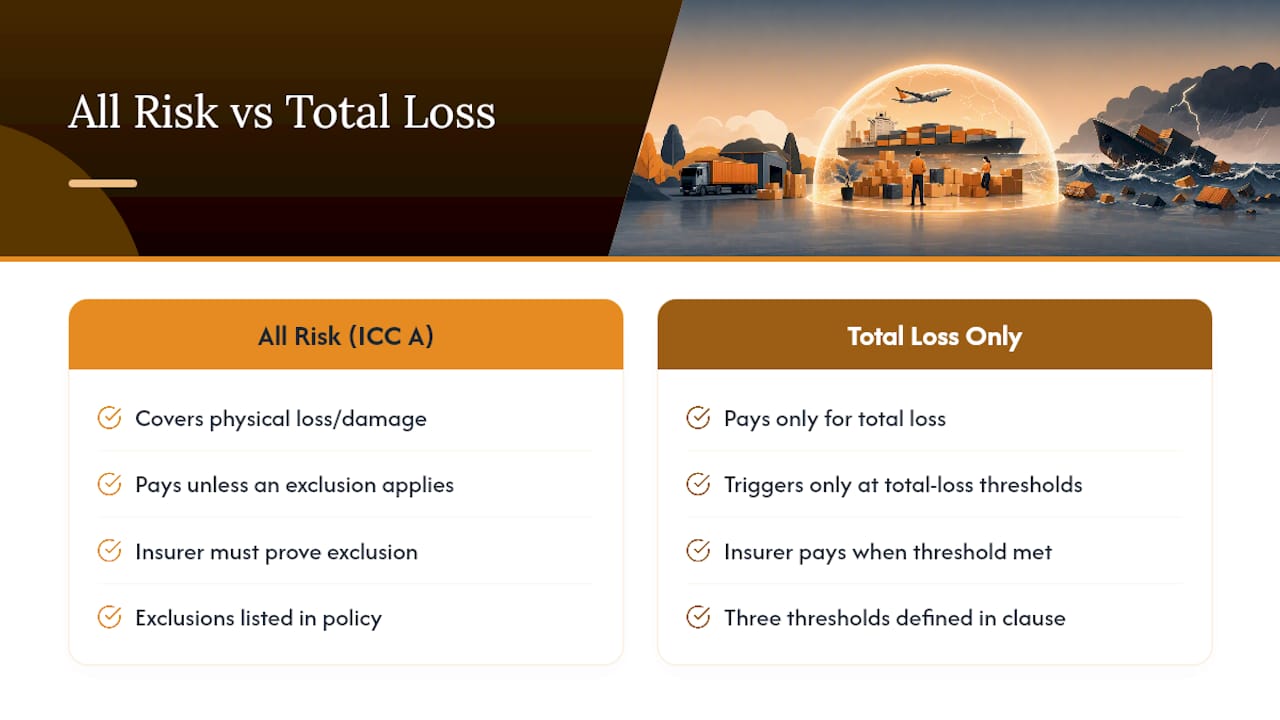
Institute Cargo Clauses A, known in the trade simply as ICC (A), is the broadest standard marine cargo clause on the market. It works by covering any physical loss or damage to your goods except for a defined list of exclusions written into the policy. That structure flips the usual burden of proof: instead of you proving a named peril caused the damage, the insurer has to prove an exclusion applies before denying your claim. That is why brokers routinely call it “all risks” coverage, even though the name overstates things slightly since exclusions still exist.
Total loss is a different animal entirely. Model insurance clause language, including the kind drafted for United Nations cargo insurance wording, defines three flavors: actual total loss (the goods are destroyed or so damaged they’re no longer the thing you shipped), presumed total loss (the shipment is missing and reasonably assumed lost, often after a vessel disappears), and constructive total loss (recovering or repairing the cargo would cost more than it’s worth). Only when one of these thresholds is met does a total-loss-only policy pay.
How All-Risk Policies Work: Coverage, Gaps, and Add-Ons
All-risk coverage under ICC (A) typically responds to the everyday disasters that actually sink e-commerce shipments: theft and pilferage at ports, breakage during handling, water contamination in a leaky container, and mishandling by a third-party carrier. Named-perils policies, by contrast, exclude most of these unless the peril is specifically listed. That gap is why ICC (A) is the default recommendation for electronics, cosmetics, machinery parts, and general merchandise moving in consolidated containers.
But “all risk” isn’t “all loss.” Standard exclusions include:
- Inherent vice (goods that spoil or degrade from their own nature, not an outside event)
- Insufficient or improper packing
- Ordinary wear and tear
- Delay, even when the delay causes a financial loss
- War, strikes, and civil commotion, unless a rider is added
Pro Tip: If you ship anything temperature-sensitive, like K-beauty skincare or supplements, ask specifically about refrigerated cargo endorsements. Standard ICC (A) wording doesn’t automatically cover spoilage from equipment failure unless that clause is added.
War and strikes coverage, refrigerated cargo clauses, and delay riders are the three endorsements sellers most often need but forget to request.
What Total Loss Coverage Actually Pays For
Total-loss-only policies are built around one question: is the shipment gone, or effectively gone? A container that burns at sea is an actual total loss. A vessel that goes missing and stays unreachable long enough triggers presumed total loss. A shipment that survives but would cost more to salvage and repair than it’s worth becomes a constructive total loss, and this is where things get procedurally interesting.
To collect on a constructive total loss, you typically have to abandon the cargo to the insurer, formally giving up your ownership claim. Once the insurer accepts that abandonment, the full sum insured becomes payable, similar to how actual and presumed total loss claims settle.
Partial damage works differently under either policy type:
- Total loss claims pay the sum insured, full stop.
- Partial losses under a broader all-risk policy get proportionate indemnity, or the actual cost of repair and reconditioning, whichever the policy specifies.
That distinction is exactly why total-loss-only coverage leaves a wide gap: a shipment that’s 40% damaged, still sellable, still worth repairing, gets nothing under a total-loss-only policy no matter how expensive the damage is.
All Risk vs Total Loss: A Practical Decision Checklist
| Factor | All-risk (ICC A) | Total-loss-only |
|---|---|---|
| Payment trigger | Any loss or damage not excluded | Actual, presumed, or constructive total loss only |
| Payout basis | Sum insured (total loss) or proportionate indemnity/repair cost (partial loss) | Sum insured only, and only if total loss occurs |
| Typical exclusions | Inherent vice, poor packing, wear and tear, delay, war (unless added) | Same core exclusions, plus no coverage for any partial damage |
| Premium | Higher, but often a small percentage difference versus narrower clauses | Lower, reflecting the narrow trigger |
| Best-suited cargo | Electronics, cosmetics, apparel, mixed containers, anything with resale value if damaged | Raw bulk commodities, scrap, low-margin goods where partial damage isn’t worth insuring |
Use this order of operations when deciding:
- If your cargo has meaningful unit value or gets handled multiple times before reaching an FBA warehouse, default to all-risk.
- If you’re shipping low-value bulk material where partial damage is a rounding error, total-loss-only can be acceptable.
- If you want both cost control and protection, pair a base ICC (A) policy with targeted riders instead of dropping to total-loss-only entirely.
The premium gap rarely justifies the coverage gap. Industry pricing guides consistently show the cost difference between ICC (A) and narrower clauses runs a few percentage points, while the coverage difference is the entire universe of partial-loss claims.
Buying the Right Policy: What to Ask Before You Sign
Start with how the policy defines your cargo’s value. Most marine insurers use CIF value plus 10% as the default sum insured convention, covering freight, insurance, and a cushion for incidentals like currency swings. For high-unit-value SKUs, ask about agreed value instead. Underinsuring a total-loss scenario because you used a stale CIF number is one of the most common and preventable claims disputes.
Before signing anything, run through this list:
- Confirm whether the policy references ICC (A) by name or uses vague “all risks” marketing language without the clause behind it.
- Check the attachment point and coverage period (warehouse to warehouse, or port to port).
- Ask about the deductible or franchise amount and whether it applies per shipment or per claim.
- Request the war, strikes, and refrigerated cargo endorsements in writing if your goods need them.
- Get a clear list of documents required to file a claim before you ever need one.
Pro Tip: Photograph packing before sealing every container. Insurers frequently dispute “insufficient packing” exclusions, and dated photos are the fastest way to shut that argument down.
Red flags include vague peril lists, no stated attachment period, and any clause that shifts documentation burden onto you without specifying what’s required.
ForwarderOne’s Take: Coverage Advice for Small Sellers
Most claims friction we see doesn’t come from the policy wording. It comes from missing paperwork at the exact moment a claim gets filed. DDP shipping bundles customs clearance and delivery into one workflow, which means your commercial invoice, packing list, and bill of lading stay organized instead of scattered across three vendors.
For a container of consolidated electronics or cosmetics headed to FBA, we point sellers toward ICC (A). For a single SKU of low-margin bulk packaging material, a lighter total-loss layer sometimes makes financial sense. A dedicated account manager who already knows your shipment history is the difference between a claim that clears in days and one that drags for weeks.
Why Sellers Overthink This More Than They Should
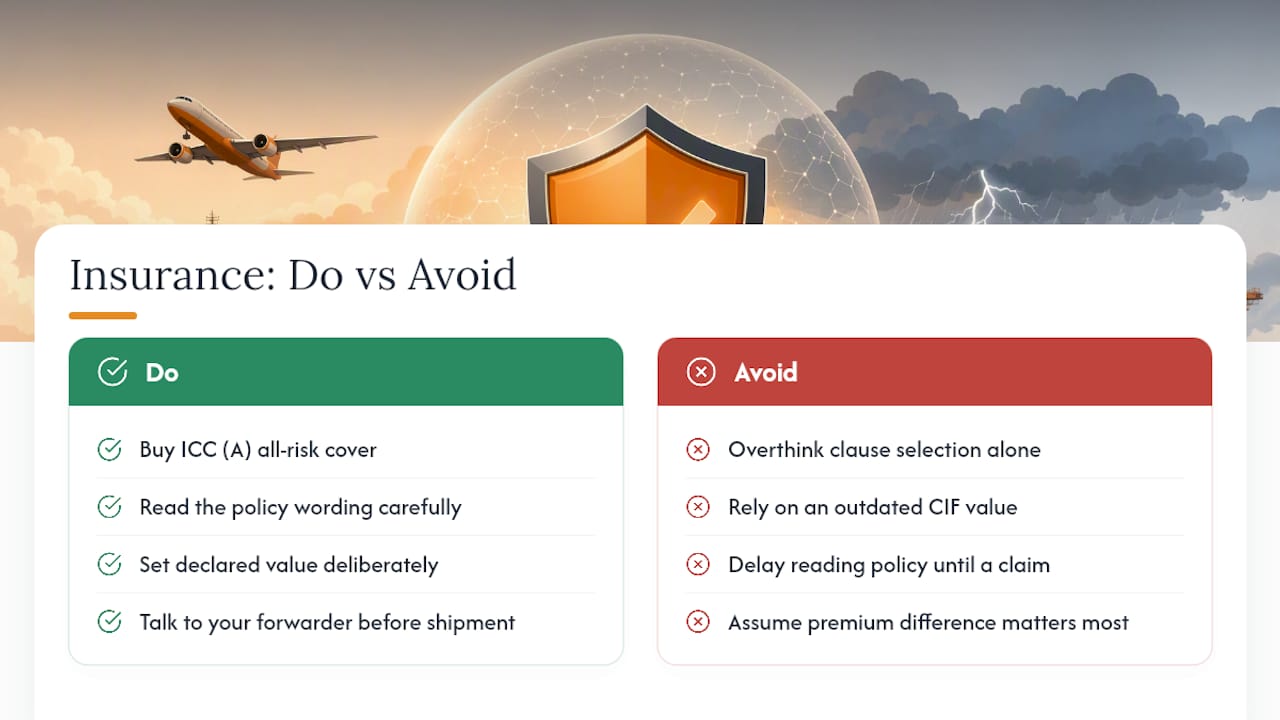
The all-risk versus total-loss debate gets treated like a complicated actuarial decision. It isn’t. If your cargo has resale value and gets handled more than once before it reaches a warehouse, buy ICC (A) and stop second-guessing it. The premium difference is small enough that optimizing it barely moves your margin, while the coverage gap on a partial-damage claim can wipe out an entire shipment’s profit.
Where sellers actually lose money is in valuation, not clause selection. An outdated CIF number or a policy nobody read closely until a claim was already filed causes more disputes than any exclusion clause does. Read the wording, set the declared value deliberately, and talk to your forwarder before the shipment leaves the factory, not after it arrives damaged. If you want help matching coverage to a specific shipment, ForwarderOne’s freight services can walk through it with you.
— Keven
Sources
For exact wording, read the Institute Cargo Clauses breakdown and the UN model all-risks clause. For buying strategy and market pricing context, the FreightAmigo cargo insurance guide and ShipCalculators’ clause explainer cover practical mechanics well.
FAQ
What Is All-Risk Insurance Called Now?
It’s still commonly called “all-risk,” but the formal industry term is Institute Cargo Clauses A, or ICC (A). Brokers use both names interchangeably, though ICC (A) is the precise clause reference you’ll see in policy documents.
Should I Accept a Total Loss Offer?
That depends on documentation, repairability, and salvage value. If the insurer’s total-loss settlement reflects your full sum insured and repair costs genuinely exceed the cargo’s worth, accepting usually makes sense. If part of the shipment is salvageable, get an independent repair estimate before agreeing to abandon it.
What Are the Two Types of Losses in Insurance?
Cargo insurance recognizes total loss and partial loss. Total loss covers actual, presumed, and constructive total loss and pays the full sum insured, while partial loss is indemnified proportionally or through repair and reconditioning costs.
What Does All-Risk Cover?
All-risk (ICC A) covers physical loss or damage to cargo from any cause not specifically excluded, including theft, breakage, and water damage. It excludes inherent vice, insufficient packing, wear and tear, and delay unless additional endorsements are purchased.
Need cargo insurance matched to your shipment?
ForwarderOne helps ecommerce sellers compare coverage tiers, declared value, documents, customs clearance, and final delivery in one managed freight workflow.